2007 FIAT SEICENTO window
[x] Cancel search: windowPage 51 of 154
50GETTING TO KNOW YOUR CAR
Heavy loads which are
not securely anchored
could seriously injure pas-
sengers in the event of an acci-
dent.
IMPORTANTCheck and adjust
the height of the dipped headlight
beam when travelling at night with a
rather heavy load in the boot (see
HEADLIGHTSin this chapter).
When refitting the rear
window shelf, fasten the
two side tie-rods fig. 67
passing them on the outside of
the struts.
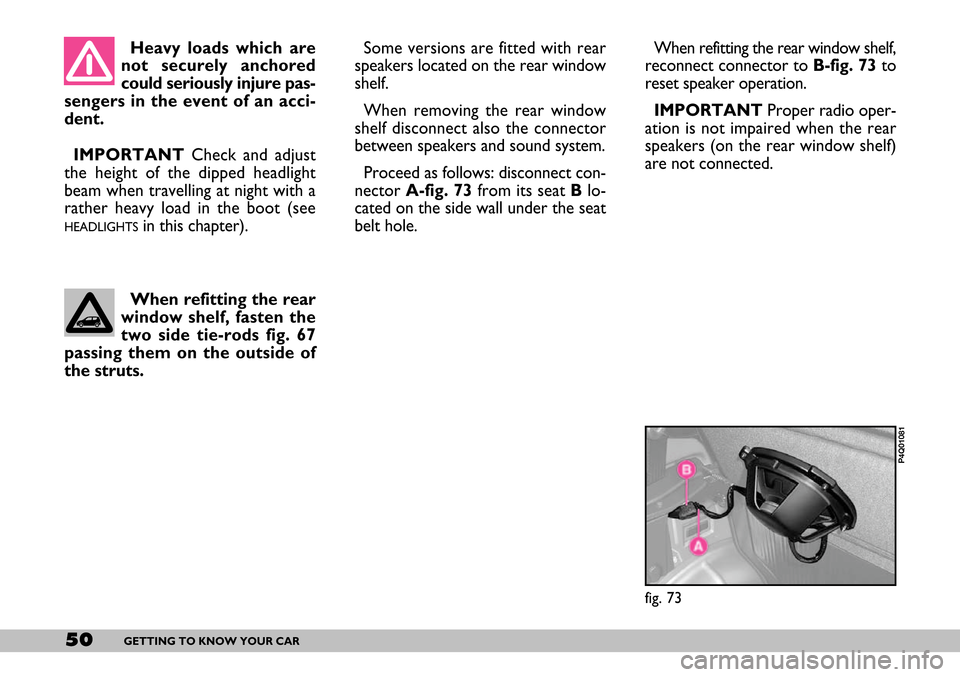
Some versions are fitted with rear
speakers located on the rear window
shelf.
When removing the rear window
shelf disconnect also the connector
between speakers and sound system.
Proceed as follows: disconnect con-
nector A-fig. 73from its seat Blo-
cated on the side wall under the seat
belt hole. When refitting the rear window shelf,
reconnect connector to B-fig. 73to
reset speaker operation.
IMPORTANTProper radio oper-
ation is not impaired when the rear
speakers (on the rear window shelf)
are not connected.
fig. 73
P4Q01081
Page 53 of 154
52GETTING TO KNOW YOUR CAR
Take care that scarves,
ties or loose clothing do
not accidentally come
near moving parts; they could
become entangled with serious
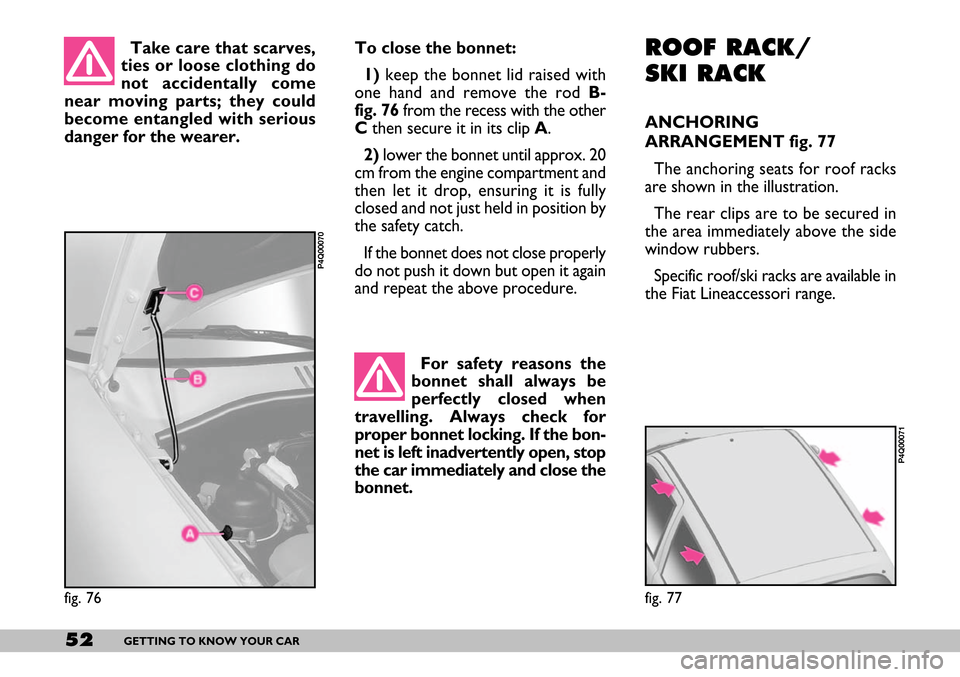
danger for the wearer. To close the bonnet:
1)keep the bonnet lid raised with
one hand and remove the rod B-
fig. 76from the recess with the other
Cthen secure it in its clip A.
2) lower the bonnet until approx. 20
cm from the engine compartment and
then let it drop, ensuring it is fully
closed and not just held in position by
the safety catch.
If the bonnet does not close properly
do not push it down but open it again
and repeat the above procedure.ROOF RACK/
SKI RACK
ANCHORING
ARRANGEMENT fig. 77
The anchoring seats for roof racks
are shown in the illustration.
The rear clips are to be secured in
the area immediately above the side
window rubbers.
Specific roof/ski racks are available in
the Fiat Lineaccessori range.
For safety reasons the
bonnet shall always be
perfectly closed when
travelling. Always check for
proper bonnet locking. If the bon-
net is left inadvertently open, stop
the car immediately and close the
bonnet.
fig. 76
P4Q00070
fig. 77
P4Q00071
Page 87 of 154

86DRIVING YOUR CAR
STORING THE CAR
The following precautions should be
taken if the car will not be used for
several months:
– Park the car in covered, dry and if
possible well-ventilated premises.
– Engage a gear.
– Make sure the handbrake is not
engaged.
– Remove the cables from the bat-
tery terminals (first remove the cable
to the negative terminal), and check
the battery charge. If the car is to be
stored for long periods the charge of
the battery should be checked every
month and recharged if it falls below
12.5V.– Clean and protect the shiny metal
parts using special compounds readily
available.
– Sprinkle talcum powder on the
rubber windscreen and rear window
wiper blades and lift them off the glass.
– Open the windows slightly.– Cover the car with a cloth or per-
forated plastic sheet. Do not use
sheets of non-perforated plastic as
they do not allow moisture on the car
body to evaporate.
– Inflate the tyres to + 0.5 bar above
the normal specified pressure and
check it at intervals.
– Do not drain the engine cooling
system.
Page 105 of 154

104IN AN EMERGENCY
System/Component Fuse no. Amperage Location
Front left-hand sidelight
Front right-hand sidelight
Left-hand taillight
Right-hand taillight
Left-hand dipped beam headlight
Right-hand dipped beam headlight
Left-hand main beam headlight
Right-hand main beam headlight
Left-hand brake light
Right-hand brake light
Additional brake light
(3rdbrake light)
Left-hand number plate light
Right-hand number plate light
Reversing light
Rear foglight
Hazard lights
Direction indicators
Front foglights
Ceiling light
Windscreen wiper/washer
Horn
Electric windows
Door locking system
Heated rear window
Cigar lighter
5 10A fig. 39
4 10A fig. 39
4 10A fig. 39
5 10A fig. 39
6 10A fig. 39
7 10A fig. 39
8 10A fig. 39
9 10A fig. 39
21 10A fig. 39
21 10A fig. 39
21 10A fig. 39
4 10A fig. 39
5 10A fig. 39
21 10A fig. 39
18 10A fig. 39
16 10A fig. 39
22 10A fig. 39
19 15A fig. 39
15 15A fig. 39
25 20A fig. 39
17 15A fig. 39
2 25A fig. 39
1 15A fig. 39
14 20A fig. 39
24 25A fig. 39
System/Component Fuse no. Amperage Location
6 10A fig. 39
22 10A fig. 39
9 10A fig. 39
13 20A fig. 39
20 20A fig. 39
15 15A fig. 39
11 20A fig. 39
23 10A fig. 39
3 10A fig. 39
1 7,5A fig. 42
1 7,5A fig. 42
E 30A fig. 40
C 30A fig. 40
24 25A fig. 39
3 7.5A fig. 42
3 7.5A fig. 42
F 30A fig. 40
2 15A fig. 42
2 15A fig. 42
B 40A fig. 40
12 7.5A fig. 39
15 15A fig. 39
10 10A fig. 39Headlight beam adjuster
Instrument panel (+15)
Main beam headlight warning light
Stalks: light control
Stalks: general
Sound system + battery
Sunroof
Airbag system
ABS (+15)
Fiat CODE system (+30)
Injection control unit (+30)
Climate control system
Engine cooler radiator fan
Passenger compartment fan
Electronic ignition
injection system (+15)
Fiat CODE system (+15)
Optional device power circuits
Electronic injection sensors
Climate control system auxiliary units
Ignition switch
Relay coil power
Instrument panel (+30)
Electrical power steering system
(+15)
Page 111 of 154

110CAR MAINTENANCE
SERVICE SCHEDULE
These coupons are to be used every 20,000 km.
thousands of kilometres
Check tyre conditions and wear and adjust pressure, if required
Check lighting system operation (headlights, direction indicators, hazard lights,
boot light, ceiling lights, glove compartment light, instrument panel warning
lights, etc.)
Check windscreen washer/wiper system and adjust nozzles
Check windscreen/rear window wiper blade position/wear
Check front disc brake pad conditions and wear
Check rear drum brake linings and wear
Inspect: conditions of: outside bodywork, underbody protection, piping/hosing
(exhaust - fuel lines - brake lines), rubber parts (boots, sleeves, bushings, etc.)
Check for bonnet and boot lock cleanness, lever cleanness and lubrication
Check tension of accessory drive belts and adjust, if required
Inspect accessory drive belt conditions
Check tappet clearance and adjust, if required
Check/adjust handbrake stroke20 40 60 80 100 120 140 160 180
●●●●●●●●●
●●●●●●●●●
●●●●●●●●●
●●●●●●●●●
●●●●●●●●●
●●●
●●●●●●●●●
●●●●●●●●●
●
●●●●
●●●●
●●●●●●●●●
Page 113 of 154

112CAR MAINTENANCE
ANNUAL INSPECTION SCHEDULE
– Inspect conditions of. engine, gear-
box, transmission, piping (exhaust -
fuel feed - brakes), rubber parts
(boots - sleeves - bushings - etc.),
brake and fuel line hoses.
– Check for bonnet and boot lock
cleanness, lever cleanness and lubri-
cation.
– Check battery charge status.
– Check conditions of various con-
trol belts.
– Check and top up fluid levels (en-
gine coolant, brakes, windscreen
washer, battery, etc.).
– Change engine oil.
– Replace engine oil filter.
– Replace pollen filter (where fitted). The following annual inspection
schedule is recommended for
cars travelling less than
20,000 km a year (e.g. approxi-
mately 10,000 km). The schedule
includes the following operations:
– Check tyre condition and wear
and adjust pressure, if required (in-
cluding spare wheel).
– Check operation of lights (head-
lights, direction indicators, hazard
lights, boot light, passenger compart-
ment ceiling light, glove compartment
light, instrument panel lights, etc.).
– Check windscreen wiper/washer
and adjust nozzles.
– Check position wear of wind-
screen/rear window wiper blades.
– Check front brake pad conditions
and wear.
ADDITIONAL
CHECKS
Every 1,000 kmor before long
trips, check and top up as necessary:
– engine coolant level, brake fluid
level, windscreen washer liquid level,
tyre pressure and conditions.
Every 3,000 kmcheck and top up
as necessary: engine oil level.
We recommend using FL Selenia
products which were specifically de-
signed and made for use in Fiat vehi-
cles (see
CAPACITIEStable in TECHNICAL
SPECIFICATIONS
).
Page 117 of 154

116CAR MAINTENANCE
fig. 5
P4Q01042
Do not travel with the
windscreen washer reser-
voir empty. The wind-
screen washer is fundamental for
improving visibility. Some windscreen wiper
additives on the market
are flammable. The en-
gine compartment contains hot
parts which could start a fire in
the event of contact.
BRAKE FLUID fig. 5
Unscrew cap check that the fluid
level in the reservoir is at maximum.
Fluid level in the reservoir shall not
exceed the MAXmark. Check coolant level when the engine
is cold. The level should be included
between the MIN and MAXrefer-
ence lines on the reservoir.
If the level is low, top up slowly
through the filler on the reservoir
with a 50-50 mixture of distilled wa-
ter and FL Selenia PARAFLU UP
fluid until the level approaches the
MAX line.
A 50-50 mixture of PARAFLU UP
and distilled water gives freeze pro-
tection to –35°C.
The engine cooling sys-
tem works with
PARAFLU UP. Top up
only with the same fluid con-
tained in the cooling circuit.
PARAFLU UP cannot be mixed
with other fluids. Should this take
place, do not start the engine and
contact Fiat Dealership.
WINDSCREEN/REAR
WINDOW WASHER LIQUID
To add liquid remove the cap A-
fig. 4.
Use a mixture of water and
TUTELA PROFESSIONAL SC35
fluid in the following concentrations:
30% of TUTELA PROFESSIONAL
SC35and 70% of water in summer.
50% of TUTELA PROFESSIONAL
SC35and 50% of water in winter.
fig. 4
P4Q01041
Page 123 of 154

122CAR MAINTENANCE
RUBBER TUBING
Follow the SERVICE SCHEDULEto the
letter as concerns braking, power
steering and fuel line rubber tubing.
Ozone, high temperatures and long
absence of fluid in the system can in
fact cause the hardening and cracking
of the pipes with possible loss of fluid.
A careful check is therefore essential.
WINDSCREEN AND
REAR WINDOW
WIPERS
BLADES
Periodically clean the rubber part
with suitable products. We recom-
mendTUTELA PROFESSIONAL
SC35.
Change the blades if the rubber edge
is warped or worn out. You should in
any case change them approximately
once a year. who can judge whether they are still
fit for use. Remember to check the
spare tyre particularly carefully too.
If a replacement is necessary, always
use new tyres and avoid using ones
the origin of which you are not cer-
tain about.
The Fiat 600 fits tubeless tyres. Un-
der no circumstances use an inner
tube with these tyres.
If you replace a tyre it is a good idea
to change the inflation valve, too.
To ensure the front and rear tyres
all wear evenly, you are advised to
change the tyres over every 10-15
thousand kilometres keeping them on
the same side of the car so as not to
reverse the direction of rotation.
Do not change the tyres
over in criss-cross fashion
by moving a tyre from
the left hand side of the car to
the right and vice versa.
Travelling with worn
wiper blades is dangerous
because it reduces visibil-
ity in bad weather.
In winter if the temperature falls be-
low zero, make sure the blades are
not frozen to the windscreen. If nec-
essary, free them with a de-icing com-
pound.