2007 FIAT LINEA battery
[x] Cancel search: batteryPage 86 of 230

85
SAFETY
DEVICES
CORRECT USE
OF THE
CAR
WARNING
LIGHTS AND
MESSAGES
IN AN
EMERGENCY
CAR
MAINTENANCE
TECHNICAL
SPECIFICATIONS
INDEX
DASHBOARD
AND CONTROLS
Power window system initialisation
Safety system shall be re-initialised after
disconnecting the battery or if the rele-
vant protection fuse is blown.
Initialisation procedure:
❒fully close manually the window to ini-
tialise;
❒rafter the window has reached the up-
per end of travel, hold the up button
pressed for at least one second.
Incorrect use of the power
windows may be dangerous.
Before operation, always check that
no-one is exposed to the risk of being
injured by directly by the moving win-
dow or objects getting caught and
dragged. When leaving the car, al-
ways remove the key from the igni-
tion device to avoid the risk of injury
due to accidental operation of the
power windows.
WARNING
Front and rear passenger door
windows (where provided)
Front passenger door armrest and rear
door armrests feature the switches A-fig.
82to be used for controlling the corre-
sponding window.
Press button A-fig. 83to inhibit rear door
controls (where provided).MANUAL REAR
(where provided) fig. 84
To open and to close the window use the
relevant window winder.
fig. 84F0R0070mfig. 82F0R0069m
fig. 83F0R0000m
Page 87 of 230

86
SAFETY
DEVICES
CORRECT USE
OF THE
CAR
WARNING
LIGHTS AND
MESSAGES
IN AN
EMERGENCY
CAR
MAINTENANCE
TECHNICAL
SPECIFICATIONS
INDEX
DASHBOARD
AND CONTROLS
BOOT
OPENING THE BOOT
The boot lock may be released from the
outside of the car by pressing
Ron the
remote control (where provided) or by
inserting and turning the metallic insert of
the key in the boot lock anticlockwise as
shown in fig. 87/a. The boot lock can be
released from inside the vehicle operating
on lever A-fig.86 located on driver side
seat or pressing push-button B-fig.87/b.BOOT CLOSING
To close the boot, lower it onto the lock
until you hear it click. In emergency con-
ditions (if either the remote control or car
battery is flat), release the boot lock by
turn the key in clockwise.
fig. 85F0R0071m
fig. 86F0R0210m
fig. 87/aF0R0072m
Do not fit additional objects
onto the rear window shelf or
tailgate (speakers, spoilers,
etc.) except when contem-
plated by the manufacturer to ensure
the correct operation of the side gas
shock absorbers of the tailgate itself.
Never exceed the maximum
allowed load in the boot (see
“Technical Specifications”). Make
sure that the objects are well
arranged in the boot so that they will
not be projected forwards following
sudden braking.
WARNING
Never travel with objects on
the rear window shelf: they
cause cause injury to passengers in
the event of an accident or sudden
braking.
WARNING
fig. 87/b
B
F0R0239m
Page 101 of 230

100
SAFETY
DEVICES
CORRECT USE
OF THE
CAR
WARNING
LIGHTS AND
MESSAGES
IN AN
EMERGENCY
CAR
MAINTENANCE
TECHNICAL
SPECIFICATIONS
INDEX
DASHBOARD
AND CONTROLS
TRANSCEIVERS
AND MOBILE PHONES
Radio transceiver equipment (e.g.: e-tacs
mobile phones, HAM radio systems and
the like) shall not be used inside the car
unless a separate aerial is mounted on the
roof.
IMPORTANT The use of similar devices
inside the passenger compartment (with-
out separated aerial) produces radio-fre-
quency electromagnetic fields which, am-
plified by the resonance effects inside the
passenger compartment, may cause elec-
trical systems equipping the car to mal-
function. This could compromise safety in
addition to constituting a potential hazard
for the passengers.
In addition, transmission and reception of
these devices may be affected by the
shielding effect of the car body.
As concerns EC-approved mobile phones
(GSM, GPRS, UMTS), strictly comply with
the instructions for use provided by the
mobile phone’s manufacturer.ACCESSORIES
PURCHASED BY THE
OWNER
If after buying the car, you decide to install
electrical accessories that require a per-
manent electric supply (alarm, satellite an-
titheft system, etc.) or accessories that in
any case burden the electric supply, con-
tact Fiat Dealership, whose qualified per-
sonnel, besides suggesting the most suit-
able devices belonging to Lineaccessori Fi-
at, will also evaluate the overall electric ab-
sorption, checking whether the car’s elec-
tric system is able to withstand the load
required, or whether it needs to be inte-
grated with a more powerful battery.
Be very careful when fitting
non-standard additional
spoilers, light alloy wheels or wheel
cups: they could reduce brake venti-
lation and consequently brake effi-
ciency in the case of repeated, violent
braking or on long downhill roads.
Make sure that nothing obstructs the
pedal stroke (mats, etc.)
WARNING
ELECTRICAL/ELECTRONIC
DEVICE INSTALLATION
Electrical and electronic devices installed
after buying the car by after-market ser-
vice must carry the following label:
Fiat Auto S.p.A. authorises the installation
of transceiving devices provided that they
are installed according to rules of good en-
gineering practice respecting the manu-
facturer’s indications by a specialised cen-
tre.
IMPORTANT Traffic police may not allow
the car on the road in the event of as-
sembly of devices which imply modifica-
tions to the features of the car. This may
also cause lapse of warranty in relation to
faults caused by the change or either di-
rectly or indirectly related to it.
Fiat Auto S.p.A. shall not be liable for dam-
age caused by the installation of acces-
sories either not supplied or recom-
mended by Fiat Auto S.p.A. and/or in-
stalled in compliance with the provided in-
structions.
Page 123 of 230

122
WARNING
LIGHTS AND
MESSAGES
IN AN
EMERGENCY
CAR
MAINTENANCE
TECHNICAL
SPECIFICATIONS
INDEX
DASHBOARD
AND CONTROLS
SAFETY
DEVICES
CORRECT USE
OF THE CAR
ENGINE STARTING
The car is provided with an electronic en-
gine lock device: refer to “The Fiat CODE
system” paragraph in “Dashboard and
controls” if you cannot start the engine.
The engine may be noisier during the first
seconds of operation, particularly after a
long period of inactivity. This is charac-
teristic of hydraulic tappets, the timing sys-
tem chosen to reduce the number of ser-
vicing interventions and does effects nei-
ther functionality nor reliability.
It is advisable not to demand
maximum performance from
your car (e.g. excessive accel-
erations, long distances at top
rpm, excessive intense braking, etc.) as
soon as the engine is started.
Do not leave the key in the ig-
nition switch with the engine
off to avoid unnecessary con-
sumption of electricity which
could drain the battery. It is dangerous
to run the engine in closed environ-
ments.
Running the engine in con-
fined areas is extremely dan-
gerous. The engine consumes oxygen
and produces carbon monoxide
which is a highly toxic and lethal gas.
WARNING
Remember that the brake
booster and power steering
are not operational until the engine
has been started, therefore much ef-
fort than usual is required on the
brake pedal and steering wheel.
WARNING
STARTING PROCEDURE FOR
PETROL VERSIONS
Proceed as follows:
❒ensure that the handbrake is up;
❒put the gear lever into neutral;
❒press the clutch pedal down to the
floor without touching the accelerator;
❒turn the ignition key to AVVand let
it go the moment the engine starts.
If the engine does not start at the first at-
tempt, return the ignition key to STOP
before repeating starting.
Page 126 of 230
125
WARNING
LIGHTS AND
MESSAGES
IN AN
EMERGENCY
CAR
MAINTENANCE
TECHNICAL
SPECIFICATIONS
INDEX
DASHBOARD
AND CONTROLS
SAFETY
DEVICES
CORRECT USE
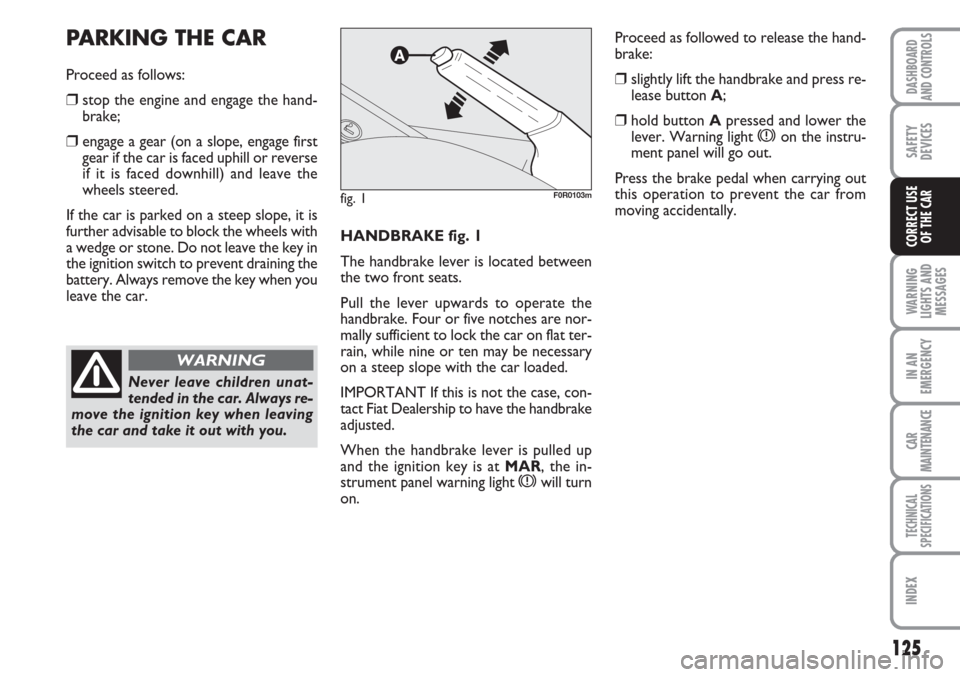
OF THE CARHANDBRAKE fig. 1
The handbrake lever is located between
the two front seats.
Pull the lever upwards to operate the
handbrake. Four or five notches are nor-
mally sufficient to lock the car on flat ter-
rain, while nine or ten may be necessary
on a steep slope with the car loaded.
IMPORTANT If this is not the case, con-
tact Fiat Dealership to have the handbrake
adjusted.
When the handbrake lever is pulled up
and the ignition key is atMAR, the in-
strument panel warning light
xwill turn
on.
PARKING THE CAR
Proceed as follows:
❒stop the engine and engage the hand-
brake;
❒engage a gear (on a slope, engage first
gear if the car is faced uphill or reverse
if it is faced downhill) and leave the
wheels steered.
If the car is parked on a steep slope, it is
further advisable to block the wheels with
a wedge or stone. Do not leave the key in
the ignition switch to prevent draining the
battery. Always remove the key when you
leave the car.
Never leave children unat-
tended in the car. Always re-
move the ignition key when leaving
the car and take it out with you.
WARNING
fig. 1F0R0103m
Proceed as followed to release the hand-
brake:
❒slightly lift the handbrake and press re-
lease button A;
❒hold button Apressed and lower the
lever. Warning light xon the instru-
ment panel will go out.
Press the brake pedal when carrying out
this operation to prevent the car from
moving accidentally.
Page 130 of 230

129
WARNING
LIGHTS AND
MESSAGES
IN AN
EMERGENCY
CAR
MAINTENANCE
TECHNICAL
SPECIFICATIONS
INDEX
DASHBOARD
AND CONTROLS
SAFETY
DEVICES
CORRECT USE
OF THE CAR
INSTALLING THE TOW
HOOK
The towing device should be fastened to
the body by specialised personnel accord-
ing to any additional and/or integrative in-
formation supplied by the Manufacturer of
the device.
The towing device must meet current reg-
ulations with reference to 94/20/EEC
Directive and subsequent amendments.
For any version the towing device used
must match the towable weight of the car
on which it is to be installed.
For the electric connection a unified con-
nector should be used which is generally
placed on a special bracket normally fas-
tened to the towing device, and a special
ECU for external trailer light control shall
be installed on the car.
For the electrical connection, 7 or 13 pin
12VDC connection is to be used (CU-
NA/UNI and ISO/DIN Standards). Follow
the instructions provided by the car man-
ufacturer and/or the tow hitch manufac-
turer.An electric brake should be supplied di-
rectly by the battery through a cable with
a cross section of no less than 2.5 mm
2.
IMPORTANT Electric brake or other de-
vice shall be used with running engine.
In addition to the electrical branches, the
car’s electric system can only be con-
nected to the supply cable for an electric
brake and to the cable for an internal light,
though not above 15W.
For connections use the preset control
unit with battery cable no less than 2.5
mm
2. Respect the speed limits specific for each
country for vehicles towing trailers. In all
cases, the top speed must not exceed 100
km/h.
Fit a suitable towing stabilizer to the trail-
er to be towed.
The ABS with which the car
may be equipped will not
control the braking system of the
trailer. Particular caution is required
on slippery roads.
WARNING
Never modify the braking
system of the car to control
the trailer brake. The trailer braking
system must be fully independent
from the hydraulic system of the car.
WARNING
Page 133 of 230

132
WARNING
LIGHTS AND
MESSAGES
IN AN
EMERGENCY
CAR
MAINTENANCE
TECHNICAL
SPECIFICATIONS
INDEX
DASHBOARD
AND CONTROLS
SAFETY
DEVICES
CORRECT USE
OF THE CAR
CAR INACTIVITY
If the car is to be left inactive for longer
than a month, the following precautions
should be noted:
❒park the car in covered, dry and if pos-
sible well-ventilated premises;
❒engage a gear;
❒check that the handbrake is not en-
gaged;
❒disconnect the negative battery termi-
nal and check battery charge (see para-
graph “Charge level check” in chapter
“Maintenance and care”). Repeat this
check once every three months dur-
ing storage. Recharge the battery if nec-
essary (see paragraph “If the battery is
flat” in chapter “In an emergency”);
❒clean and protect the painted parts us-
ing protective wax;
❒clean and protect the shiny metal parts
using special compounds readily avail-
able;
❒sprinkle talcum powder on the rubber
windscreen and rear window wiper
blades and lift them off the glass;
❒slightly open the windows;
❒cover the car with a fabric or perfo-
rated plastic terrapin. Do not use com-
pact plastic sheets which do not allow
humidity to evaporate from the surface
of the car;
❒inflate tyres to +0.5 bar above the nor-
mal specified pressure and check it at
intervals;
❒if you don’t disconnect the battery from
the electric system, check its charge
every month (see paragraph “Charge
level check” in chapter “Maintenance
and care”);
❒recharge the battery if necessary (see
paragraph “If the battery is flat” in chap-
ter “In an emergency”);
❒do not drain the engine cooling system.
IMPORTANT Where relevant, switch off
the car alarm with the remote control.
Keep your speed down when
snow chains are fitted. Do
not exceed 50 km/h. Avoid
potholes, steps and pave-
ments and avoid also to dri-
ve for long distances on
roads not covered with snow to pre-
vent damaging the car and the
roadbed.
WARNING
Chains cannot be applied to
tyre 205/45 R17 88V.
WARNING
Page 134 of 230

133
IN AN
EMERGENCY
CAR
MAINTENANCE
TECHNICAL
SPECIFICATIONS
INDEX
DASHBOARD
AND CONTROLS
SAFETY
DEVICES
CORRECT USE
OF THE
CAR
WARNING
LIGHTS AND
MESSAGES
GENERAL WARNINGS ..................................................... 134
LOW BRAKE FLUID............................................................ 134
HANDBRAKE ON................................................................ 134
AIR BAG FAILURE................................................................ 135
HOT
ENGINE COOLANT........................................................... 135
LOW BATTERY CHARGE................................................. 136
LOW ENGINE OIL PRESSURE.......................................... 136
INCOMPLETE DOOR LOCKING.................................... 137
SEAT BELTS NOT FASTENED.......................................... 137
EBD SYSTEM FAILURE........................................................ 137
INJECTION SYSTEM FAILURE
(DIESEL VERSIONS) ............................................................ 138
EOBD SYSTEM FAILURE (PETROL VERSIONS) .........138
FRONT PASSENGER AIRBAG DEACTIVATED........... 139
ABS SYSTEM FAILURE......................................................... 139
FUEL RESERVE....................................................................... 139
GLOW PLUG WARMING ................................................ 140
GLOW PLUG WARMING FAILURE............................... 140
WATER IN DIESEL FUEL FILTER..................................... 140FIAT CODE PROTECTION
SYSTEM FAILURE.................................................................. 140
EXTERNAL LIGHTS FAILURE........................................... 141
REAR FOG LIGHTS.............................................................. 141
GENERIC FAILURE INDICATION ................................. 141
ESP SYSTEM FAILURE ........................................................ 142
BRAKE PAD WEAR ............................................................ 142
PARKING SENSOR FAILURE............................................ 143
SIDELIGHTS AND LOW BEAMS..................................... 143
FOLLOW ME HOME........................................................... 143
FRONT FOG LIGHTS ........................................................ 143
LEFT-HAND DIRECTION INDICATOR........................ 143
RIGHT-HAND DIRECTION INDICATOR.................... 143
CRUISE CONTROL ............................................................ 143
MAIN BEAM HEADLIGHTS............................................... 143
POSSIBLE PRESENCE OF ICE ON THE ROAD ........... 144
LIMITED RANGE ................................................................. 144
ASR SYSTEM ......................................................................... 144
WW W
A A
R R
N N
I I
N N
G G
L L
I I
G G
H H
T T
S S
A A
N N
D D
M M
E E
S S
S S
A A
G G
E E
S S