Page 471 of 568

Adding Coolant
Your vehicle has been built with an improved engine
coolant that allows extended maintenance intervals. This
coolant can be used up to 5 Years or 100,000 miles before
replacement. To prevent reducing this extended mainte-
nance period, it is important that you use the same
coolant throughout the life of your vehicle. Please review
these recommendations for using Hybrid Organic Addi-
tive Technology (HOAT) coolant.
When adding coolant, a minimum solution of 50% rec-
ommended Mopar Antifreeze/ Coolant 5 Year/100,000
Mile Formula HOAT (Hybrid Organic Additive Technol-
ogy), or equivalent, in water should be used. Use higher
concentrations (not to exceed 70%) if temperatures below
�34°F (�37°C ) are anticipated.
Use only high purity water such as distilled or deionized
water when mixing the water/engine coolant solution.The use of lower quality water will reduce the amount of
corrosion protection in the engine cooling system.
Please note that it is the owner’s responsibility to main-
tain the proper level of protection against freezing ac-
cording to the temperatures occurring in the area where
the vehicle is operated.
NOTE:Mixing coolant types will decrease the life of the
engine coolant and will require more frequent coolant
changes.
Cooling System Pressure Cap
The cap must be fully tightened to prevent loss of
coolant, and to insure that coolant will return to the
radiator from the coolant recovery bottle.
The cap should be inspected and cleaned if there is any
accumulation of foreign material on the sealing surfaces.
MAINTAINING YOUR VEHICLE 471
7
Page 475 of 568

Brake System
Power Disc Brakes (front and rear)
Disc brakes do not require adjustment; however, several
hard stops during the break-in period are recommended
to seat the linings and wear off any foreign material.
Brake And Power Steering Hoses
When the vehicle is serviced for scheduled maintenance,
inspect surface of hoses and nylon tubing for evidence of
heat and mechanical damage. Hard and brittle rubber,
cracking, tears, cuts, abrasion, and excessive swelling
indicate deterioration of the rubber. Particular attention
should be made to examining those hose surfaces nearest
to high heat sources, such as the exhaust manifold.
Insure nylon tubing in these areas has not melted or
collapsed.Inspect all hose connections such as clamps and cou-
plings to make sure they are secure and no leaks are
present.
NOTE:Often, fluid such as oil, power steering fluid,
and brake fluid are used during assembly plant opera-
tions to facilitate the assembly of hoses to couplings.
Therefore, oil wetness at the hose-coupling area is not
necessarily an indication of leakage. Actual dripping of
hot fluid when systems are under pressure (during
vehicle operation), should be noted before hose is re-
placed based on leakage.
NOTE:Inspection of brake hoses should be performed
whenever the brake system is serviced and every engine
oil change. Inspect hydraulic brake hoses for surface
cracking, scuffing, or worn spots. If there is any evidence
of cracking, scuffing, or worn spots, the hose should be
replaced immediately! Eventual deterioration of the hose
can take place resulting in a possibility of a burst failure.
MAINTAINING YOUR VEHICLE 475
7
Page 477 of 568
WARNING!
Overfilling the brake fluid reservoir can result in
spilling brake fluid on hot engine parts and the
brake fluid catching fire.
Use only brake fluid that has been in a tightly closed
container to avoid contamination from foreign matter or
moisture.
CAUTION!
Do not allow a petroleum-base fluid to contaminate
the brake fluid. Seal damage may result.
Clutch Hydraulic System
The clutch hydraulic system is a sealed maintenance-free
system. In the event of leakage or other malfunction, the
system must be replaced.
Clutch Linkage
If the clutch pedal linkage begins to squeak or grunt, the
clutch pedal pivot bushings should be lubricated. Refer
to Fluids, Lubricants and Genuine Parts for the correct
lubricant type.
Rear Axle And 4x4 Front Driving Axle Fluid Level
Refer to Fluids, Lubricants and Genuine Parts for the
correct Fluid type. For normal service, periodic fluid level
checks are not required. When the vehicle is serviced for
other reasons the exterior surfaces of the axle assembly
should be inspected. If gear oil leakage is suspected
inspect the fluid level.
MAINTAINING YOUR VEHICLE 477
7
Page 479 of 568

Transfer Case
Fluid Level Check
This fluid level can be checked by removing the filler
plug. The fluid level should be to the bottom edge of the
filler plug hole with the vehicle in a level position.
Lubricant Selection
Refer to Fluids, Lubricants and Genuine Parts for correct
fluid type.
Manual Transmission
Lubricant Selection G238 (6-Speed Manual
Transmission — If Equipped)
This transmission is filled with manual transmission
fluid at the factory. This fluid does not require periodic
changing. If it is necessary to add or change fluid in this
transmission refer to Fluids, Lubricants and Genuine
Parts for correct fluid type. This is the only lubricant
recommended for use in the Getrag 238 transmission.
Lubricant Selection G56 (6-Speed Manual
Transmission — If Equipped)
This transmission is filled with manual transmission
fluid at the factory. This fluid only requires periodic
changing if the vehicle is operated under severe condi-
tions as defined under Maintenance Schedule ”B” in the
Maintenance Schedule section of this Owner’s Manual. If
it is necessary to add or change fluid in this transmission
refer to Fluids, Lubricants and Genuine Parts for correct
fluid type. This is the only lubricant recommended for
use in the G56 transmission.
Fluid Level Check – All Manual Transmissions
This fluid level can be checked by removing the fill plug.
If the level of the lubricant is more than 1/4” (6.4 mm)
below the bottom of the filler hole while the vehicle is on
level ground, enough lubricant should be added to bring
the level to the bottom of the filler hole.
MAINTAINING YOUR VEHICLE 479
7
Page 482 of 568
CAUTION!
Be aware that if the fluid temperature is below 50°F
(10°C) it may not register on the dipstick. Do not add
fluid until the temperature is elevated enough to
produce an accurate reading.
7. Check for leaks. Release parking brake.
To prevent dirt and water from entering the transmission
after checking or replenishing fluid, make certain that the
dipstick cap is properly reseated. It is normal for the
dipstick cap to spring back slightly from its fully seated
position, as long as its seal remains engaged in the
dipstick tube.
Automatic Transmission Fluid and Filter Change
It is important that proper lubricant is used in the
transmission. Refer to Fluids, Lubricants and Genuine
Parts for correct fluid type.The fluid and filter(s) should be changed as specified in
the Maintenance Schedule (Section 8).
NOTE:If the transmission is disassembled for any
reason, the fluid and filter(s) should be changed.
Special Additives
The manufacturer strongly recommends against the ad-
dition of any additives to the transmission. Exception to
this policy is the use of special dyes to aid in detecting
fluid leaks. The use of transmission sealers should be
avoided, since they may adversely affect seals.
Front and rear Wheel Bearings
Front Wheel Bearings
Front wheel bearings for all Dodge Ram Trucks are
sealed-for-life. They do not require greasing or seal
replacement. In some instances, these bearings will
482 MAINTAINING YOUR VEHICLE
Page 483 of 568

“purge” excess grease and the bearing will look slightly
wet. This is normal. Periodic inspection for excess play is
recommended.
Rear Wheel Bearings — Manufacturer’s Axles
These bearings are normally considered permanently
lubricated. Cleaning and repacking is required only
when axle shafts are removed or in case of extreme water
or dust contamination.
Noise Control System Required Maintenance &
Warranty For 3500 2-Wheel Drive and 4-Wheel
Drive models over 10,000 lbs. (4 535 kg) Gross
Vehicle Weight Rating.
All vehicles built over 10,000 lbs (4 535 kg) Gross Vehicle
Weight Rating and manufactured for sale and use in the
United States are required to comply with the Federal
Government’s Exterior Noise Regulations. These vehiclescan be identified by the Noise Emission Control Label
located in the operator’s compartment.
Required Maintenance for Noise Control Systems
The following maintenance services must be performed
every 6 months or 6,000 miles (9 600 km), whichever
comes first, to assure proper operation of the noise
control systems. In addition, inspection and service
MAINTAINING YOUR VEHICLE 483
7
Page 484 of 568

should be performed anytime a malfunction is observed
or suspected. Proper maintenance of the entire vehicle
will help the effectiveness of the noise control systems.
Air Cleaner Assembly
Inspect air cleaner housing for proper assembly and fit.
Make certain that the air cleaner is properly positioned
and the cover is tight. Check all hoses leading to the
cleaner for tightness. The gasket between the air cleaner
housing and throttle body must be intact and in good
condition. The engine air cleaner filter must also be clean
and serviced according to the instructions outlined in the
appropriate maintenance schedule.
Tampering with Noise Control System Prohibited
Federal law prohibits the following acts or the causing
thereof: (1) the removal or rendering inoperative by any
person, other than for purposes of maintenance, repair, or
replacement, of any device or element of design incorpo-
rated into any new vehicle for the purpose of noisecontrol prior to its sale or delivery to the ultimate
purchaser or while it is in use, or (2) the use of the vehicle
after such device or element of design has been removed
or rendered inoperative by any person.
Among those acts presumed to constitute tampering are
the acts listed below.
AIR CLEANER
•Removal of the air cleaner.
•Inverting the air cleaner lid.
•Removal of the air ducting.
EXHAUST SYSTEM
•Removal or rendering inoperative exhaust system
components including the muffler or tailpipe.
484 MAINTAINING YOUR VEHICLE
Page 486 of 568
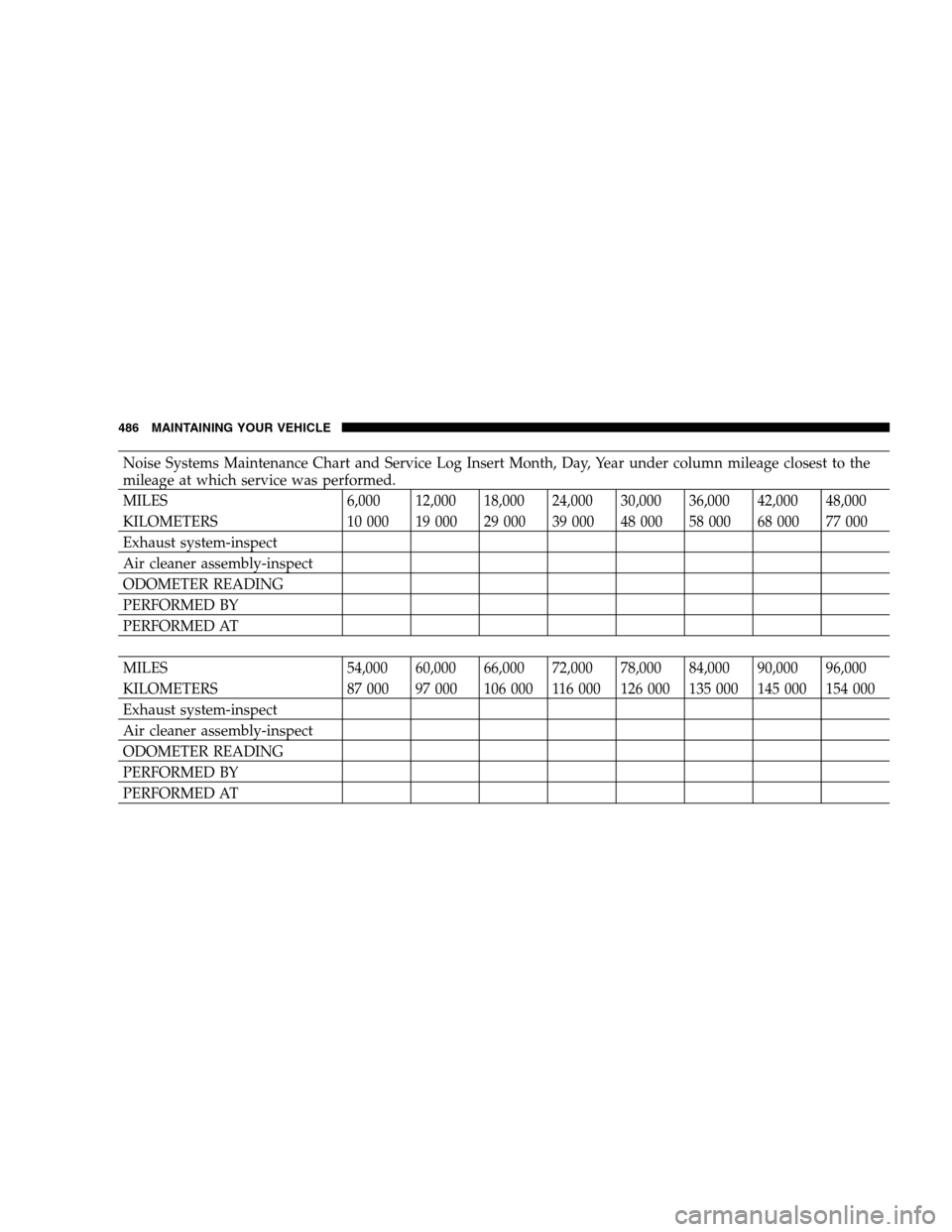
Noise Systems Maintenance Chart and Service Log Insert Month, Day, Year under column mileage closest to the
mileage at which service was performed.
MILES 6,000 12,000 18,000 24,000 30,000 36,000 42,000 48,000
KILOMETERS 10 000 19 000 29 000 39 000 48 000 58 000 68 000 77 000
Exhaust system-inspect
Air cleaner assembly-inspect
ODOMETER READING
PERFORMED BY
PERFORMED AT
MILES 54,000 60,000 66,000 72,000 78,000 84,000 90,000 96,000
KILOMETERS 87 000 97 000 106 000 116 000 126 000 135 000 145 000 154 000
Exhaust system-inspect
Air cleaner assembly-inspect
ODOMETER READING
PERFORMED BY
PERFORMED AT
486 MAINTAINING YOUR VEHICLE