Page 464 of 568
Refrigerant Recovery and Recycling
R-134a Air Conditioning Refrigerant is a hydrofluorocar-
bon (HFC) that is endorsed by the Environmental Pro-
tection Agency and is an ozone-saving product. How-
ever, the manufacturer recommends that air conditioning
service be performed by dealers or other service facilities
using recovery and recycling equipment.
NOTE:Use only manufacturer approved A/C System
Sealers, Stop Leak Products, Seal Conditioners, Compres-
sor Oil, or Refrigerants.
Power Steering — Fluid Check
Checking the power steering fluid level at a defined
service interval is not required. The fluid should only be
checked if a leak is suspected, abnormal noises are
apparent, and/or the system is not functioning as antici-
pated. Coordinate inspection efforts through a certified
DaimlerChrysler Dealership.�
WARNING!
Fluid level should be checked on a level surface and
with the engine off to prevent injury from moving
parts and to insure accurate fluid level reading. Do
not overfill. Use only manufacturers recommended
power steering fluid.
If necessary, add fluid to restore to the proper indicated
level. With a clean cloth, wipe any spilled fluid from all
surfaces. Refer to Fluids, Lubricants, and Genuine Parts
for correct fluid type.
Front Suspension Ball Joints
4 x 2 Models
The ball joints and seals should be inspected whenever
the vehicle is serviced for other reasons.
464 MAINTAINING YOUR VEHICLE
Page 467 of 568
Windshield Wiper Blades
The rubber edges of the wiper blades and the windshield
should be cleaned periodically with a sponge or soft cloth
and a mild nonabrasive cleaner. This will remove accu-
mulations of salt or road film.
Operation of the wipers on dry glass for long periods
may cause deterioration of the wiper blades. Always use
washer fluid when using the wipers to remove salt or dirt
from a dry windshield.
Avoid using the wiper blades to remove frost or ice from
the windshield. Keep the blade rubber out of contact with
petroleum products such as engine oil, gasoline, etc.
Windshield Washers
The fluid reservoir is located under the hood and should
be checked for fluid level at regular intervals. Fill thereservoir with windshield washer solvent only (not ra-
diator antifreeze). When refilling the washer fluid reser-
voir, take some washer fluid and apply it to a cloth or
towel and wipe clean the wiper blades, this will help
blade performance.
To prevent freeze-up of your windshield washer system
in cold weather, select a solution or mixture that meets or
exceeds the temperature range of your climate. This
rating information can be found on most washer fluid
containers.
WARNING!
Commercially available windshield washer solvents
are flammable. They could ignite and burn you. Care
must be exercised when filling or working around
the washer solution.
MAINTAINING YOUR VEHICLE 467
7
Page 476 of 568
WARNING!
Worn brake hoses can burst and cause brake failure.
You could have an accident. If you see any signs of
cracking, scuffing, or worn spots, have the brake
hoses replaced immediately.
Brake Master Cylinder — Brake Fluid Level Check
The fluid level of the master cylinder should be checked
when performing under the hood service, or immedi-
ately if the brake system warning lamp indicates system
failure.
The brake master cylinder has a translucent plastic
reservoir. On the outboard side of the reservoir, there is a
“MAX” dot and an “MIN” dot. The fluid level must be
kept within these two dots. Do not add fluid above the
MAX mark, because leakage may occur at the cap.With disc brakes the fluid level can be expected to fall as
the brake linings wear. However, an unexpected drop in
fluid level may be caused by a leak and a system check
should be conducted.
Refer to Fluids, Lubricants and Genuine Parts for the
correct Fluid type.WARNING!
Use of a brake fluid that may have a lower initial
boiling point, or is unidentified as to specification,
may result in sudden brake failure during hard
prolonged braking. You could have an accident.
476 MAINTAINING YOUR VEHICLE
Page 477 of 568
WARNING!
Overfilling the brake fluid reservoir can result in
spilling brake fluid on hot engine parts and the
brake fluid catching fire.
Use only brake fluid that has been in a tightly closed
container to avoid contamination from foreign matter or
moisture.
CAUTION!
Do not allow a petroleum-base fluid to contaminate
the brake fluid. Seal damage may result.
Clutch Hydraulic System
The clutch hydraulic system is a sealed maintenance-free
system. In the event of leakage or other malfunction, the
system must be replaced.
Clutch Linkage
If the clutch pedal linkage begins to squeak or grunt, the
clutch pedal pivot bushings should be lubricated. Refer
to Fluids, Lubricants and Genuine Parts for the correct
lubricant type.
Rear Axle And 4x4 Front Driving Axle Fluid Level
Refer to Fluids, Lubricants and Genuine Parts for the
correct Fluid type. For normal service, periodic fluid level
checks are not required. When the vehicle is serviced for
other reasons the exterior surfaces of the axle assembly
should be inspected. If gear oil leakage is suspected
inspect the fluid level.
MAINTAINING YOUR VEHICLE 477
7
Page 481 of 568

To check the automatic transmission fluid level properly,
the following procedure must be used:
1. Operate the engine at idle speed and normal operating
temperature.
2. The vehicle must be on level ground.
3. Fully apply the parking brake and press the brake
pedal.
4. Place the gear selector momentarily in each gear
position ending with the lever in P (Park).
5. Remove the dipstick, wipe it clean and reinsert it until
seated.
6. Remove the dipstick again and note the fluid level on
both sides. The fluid level should be between the “HOT”
(upper) reference holes on the dipstick at normal operat-
ing temperature. Verify that solid coating of oil is seen on
both sides of the dipstick. If the fluid is low, add asrequired into the dipstick tube.Do not overfill.After
adding any quantity of oil through the oil fill tube, wait
a minimum of two (2) minutes for the oil to fully drain
into the transmission before rechecking the fluid level.
NOTE:If it is necessary to check the transmissionbelow
the operating temperature, the fluid level should be
between the two “COLD” (lower) holes on the dipstick
with the fluid at approximately 70°F (21°C) (room tem-
perature). If the fluid level is correctly established at
room temperature, it should be between the “HOT”
(upper) reference holes when the transmission reaches
180°F (82°C). Remember it is best to check the level at the
normal operating temperature.
MAINTAINING YOUR VEHICLE 481
7
Page 520 of 568
At Each Stop for Fuel
•Check the engine oil level about 5 minutes after a fully
warmed engine is shut off. Checking the oil level while
the vehicle is on level ground will improve the accu-
racy of the oil level reading. Add oil only when the
level is at or below the ADD or MIN mark.
•Check the windshield washer solvent and add if
required. When refilling the washer fluid reservoir,
take some washer fluid and apply it to a cloth or towel
and wipe clean the wiper blades, this will help blade
performance.
Once a Month
•Check tire pressure and look for unusual wear or
damage.
•Inspect the battery and clean and tighten the terminals
as required.
•Check the fluid levels of coolant bottle, brake master
cylinder, and transmission and add as needed.
•Check all lights and all other electrical items for correct
operation.
At Each Oil Change
•Change the engine oil filter.
•Lubricate Drivetrain/Steering/Suspension Grease Fit-
tings (if equipped)
•Inspect the exhaust system.
•Inspect the brake hoses.
•Inspect the CV joints/U— joints (if equipped) and
front suspension components.
•Check the automatic transmission fluid level.
•Check the manual transmission fluid level.
•Check the coolant level, hoses, and clamps.
•Lubricate Front Drive Shaft Fitting (2500/3500, 4X4).
520 MAINTENANCE SCHEDULES
8
M
A
I
N
T
E
N
A
N
C
E
S
C
H
E
D
U
L
E
S
Page 522 of 568
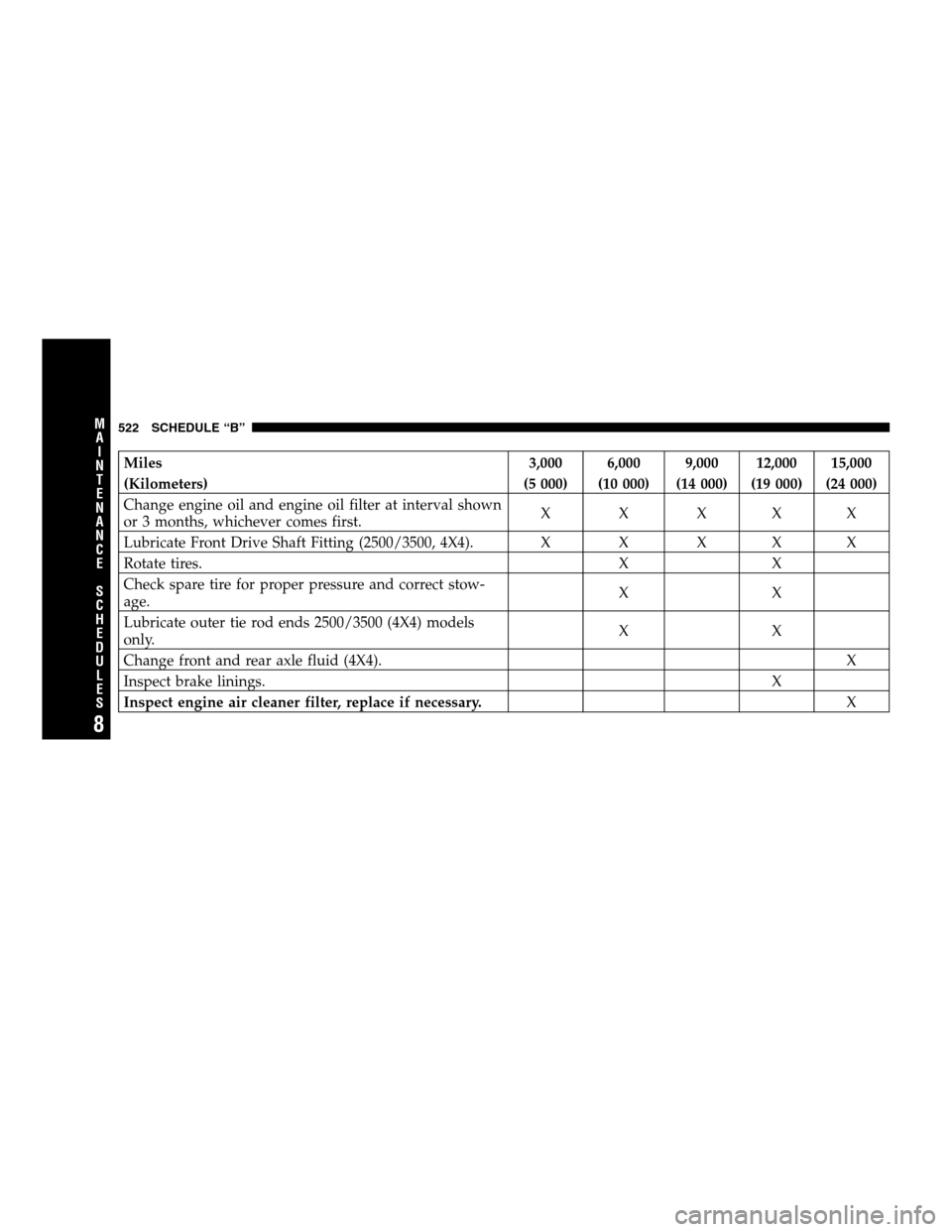
Miles 3,000 6,000 9,000 12,000 15,000
(Kilometers) (5 000) (10 000) (14 000) (19 000) (24 000)
Change engine oil and engine oil filter at interval shown
or 3 months, whichever comes first.X X XXX
Lubricate Front Drive Shaft Fitting (2500/3500, 4X4). X X X X X
Rotate tires. X X
Check spare tire for proper pressure and correct stow-
age.XX
Lubricate outer tie rod ends 2500/3500 (4X4) models
only.XX
Change front and rear axle fluid (4X4). X
Inspect brake linings.X
Inspect engine air cleaner filter, replace if necessary.X
522 SCHEDULE “B”
8
M
A
I
N
T
E
N
A
N
C
E
S
C
H
E
D
U
L
E
S
Page 523 of 568
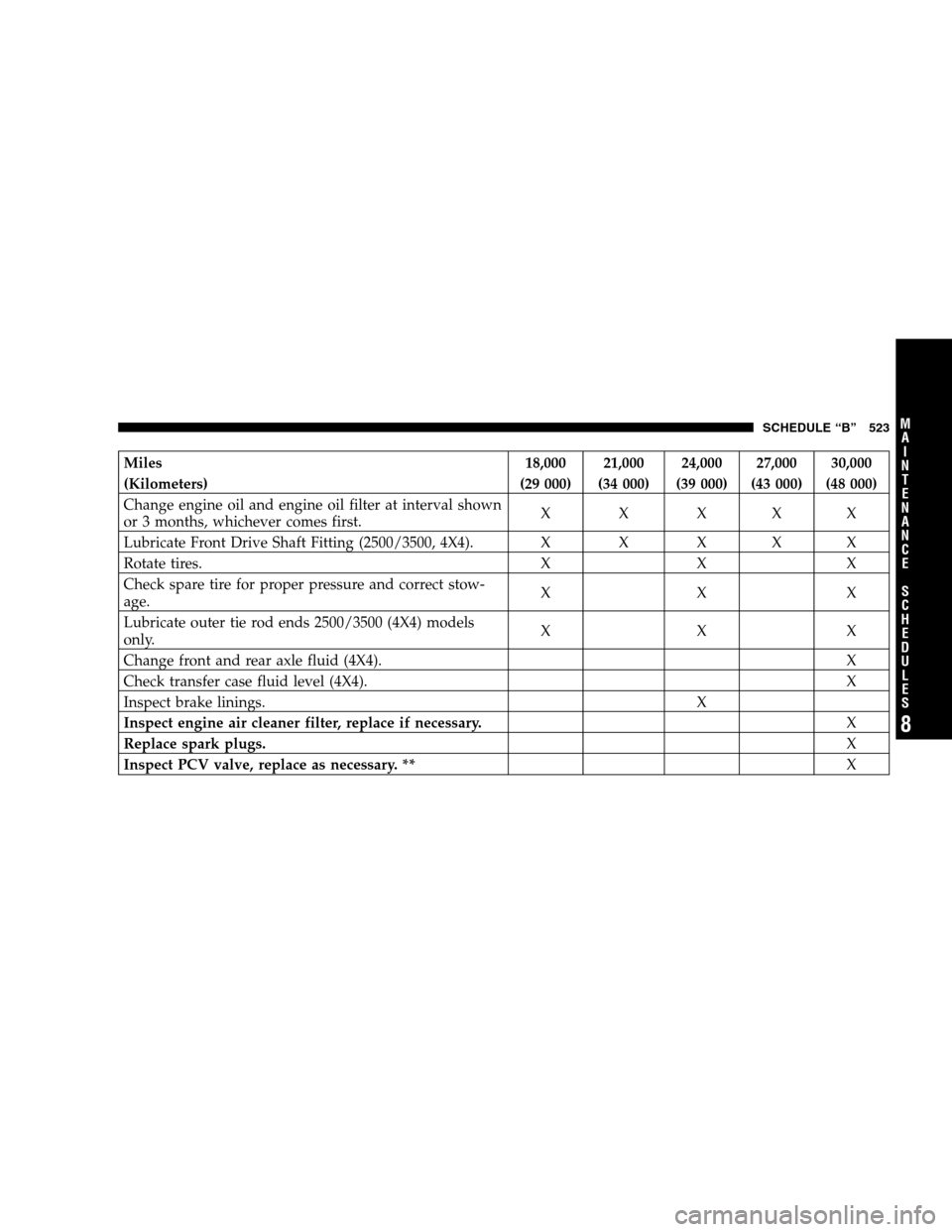
Miles 18,000 21,000 24,000 27,000 30,000
(Kilometers) (29 000) (34 000) (39 000) (43 000) (48 000)
Change engine oil and engine oil filter at interval shown
or 3 months, whichever comes first.X X XXX
Lubricate Front Drive Shaft Fitting (2500/3500, 4X4). X X X X X
Rotate tires. X X X
Check spare tire for proper pressure and correct stow-
age.XXX
Lubricate outer tie rod ends 2500/3500 (4X4) models
only.XXX
Change front and rear axle fluid (4X4). X
Check transfer case fluid level (4X4).X
Inspect brake linings. X
Inspect engine air cleaner filter, replace if necessary.X
Replace spark plugs.X
Inspect PCV valve, replace as necessary. **X
SCHEDULE “B” 523
8
M
A
I
N
T
E
N
A
N
C
E
S
C
H
E
D
U
L
E
S