Page 357 of 492
Towing Tips
Before setting out on a trip, practice turning, stopping
and backing the trailer in an area away from heavy
traffic.If using a manual transmission vehicle for trailer towing,
all starts must be in FIRST gear to avoid excessive clutch
slippage.
Towing Tips Ð Automatic Transmission
The ªDº range can be selected when towing. However, if
frequent shifting occurs while in this range, the ªTOW
HAULº or ªOD/OFFº range should be selected.
NOTE:Using the ªTOW HAULº or ªOD/OFFº range
while operating the vehicle under heavy operating con-
ditions will improve performance and extend transmis-
sion life by reducing excessive shifting and heat build up.
This action will also provide better engine braking.
The automatic transmission fluid and filter should be
changed if you REGULARLY tow a trailer for more than
45 minutes of continuous operation. See Schedule ªBº in
section 8 of this manual for transmission fluid change
intervals.
7- Pin Connector
356 STARTING AND OPERATING
Page 359 of 492
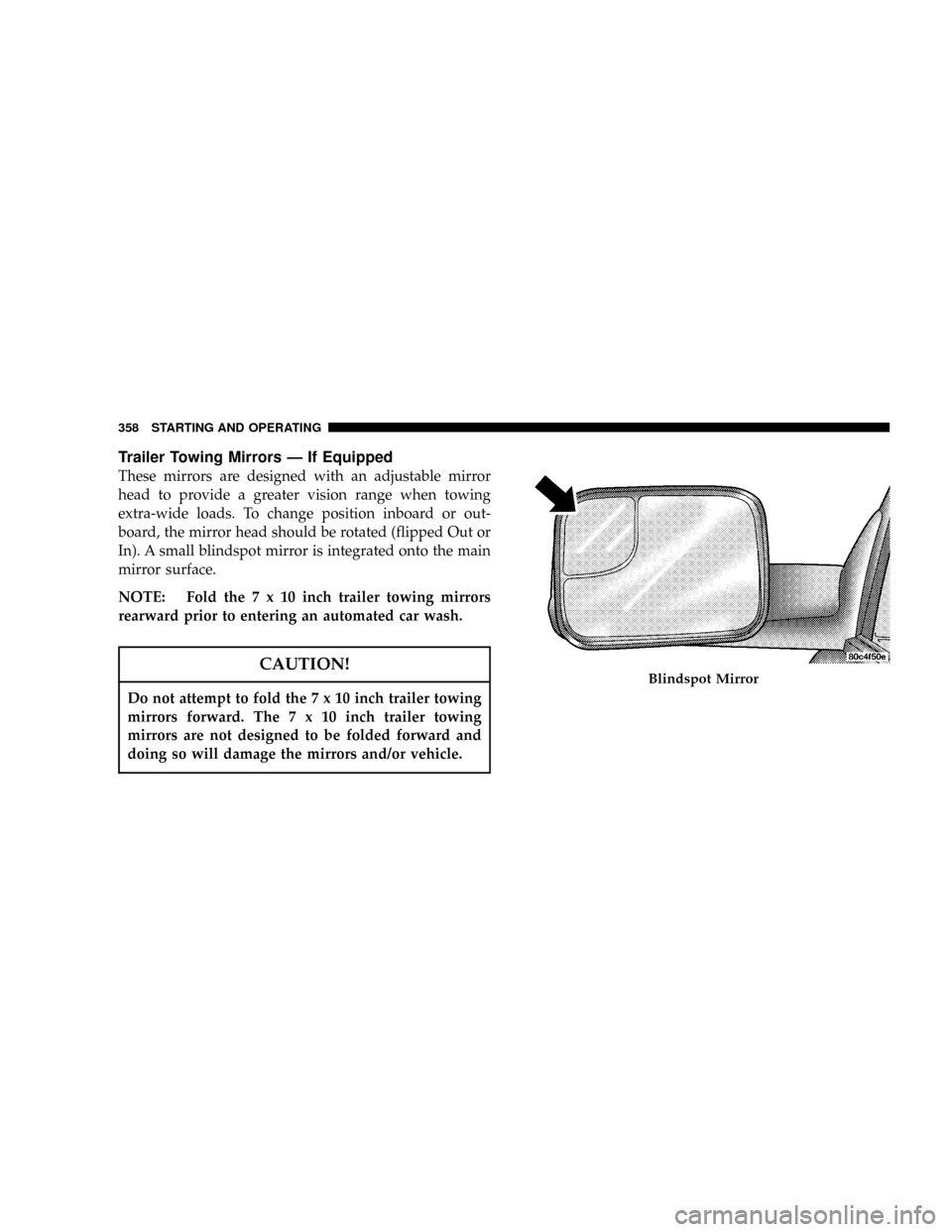
Trailer Towing Mirrors Ð If Equipped
These mirrors are designed with an adjustable mirror
head to provide a greater vision range when towing
extra-wide loads. To change position inboard or out-
board, the mirror head should be rotated (flipped Out or
In). A small blindspot mirror is integrated onto the main
mirror surface.
NOTE: Fold the7x10inch trailer towing mirrors
rearward prior to entering an automated car wash.
CAUTION!
Do not attempt to fold the7x10inch trailer towing
mirrors forward. The7x10inch trailer towing
mirrors are not designed to be folded forward and
doing so will damage the mirrors and/or vehicle.
Blindspot Mirror
358 STARTING AND OPERATING
Page 360 of 492
SNOWPLOW
Dodge Power Wagon Models
NOTE:Do not use Dodge Power Wagon Models for
snowplow applications.
WARNING!
Snowplows and other aftermarket equipment
should not be added to the front end or your vehicle.
The airbag crash sensors may be affected by the
change in the front end structure. The airbags could
deploy unexpectedly or could fail to deploy during a
collision resulting in serious injury or death.
Trailer Towing Position
STARTING AND OPERATING 359
5
Page 391 of 492

Change Engine Oil
Road conditions as well as your kind of driving affect the
interval at which your oil should be changed. Check the
following to determine if any apply to you:
²Day or night temperatures are below 32ÉF (0ÉC).
²Stop and go driving.
²Extensive engine idling.
²Driving in dusty conditions
²Short trips of less than 10 miles (16.2 km)
²More than 50% of your driving is at sustained high
speeds during hot weather, above 32ÉC (90ÉF)
²Trailer towing
²Heavy Loading
²Taxi, Police or delivery service (commercial service)
²Off-road or desert operation
²If equipped for and operating with E-85 (ethanol)
fuel.
NOTE:IfANYof these apply to you then change your
engine oil every 3,000 miles (5 000 km) or 3 months,
whichever comes first and follow schedule ªBº of the
9Maintenance Schedules9section of this manual.
If none of these apply to you, then change your engine oil
at every interval shown on schedule9A9of the9Mainte-
nance Schedules9section of this manual.
NOTE:Under no circumstances should oil change in-
tervals exceed 6,000 miles (10 000 km) or 6 months
whichever comes first.
Dusty Conditions
Driving through dust-laden air increases the problems of
keeping abrasive materials out of the engine. Under these
conditions, special attention should be given to the
390 MAINTAINING YOUR VEHICLE
Page 428 of 492
Cavity Cartridge
FuseMini
FuseDescription
11 20 Amp
YellowIgnition Off Draw
(IOD)-Cabin Com-
partment Node
(CCN)/Radio/Under
Hood Lamp/Wireless
Control Module
(WCM)/Satellite Digi-
tal Audio Receiver
(SDARS)/Hands Free
Module (HFM)
12 30 Amp
PinkElectric Brake
13 25 Amp
NaturalPower-Battery
RWAL/ABS Module
Feed
14 15 Amp
BluePark Lamps LeftCavity Cartridge
FuseMini
FuseDescription
15 20 Amp
YellowTrailer Park Lamps
16 15 Amp
BluePark Lamps Right
17 15 Amp
BlueSpare
18 40 Amp
GreenABS Pump
19 30 Amp
PinkTrailer Tow
20 10 Amp
RedOccupant Restraints
Controller (ORC) 2
21 10 Amp
RedOccupant Restraints
Controller (ORC) Pre-
set Carrier
22 2 Amp
GrayIGN Switch Feed
MAINTAINING YOUR VEHICLE 427
7
Page 447 of 492

EMISSION CONTROL SYSTEM MAINTENANCE
The ªScheduledº maintenance services, listed inbold
typein this section (Section 8) must be done at the times
or mileages specified to assure the continued proper
functioning of the emission control system. These, and all
other maintenance services included in this manual,
should be done to provide best vehicle performance and
reliability. More frequent maintenance may be needed for
vehicles in severe operating conditions such as dusty
areas and very short trip driving.
Inspection and service also should be done any time a
malfunction is suspected.
NOTE:Maintenance, replacement, or repair of the emis-
sion control devices and systems on your vehicle may be
performed by any automotive repair establishment or
individual using any automotive part which has been
certified pursuant to U.S. EPA or, in the State of Califor-
nia, California Air Resources Board regulations.
MAINTENANCE SCHEDULES
There are two maintenance schedules that show the
requiredservice for your vehicle.
First is ScheduleªBº. It is for vehicles that are operated
under the conditions that are listed below and at the
beginning of the schedule.
²Day or night temperatures are below 32É F (0É C).
²Stop and go driving.
²Extensive engine idling.
²Driving in dusty conditions.
²Short trips of less than 10 miles (16 km).
²More than 50% of your driving is at sustained high
speeds during hot weather, above 90É F C (32É).
²Trailer towing.
²Snowplowing.
446 MAINTENANCE SCHEDULES
8
M
A
I
N
T
E
N
A
N
C
E
S
C
H
E
D
U
L
E
S
Page 450 of 492

Schedule ªBº
Follow schedule ªBº if you usually operate your vehicle
under one or more of the following conditions.
²Day or night temperatures are below 32É F (0É C).
²Stop and go driving.
²Extensive engine idling.
²Driving in dusty conditions.
²Short trips of less than 10 miles (16 km).
²More than 50% of your driving is at sustained high
speeds during hot weather, above 90É F C (32É).
²Trailer towing.
²Snowplowing.
²Heavy Loading.
²Taxi, police, or delivery service (commercial service).
²Off-road or desert operation.
²If equipped for and operating with E-85 (ethanol)
fuel.
NOTE:IfANYof these apply to you then change your
engine oil every 3,000 miles (5 000 km) or 3 months,
whichever comes first and follow schedule ªBº of the
9Maintenance Schedules9section of this manual.
NOTE:IfANYof these apply to you then flush and
replace your engine coolant every 102,000 miles (170 000
km) or 60 months, whichever comes first and follow
schedule ªBº of the9Maintenance Schedules9section of
this manual.
If none of these apply to you, then change your engine oil
at every interval shown on schedule9A9of the9Mainte-
nance Schedules9section of this manual.
SCHEDULE ªBº 449
8
M
A
I
N
T
E
N
A
N
C
E
S
C
H
E
D
U
L
E
S
Page 460 of 492
Miles 105,000 108,000 111,000 114,000 117,000 120,000
(Kilometers) (169 000) (174 000) (179 000) (183 000) (188 000) (193 000)
Inspect PCV valve, replace as necessary.**X
Inspect auto tension drive belt and replace if
required.XX
Drain and refill automatic tranmission fluid
and change main sump and spin-on cooler
return filter (if equipped) [545RFE only].X
Flush and replace engine coolant at 120
months, if not replaced at 102,000 miles (170
000 km).X
* This applies only if the vehicle is used for frequent
trailer towing, snowplowing, fleet vehicle or commercial
service.
**This maintenance is recommend, but not required.Inspection and service should also be performed anytime
a malfunction is observed or suspected. Retain all re-
ceipts.
SCHEDULE ªBº 459
8
M
A
I
N
T
E
N
A
N
C
E
S
C
H
E
D
U
L
E
S