Page 342 of 492

NOTE:Tighten the gas cap 1/4 turn until you hear one
click. This is an indication that the cap is properly
tightened.
If the gas cap is not tightened properly, the Malfunction
Indicator Light will come on, Be sure the gas cap is
tightened every time the vehicle is refueled.
WARNING!
A fire may result if gasoline is pumped into a
portable container that is inside of a vehicle. You
could be burned. Always place gas containers on the
ground while filling.
Loose Fuel Filler Cap Message
If the vehicles diagnostic system determines that the fuel
filler cap in loose, improperly installed, or damaged, a
GASCAP message will be displayed in the instrumentcluster. Tighten the gas cap until a ªclickingº sound is
heard. This is an indication that the gas cap is properly
tightened. Press the odometer reset button to turn the
message off. If the problem persists, the message will
appear the next time the vehicle is started. This might
indicate a damaged cap. If the problem is detected twice
in a row, the system will turn on the Malfunction
Indicator Light (MIL). Resolving the problem will turn
the MIL light off.
VEHICLE LOADING
Certification Label
As required by National Highway Traffic Safety Admin-
istration Regulations, your vehicle has a certification
label affixed to the driver's side door or pillar.
This label contains the month and year of manufacture,
Gross Vehicle Weight Rating (GVWR), Gross Axle Weight
Rating (GAWR) front and rear, and Vehicle Identification
Number (VIN). A Month-Day-Hour (MDH) number is
STARTING AND OPERATING 341
5
Page 347 of 492
Gross Combination Weight Rating (GCWR)
The gross combination weight rating (GCWR) is the total
permissible weight of your vehicle and trailer when
weighed in combination. (Note that GCWR ratings in-
clude a 68 kg (150 lbs) allowance for the presence of a
driver).
Gross Axle Weight Rating (GAWR)
The GAWR is the maximum capacity of the front and rear
axles. Distribute the load over the front and rear axles
evenly. Make sure that you do not exceed either front or
rear GAWR.
WARNING!
It is important that you do not exceed the maximum
front or rear GAWR. A dangerous driving condition
can result if either rating is exceeded. You could lose
control of the vehicle and have an accident.
Tongue Weight (TW)
The downward force exerted on the hitch ball by the
trailer. In most cases it should not be less than 10% or
more than 15% of the trailer load. You must consider this
as part of the load on your vehicle.
346 STARTING AND OPERATING
Page 349 of 492
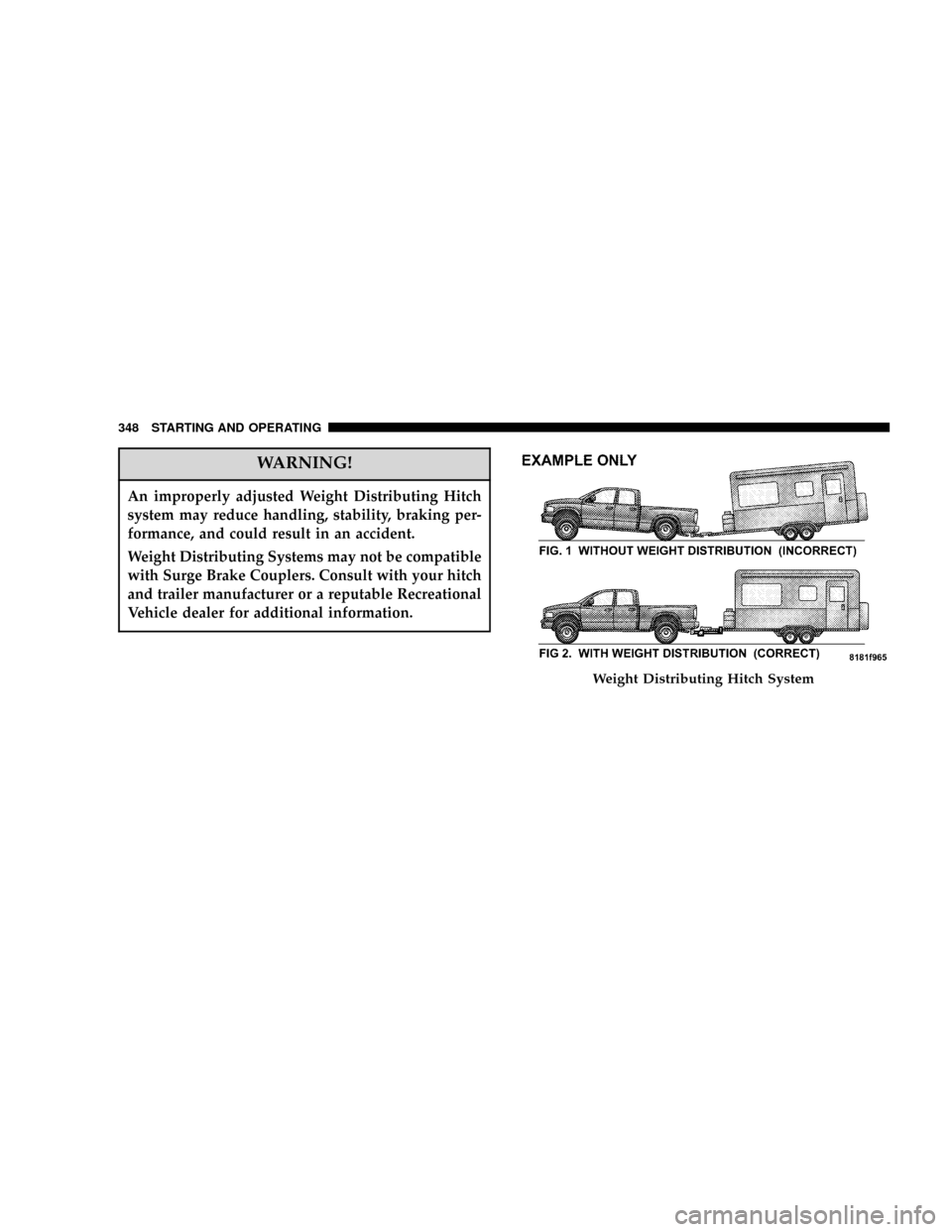
WARNING!
An improperly adjusted Weight Distributing Hitch
system may reduce handling, stability, braking per-
formance, and could result in an accident.
Weight Distributing Systems may not be compatible
with Surge Brake Couplers. Consult with your hitch
and trailer manufacturer or a reputable Recreational
Vehicle dealer for additional information.
Weight Distributing Hitch System
348 STARTING AND OPERATING
Page 353 of 492

CAUTION!
²Avoid towing a trailer for the first 500 miles (805
km) of vehicle operation. Doing so may damage
your axles, driveline and vehicle.
²During the first 500 miles (805 km) of trailer
towing, limit your speed to 50 mph (80 km/h).
Perform the maintenance listed in Section 8 of this
manual. When towing a trailer, never exceed the GAWR,
or GCWR, ratings.
WARNING!
Improper towing can lead to an injury accident.
Follow these guidelines to make your trailer towing
as safe as possible:
Make certain that the load is secured in the trailer
and will not shift during travel. When trailering
cargo that is not fully secured, dynamic load shifts
can occur that may be difficult for the driver to
control. You could lose control of your vehicle and
have an accident.
²When hauling cargo or towing a trailer, do not over-
load your vehicle or trailer. Overloading can cause a
loss of control, poor performance or damage to brakes,
axle, engine, transmission, steering, suspension, chas-
sis structure or tires.
352 STARTING AND OPERATING
Page 356 of 492
WARNING!
Do not connect trailer brakes to your vehicle's hy-
draulic brake lines. It can overload your brake sys-
tem and cause it to fail. You might not have brakes
when you need them and could have an accident.
Towing any trailer will increase your stopping dis-
tance. When towing you should allow for additional
space between your vehicle and the vehicle in front
of you. Failure to do so could result in an accident.
Towing Requirements Ð Trailer Lights & Wiring
Whenever you pull a trailer, regardless of the trailer size,
stop lights and turn signals on the trailer are required for
motoring safety.
The Trailer Tow Package may includea4and7pin
wiring harness. Use a factory approved trailer harness
and connector.NOTE:Do not cut or splice wiring into the vehicles
wiring harness.
The electrical connections are all complete to the vehicle
but you must mate the harness to a trailer connector.
Refer to the following illustrations.
4 - Pin Connector
STARTING AND OPERATING 355
5
Page 360 of 492
SNOWPLOW
Dodge Power Wagon Models
NOTE:Do not use Dodge Power Wagon Models for
snowplow applications.
WARNING!
Snowplows and other aftermarket equipment
should not be added to the front end or your vehicle.
The airbag crash sensors may be affected by the
change in the front end structure. The airbags could
deploy unexpectedly or could fail to deploy during a
collision resulting in serious injury or death.
Trailer Towing Position
STARTING AND OPERATING 359
5
Page 361 of 492
CAUTION!
Using this vehicle for snowplow applications can
cause damage to the vehicle.
WARNING!
Attaching a snowplow to this vehicle could ad-
versely affect performance of the airbag system in an
accident. Do not expect that the airbag will perform
as described earlier in this manual
RECREATIONAL TOWING Ð 4±WHEEL DRIVE
VEHICLES (BEHIND MOTORHOME, ETC.)
CAUTION!
Internal damage to the transfer case will occur if a
front or rear wheel lift is used when recreational
towing.
NOTE:The transfer case must be shifted into Neutral
(N) for recreational towing. Automatic transmissions
must be placed in P (Park) position for recreational
towing. Manual transmissions must be left in gear (not in
neutral) for recreational towing. Refer below for the
proper transfer case Neutral shifting procedure for your
vehicle.
360 STARTING AND OPERATING
Page 363 of 492

CAUTION!
Damage to the automatic transmission may occur if
the transmission is shifted into P (PARK) with the
transfer case in N (NEUTRAL) and the engine RUN-
NING. With the transfer case in N (NEUTRAL)
ensure that the engine is OFF prior to shifting the
transmission into P (PARK)
Returning to Normal Operation Ð Manual Shift
Transfer Case
Use the following procedure to prepare your vehicle for
normal usage:
1. Bring the vehicle to a complete stop.
2. Shut OFF the engine.
3. Depress the brake pedal.4. Shift automatic transmission to N (NEUTRAL), or
depress the clutch on manual transmissions.
5. Shift transfer case lever to desired position.
6. Shift automatic transmission into P (Park).
WARNING!
You or others could be injured if you leave the
vehicle unattended with the transfer case in the N
(NEUTRAL) position without first fully engaging
the parking brake. The transfer case N (NEUTRAL)
position disengages both the front and rear drive-
shafts from the powertrain and will allow the ve-
hicle to move regardless of the transmission posi-
tion. The parking brake should always be applied
when the driver is not in the vehicle.
362 STARTING AND OPERATING