2007 DODGE MAGNUM SRT warning light
[x] Cancel search: warning lightPage 210 of 380

The selector lever is automatically locked while in the P
(Park) position. To move the selector lever out of the P
(Park) position, the brake pedal must be firmly depressed
before the shift lock will release.
Shift the selector lever to the desired position only when
the engine is idling normally and the brake pedal is
applied. Do not release the brake until ready to drive. The
vehicle may otherwise accelerate quickly when the selec-
tor lever is in D (Drive) or R (Reverse) position.WARNING!
Unintended movement of a vehicle could injure
those in and near the vehicle. As with all vehicles,
you should never exit a vehicle while the engine is
running. Before exiting a vehicle, you should always
shift the vehicle into P (Park), remove the key from
the ignition, and apply the parking brake. Once the
key is removed from the ignition, the transmission
selector lever is locked in the P (Park) position,
securing the vehicle against unwanted movement.
Furthermore, you should never leave children unat-
tended inside a vehicle.
Over Temperature Mode
The transmission electronics constantly monitor the
transmission oil temperature. If the transmission exceeds
normal operating temperature, the transmission will
change the way it shifts to help control the condition.
This may result in a slightly different feeling or response
during normal operation in D (Drive) position. After the
transmission cools down, it will return to normal opera-
tion.
STARTING AND OPERATING 209
5
Page 219 of 380
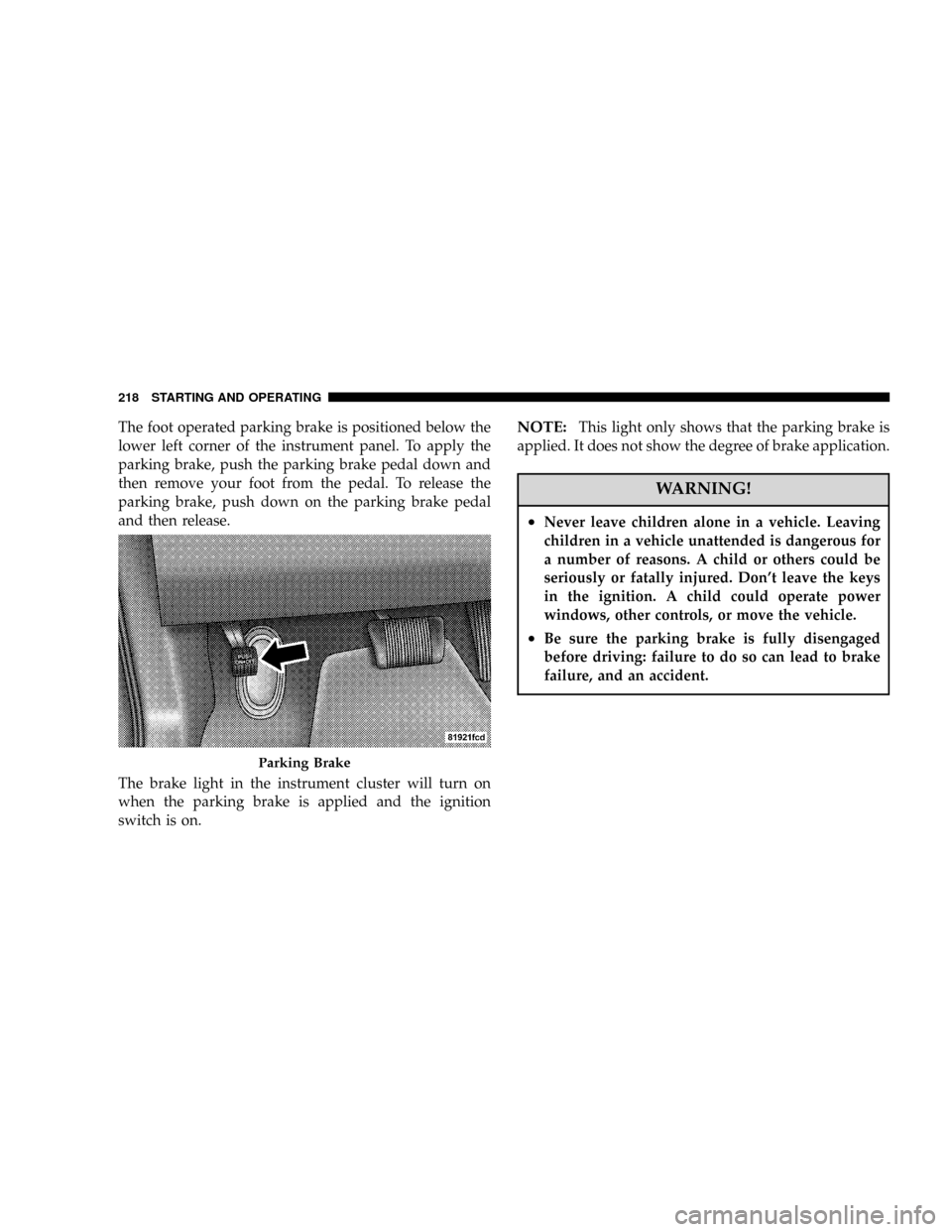
The foot operated parking brake is positioned below the
lower left corner of the instrument panel. To apply the
parking brake, push the parking brake pedal down and
then remove your foot from the pedal. To release the
parking brake, push down on the parking brake pedal
and then release.
The brake light in the instrument cluster will turn on
when the parking brake is applied and the ignition
switch is on.NOTE:This light only shows that the parking brake is
applied. It does not show the degree of brake application.
WARNING!
²Never leave children alone in a vehicle. Leaving
children in a vehicle unattended is dangerous for
a number of reasons. A child or others could be
seriously or fatally injured. Don't leave the keys
in the ignition. A child could operate power
windows, other controls, or move the vehicle.
²Be sure the parking brake is fully disengaged
before driving: failure to do so can lead to brake
failure, and an accident.
Parking Brake
218 STARTING AND OPERATING
Page 220 of 380

BRAKE SYSTEM
Your vehicle is equipped with dual hydraulic
brake systems. If either of the two hydraulic
systems loses normal capability, the remaining
system will still function. There will be some
loss of overall braking effectiveness. This may be evident
by increased pedal travel during application, greater
pedal force required to slow or stop, and potential
activation of the Brake Warning Light.
In the event power assist is lost for any reason (for
example, repeated brake applications with the engine off)
the brakes will still function. The effort required to brake
the vehicle will be much greater than that required with
the power system operating.
Anti-Lock Brake System
The Anti-Lock Brake System provides increased vehicle
stability and brake performance under most braking
conditions. The system automatically ªpumpsº the
brakes during severe braking conditions to prevent
wheel lock-up.The electronic brake force distribution (EBD) prevents the
rear wheels from over-braking and provides greater
control of available braking forces applied to the rear
axle.
When the vehicle is driven over 7 mph (11 km/h), you
may also hear a slight clicking sound as well as some
related motor noises. These noises are the system per-
forming its self check cycle to ensure that the ABS system
is working properly. This self check occurs each time the
vehicle is started and accelerated past 7 mph (11 km/h).
ABS is activated during braking under certain road or
stopping conditions. ABS-inducing conditions can in-
clude ice, snow, gravel, bumps, railroad tracks, loose
debris, or panic stops.
STARTING AND OPERATING 219
5
Page 221 of 380

You also may experience the following when the brake
system goes into Anti-lock:
²The ABS motor running (it may continue to run for a
short time after the stop),
²the clicking sound of solenoid valves,
²brake pedal pulsations,
²and a slight drop or fall away of the brake pedal at the
end of the stop.
These are all normal characteristics of ABS.
WARNING!
²The Anti-Lock Brake System contains sophisticated
electronic equipment that may be susceptible to inter-
ference caused by improperly installed or high output
radio transmitting equipment. This interference can
cause possible loss of anti-lock braking capability. In-
stallation of such equipment should be performed by
qualified professionals.
²Pumping of the Anti-Lock Brakes will diminish their
effectiveness and may lead to an accident. Pumping
makes the stopping distance longer. Just press firmly on
your brake pedal when you need to slow down or stop.
²Anti-lock system (ABS) cannot prevent the natural laws
of physics from acting on the vehicle, nor can it increase
braking or steering efficiency beyond that afforded by
the condition of the vehicle brakes and tires or the
traction afforded.
²The ABS cannot prevent accidents, including those
resulting from excessive speed in turns, following an-
other vehicle too closely, or hydroplaning. Only a safe,
attentive, and skillful driver can prevent accidents.
²The capabilities of an ABS equipped vehicle must never
be exploited in a reckless or dangerous manner, which
could jeopardize the user's safety or the safety of others.
220 STARTING AND OPERATING
Page 222 of 380

All vehicle wheels and tires must be the same size and
type and tires must be properly inflated to produce
accurate signals for the computer.
Anti-Lock Brake Light
The ABS light monitors the Anti-Lock Brake Sys-
tem. The light will come on when the ignition
switch is turned to the ON position and may stay on for
as long as four seconds.
If the ABS light remains on or comes on while driving, it
indicates that the Anti-Lock portion of the brake system
is not functioning and that service is required. However,
the conventional brake system will continue to operate
normally if the BRAKE warning light is not on.
If the ABS light is on, the brake system should be serviced
as soon as possible to restore the benefits of Anti-Lock
brakes. If the ABS light does not come on when the
Ignition switch is turned to the ON position, have the
bulb repaired as soon as possible.
If both the Brake Warning Light and the ABS Light
remain on, the Anti-Lock brakes (ABS) and ElectronicBrake Force Distribution (EBD) systems are not function-
ing. Immediate repair to the ABS system is required.
POWER STEERING
The standard power steering system will give you good
vehicle response and increased ease of maneuverability
in tight spaces. The system will provide mechanical
steering capability if power assist is lost.
If for some reason the power assist is interrupted, it will
still be possible to steer your vehicle. Under these condi-
tions, you will observe a substantial increase in steering
effort, especially at very low vehicle speeds and during
parking maneuvers.
NOTE:Increased noise levels at the end of the steering
wheel travel are considered normal and do not indicate
that there is a problem with the power steering system.
Upon initial start-up in cold weather, the power
steering pump may make noise for a short amount of
time. This is due to the cold, thick fluid in the steering
system. This noise should be considered normal, and
does not in any way damage the steering system.
STARTING AND OPERATING 221
5
Page 225 of 380

WARNING!
The BAS (Brake Assist System) cannot prevent the
natural laws of physics from acting on the vehicle,
nor can it increase the traction afforded by prevail-
ing road conditions. The BAS cannot prevent acci-
dents, including those resulting from excessive
speed in turns, driving on very slippery surfaces, or
hydroplaning. Only a safe, attentive, and skillful
driver can prevent accidents. The capabilities of a
BAS-equipped vehicle must never be exploited in a
reckless or dangerous manner, which could jeopar-
dize the user's safety or the safety of others.
ESP (Electronic Stability Program)
This system enhances directional control and stability of
the vehicle under various driving conditions. The ESP
corrects for oversteering and understeering the vehicle
by applying the brake of the appropriate wheel. Engine
power may also be reduced to assist in counteracting the
condition of oversteer or understeer and help the vehicle
maintain the desired path.The ESP uses sensors in the vehicle to determine the path
that the driver intends to steer the vehicle and compares
it to the actual path of the vehicle. When the actual path
does not match the intended path, the ESP applies the
brake of the appropriate wheel to assist in counteracting
the condition of oversteer or understeer.
²Oversteer - when the vehicle is turning more than
appropriate for the steering wheel position.
²Understeer - when the vehicle is turning less than
appropriate for the steering wheel position.
The9ESP/TCS Indicator Light,9located in the
instrument cluster, starts to flash as soon as the
tires lose traction and the ESP system becomes
active. The9ESP/TCS Indicator Light9also
flashes when TCS is active. If the9ESP/TCS Indicator
Light9begins to flash during acceleration, ease up on the
accelerator and apply as little throttle as possible. Be sure
to adapt your speed and driving to the prevailing road
conditions.
224 STARTING AND OPERATING
Page 226 of 380

WARNING!
The ESP (Electronic Stability Program) cannot pre-
vent the natural laws of physics from acting on the
vehicle, nor can it increase the traction afforded by
prevailing road conditions. The ESP cannot prevent
accidents, including those resulting from excessive
speed in turns, driving on very slippery surfaces, or
hydroplaning. Only a safe, attentive, and skillful
driver can prevent accidents. The capabilities of an
ESP-equipped vehicle must never be exploited in a
reckless or dangerous manner, which could jeopar-
dize the user's safety or the safety of others.
The ESP system has 3 available operating modes:
ESP On
This is the normal operating mode for the ESP. When-
ever the vehicle is started, the ESP system will be in
this mode. This mode should be used for most all
driving situations. The ESP should only be turned off
for specific reasons as noted in the following para-
graphs.Partial Off
The ªPartial Offº mode is intended for times when a
more spirited driving experience is desired. It is also
intended for driving in deep snow, sand, or gravel.
This mode disables the TCS portion of the ESP and
raises the threshold for ESP activation, which allows
for more wheel spin than what ESP normally allows.
The ªESP OFFº button is located in the switch
panel above the radio. To enter the ªPartial
Offº mode, momentarily depress the ªESP
OFFº button and the9ESP/TCS Indicator
Light9will illuminate. To turn the ESP on again, momen-
tarily depress the9ESP OFF9button and the9ESP/TCS
Indicator Light9will turn off.
NOTE:To improve the vehicle's traction when driving
with snow chains, or when starting-off in deep snow,
sand, or gravel, it may be desirable to switch to the
ªPartial Offº mode by momentarily depressing the ªESP
OFFº button. Once the situation requiring ªPartial Offº
mode is overcome, turn the ESP on again by momentarily
depressing the ªESP OFFº button. This may be done
while the vehicle is in motion.
STARTING AND OPERATING 225
5
Page 227 of 380

Full Off
This mode is intended for off-highway or off-road use
only and should not be used on any public roadways.
In this mode, all TCS and ESP stability features are
turned off. To enter the ªFull Offº mode, depress and
hold the ªESP OFFº button for 5 seconds while the
vehicle is stopped with the engine running. After 5
seconds, a chime will sound, the9ESP/TCS Indicator
Light9will illuminate, and the9ESP OFF9message will
display in the vehicle odometer. Press and release the
trip odometer button located on the instrument cluster
to clear this message. The ªESP OFFº message may
appear in the Electronic Vehicle Information Center
(EVIC). Refer to ªElectronic Vehicle Information Cen-
ter (EVIC)º in Section 4 of this manual. To turn ESP on
again, momentarily depress the9ESP OFF Button.9
NOTE:
The9ESP OFF,9or ªESP System Deactivatedº
message will display and the audible chime will sound
when the gear selector is moved into the PARK position
from any position other than PARK and then moved out
of the PARK position. This will occur when the message
was previously cleared.
WARNING!
In the ESP Full Off mode, the engine torque reduc-
tion and stability features are cancelled. Therefore,
the enhanced vehicle stability offered by ESP is
unavailable.
NOTE:When the ESP is switched off a feature of the
system remains active. This feature controls wheel spin
across an axle quite similarly to a limited slip differential.
If one wheel on an axle is spinning faster than the other,
the system will apply the brake of the spinning wheel
and allow more engine torque to be applied to the wheel
that is not spinning. To improve the vehicle's traction
when driving with tire chains, or when starting-off in
deep snow, sand, or gravel, it may be desirable to switch
to the ªPartial Offº mode by momentarily depressing the
ªESP OFFº button.
226 STARTING AND OPERATING