Page 289 of 400
5. Remove the spare tire.
6. Remove the fastener securing the jack.WARNING!
A loose tire or jack thrown forward in a collision or
hard stop could endanger the occupants of the ve-
hicle. Always stow the jack parts and the spare tire in
the places provided.
Jacking and Changing a Tire
1. Block the wheel diagonally
opposite the flat tire. Passengers
should not remain in the vehicle
when the vehicle is being jacked.
2. Remove the spare tire, jack, and lug wrench.
3. If equipped with steel wheels, do not remove the
wheel cover at this time. If equipped with aluminum
wheels, before raising the vehicle, use the lug wrench to
pry the center cap off carefully.
Jack Fastener
WHAT TO DO IN EMERGENCIES 289
6
Page 290 of 400
WARNING!
To avoid possible personal injury, handle the wheel
covers with care to avoid contact with the metal
edges and retention teeth.
4. Before raising the vehicle, use the lug wrench to
loosen, but not remove, the lug nuts on the wheel with
the flat tire. Turn the lug nuts counter-clockwise one turn
while the wheel is still on the ground.
5. Place the jack underneath the lift area that is closest to
the flat tire. Turn the jack screw clockwise to firmly
engage the jack saddle with the lift area of the sill flange.
Center Cap Removal
290 WHAT TO DO IN EMERGENCIES
Page 292 of 400

6. Raise the vehicle just enough to remove the flat tire
and install the spare tire.
WARNING!
Raising the vehicle higher than necessary can make
the vehicle less stable. It could slip off the jack and
hurt someone near it. Raise the vehicle only enough
to remove the tire.
7. Remove the lug nuts, wheel cover (if equipped), and
tire. Remove the cover by hand. Do not pry it off.
8. Mount the spare tire. For vehicles equipped with
wheel covers, refer to “Wheel Cover Installation.” Do not
attempt to install a wheel cover on a compact spare.
9. Tighten all the lug nuts on the mounting studs.
10. Lower the vehicle to the ground by turning the jack
handle counter-clockwise.
11. Fully tighten the lug nuts. Torque the wheel lug nuts
to 100 ft/lb. (135 N. m).12. Store the flat tire, jack, and tools.
WARNING!
A loose tire or jack thrown forward in a collision or
hard stop could endanger the occupants of the ve-
hicle. Always stow the jack parts and the spare tire in
the places provided.
Compact Spare Tire
The compact spare tire is for temporary emergency use
with radial tires. It is engineered to be used on your style
vehicle only. Since this tire has limited tread life, the
original tire should be repaired (or replaced) and rein-
stalled at the first opportunity.
•Keep tire inflated to 60 PSI (414 KPa) Cold Inflation
Pressure.
•Avoid driving more than 50 miles (80 km) before
replacing tire and wheel.
•This tire is designed as an emergency spare only-do
not exceed 50 MPH (80 km/h) speed.
292 WHAT TO DO IN EMERGENCIES
Page 295 of 400
3. Set the parking brake, place the automatic transmis-
sion in PARK, and turn the ignition switch to the OFF (or
LOCK) position on both vehicles.
4. Turn off the heater, radio, and all unnecessary electri-
cal loads.
5. Connect one end of the jumper cable to the remote
jump-start positive battery post(+)in the engine com-
partment. Connect the other end of the same cable to the
positive terminal of the booster battery. Refer to the
following illustration for jump-starting connections.
6. Connect the other cable, first to the negative terminal
of the booster battery andthen to the engine ground (-)
of the vehicle with the discharged battery.Make sure
you have a good contact on the engine ground. Refer to
the following illustration for jump-starting connections.
Jump-Starting
WHAT TO DO IN EMERGENCIES 295
6
Page 298 of 400

TOWING A DISABLED VEHICLE
WITHOUT THE IGNITION KEY
Special care must be taken when the vehicle is towed
with the ignition in the LOCK position. The only ap-
proved method of towing without the ignition key is
with a flat bed truck. Proper towing equipment is neces-
sary to prevent damage to the vehicle.
TOWING THIS VEHICLE BEHIND ANOTHER
VEHICLE (Flat towing with all four wheels on the
ground)
Flat towing of vehicles equipped with an automatic
transmission, is only permitted within the following
limitations:
With The Ignition Key
Your vehicle may be towed under the following condi-
tions: The gear selector must be in NEUTRAL, the
distance to be traveled must not exceed 30 miles (48 km),
and the towing speed must not exceed 30 mph (48km/h). Exceeding these towing limits may cause a trans-
mission geartrain failure. If the transmission is not op-
erative, or if the vehicle is to be towed more than 30 miles
(48 km), the vehicle must be transported using a flat bed
truck.
CAUTION!
•Do not attempt to tow this vehicle from the front
with sling type towing equipment. Damage to the
front fascia will result.
•If the transmission is not operative, or if the
vehicle is to be towed more than 30 miles (48 km),
then the only approved method of towing is with
a flat bed truck. Damage to the transmission may
result.
•Do not tow the vehicle from the rear. Damage to
the rear sheet metal, and fascia will occur.
•Do not push or tow this vehicle with another
vehicle as damage to the bumper fascia and trans-
mission may result.
298 WHAT TO DO IN EMERGENCIES
Page 320 of 400

surfaces. Refer to “Fluids, Lubricants, and Genuine
Parts” in this section for the correct fluid type.
Front & Rear Suspension Ball Joints
The suspension ball joints should be inspected for exter-
nal leakage or damage when other maintenance is per-
formed.
Steering Linkage
The tie rod end ball joints should be inspected for
external leakage or damage when other maintenance is
performed.
Body Lubrication
Locks and all body pivot points, including seat tracks,
door hinges, liftgate hinges, and hood hinges, should be
lubricated periodically to assure quiet, easy operation
and to protect against rust and wear. Prior to the appli-
cation of any lubricant, the parts concerned should be
wiped clean to remove dust and grit; after lubricating
excess oil and grease should be removed. Particular
attention should also be given to hood latching compo-
nents to insure proper function. When performing other
underhood services, the hood latch, release mechanism,
and safety catch should be cleaned and lubricated.The external lock cylinders should be lubricated twice a
year, preferably in the fall and spring. Apply a small
amount of a high quality lubricant such as Mopar�Lock
Cylinder Lubricant or equivalent directly into the lock
cylinder.
Wiper Blades
Clean the rubber edges of the wiper blades and the
windshield and rear window periodically with a sponge
or soft cloth and a mild nonabrasive cleaner. This will
remove accumulations of salt or road film.
Operation of the wipers on dry glass for long periods
may cause deterioration of the wiper blades. Always use
washer fluid when using the wipers to remove salt or dirt
from a dry windshield or rear window.
Avoid using the wiper blades to remove frost or ice from
the windshield or rear window. Keep the blade rubber
out of contact with petroleum products such as engine
oil, gasoline, etc.
320 MAINTAINING YOUR VEHICLE
Page 338 of 400
Cavity Car-
tridge
FuseMini
FuseDescription
11 — 25 Amp
ClearAuto Shutdown/
Powertrain Control
Module (PCM)
12 — — —
13 — — —
14 — 25 Amp
ClearPowertrain Control
Module (PCM)
15 — 20 Amp
YellowInjectors, Ignition Coils
16 — — —
17 30 Amp
Pink— Anti-lock Brakes System
(ABS) Valves - if
equipped/Powertrain
Control Module (PCM)
18 30 Amp
Pink— Windshield Wiper/
Washer
19 50 Amp
Red— Radiator FanCavity Car-
tridge
FuseMini
FuseDescription
20 20 Amp
Blue— Starter
21 50 Amp
Red— Anti-lock Brakes System
(ABS) Pump Motor - if
equipped
22 40 Amp
Green— AC Clutch/Radiator Fan
High — Low
23 — — —
24 60 Amp
Yellow— Radiator Fan - AWD
25 30 Amp
Pink— Front Control Module
(FCM)
26 20 Amp
Blue— Transmission - RLE
27 30 Amp
Pink— Front Control Module
(FCM)
338 MAINTAINING YOUR VEHICLE
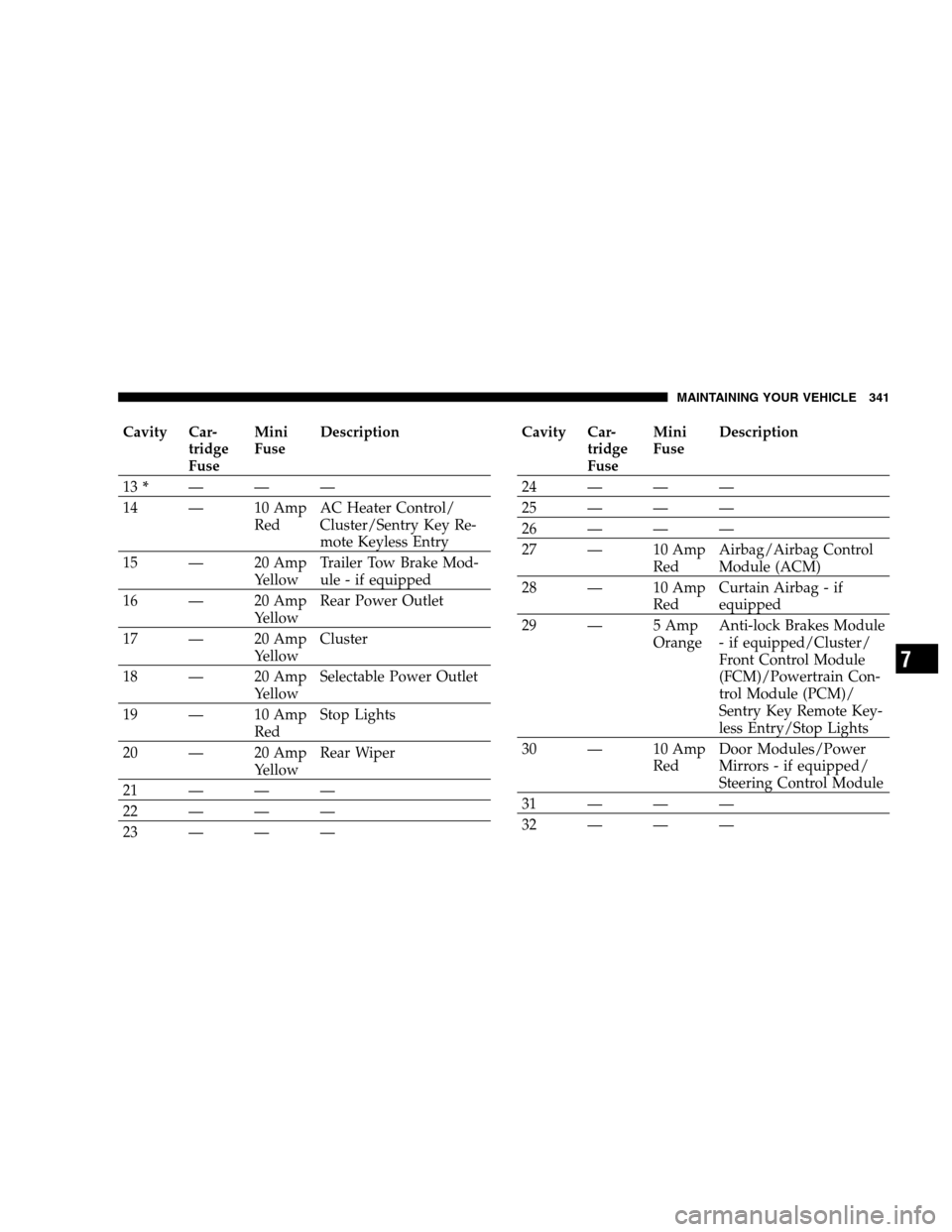
Page 341 of 400
Cavity Car-
tridge
FuseMini
FuseDescription
13*———
14 — 10 Amp
RedAC Heater Control/
Cluster/Sentry Key Re-
mote Keyless Entry
15 — 20 Amp
YellowTrailer Tow Brake Mod-
ule - if equipped
16 — 20 Amp
YellowRear Power Outlet
17 — 20 Amp
YellowCluster
18 — 20 Amp
YellowSelectable Power Outlet
19 — 10 Amp
RedStop Lights
20 — 20 Amp
YellowRear Wiper
21 — — —
22 — — —
23 — — —Cavity Car-
tridge
FuseMini
FuseDescription
24 — — —
25 — — —
26 — — —
27 — 10 Amp
RedAirbag/Airbag Control
Module (ACM)
28 — 10 Amp
RedCurtain Airbag - if
equipped
29 — 5 Amp
OrangeAnti-lock Brakes Module
- if equipped/Cluster/
Front Control Module
(FCM)/Powertrain Con-
trol Module (PCM)/
Sentry Key Remote Key-
less Entry/Stop Lights
30 — 10 Amp
RedDoor Modules/Power
Mirrors - if equipped/
Steering Control Module
31 — — —
32 — — —
MAINTAINING YOUR VEHICLE 341
7