Page 318 of 400
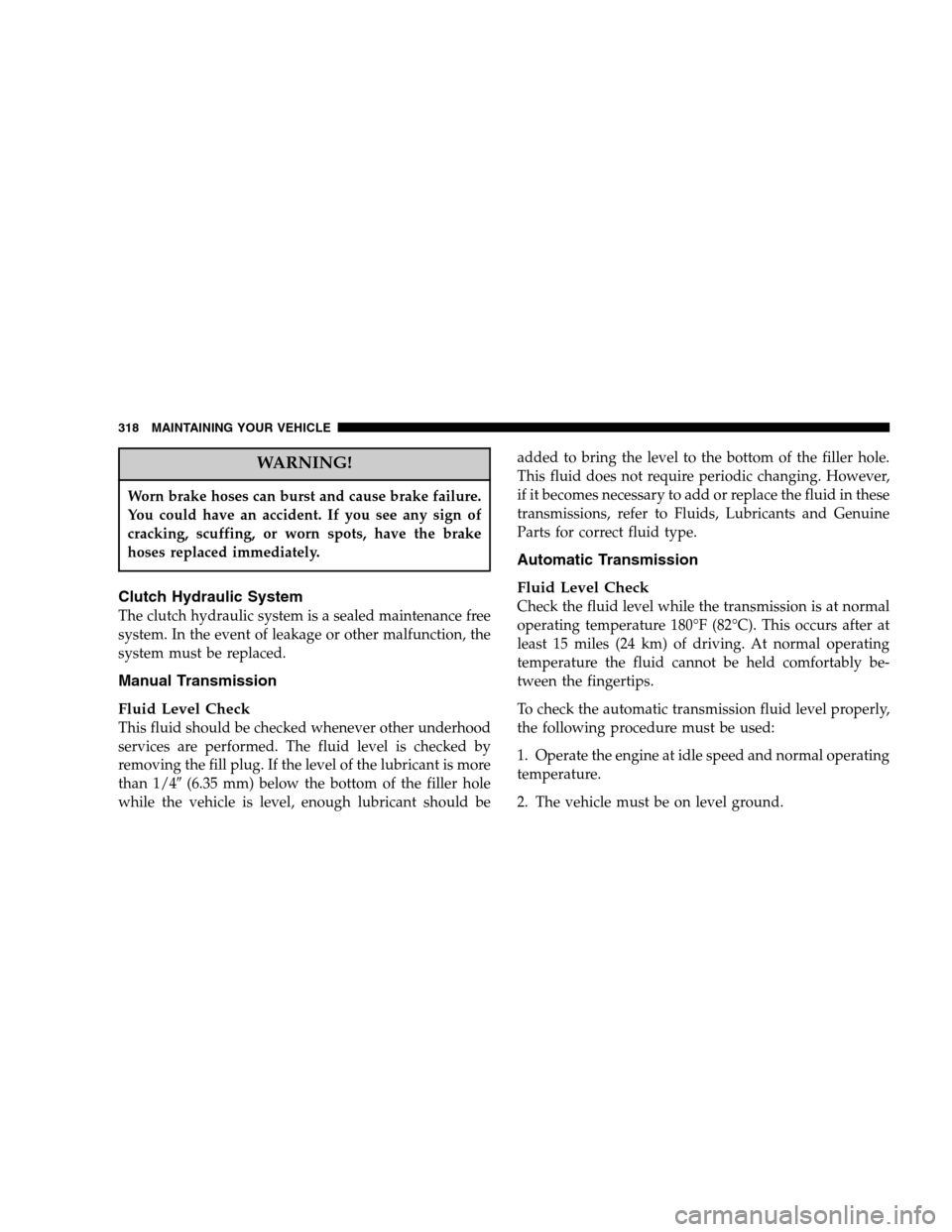
WARNING!
Worn brake hoses can burst and cause brake failure.
You could have an accident. If you see any sign of
cracking, scuffing, or worn spots, have the brake
hoses replaced immediately.
Clutch Hydraulic System
The clutch hydraulic system is a sealed maintenance free
system. In the event of leakage or other malfunction, the
system must be replaced.
Manual Transmission
Fluid Level Check
This fluid should be checked whenever other underhood
services are performed. The fluid level is checked by
removing the fill plug. If the level of the lubricant is more
than 1/4�(6.35 mm) below the bottom of the filler hole
while the vehicle is level, enough lubricant should beadded to bring the level to the bottom of the filler hole.
This fluid does not require periodic changing. However,
if it becomes necessary to add or replace the fluid in these
transmissions, refer to Fluids, Lubricants and Genuine
Parts for correct fluid type.
Automatic Transmission
Fluid Level Check
Check the fluid level while the transmission is at normal
operating temperature 180°F (82°C). This occurs after at
least 15 miles (24 km) of driving. At normal operating
temperature the fluid cannot be held comfortably be-
tween the fingertips.
To check the automatic transmission fluid level properly,
the following procedure must be used:
1. Operate the engine at idle speed and normal operating
temperature.
2. The vehicle must be on level ground.
318 MAINTAINING YOUR VEHICLE
Page 319 of 400
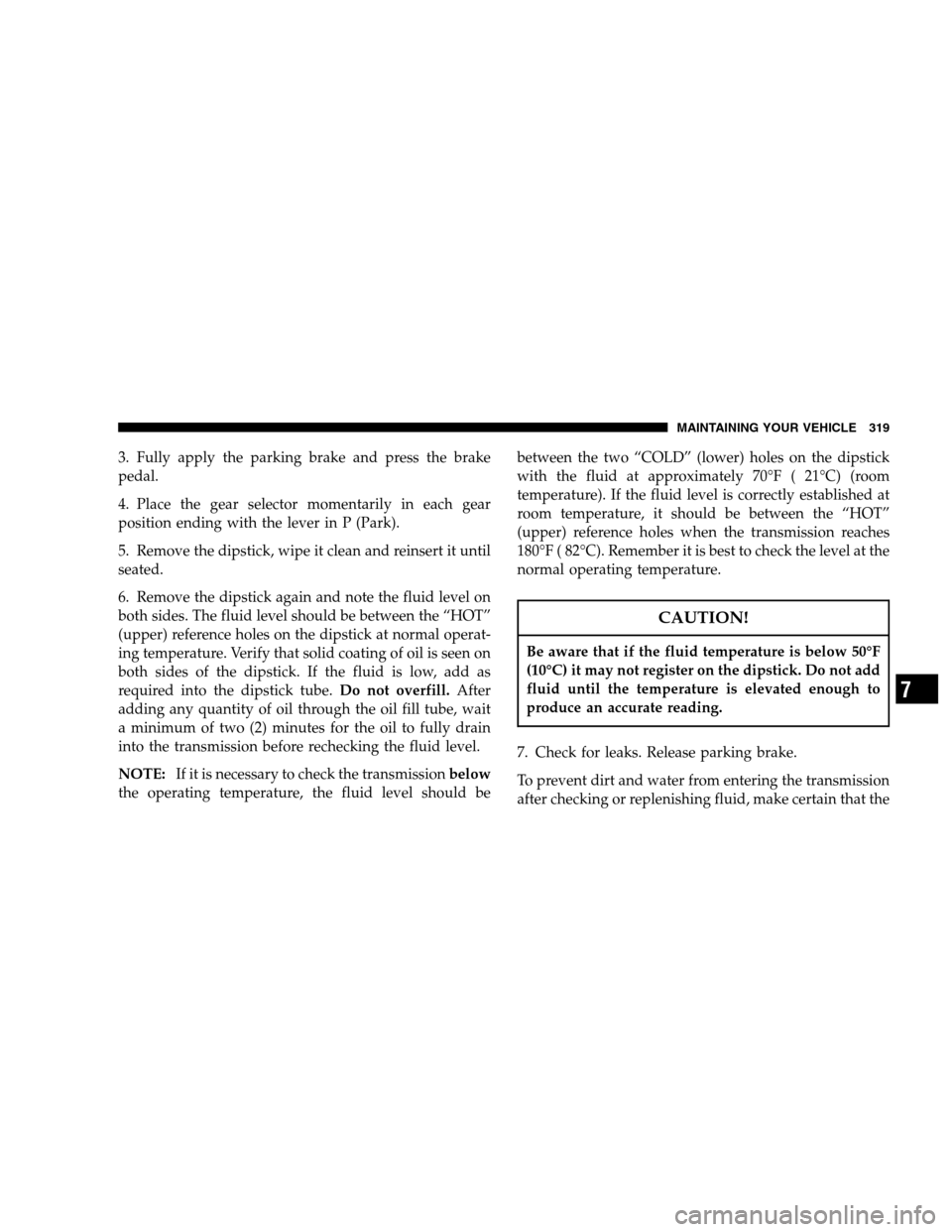
3. Fully apply the parking brake and press the brake
pedal.
4. Place the gear selector momentarily in each gear
position ending with the lever in P (Park).
5. Remove the dipstick, wipe it clean and reinsert it until
seated.
6. Remove the dipstick again and note the fluid level on
both sides. The fluid level should be between the “HOT”
(upper) reference holes on the dipstick at normal operat-
ing temperature. Verify that solid coating of oil is seen on
both sides of the dipstick. If the fluid is low, add as
required into the dipstick tube.Do not overfill.After
adding any quantity of oil through the oil fill tube, wait
a minimum of two (2) minutes for the oil to fully drain
into the transmission before rechecking the fluid level.
NOTE:If it is necessary to check the transmissionbelow
the operating temperature, the fluid level should bebetween the two “COLD” (lower) holes on the dipstick
with the fluid at approximately 70°F ( 21°C) (room
temperature). If the fluid level is correctly established at
room temperature, it should be between the “HOT”
(upper) reference holes when the transmission reaches
180°F ( 82°C). Remember it is best to check the level at the
normal operating temperature.
CAUTION!
Be aware that if the fluid temperature is below 50°F
(10°C) it may not register on the dipstick. Do not add
fluid until the temperature is elevated enough to
produce an accurate reading.
7. Check for leaks. Release parking brake.
To prevent dirt and water from entering the transmission
after checking or replenishing fluid, make certain that the
MAINTAINING YOUR VEHICLE 319
7
Page 320 of 400
dipstick cap is properly reseated. It is normal for the
dipstick cap to spring back slightly from its fully seated
position, as long as its seal remains engaged in the
dipstick tube.
Automatic Transmission Fluid And Filter Change
To obtain best performance and long life for automatic
transmissions, the manufacturer recommends that they
be given regular maintenance service by an Authorized
Dodge Dealer or Service Center. It is important that the
transmission fluid be maintained at the correct level and
that it be drained and refilled as specified.
Follow the proper Maintenance Schedule for your type of
driving.
It is important that proper lubricant is used in the
transmission. Refer to Fluids, Lubricants and Genuine
Parts for correct fluid type. It is important that the
transmission fluid be maintained at the prescribed level
using the recommended fluid.
CAUTION!
Using a transmission fluid other than the manufac-
turers recommended fluid may cause deterioration
in transmission shift quality and/or torque converter
shudder. Using a transmission fluid other than the
manufacturers recommended fluid will result in
more frequent fluid and filter changes. Refer to
Fluids, Lubricants and Genuine Parts for correct
fluid type.
Special Additives
The manufacturer strongly recommends against the ad-
dition of any additives to the transmission. Exception to
this policy is the use of special dyes to aid in detecting
fluid leaks. The use of transmission sealers should be
avoided, since they may adversely affect seals.
320 MAINTAINING YOUR VEHICLE
Page 347 of 400
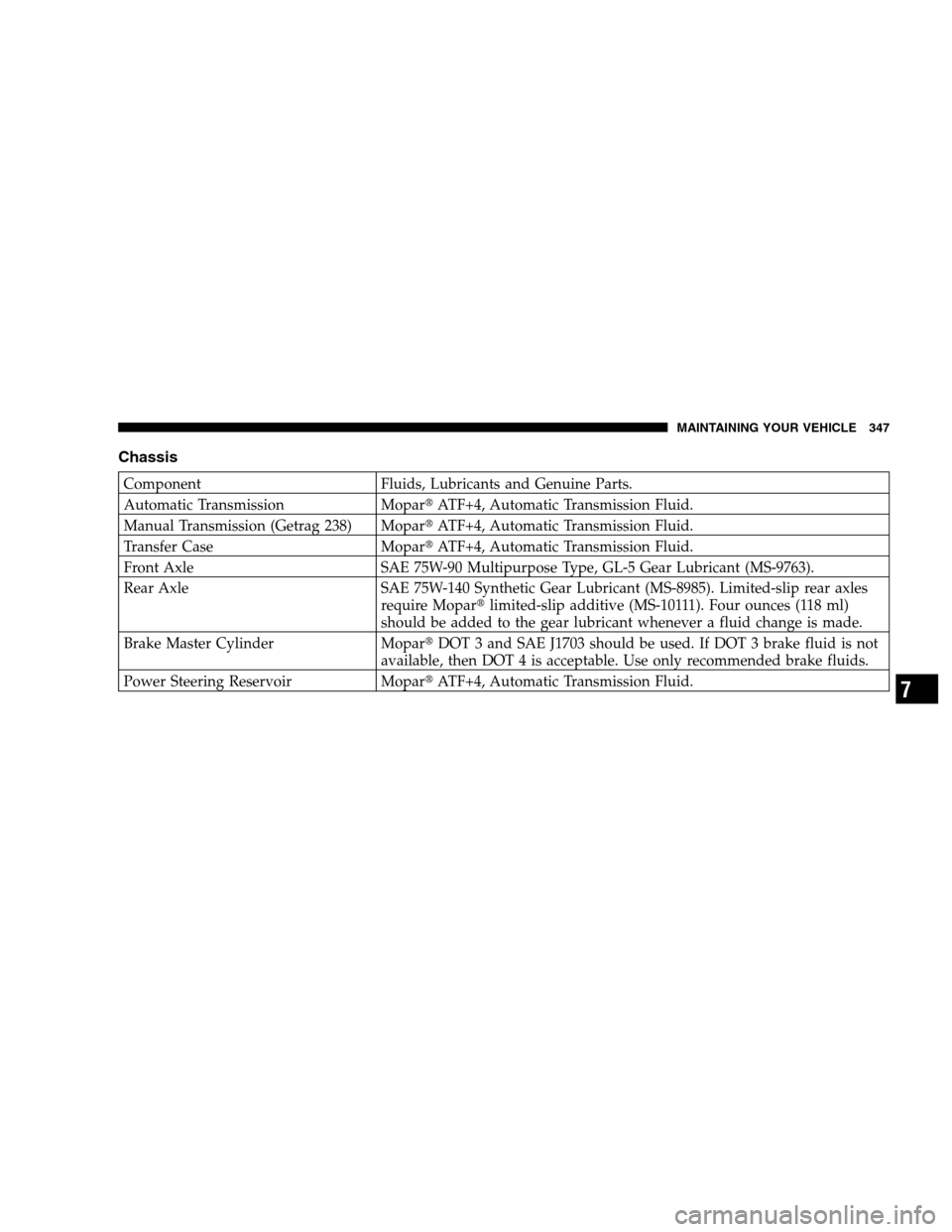
Chassis
Component Fluids, Lubricants and Genuine Parts.
Automatic Transmission Mopar�ATF+4, Automatic Transmission Fluid.
Manual Transmission (Getrag 238) Mopar�ATF+4, Automatic Transmission Fluid.
Transfer Case Mopar�ATF+4, Automatic Transmission Fluid.
Front Axle SAE 75W-90 Multipurpose Type, GL-5 Gear Lubricant (MS-9763).
Rear Axle SAE 75W-140 Synthetic Gear Lubricant (MS-8985). Limited-slip rear axles
require Mopar�limited-slip additive (MS-10111). Four ounces (118 ml)
should be added to the gear lubricant whenever a fluid change is made.
Brake Master Cylinder Mopar�DOT 3 and SAE J1703 should be used. If DOT 3 brake fluid is not
available, then DOT 4 is acceptable. Use only recommended brake fluids.
Power Steering Reservoir Mopar�ATF+4, Automatic Transmission Fluid.
MAINTAINING YOUR VEHICLE 347
7
Page 352 of 400
At Each Stop for Fuel
•Check the engine oil level about 5 minutes after a fully
warmed engine is shut off. Checking the oil level while
the vehicle is on level ground will improve the accu-
racy of the oil level reading. Add oil only when the
level is at or below the ADD or MIN mark.
•Check the windshield washer solvent and add, if
required.
Once a Month
•Check tire pressure and look for unusual wear or
damage.
•Inspect the battery and clean and tighten the terminals
as required.
•Check the fluid levels of coolant reservoir, brake
master cylinder, and transmission and add as needed.
•Check all lights and all other electrical items for correct
operation.
At Each Oil Change
•Change the engine oil filter.
•Inspect the exhaust system.
•Inspect the brake hoses.
•Inspect the CV joints (if equipped) and front suspen-
sion components.
•Check the automatic transmission fluid level (if
equipped).
•Check the manual transmission fluid level (if
equipped).
•Check the coolant level, hoses, and clamps.
352 MAINTENANCE SCHEDULES
8
M
A
I
N
T
E
N
A
N
C
E
S
C
H
E
D
U
L
E
S
Page 357 of 400
Miles 48,000 51,000 54,000 57,000 60,000
(Kilometers) (80 000) (85 000) (90 000) (95 000) (100 000)
Change engine oil and engine oil filter, or at 3
months whichever comes first.X X XXX
Rotate tires. X X X
Check spare tire for proper pressure and correct
stowage.XXX
Change rear axle fluid.X
Change front axle fluid (4X4).X
Inspect brake linings. X
Inspect engine air cleaner filter, replace if neces-
sary.X
Replace spark plugs.X
Inspect PCV valve, replace as necessary.**X
Inspect auto tension drive belt and replace, if re-
quired.X
Drain and refill automatic transmission fluid,
change filter (3.7L). *X
SCHEDULE “B” 357
8
M
A
I
N
T
E
N
A
N
C
E
S
C
H
E
D
U
L
E
S
Page 358 of 400
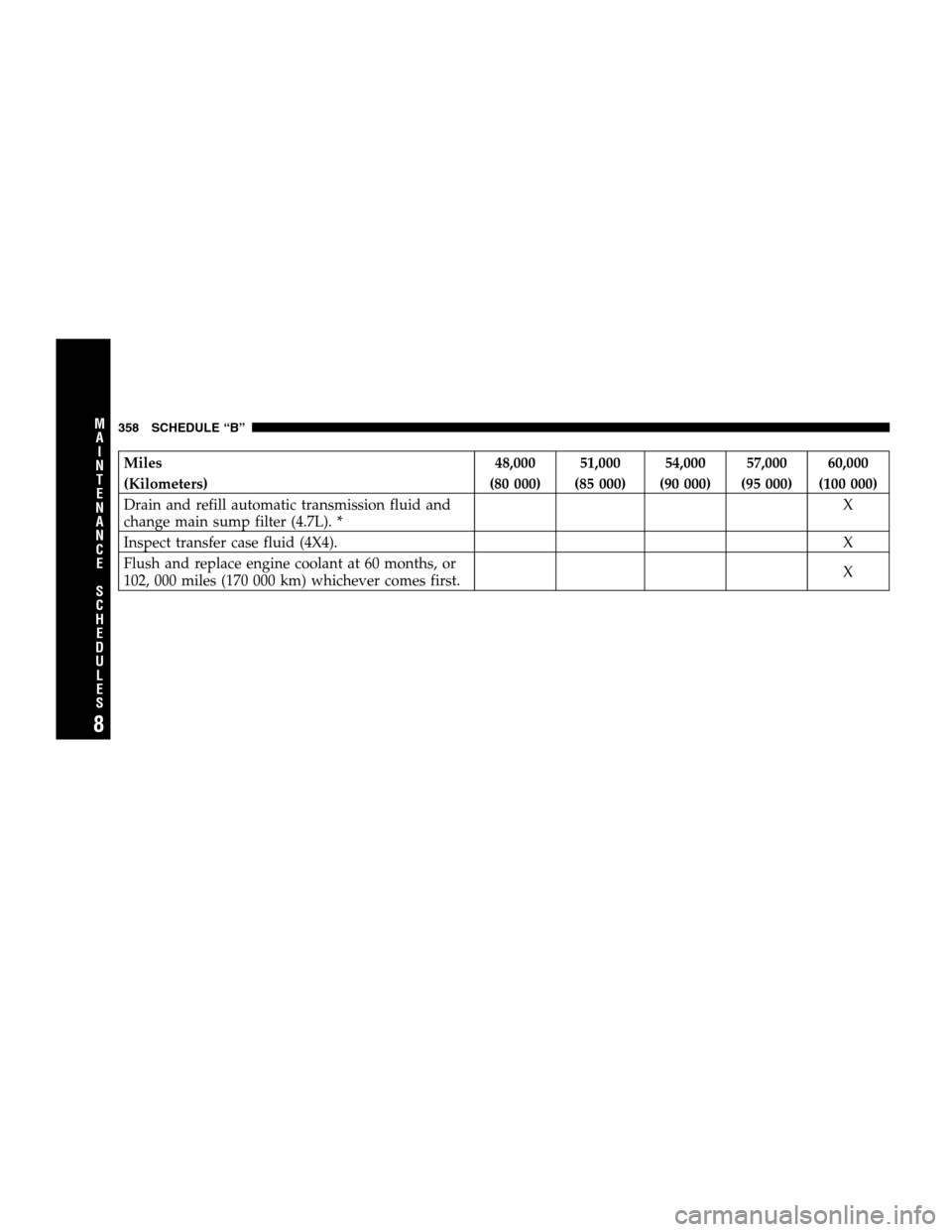
Miles 48,000 51,000 54,000 57,000 60,000
(Kilometers) (80 000) (85 000) (90 000) (95 000) (100 000)
Drain and refill automatic transmission fluid and
change main sump filter (4.7L). *X
Inspect transfer case fluid (4X4).X
Flush and replace engine coolant at 60 months, or
102, 000 miles (170 000 km) whichever comes first.X
358 SCHEDULE “B”
8
M
A
I
N
T
E
N
A
N
C
E
S
C
H
E
D
U
L
E
S
Page 363 of 400
Miles 105,000 108,000 111,000 114,000 117,000 120,000
(Kilometers) (175 000) (180 000) (185 000) (190 000) (195 000) (200 000)
Drain and refill automatic transmission fluid,
change filter (3.7L). *X
Drain and refill automatic transmission fluid
and change main sump filter and spin-on
cooler return filter if equipped. (4.7L). *X
Flush and replace engine coolant, if not re-
placed at 102,000 miles (170 000 km).X
*This applies only if your vehicle is used for police, taxi,
fleet, or frequent trailer towing.
** This maintenance is recommended by the manufac-
turer to the owner, but not required to maintain the
emissions warranty.Inspection and service should also be performed anytime
a malfunction is observed or suspected. Retain all re-
ceipts.
SCHEDULE “B” 363
8
M
A
I
N
T
E
N
A
N
C
E
S
C
H
E
D
U
L
E
S