Page 283 of 400
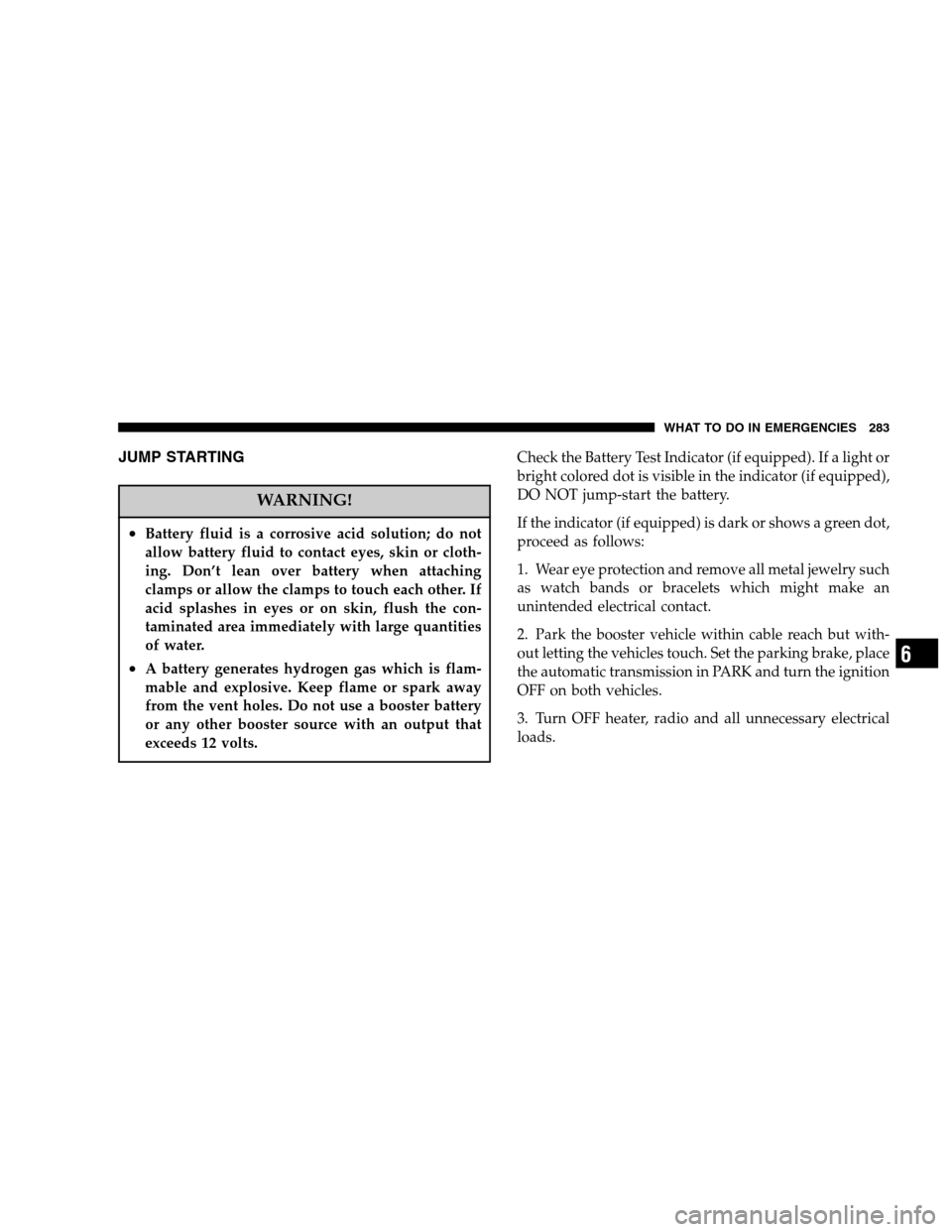
JUMP STARTING
WARNING!
•Battery fluid is a corrosive acid solution; do not
allow battery fluid to contact eyes, skin or cloth-
ing. Don’t lean over battery when attaching
clamps or allow the clamps to touch each other. If
acid splashes in eyes or on skin, flush the con-
taminated area immediately with large quantities
of water.
•A battery generates hydrogen gas which is flam-
mable and explosive. Keep flame or spark away
from the vent holes. Do not use a booster battery
or any other booster source with an output that
exceeds 12 volts.
Check the Battery Test Indicator (if equipped). If a light or
bright colored dot is visible in the indicator (if equipped),
DO NOT jump-start the battery.
If the indicator (if equipped) is dark or shows a green dot,
proceed as follows:
1. Wear eye protection and remove all metal jewelry such
as watch bands or bracelets which might make an
unintended electrical contact.
2. Park the booster vehicle within cable reach but with-
out letting the vehicles touch. Set the parking brake, place
the automatic transmission in PARK and turn the ignition
OFF on both vehicles.
3. Turn OFF heater, radio and all unnecessary electrical
loads.
WHAT TO DO IN EMERGENCIES 283
6
Page 290 of 400

▫Front Suspension Ball Joints..............306
▫Drive Shaft Constant Velocity Joints........307
▫Body Lubrication.....................307
▫Windshield Wiper Blades................307
▫Windshield Washers...................308
▫Exhaust System......................309
▫Cooling System.......................310
▫Emission Related Components............315
▫Brake System........................316
▫Clutch Hydraulic System................318
▫Manual Transmission..................318
▫Automatic Transmission................318
▫Transfer Case........................321▫Axles ..............................321
▫Selection Of Lubricating Grease...........322
▫Appearance Care And Protection
From Corrosion......................323
�Fuses (Power Distribution Center)...........327
�Vehicle Storage........................332
�Replacement Light Bulbs.................332
�Bulb Replacement......................333
▫Headlamps..........................333
▫Front Park And Turn Signal Lamp..........337
▫Rear Side Marker, Taillamps/Stoplamp, And
Turn Signal Bulbs — Replacement.........338
▫Center High-Mounted Stoplamp And
Cargo Lamp.........................341
290 MAINTAINING YOUR VEHICLE
Page 316 of 400
attempt to clean the oil PCV valve!Check ventilating
hose for indication of damage or plugging with deposits.
Replace if necessary.
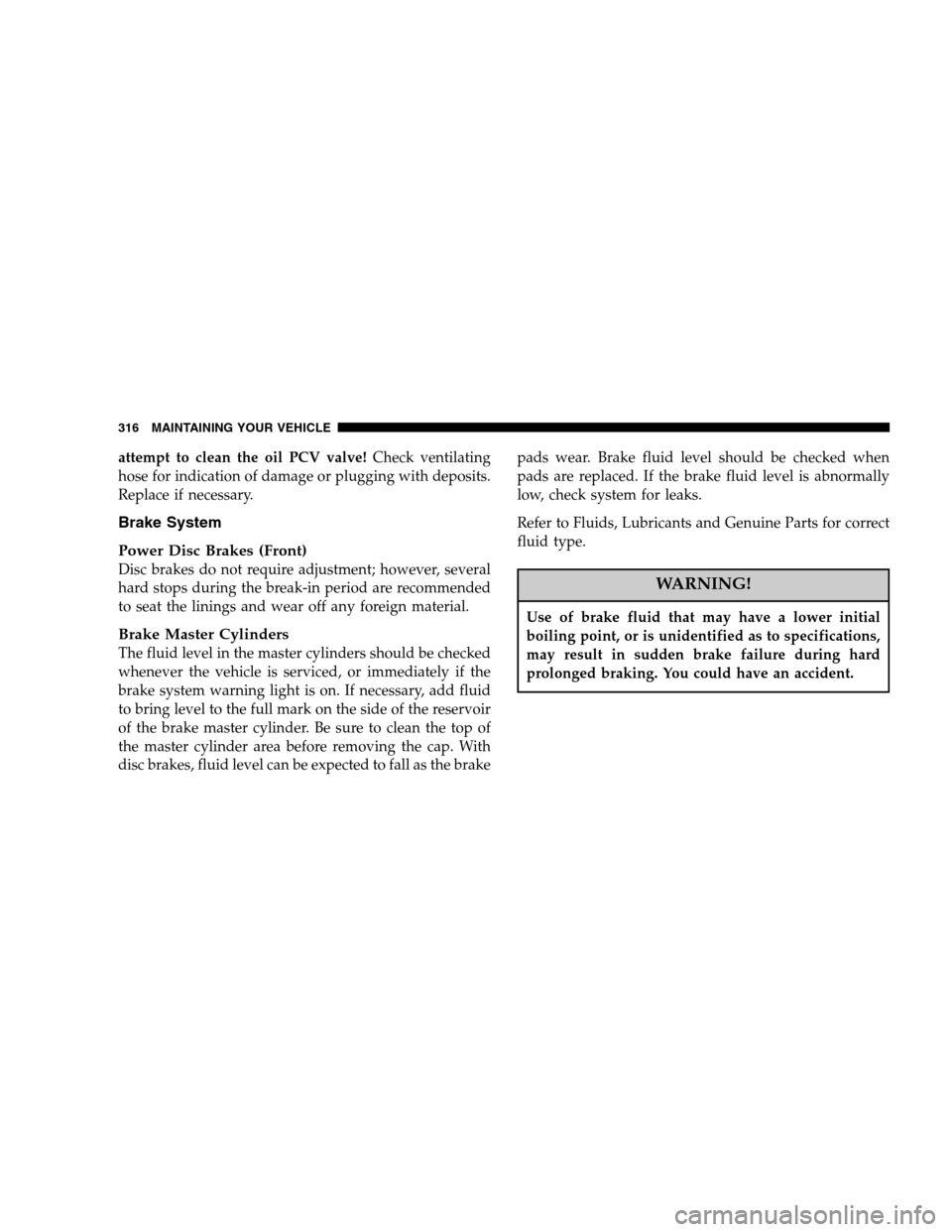
Brake System
Power Disc Brakes (Front)
Disc brakes do not require adjustment; however, several
hard stops during the break-in period are recommended
to seat the linings and wear off any foreign material.
Brake Master Cylinders
The fluid level in the master cylinders should be checked
whenever the vehicle is serviced, or immediately if the
brake system warning light is on. If necessary, add fluid
to bring level to the full mark on the side of the reservoir
of the brake master cylinder. Be sure to clean the top of
the master cylinder area before removing the cap. With
disc brakes, fluid level can be expected to fall as the brakepads wear. Brake fluid level should be checked when
pads are replaced. If the brake fluid level is abnormally
low, check system for leaks.
Refer to Fluids, Lubricants and Genuine Parts for correct
fluid type.
WARNING!
Use of brake fluid that may have a lower initial
boiling point, or is unidentified as to specifications,
may result in sudden brake failure during hard
prolonged braking. You could have an accident.
316 MAINTAINING YOUR VEHICLE
Page 317 of 400
WARNING!
Overfilling the brake fluid reservoir can result in
spilling brake fluid on hot engine parts and the
brake fluid catching fire.
Use only brake fluid that has been in a tightly closed
container to avoid contamination from foreign matter or
moisture.
CAUTION!
Do not allow a petroleum-base fluid to contaminate
the brake fluid. Seal damage may result.
Brake Linings
Your vehicle is equipped with self-adjusting brakes.
During normal driving, a few brake applications whilemoving in reverse will maintain your brakes at the
specified adjustment. Adjustment will continue until the
brake linings are worn. To avoid brake failure, brake pull
or damage to the rotors or drums, inspect the brake
linings as specified in the maintenance schedule. If
excessively worn, the brake linings must be replaced.
Brake Hoses
Inspection should be performed whenever the brake
system is serviced or at intervals specified. Inspect hy-
draulic brake hoses for surface cracking, scuffing or worn
spots. If there is any evidence of cracking, scuffing, or
worn spots, the hose should be replaced immediately!
Eventual deterioration of the hose can take place with
possible burst failure.
MAINTAINING YOUR VEHICLE 317
7
Page 318 of 400
WARNING!
Worn brake hoses can burst and cause brake failure.
You could have an accident. If you see any sign of
cracking, scuffing, or worn spots, have the brake
hoses replaced immediately.
Clutch Hydraulic System
The clutch hydraulic system is a sealed maintenance free
system. In the event of leakage or other malfunction, the
system must be replaced.
Manual Transmission
Fluid Level Check
This fluid should be checked whenever other underhood
services are performed. The fluid level is checked by
removing the fill plug. If the level of the lubricant is more
than 1/4�(6.35 mm) below the bottom of the filler hole
while the vehicle is level, enough lubricant should beadded to bring the level to the bottom of the filler hole.
This fluid does not require periodic changing. However,
if it becomes necessary to add or replace the fluid in these
transmissions, refer to Fluids, Lubricants and Genuine
Parts for correct fluid type.
Automatic Transmission
Fluid Level Check
Check the fluid level while the transmission is at normal
operating temperature 180°F (82°C). This occurs after at
least 15 miles (24 km) of driving. At normal operating
temperature the fluid cannot be held comfortably be-
tween the fingertips.
To check the automatic transmission fluid level properly,
the following procedure must be used:
1. Operate the engine at idle speed and normal operating
temperature.
2. The vehicle must be on level ground.
318 MAINTAINING YOUR VEHICLE
Page 319 of 400

3. Fully apply the parking brake and press the brake
pedal.
4. Place the gear selector momentarily in each gear
position ending with the lever in P (Park).
5. Remove the dipstick, wipe it clean and reinsert it until
seated.
6. Remove the dipstick again and note the fluid level on
both sides. The fluid level should be between the “HOT”
(upper) reference holes on the dipstick at normal operat-
ing temperature. Verify that solid coating of oil is seen on
both sides of the dipstick. If the fluid is low, add as
required into the dipstick tube.Do not overfill.After
adding any quantity of oil through the oil fill tube, wait
a minimum of two (2) minutes for the oil to fully drain
into the transmission before rechecking the fluid level.
NOTE:If it is necessary to check the transmissionbelow
the operating temperature, the fluid level should bebetween the two “COLD” (lower) holes on the dipstick
with the fluid at approximately 70°F ( 21°C) (room
temperature). If the fluid level is correctly established at
room temperature, it should be between the “HOT”
(upper) reference holes when the transmission reaches
180°F ( 82°C). Remember it is best to check the level at the
normal operating temperature.
CAUTION!
Be aware that if the fluid temperature is below 50°F
(10°C) it may not register on the dipstick. Do not add
fluid until the temperature is elevated enough to
produce an accurate reading.
7. Check for leaks. Release parking brake.
To prevent dirt and water from entering the transmission
after checking or replenishing fluid, make certain that the
MAINTAINING YOUR VEHICLE 319
7
Page 328 of 400
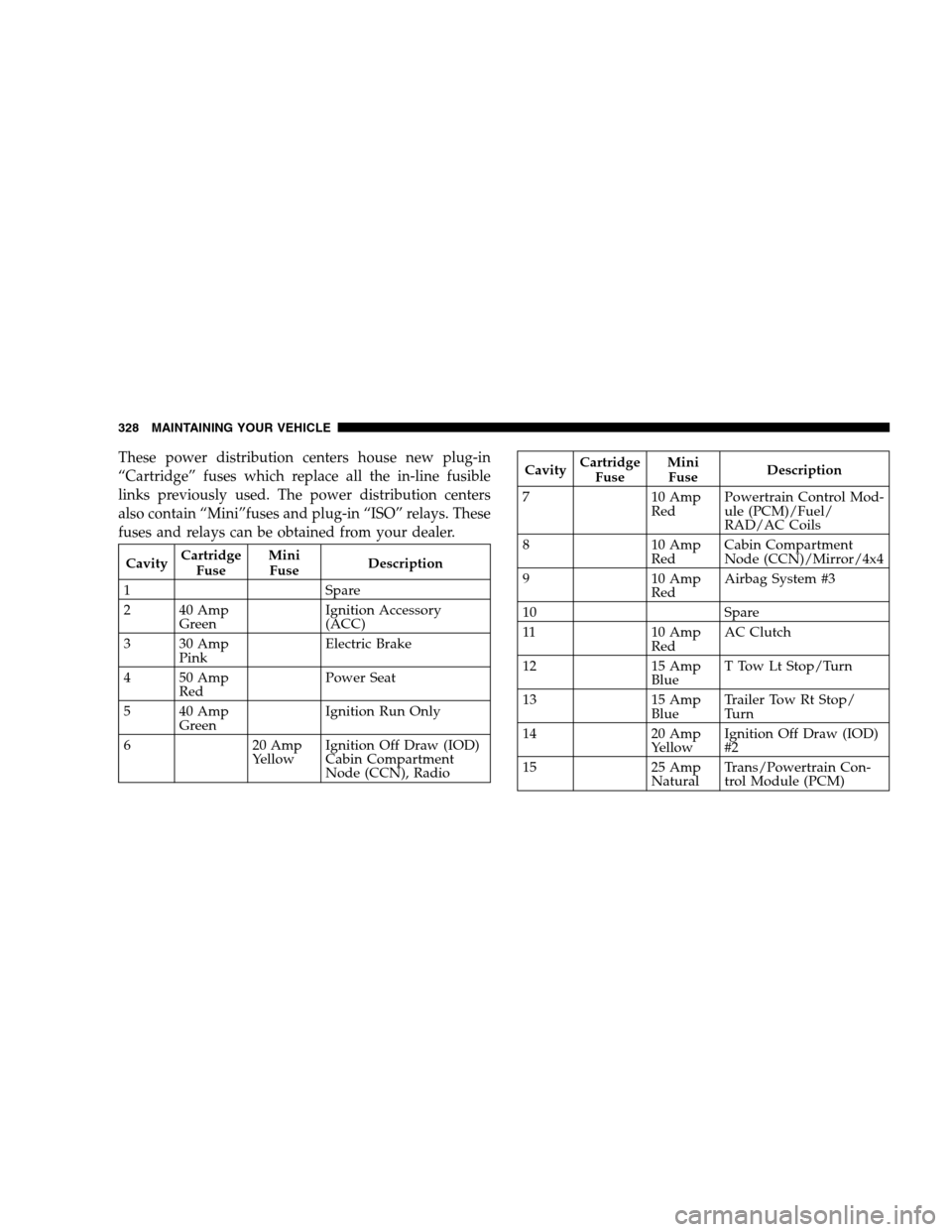
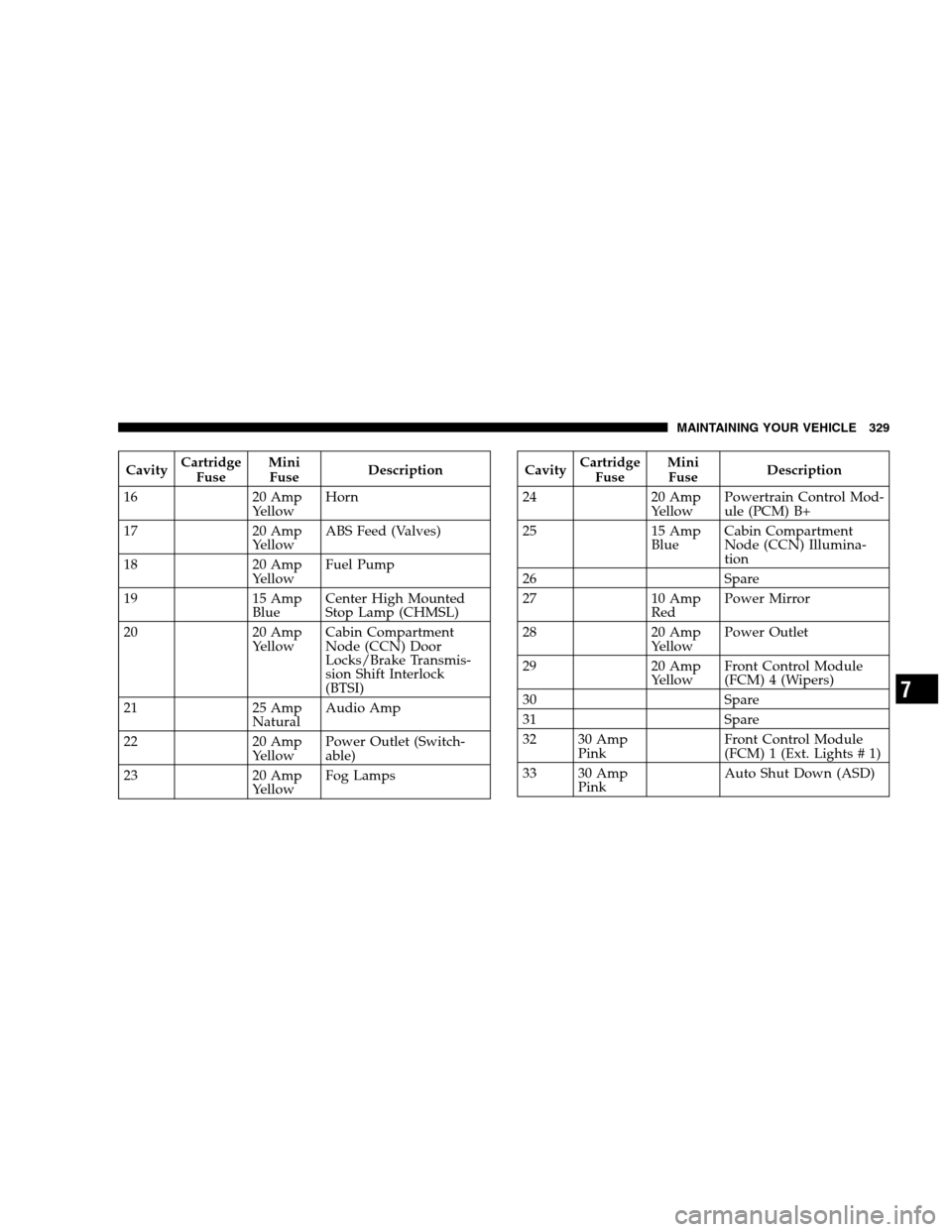
These power distribution centers house new plug-in
“Cartridge” fuses which replace all the in-line fusible
links previously used. The power distribution centers
also contain “Mini”fuses and plug-in “ISO” relays. These
fuses and relays can be obtained from your dealer.
CavityCartridge
FuseMini
FuseDescription
1 Spare
2 40 Amp
GreenIgnition Accessory
(ACC)
3 30 Amp
PinkElectric Brake
4 50 Amp
RedPower Seat
5 40 Amp
GreenIgnition Run Only
6 20 Amp
YellowIgnition Off Draw (IOD)
Cabin Compartment
Node (CCN), Radio
CavityCartridge
FuseMini
FuseDescription
7 10 Amp
RedPowertrain Control Mod-
ule (PCM)/Fuel/
RAD/AC Coils
8 10 Amp
RedCabin Compartment
Node (CCN)/Mirror/4x4
9 10 Amp
RedAirbag System #3
10 Spare
11 10 Amp
RedAC Clutch
12 15 Amp
BlueT Tow Lt Stop/Turn
13 15 Amp
BlueTrailer Tow Rt Stop/
Turn
14 20 Amp
YellowIgnition Off Draw (IOD)
#2
15 25 Amp
NaturalTrans/Powertrain Con-
trol Module (PCM)
328 MAINTAINING YOUR VEHICLE
Page 329 of 400
CavityCartridge
FuseMini
FuseDescription
16 20 Amp
YellowHorn
17 20 Amp
YellowABS Feed (Valves)
18 20 Amp
YellowFuel Pump
19 15 Amp
BlueCenter High Mounted
Stop Lamp (CHMSL)
20 20 Amp
YellowCabin Compartment
Node (CCN) Door
Locks/Brake Transmis-
sion Shift Interlock
(BTSI)
21 25 Amp
NaturalAudio Amp
22 20 Amp
YellowPower Outlet (Switch-
able)
23 20 Amp
YellowFog LampsCavityCartridge
FuseMini
FuseDescription
24 20 Amp
YellowPowertrain Control Mod-
ule (PCM) B+
25 15 Amp
BlueCabin Compartment
Node (CCN) Illumina-
tion
26 Spare
27 10 Amp
RedPower Mirror
28 20 Amp
YellowPower Outlet
29 20 Amp
YellowFront Control Module
(FCM) 4 (Wipers)
30 Spare
31 Spare
32 30 Amp
PinkFront Control Module
(FCM) 1 (Ext. Lights # 1)
33 30 Amp
PinkAuto Shut Down (ASD)
MAINTAINING YOUR VEHICLE 329
7