Page 285 of 400
WARNING!
Any procedure other than above could result in:
1. Personal injury caused by electrolyte squirting
out the battery vent;
2. Personal injury or property damage due to battery
explosion;
3. Damage to charging system of booster vehicle or
of immobilized vehicle.
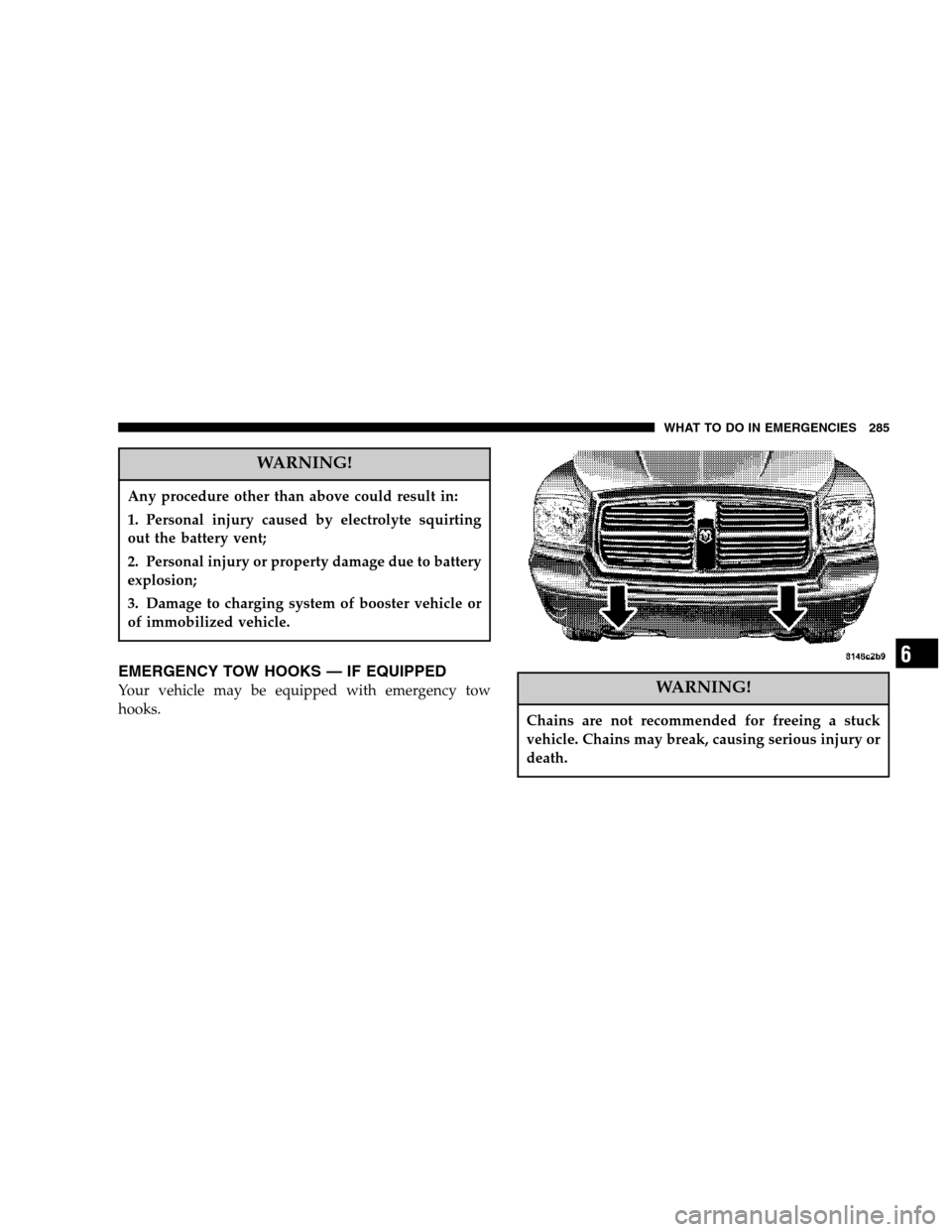
EMERGENCY TOW HOOKS — IF EQUIPPED
Your vehicle may be equipped with emergency tow
hooks.WARNING!
Chains are not recommended for freeing a stuck
vehicle. Chains may break, causing serious injury or
death.
WHAT TO DO IN EMERGENCIES 285
6
Page 289 of 400
MAINTAINING YOUR VEHICLE
CONTENTS
�3.7L/4.7L Engine Compartment.............292
�Onboard Diagnostic System — OBD II........293
▫Loose Fuel Filler Cap Message............293
�Emissions Inspection And Maintenance
Programs............................294
�Replacement Parts......................295
�Dealer Service.........................296
�Maintenance Procedures..................296
▫Engine Oil..........................297▫Engine Oil Filter......................300
▫Drive Belts — Check Condition And Tension . . 301
▫Spark Plugs.........................301
▫Engine Air Cleaner Filter................302
▫Engine Fuel Filter.....................302
▫Catalytic Converter....................302
▫Maintenance Free Battery................304
▫Air Conditioner Maintenance.............305
▫Power Steering — Fluid Check............306
7
Page 294 of 400

cap until a�clicking�sound is heard. This is an indication
that the gas cap is properly tightened. Press the odometer
reset button to turn the message off. If the problem
persists, the message will appear the next time the
vehicle is started. This might indicate a damaged cap. If
the problem is detected twice in a row, the system will
turn on the Malfunction Indicator Light (MIL). Resolving
the problem will turn the MIL light off.
EMISSIONS INSPECTION AND MAINTENANCE
PROGRAMS
In some localities, it may be a legal requirement to pass
an inspection of your vehicle’s emissions control system.
Failure to pass could prevent vehicle registration.
For states which have an I/M (Inspection and
Maintenance) requirement, this check verifies the
following: the MIL (Malfunction Indicator Lamp)is functioning and is not on when the engine is running,
and that the OBD (On Board Diagnostic) system is ready
for testing.
Normally, the OBD system will be ready. The OBD
system maynotbe ready if your vehicle was recently
serviced, if you recently had a dead battery, or a battery
replacement. If the OBD system is determined not ready
for the I/M test, your vehicle may fail the test.
Your vehicle has a simple ignition key actuated test
which you can use prior to going to the test station. To
check if your vehicle’s OBD system is ready, you must do
the following:
1. Insert your ignition key into the ignition switch.
2. Turn the ignition to the ON position, but do not crank
or start the engine. If you crank or start the engine, you
will have to start this test over.
294 MAINTAINING YOUR VEHICLE
Page 295 of 400

3. As soon as you turn your key to the ON position, you
will see your MIL symbol come on as part of a normal
bulb check.
4. Approximately 15 seconds later, one of two things will
happen:
a. The MIL light will blink for approximately 5 sec-
onds and then remain on until the first engine crank or
the key is turned off. This means that your vehicle’s
OBD system isnot readyand you shouldnotproceed
to the I/M station.
b. The MIL light will remain fully illuminated until the
first engine crank or the key is turned off. This means
that your vehicle’s OBD system isreadyand you can
proceed to the I/M station.
If your OBD system isnot readyyou should see your
dealer or repair facility. If your vehicle was recently
serviced or had a battery failure or replacement, you mayneed to do nothing more than drive your vehicle as you
normally would in order for your OBD system to update.
A recheck with the above test routine may then indicate
that the system is now ready.
Regardless of whether your vehicle’s OBD system is
ready or not ready, if the MIL symbol is illuminated
during normal vehicle operation, you should have your
vehicle serviced before going to the I/M station. The I/M
station can fail your vehicle because the MIL symbol is on
with the engine running.
REPLACEMENT PARTS
Use of genuine Mopar�parts for normal/scheduled
maintenance and repairs is highly recommended to in-
sure the designed performance. Damage or failures
caused by the use of non-Mopar�parts for maintenance
and repairs will not be covered by the manufacturer’s
warranty.
MAINTAINING YOUR VEHICLE 295
7
Page 301 of 400

Drive Belts — Check Condition and Tension
Belt tension is controlled by means of an automatic
tensioner. No belt tension adjustments are required.
However, belt and belt tensioner condition should be
inspected at the specified intervals, and replaced if re-
quired. See your authorized dealer for service
At the mileage indicated in the maintenance schedule, all
belts and tensioner should be checked for condition.
Improper belt tension can cause belt slippage and failure.
Belts should be inspected for evidence of cuts, cracks,
glazing, or frayed cords and replaced if there is indication
of damage which could result in belt failure. Low gen-
erator belt tension can cause battery failure.
Also check belt routing to make sure there is no interfer-
ence between the belts and other engine components.
Spark Plugs
Spark plugs must fire properly to assure proper engine
performance and emission control. The plugs installed in
your vehicle should operate satisfactorily in normal
service for the mileage indicated in the Maintenance
Chart. New plugs should be installed at this mileage. The
entire set should be replaced if there is any malfunction
due to a faulty spark plug. Check the Vehicle Emissions
Control Information label for the proper type of spark
plug for your vehicle.
CAUTION!
When replacing plugs, do not overtighten. You could
damage them and cause them to leak.
MAINTAINING YOUR VEHICLE 301
7
Page 304 of 400

To minimize the possibility of catalyst damage:
•Do not shut off the engine or interrupt the ignition
when the transmission is in gear and the vehicle is in
motion.
•Do not try to start engine by pushing or towing the
vehicle.
•Do not idle the engine with any spark plug wires
disconnected or removed, such as when diagnostic
testing, or for prolonged periods during very rough
idling or malfunctioning operating conditions.
Maintenance Free Battery
The top of the maintenance free battery is permanently
sealed. You will never have to add water, nor is periodic
maintenance required.
WARNING!
•Battery fluid is a corrosive acid solution and can
burn or even blind you. Don’t allow battery fluid
to contact your eyes, skin or clothing. Don’t lean
over a battery when attaching clamps. If acid
splashes in eyes or on skin, flush the area imme-
diately with large amounts of water.
•Battery gas is flammable and explosive. Keep
flame or sparks away from the battery. Don’t use
a booster battery or any other booster source with
an output greater than 12 volts. Don’t allow cable
clamps to touch each other.
•Battery posts, terminals and related accessories
contain lead and lead compounds. Wash hands
after handling.
304 MAINTAINING YOUR VEHICLE
Page 305 of 400

CAUTION!
•It is essential when replacing the cables on the
battery that the positive cable is attached to the
positive post and the negative cable is attached to the
negative post. Battery posts are marked (+) positive
and negative (-) and identified on the battery case.
•If a “fast charger” is used while battery is in vehicle,
disconnect both vehicle battery cables before con-
necting the charger to battery. Do not use a “fast
charger” to provide starting voltage.
Air Conditioner Maintenance
For best possible performance, your air conditioner
should be checked and serviced by an Authorized Dealer
at the start of each warm season. This service should
include cleaning of the condenser fins and a performance
test. Drive belt tension should also be checked at this
time.
WARNING!
•Use only refrigerants and compressor lubricants
approved by the manufacturer for your air condi-
tioning system. Some unapproved refrigerants are
flammable and can explode, injuring you. Other
unapproved refrigerants or lubricants can cause
the system to fail, requiring costly repairs. Refer
to Section 3 of the Warranty Information book for
further warranty information.
•The air conditioning system contains refrigerant
under high pressure. To avoid risk of personal
injury or damage to the system, adding refrigerant
or any repair requiring lines to be disconnected
should be done by an experienced repairman.
MAINTAINING YOUR VEHICLE 305
7
Page 331 of 400
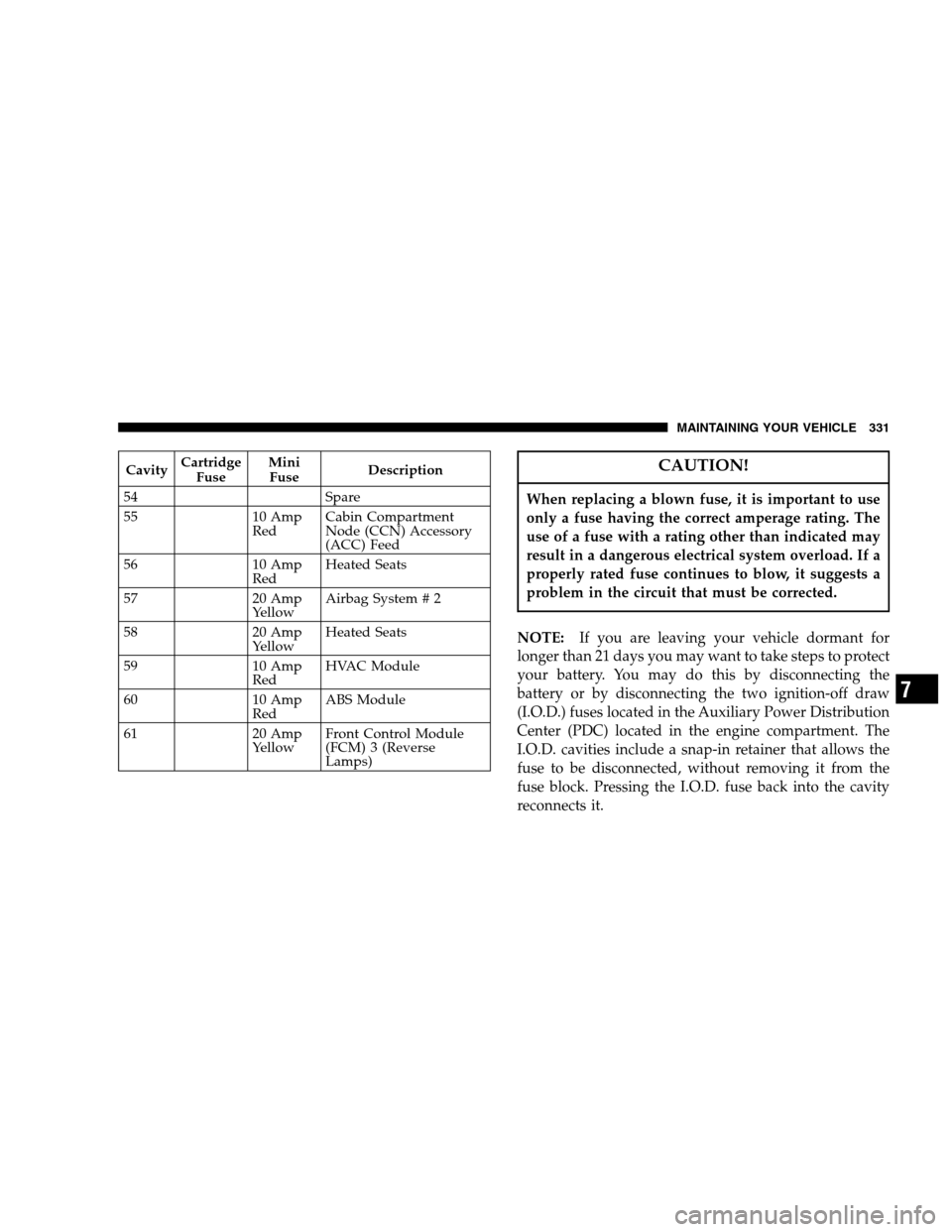
CavityCartridge
FuseMini
FuseDescription
54 Spare
55 10 Amp
RedCabin Compartment
Node (CCN) Accessory
(ACC) Feed
56 10 Amp
RedHeated Seats
57 20 Amp
YellowAirbag System # 2
58 20 Amp
YellowHeated Seats
59 10 Amp
RedHVAC Module
60 10 Amp
RedABS Module
61 20 Amp
YellowFront Control Module
(FCM) 3 (Reverse
Lamps)CAUTION!
When replacing a blown fuse, it is important to use
only a fuse having the correct amperage rating. The
use of a fuse with a rating other than indicated may
result in a dangerous electrical system overload. If a
properly rated fuse continues to blow, it suggests a
problem in the circuit that must be corrected.
NOTE:If you are leaving your vehicle dormant for
longer than 21 days you may want to take steps to protect
your battery. You may do this by disconnecting the
battery or by disconnecting the two ignition-off draw
(I.O.D.) fuses located in the Auxiliary Power Distribution
Center (PDC) located in the engine compartment. The
I.O.D. cavities include a snap-in retainer that allows the
fuse to be disconnected, without removing it from the
fuse block. Pressing the I.O.D. fuse back into the cavity
reconnects it.
MAINTAINING YOUR VEHICLE 331
7