Page 266 of 400

CAUTION!
The transfer case must be shifted into Neutral (N) for
recreational towing. The Neutral (N) selection but-
ton is located on the lower left hand corner of the
4WD Control Switch. Shifts into and out of transfer
case Neutral (N) can take place with the selector
switch in any mode position.
Automatic Transmissions must be placed in P (Park)
position for recreational towing.
Manual Transmissions must be placed in gear (for
example, 4th gear) for recreational towing. Failure to
follow these procedures can cause severe transmis-
sion and/or transfer case damage.
Recreational Towing Procedure
Use the following procedure to prepare your vehicle for
recreational towing.
CAUTION!
It is necessary to follow these steps to be certain that
the transfer case is fully in Neutral (N) before
recreational towing to prevent damage to internal
parts.
1. Bring vehicle to a complete stop.
2. Shut engine OFF.
3. Place ignition key in the ON position.
4. Depress brake pedal.
5. Shift automatic transmission to Neutral (N) or depress
clutch on manual transmission.
266 STARTING AND OPERATING
Page 268 of 400

during the 4 second timer, then the Neutral (N) indicator
light will flash continuously until all requirements are met
or until the Neutral (N) button is released.
NOTE:The ignition key must be ON for a shift to take
place and for the position indicator lights to be operable.
If the key in not ON, the shift will not take place and no
position indicator lights will be on or flashing.
NOTE:Flashing neutral (N) position indicator light
indicates that shift requirements have not been met.
CAUTION!
Damage to the transmission may occur if the trans-
mission is shifted into Park (P) with the transfer case
in Neutral (N) and the engine RUNNING. With the
transfer case in Neutral (N), ensure that the engine is
OFF prior to shifting the transmission into Park (P).
Returning to Normal Operation
Use the following procedure to prepare your vehicle for
normal usage.
1. Reconnect the negative battery cable.
2. The vehicle must be at a complete stop.
3. Place the ignition if the Off position (if it has been
moved or the engine has been started).
4. Place ignition key in the ON position (engine Off).
5. Depress brake pedal.
6. Shift automatic transmission to Neutral (N) or depress
clutch on manual transmission.
7. Using the point of a ballpoint pen or similar object,
depress the recessed transfer case Neutral (N) button for
1 second.
268 STARTING AND OPERATING
Page 269 of 400

8. After the Neutral (N) indicator light turns off release
the Neutral (N) button.
9. After the Neutral (N) button has been released the
transfer case will shift to the position identified by the
selector switch.
10. Start the engine. Shift the automatic transmission into
Drive (D), or place the manual transmission in 1st gear
and momentarily release the clutch, to verify that the
transfer case has engaged.
11. Set parking brake. Shift automatic transmission to
Park (P) or shift manual transmission to Neutral.
NOTE:Items 1 through 5 are requirements that must be
met prior to depressing the Neutral (N) selection button,and must continue to be met until 1 second elapses and
the shift has been completed. If any of these requirements
(with the exception of 3 - key ON) are not met prior to
depressing the Neutral (N) button or are no longer met
during the 1 second time, then all of the mode position
indicator lights will flash continuously until all require-
ments are met or until the Neutral (N) button is released.
NOTE:The ignition key must be ON for a shift to take
place and for the position indicator lights to be operable.
If the key is not ON, the shift will not take place and no
position indicator lights will be on or flashing.
NOTE:Flashing neutral (N) position indicator light
indicates that shift requirements have not been met.
STARTING AND OPERATING 269
5
Page 290 of 400

▫Front Suspension Ball Joints..............306
▫Drive Shaft Constant Velocity Joints........307
▫Body Lubrication.....................307
▫Windshield Wiper Blades................307
▫Windshield Washers...................308
▫Exhaust System......................309
▫Cooling System.......................310
▫Emission Related Components............315
▫Brake System........................316
▫Clutch Hydraulic System................318
▫Manual Transmission..................318
▫Automatic Transmission................318
▫Transfer Case........................321▫Axles ..............................321
▫Selection Of Lubricating Grease...........322
▫Appearance Care And Protection
From Corrosion......................323
�Fuses (Power Distribution Center)...........327
�Vehicle Storage........................332
�Replacement Light Bulbs.................332
�Bulb Replacement......................333
▫Headlamps..........................333
▫Front Park And Turn Signal Lamp..........337
▫Rear Side Marker, Taillamps/Stoplamp, And
Turn Signal Bulbs — Replacement.........338
▫Center High-Mounted Stoplamp And
Cargo Lamp.........................341
290 MAINTAINING YOUR VEHICLE
Page 318 of 400

WARNING!
Worn brake hoses can burst and cause brake failure.
You could have an accident. If you see any sign of
cracking, scuffing, or worn spots, have the brake
hoses replaced immediately.
Clutch Hydraulic System
The clutch hydraulic system is a sealed maintenance free
system. In the event of leakage or other malfunction, the
system must be replaced.
Manual Transmission
Fluid Level Check
This fluid should be checked whenever other underhood
services are performed. The fluid level is checked by
removing the fill plug. If the level of the lubricant is more
than 1/4�(6.35 mm) below the bottom of the filler hole
while the vehicle is level, enough lubricant should beadded to bring the level to the bottom of the filler hole.
This fluid does not require periodic changing. However,
if it becomes necessary to add or replace the fluid in these
transmissions, refer to Fluids, Lubricants and Genuine
Parts for correct fluid type.
Automatic Transmission
Fluid Level Check
Check the fluid level while the transmission is at normal
operating temperature 180°F (82°C). This occurs after at
least 15 miles (24 km) of driving. At normal operating
temperature the fluid cannot be held comfortably be-
tween the fingertips.
To check the automatic transmission fluid level properly,
the following procedure must be used:
1. Operate the engine at idle speed and normal operating
temperature.
2. The vehicle must be on level ground.
318 MAINTAINING YOUR VEHICLE
Page 328 of 400
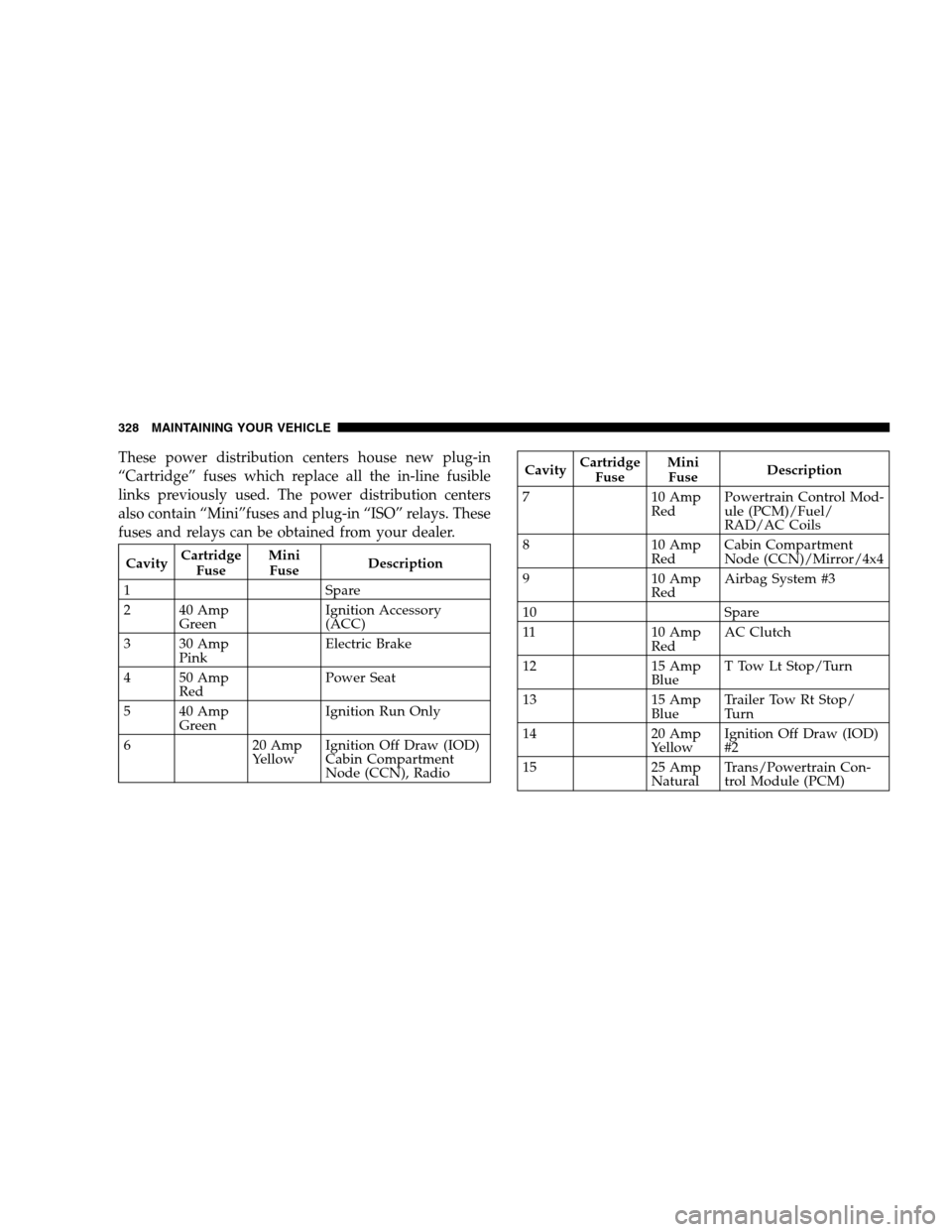
These power distribution centers house new plug-in
“Cartridge” fuses which replace all the in-line fusible
links previously used. The power distribution centers
also contain “Mini”fuses and plug-in “ISO” relays. These
fuses and relays can be obtained from your dealer.
CavityCartridge
FuseMini
FuseDescription
1 Spare
2 40 Amp
GreenIgnition Accessory
(ACC)
3 30 Amp
PinkElectric Brake
4 50 Amp
RedPower Seat
5 40 Amp
GreenIgnition Run Only
6 20 Amp
YellowIgnition Off Draw (IOD)
Cabin Compartment
Node (CCN), Radio
CavityCartridge
FuseMini
FuseDescription
7 10 Amp
RedPowertrain Control Mod-
ule (PCM)/Fuel/
RAD/AC Coils
8 10 Amp
RedCabin Compartment
Node (CCN)/Mirror/4x4
9 10 Amp
RedAirbag System #3
10 Spare
11 10 Amp
RedAC Clutch
12 15 Amp
BlueT Tow Lt Stop/Turn
13 15 Amp
BlueTrailer Tow Rt Stop/
Turn
14 20 Amp
YellowIgnition Off Draw (IOD)
#2
15 25 Amp
NaturalTrans/Powertrain Con-
trol Module (PCM)
328 MAINTAINING YOUR VEHICLE
Page 392 of 400

Chains.............................. 235
Changing............................ 273
Compact Spare........................ 230
General Information.................... 226
High Speed.......................... 229
Inflation Pressures..................... 227
Jacking............................. 278
LifeofTires .......................... 233
Load Capacity.....................222,223
Quality Grading....................... 375
Radial.............................. 229
Replacement......................... 233
Rotation............................. 237
Safety...........................218,226
Sizes ............................... 219
Snow Tires........................... 237
Spare Tire........................... 275
Spinning ............................ 231
Tread Wear Indicators................... 232Wheel Mounting....................... 278
Wheel Nut Torque..................... 281
Tongue Weight/Trailer Weight.............. 257
Torque Converter Clutch.................. 195
Tow Hooks, Emergency................... 285
Towing ............................... 251
Disabled Vehicle....................... 286
Guide .............................. 257
Recreational.......................... 265
Weight .............................. 257
Traction ............................... 211
TrailerTowing .......................... 251
Cooling System Tips.................... 264
Hitches............................. 256
Minimum Requirements................. 258
Trailer and Tongue Weight................ 257
Wiring .............................. 261
TrailerTowingGuide ..................... 257
TrailerWeight .......................... 257
392 INDEX