Page 194 of 384
STARTING PROCEDURES
Before starting your vehicle, adjust your seat, adjust the
inside and outside mirrors, fasten your seat belt, and if
present, instruct all other occupants to buckle their seat
belts.WARNING!
•Never leave children alone in a vehicle. Leaving
children in a vehicle unattended is dangerous for
a number of reasons. A child or others could be
seriously or fatally injured. Don’t leave the keys
in the ignition. A child could operate power
windows, other controls, or move the vehicle.
•Do not leave animals or children inside parked
vehicles in hot weather; interior heat build up
may cause serious injury or death.
•Be sure to turn off the engine if you want to rest or
sleep in your car. Accidents can be caused by
inadvertently moving the gear selection lever or
by pressing the accelerator pedal. This may cause
excessive heat in the exhaust system, resulting in
overheating and vehicle fire, which may cause
serious or fatal injuries.
194 STARTING AND OPERATING
Page 199 of 384

The selector lever is automatically locked while in the P
(Park) position. To move the selector lever out of the P
(Park) position, the brake pedal must be firmly depressed
before the shift lock will release.
Shift the selector lever to the desired position only when
the engine is idling normally and the brake pedal is
applied. Do not release the brake until ready to drive. The
vehicle may otherwise accelerate quickly when the selec-
tor lever is in D (Drive) or R (Reverse) position.WARNING!
Unintended movement of a vehicle could injure
those in and near the vehicle. As with all vehicles,
you should never exit a vehicle while the engine is
running. Before exiting a vehicle, you should always
shift the vehicle into P (Park), remove the key from
the ignition, and apply the parking brake. Once the
key is removed from the ignition, the transmission
selector lever is locked in the P (Park) position,
securing the vehicle against unwanted movement.
Furthermore, you should never leave children unat-
tended inside a vehicle.
Over Temperature Mode
The transmission electronics constantly monitor the
transmission oil temperature. If the transmission exceeds
normal operating temperature, the transmission will
change the way it shifts to help control the condition.
This may result in a slightly different feeling or response
during normal operation in D (Drive) position. After the
transmission cools down, it will return to normal opera-
tion.
STARTING AND OPERATING 199
5
Page 200 of 384

Brake/Transmission Shift Interlock System
This vehicle is equipped with a brake transmission shift
interlock system (BTSI) that holds the selector lever in the
P (Park) position when the ignition switch is in the LOCK
position. To move the selector lever out of the P (Park)
position, the ignition switch must be turned to the ON
position, and the brake pedal must be depressed.For electrical system malfunctions, there is an override
for the interlock system. In order to override this system
the key must be in the ignition with the switch in the
ACC or ON positions. Remove the rubber storage tray
from the bin located to the right of the selector lever. The
override can be activated by pressing the pink-colored
tab, which can be accessed through a hole inside the bin.
While the override is pressed, the shifter can be moved
out of the park position without pressing the brake. After
operation, return the rubber storage tray to its original
position.
4 Speed Automatic Transmission
Shifting from D (Drive) to P (Park) or R (Reverse) (or
from P or R to D) should be done only after the
accelerator pedal is released and the vehicle is stopped.
Be sure to keep your foot on the brake when moving the
selector lever between these gears.
Brake Interlock Override
200 STARTING AND OPERATING
Page 202 of 384
The following indicators should be used to ensure that
you have engaged the selector lever into the P (Park)
position:
•When shifting into P (Park) move the lever all the way
forward until it stops, and is fully seated.
•Look at the shift indicator display on the instrument
panel to ensure it is in the P (Park) position.
CAUTION!
Damage to the shifter could result if the selector
lever is moved out of P (Park) before the ignition is
turned from the LOCK to ON position.
R (Reverse)
For moving the vehicle rearward. Always stop before
moving the lever to R (Reverse), except when rocking
the vehicle.
N (Neutral)
Engine may be started in this range.
CAUTION!
Coasting the vehicle, or driving for any other reason
with selector lever in NEUTRAL can result in trans-
mission damage.
WARNING!
Do not coast in N (Neutral) and never turn off the
ignition to coast down a hill. These are unsafe
practices that limit your response to changing traffic
or road conditions. You might lose control of the
vehicle and have an accident.
D (Overdrive)
This range should be used for most city and highway
driving. It provides the smoothest up shifts and down
shifts, and the best fuel economy. Select the “3” range
when frequent transmission shifting occurs when us-
ing the Overdrive range, such as when operating the
202 STARTING AND OPERATING
Page 206 of 384

When parking on a flat surface, place the gear selector in
the P (Park) position first, and then apply the parking
brake.
When parking on a hill, it is important to set the parking
brake before placing the gear selector in P (Park), other-
wise the load on the transmission locking mechanism
may make it difficult to move the selector out of park. As
an added precaution, turn the front wheels toward the
curb on a downhill grade and away from the curb on an
uphill grade.
WARNING!
Never use Park position on an automatic transmis-
sion as a substitute for the parking brake. Always
apply parking brake fully when parked to guard
against vehicle movement and possible injury or
damage.
The following indicators should be used to ensure that
you have engaged the selector lever into the P (Park)
position:
•When shifting into P (Park) move the lever all the way
forward until it stops, and is fully seated.
•Look at the shift indicator display on the instrument
panel to ensure it is in the P (Park) position.
CAUTION!
Damage to the shifter could result if the selector
lever is moved out of P (Park) before the ignition is
turned from the LOCK to ON position.
R (Reverse)
Shift into R (Reverse) gear only when the vehicle is
completely stopped.
N (Neutral)
No power is transmitted from the engine to the drive
axle. When the brakes are released, the vehicle can be
moved freely (pushed or towed). Do not engage N
(Neutral) position while driving except to coast when
the vehicle is in danger of skidding (e.g., on icy roads).
206 STARTING AND OPERATING
Page 207 of 384
The engine may be started in this range. Use this range
for starting your vehicle if it is moving or being towed.
CAUTION!
Coasting the vehicle, or driving for any other reason
with selector lever in NEUTRAL can result in trans-
mission damage.
WARNING!
Do not coast in N (Neutral) and never turn off the
ignition to coast down a hill. These are unsafe
practices that limit your response to changing traffic
or road conditions. You might lose control of the
vehicle and have an accident.
D (Drive)
This range should be used for most city and highway
driving. It provides the smoothest upshifts and down-
shifts and best fuel economy.
The transmission automatically upshifts through fifth
gear. The D (Drive) position provides optimum driving
characteristics under all normal operating conditions.
When frequent transmission shifting occurs when using
the Overdrive range, such as when operating the vehicle
under heavy loading conditions (in hilly terrain, travel-
ing into strong head winds, or while towing heavy
trailers, use the AutoStick�mode and select the “3”
range.
AutoStick�Gear selection
The AutoStick�feature can be selected by pressing the
selector lever to the right or the left with the lever in the
D (Drive) position. The gear currently selected is indi-
cated in the instrument cluster display. Briefly, press the
selector lever in the “D -” direction and the transmission
will shift from the current gear to the next lower gear.
Press and hold the selector lever in the “D-” direction and
the transmission will shift from the current gear directly
to the next lowest gear for best acceleration.
STARTING AND OPERATING 207
5
Page 213 of 384
PARKING BRAKE
The parking brake should always be applied when the
driver is not in the vehicle.
WARNING!
Never use Park position on an automatic transmis-
sion as a substitute for the parking brake. Always
apply parking brake fully when parked to guard
against vehicle movement and possible injury or
damage.
When parking on a flat surface, place the gear selector in
the P (Park) position first, and then apply the parking
brake.
When parking on a hill, it is important to apply the
parking brake before placing the gear selector in P (Park),
otherwise the load on the transmission locking mecha-
nism may make it difficult to move the selector out of
park. As an added precaution, turn the front wheels
toward the curb on a downhill grade and away from the
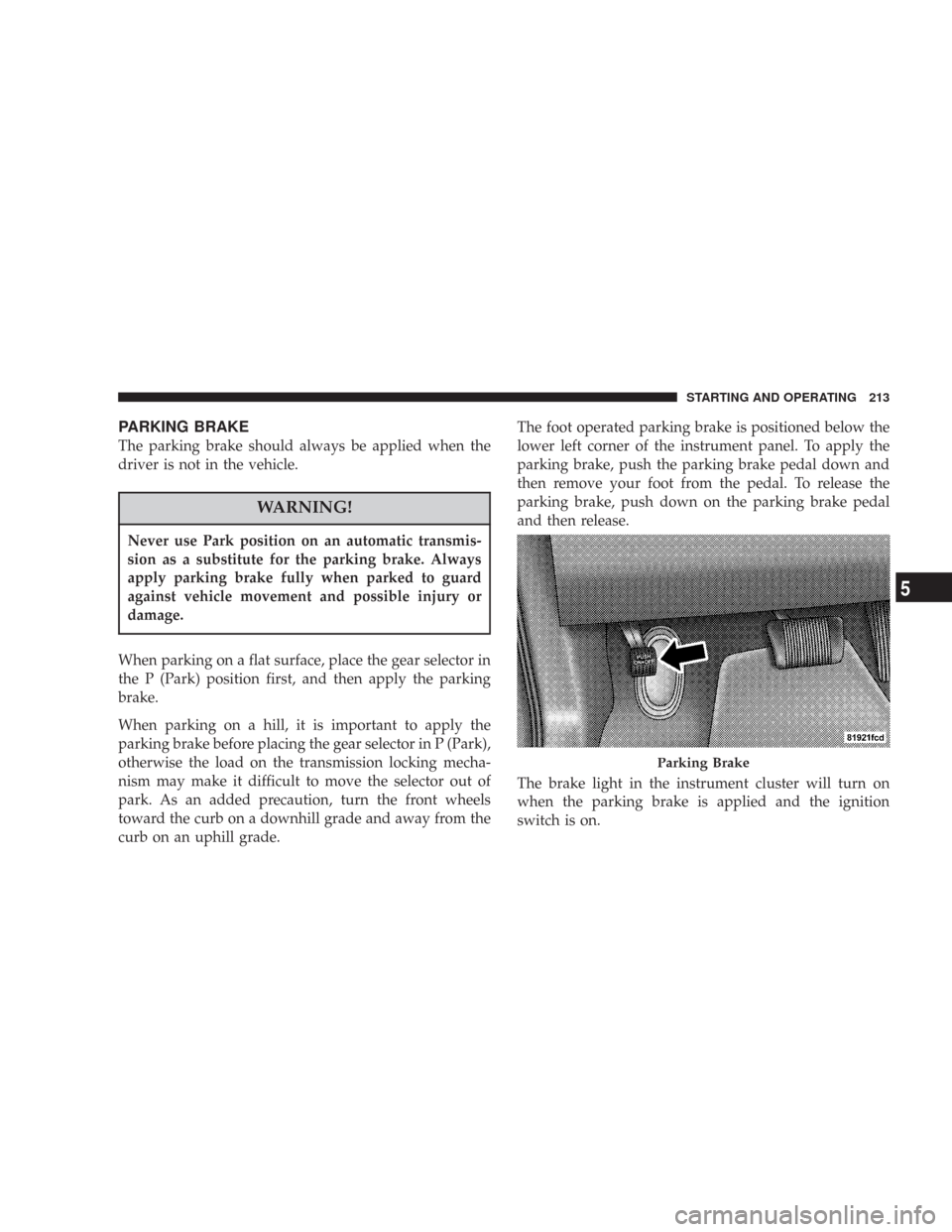
curb on an uphill grade.The foot operated parking brake is positioned below the
lower left corner of the instrument panel. To apply the
parking brake, push the parking brake pedal down and
then remove your foot from the pedal. To release the
parking brake, push down on the parking brake pedal
and then release.
The brake light in the instrument cluster will turn on
when the parking brake is applied and the ignition
switch is on.
Parking Brake
STARTING AND OPERATING 213
5
Page 214 of 384

NOTE:This light only shows that the parking brake is
applied. It does not show the degree of brake application.
WARNING!
•Never leave children alone in a vehicle. Leaving
children in a vehicle unattended is dangerous for
a number of reasons. A child or others could be
seriously or fatally injured. Don’t leave the keys
in the ignition. A child could operate power
windows, other controls, or move the vehicle.
•Be sure the parking brake is fully disengaged
before driving: failure to do so can lead to brake
failure, and an accident.
BRAKE SYSTEM
Your vehicle is equipped with dual hydraulic
brake systems. If either of the two hydraulic
systems loses normal capability, the remaining
system will still function. There will be some
loss of overall braking effectiveness. This may be evident
by increased pedal travel during application, greater
pedal force required to slow or stop, and potential
activation of the Brake Warning Light.
In the event power assist is lost for any reason (for
example, repeated brake applications with the engine off)
the brakes will still function. The effort required to brake
the vehicle will be much greater than that required with
the power system operating.
Anti-Lock Brake System — If Equipped
The Anti-Lock Brake System provides increased vehicle
stability and brake performance under most braking
conditions. The system automatically “pumps” the
brakes during severe braking conditions to prevent
wheel lock-up.
214 STARTING AND OPERATING
