Page 264 of 384

NOTE:The trailer tongue weight must be considered as
part of the combined weight of occupants and cargo, and
should never exceed the weight referenced on the “Tire
and Loading Information” placard. Refer to “Tire–Safety
Information” in this section.
Trailer and Tongue Weight
Always load a trailer with 60% to 65% of the weight in
the front of the trailer. This places 10% to 15% of the
Gross Trailer Weight (GTW) on the tow hitch of your
vehicle. Loads balanced over the wheels or heavier in the
rear can cause the trailer to swayseverelyside to side
which will cause loss of control of the vehicle and trailer.
Failure to load trailers heavier in front is the cause of
many trailer accidents.
Never exceed the maximum tongue weight stamped on
your bumper or trailer hitch.Consider the following items when computing the
weight on the rear axle of the vehicle:
•The tongue weight of the trailer.
•The weight of any other type of cargo or equipment
put in or on your vehicle.
•The weight of the driver and all passengers.
NOTE:Remember that everything put into or on the
trailer adds to the load on your vehicle. Also, additional
factory-installed options, or dealer-installed options,
264 STARTING AND OPERATING
Page 265 of 384

must be considered as part of the total load on your
vehicle. Refer to the “Tire and Loading Information”
placard for the maximum combined weight of occupants
and cargo for your vehicle.
Towing Requirements
To promote proper break-in of your new vehicle driv-
etrain components the following guidelines are recom-
mended:
CAUTION!
•Avoid towing a trailer for the first 500 miles (805
km) of vehicle operation. Doing so may damage
your vehicle.
•During the first 500 miles (805 km) of trailer
towing, limit your speed to 50 mph (80 km/h).
Perform the maintenance listed in Section 8 of this
manual. When towing a trailer, never exceed the GAWR,
or GCWR, ratings.
WARNING!
Improper towing can lead to an injury accident.
Follow these guidelines to make your trailer towing
as safe as possible:
Make certain that the load is secured in the trailer
and it will not shift during travel. When trailering
cargo that is not fully secured, dynamic load shifts
can occur that may be difficult for the driver to
control. You could lose control of your vehicle and
have an accident.
•When hauling cargo, or towing a trailer, do not
overload your vehicle or trailer. Overloading can cause
a loss of control, poor performance, or damage to
brakes, axle, engine, transmission, steering, suspen-
sion, chassis structure, or tires.
•Safety chains must always be used between your
vehicle and trailer. Always connect the chains to the
frame or hook retainers of the vehicle hitch. Cross the
chains under the trailer tongue and allow enough
slack for turning corners.
STARTING AND OPERATING 265
5
Page 266 of 384
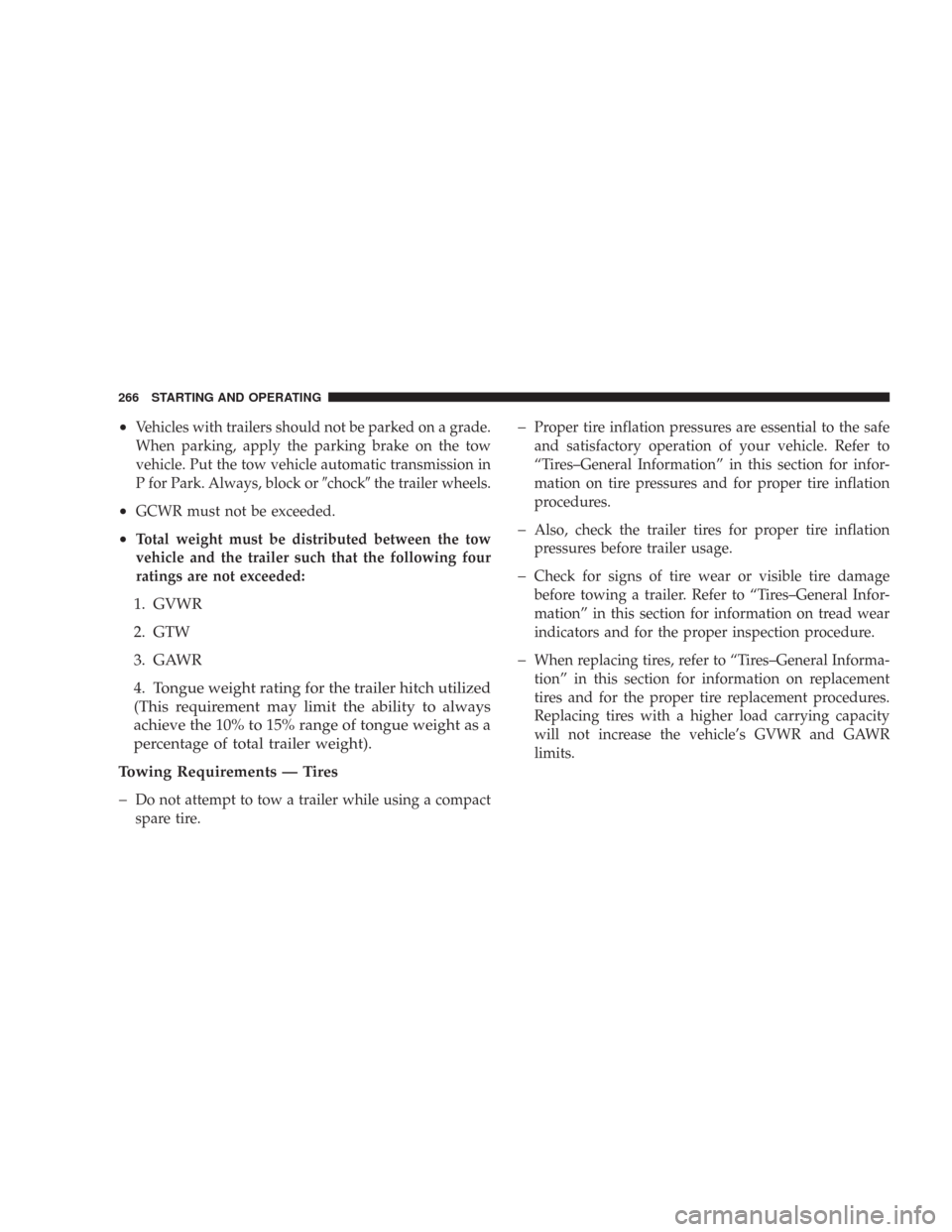
•Vehicles with trailers should not be parked on a grade.
When parking, apply the parking brake on the tow
vehicle. Put the tow vehicle automatic transmission in
P for Park. Always, block or�chock�the trailer wheels.
•GCWR must not be exceeded.
•Total weight must be distributed between the tow
vehicle and the trailer such that the following four
ratings are not exceeded:
1. GVWR
2. GTW
3. GAWR
4. Tongue weight rating for the trailer hitch utilized
(This requirement may limit the ability to always
achieve the 10% to 15% range of tongue weight as a
percentage of total trailer weight).
Towing Requirements — Tires
Do not attempt to tow a trailer while using a compact
spare tire.
Proper tire inflation pressures are essential to the safe
and satisfactory operation of your vehicle. Refer to
“Tires–General Information” in this section for infor-
mation on tire pressures and for proper tire inflation
procedures.
Also, check the trailer tires for proper tire inflation
pressures before trailer usage.
Check for signs of tire wear or visible tire damage
before towing a trailer. Refer to “Tires–General Infor-
mation” in this section for information on tread wear
indicators and for the proper inspection procedure.
When replacing tires, refer to “Tires–General Informa-
tion” in this section for information on replacement
tires and for the proper tire replacement procedures.
Replacing tires with a higher load carrying capacity
will not increase the vehicle’s GVWR and GAWR
limits.
266 STARTING AND OPERATING
Page 375 of 384
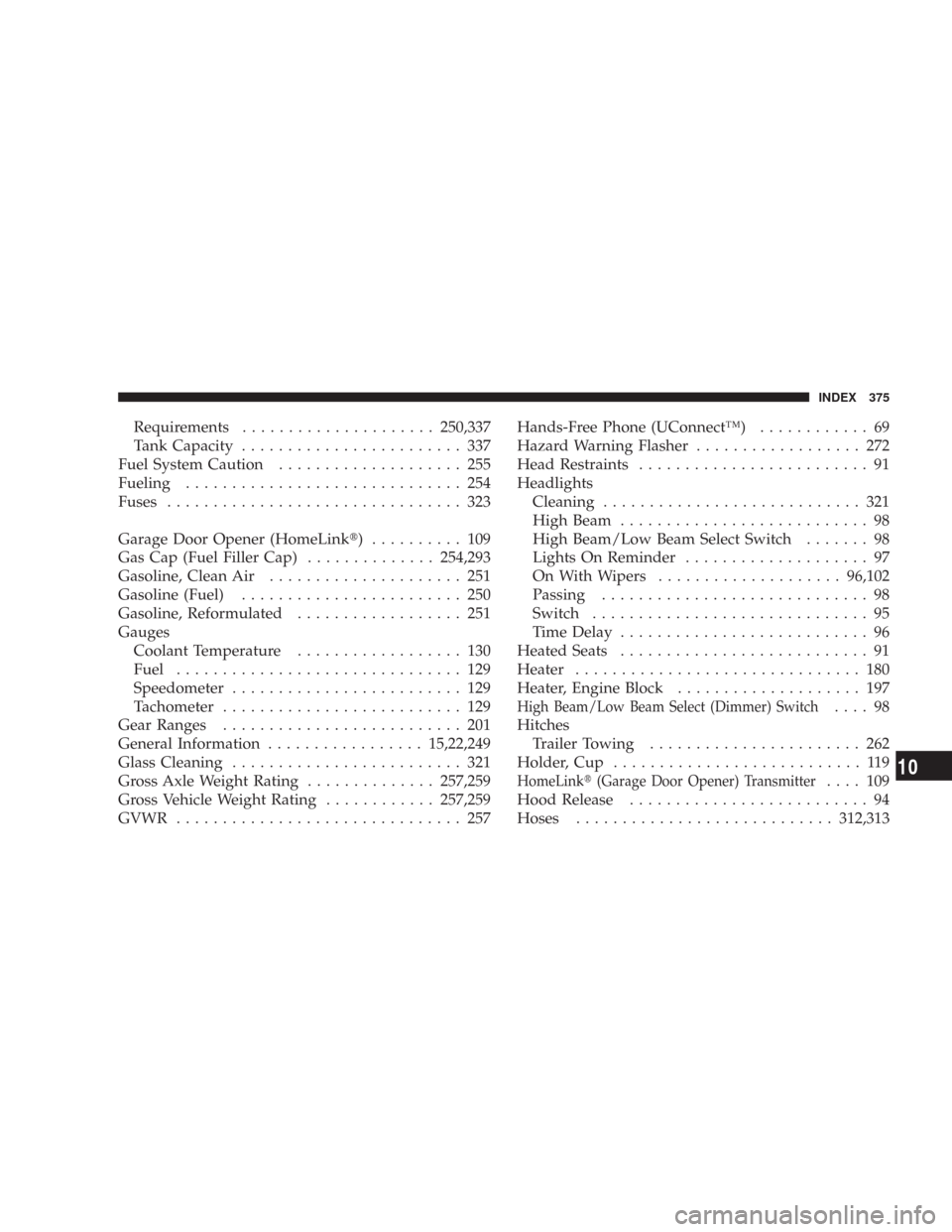
Requirements.....................250,337
Tank Capacity........................ 337
Fuel System Caution.................... 255
Fueling.............................. 254
Fuses................................ 323
Garage Door Opener (HomeLink�) .......... 109
Gas Cap (Fuel Filler Cap)..............254,293
Gasoline, Clean Air..................... 251
Gasoline (Fuel)........................ 250
Gasoline, Reformulated.................. 251
Gauges
Coolant Temperature.................. 130
Fuel............................... 129
Speedometer......................... 129
Tachometer.......................... 129
Gear Ranges.......................... 201
General Information.................15,22,249
Glass Cleaning......................... 321
Gross Axle Weight Rating..............257,259
Gross Vehicle Weight Rating............257,259
GVWR ............................... 257Hands-Free Phone (UConnect™)............ 69
Hazard Warning Flasher.................. 272
Head Restraints......................... 91
Headlights
Cleaning............................ 321
High Beam........................... 98
High Beam/Low Beam Select Switch....... 98
Lights On Reminder.................... 97
On With Wipers....................96,102
Passing............................. 98
Switch.............................. 95
Time Delay........................... 96
Heated Seats........................... 91
Heater............................... 180
Heater, Engine Block.................... 197
High Beam/Low Beam Select (Dimmer) Switch.... 98
Hitches
Trailer Towing....................... 262
Holder, Cup........................... 119
HomeLink�(Garage Door Opener) Transmitter.... 109
Hood Release.......................... 94
Hoses............................312,313
INDEX 375
10
Page 383 of 384

Tongue Weight/Trailer Weight............. 264
Torque Converter Clutch................. 204
Towing.............................. 259
Behind a Motor Home................. 270
Disabled Vehicle...................... 285
Guide.............................. 263
Recreational......................... 270
Weight............................. 263
Towing Vehicle Behind a Motor Home....... 270
Traction Control........................ 218
Traction Control Switch.................. 218
Trailer Towing......................... 259
Cooling System Tips................... 270
Hitches............................. 262
Minimum Requirements................ 265
Trailer and Tongue Weight.............. 264
Wiring............................. 268
Trailer Towing Guide.................... 263
Trailer Weight......................... 263
Transmission.......................... 316
Automatic.....................200,205,316
Fluid.............................. 339
Shifting............................ 197Transmitter Battery Service
(Remote Keyless Entry)................... 21
Transmitter, Garage Door Opener (HomeLink�).... 109
Transmitter Programming
(Remote Keyless Entry)................... 21
Transmitter, Remote Keyless Entry (RKE)...... 17
Transporting Pets........................ 58
Tread Wear Indicators................... 237
Trip Odometer......................... 129
Trunk Release, Emergency................. 33
Trunk Release Remote Control.............. 32
Turn Signals........................98,131
UConnect™ (Hands-Free Phone)............ 69
Uniform Tire Quality Grades.............. 366
Universal Transmitter.................... 109
Unleaded Gasoline...................... 250
Untwisting Procedure, Seat Belt............. 39
Vanity Mirrors.......................... 68
Variance, Compass...................... 143
Vehicle Certification Label................ 256
Vehicle Identification Number (VIN).......... 6
INDEX 383
10
Page:
< prev 1-8 9-16 17-24