Page 300 of 384

Engine Oil Filter
The engine oil filter should be replaced at every engine
oil change.
Engine Oil Filter Selection
This manufacturer’s engines have a full-flow type oil
filter. Use a filter of this type for replacement. The quality
of replacement filters varies considerably. Only high
quality filters should be used to assure most efficient
service. Mopar�Engine Oil Filters are a high quality oil
filter and are recommended.
Drive Belts — Check Condition and Tension
Belt tension is controlled by means of an automatic
tensioner. Therefore, no belt tension adjustments are
required. However, belt and belt tensioner condition
should be inspected at the specified intervals and re-
placed if required. Improper belt tension can cause belt
slippage and failure. Low generator belt tension can
cause battery failure.
At the mileage indicated in the maintenance schedule,
inspect belt and belt tensioner condition. Inspect belts for
evidence of cuts, cracks, glazing, or frayed cords and
replaced if there is indication of damage, which couldresult in belt failure. Also, check belt routing to make sure
there is no interference between the belts and other
engine components. See your authorized dealer for ser-
vice.
Spark Plugs
Spark plugs must fire properly to assure engine perfor-
mance and emission control. New plugs should be in-
stalled at the specified mileage. The entire set should be
replaced if there is any malfunction due to a faulty spark
plug. Malfunctioning spark plugs can damage the cata-
lytic converter. For proper type of replacement spark
plugs, refer to the “Vehicle Emission Control Informa-
tion” label in the engine compartment.
Engine Air Cleaner Filter
For normal driving conditions, inspect and replace the
engine air cleaner filter at the intervals shown on Sched-
ule “A.” For vehicles driven frequently in dusty or under
severe conditions, inspect and replace the engine air
cleaner filter at the intervals shown on Schedule “B.”
300 MAINTAINING YOUR VEHICLE
Page 305 of 384

Refrigerant Recovery and Recycling
R-134a Air Conditioning Refrigerant is a hydrofluorocar-
bon (HFC) that is endorsed by the Environmental Pro-
tection Agency and is an ozone-saving product. How-
ever, the manufacturer recommends that air conditioning
service be performed by dealers or other service facilities
using recovery and recycling equipment.
NOTE:Use only manufacturer approved A/C System
Sealers, Stop Leak Products, Seal Conditioners, Compres-
sor Oil, and Refrigerants.
A/C Air Filter — If Equipped
The filter is located in the fresh air inlet under the hood,
behind a removable panel in the cowl on the passenger
side of the vehicle, next to the windshield wipers. When
installing a new filter, ensure its proper orientation. To
replace the filter, remove the access door in the cowl
screen by pressing the retaining clips. Slide the lid on the
filter adapter forward and down and remove used filter.
Install new filter with arrows pointing in the direction of
airflow, which is toward the rear of the vehicle (text and
arrows on the filter indicate this).Refer to the “Maintenance Schedule” in this manual for
the recommended air conditioning filter replacement
intervals.
Power Steering — Fluid Check
Checking the power steering fluid level at a defined
service interval is not required. The fluid should only be
checked if a leak is suspected, abnormal noises are
apparent, and/or the system is not functioning as antici-
pated. Coordinate inspection efforts through a certified
DaimlerChrysler Dealership.
WARNING!
Fluid level should be checked on a level surface and
with the engine off to prevent injury from moving
parts and to insure accurate fluid level reading. Do
not overfill. Use only manufacturer’s recommended
power steering fluid.
MAINTAINING YOUR VEHICLE 305
7
Page 307 of 384
Windshield Washers
The windshield washer fluid reservoir is located in the
front of the engine compartment on the passenger side of
the vehicle. Be sure to check the fluid level at regular
intervals. Fill the reservoir with windshield washer sol-
vent (not radiator antifreeze) and operate the system for
a few seconds to flush out the residual water.
The fluid reservoir will hold nearly 1 gallon (4 liters) of
washer fluid when the message “Low Washer Fluid”
appears in the Electronic Vehicle Information Center
(EVIC) — if equipped.
WARNING!
Commercially available windshield washer solvents
are flammable. They could ignite and burn you. Care
must be exercised when filling or working around
the washer solution.
Exhaust System
The best protection against carbon monoxide entry into
the vehicle body is a properly maintained engine exhaust
system.
Whenever a change is noticed in the sound of the exhaust
system, when exhaust fumes can be detected inside the
vehicle, or when the underside or rear of the vehicle is
damaged, have a competent mechanic inspect the com-
plete exhaust system and adjacent body areas for broken,
damaged, deteriorated, or mispositioned parts. Open
seams or loose connections could permit exhaust fumes
to seep into the passenger compartment. In addition,
inspect the exhaust system each time the vehicle is raised
for lubrication or oil change. Replace as required.
MAINTAINING YOUR VEHICLE 307
7
Page 315 of 384
Master Cylinder — Brake Fluid Level Check
Check the fluid level in the master cylinder immediately
if the brake system warning light indicates system fail-
ure.
Check the fluid level in the master cylinder when per-
forming underhood services.
Clean the top of the master cylinder area before removing
the cap. Add fluid to bring the level up to the top of the
“FULL” mark on the side of the master cylinder reservoir.
Overfilling of fluid is not recommended because it may
cause leaking in the system.
Add enough fluid to bring the level up to the require-
ments described on the brake fluid reservoir. With disc
brakes, fluid level can be expected to fall as the brake
pads wear. However, low fluid level may be caused by a
leak and a checkup may be needed.
Use only manufacturer’s recommended brake fluid. Re-
fer to “Fluids, Lubricants, and Genuine Parts” in this
section for the correct fluid type.WARNING!
•Overfilling the brake fluid reservoir can result in
spilling brake fluid on hot engine parts and the
brake fluid catching fire.
•Use of a brake fluid that has a lower initial boiling
point than the recommended MOPAR�DOT 3
product or a brake fluid that is unidentified as to
FMVSS specification may result in sudden brake
failure during hard prolonged braking. You could
have an accident.
Use only brake fluid that has been in a tightly closed
container to avoid contamination from foreign matter or
moisture.
CAUTION!
Do not allow petroleum base fluid to contaminate
the brake fluid, all brake seal components could be
damaged causing partial or complete brake failure.
MAINTAINING YOUR VEHICLE 315
7
Page 344 of 384

At Each Stop for Fuel
•
Check the engine oil level about 5 minutes after a fully
warmed engine is shut off. Checking the oil level while
the vehicle is on level ground will improve the accu-
racy of the oil level reading. Add oil only when the
level is at or below the ADD or MIN mark.
•Check the windshield washer solvent and add if
required.
Once a Month
•
Check tire pressure and look for unusual wear or
damage.
•Inspect the battery, and clean, and tighten the termi-
nals as required.
•Check the fluid levels of coolant reservoir and brake
master cylinder, and add as needed.
•Check all lights and all other electrical items for correct
operation.
•Check rubber seals on each side of the radiator for
proper fit.
At Each Oil Change
•
Change the engine oil filter.
•Inspect the exhaust system.
•Inspect the brake hoses.
•Inspect the CV joints and front and rear suspension
components.
•Check the coolant level, hoses, and clamps.
344 MAINTENANCE SCHEDULES
8
M
A
I
N
T
E
N
A
N
C
E
S
C
H
E
D
U
L
E
S
Page 347 of 384
Miles 21,000 24,000 27,000 30,000 33,000 36,000
(Kilometers) (35 000) (40 000) (45 000) (50 000) (55 000) (60 000)
Change engine oil and engine oil filter, if not
replaced at 3 months.XXXXX X
Inspect theair cleaner filterand replace if re-
quired.*XXX X X
Replace theair cleaner filter.X
Replace thespark plugs.5.7L Engine. X
Inspect the front and rear brake linings and
rotors.XX
Check and replace, if necessary, thePCV
valve.*X
Replace the air conditioning filter. X X
Rotate the tires. X X X
SCHEDULE “B” 347
8
M
A
I
N
T
E
N
A
N
C
E
S
C
H
E
D
U
L
E
S
Page 349 of 384
Miles 57,000 60,000 63,000 66,000 69,000 72,000
(Kilometers) (95 000) (100 000) (105 000) (110 000) (115 000) (120 000)
Change engine oil and engine oil filter, if not
replaced at 3 months.XXXXX X
Inspect theair cleaner filterand replace if re-
quired.*X XXX X
Replace theair cleaner filter.X
Replace thespark plugs.5.7L Engine. X
Inspect the front and rear brake linings and
rotors.XX
Check and Inspect the accessory drive belt
and tensioner. Replace if required.X
Check and replace, if necessary, thePCV
valve.*‡X
Change the automatic transmission fluid and
filter.X
Replace the air conditioning filter. X X
Flush and replace engine coolant at 60 months
if not done at 102,000 miles.X
Rotate the tires. X X X
SCHEDULE “B” 349
8
M
A
I
N
T
E
N
A
N
C
E
S
C
H
E
D
U
L
E
S
Page 350 of 384
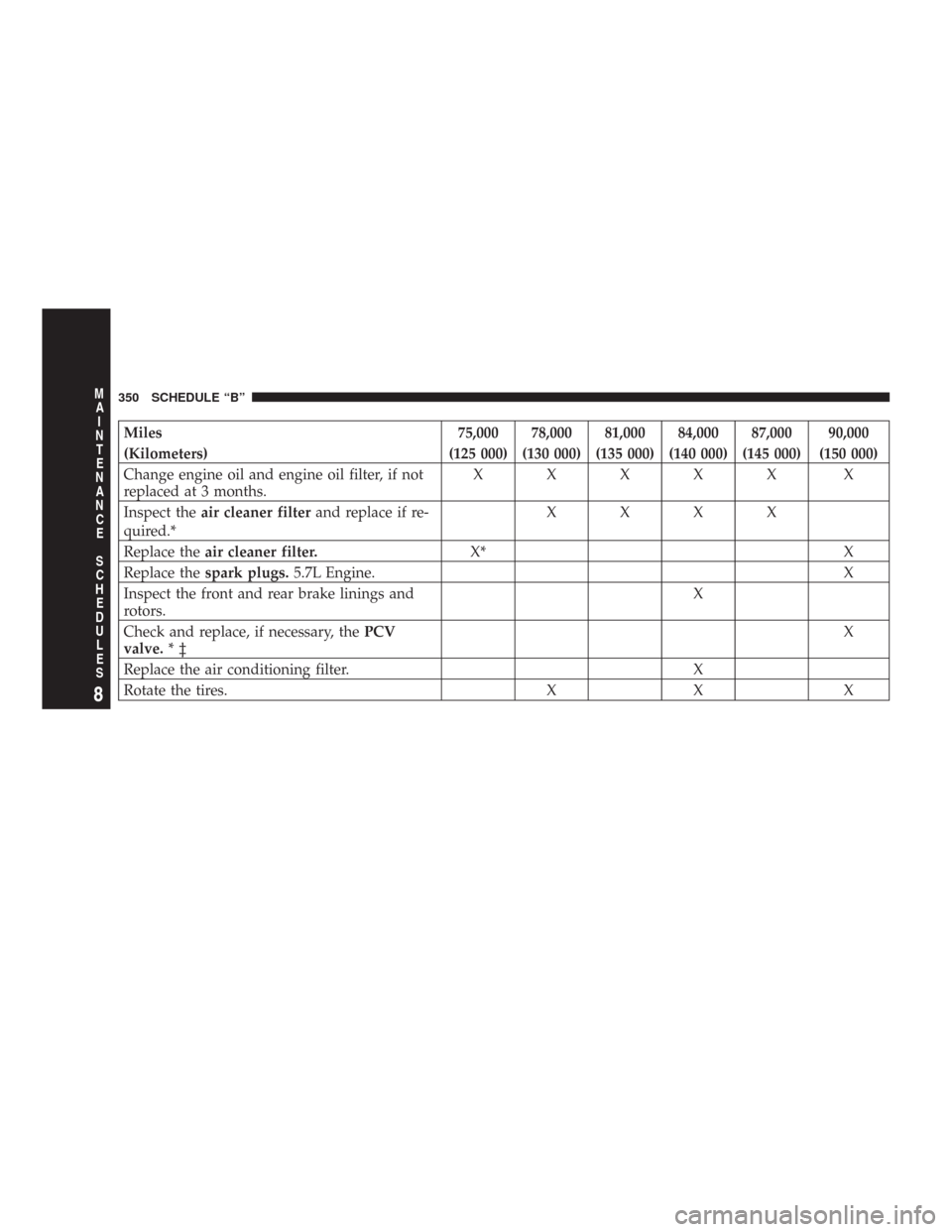
Miles 75,000 78,000 81,000 84,000 87,000 90,000
(Kilometers) (125 000) (130 000) (135 000) (140 000) (145 000) (150 000)
Change engine oil and engine oil filter, if not
replaced at 3 months.XXXXX X
Inspect theair cleaner filterand replace if re-
quired.*XXXX
Replace theair cleaner filter.X* X
Replace thespark plugs.5.7L Engine. X
Inspect the front and rear brake linings and
rotors.X
Check and replace, if necessary, thePCV
valve.*‡X
Replace the air conditioning filter. X
Rotate the tires. X X X
350 SCHEDULE “B”
8
M
A
I
N
T
E
N
A
N
C
E
S
C
H
E
D
U
L
E
S