Page 273 of 384

NOTE:There are steps that you can take to slow down
an impending overheat condition. If your air conditioner
is on, turn it off. The air conditioning system adds heat to
the engine cooling system and turning off the A/C
removes this heat. You can also turn the Temperature
control to maximum heat, the Mode control to floor, and
the fan control to HI. This allows the heater core to act as
a supplement to the radiator and aids in removing heat
from the engine cooling system.
CAUTION!
Driving with a hot cooling system could damage
your vehicle. If temperature gauge reads “H”, pull
over and stop the vehicle. Idle the vehicle with the
air conditioner turned off until the pointer drops
back into the normal range. If the pointer remains on
the “H”, turn the engine off immediately, and call for
service.
WARNING!
A hot engine cooling system is dangerous. You or
others could be badly burned by steam or boiling
coolant. You may want to call a service center if your
vehicle overheats. If you decide to look under the
hood yourself, see Section 7, Maintenance, of this
manual. Follow the warnings under the Cooling
System Pressure Cap paragraph.
WHAT TO DO IN EMERGENCIES 273
6
Page 274 of 384

JACKING AND TIRE CHANGING
WARNING!
•Do not attempt to change a tire on the side of the
vehicle close to moving traffic. Pull far enough off
the road to avoid the danger of being hit when
operating the jack or changing the wheel.
•Getting under a jacked-up vehicle is dangerous.
The vehicle could slip off the jack and fall on you.
You could be crushed. Never get any part of your
body under a vehicle that is on a jack. Never start
or run the engine while the vehicle is on a jack. If
you need to get under a raised vehicle, take it to a
service center where it can be raised on a lift.
•The jack is designed to use as a tool for changing
tires only. The jack should not be used to lift the
vehicle for service purposes. The vehicle should
be jacked on a firm level surface only. Avoid ice or
slippery areas.
Preparations For Jacking
1. Park the vehicle on a firm level surface as far from the
edge of the roadway as possible. Avoid icy or slippery
areas.
2.Set the parking brakeand place the gear selector in
PARK.
3. Turn OFF the ignition.
4. Turn on the Hazard Warning Flasher.
Hazard Flasher Switch
274 WHAT TO DO IN EMERGENCIES
Page 276 of 384
4. Remove the spare tire.
5. Remove the fastener securing the jack.WARNING!
A loose tire or jack thrown forward in a collision or
hard stop could endanger the occupants of the ve-
hicle. Always stow the jack parts and the spare tire in
the places provided.
Spare Tire FastenerJack Fastener
276 WHAT TO DO IN EMERGENCIES
Page 277 of 384
Jacking and Changing a Tire
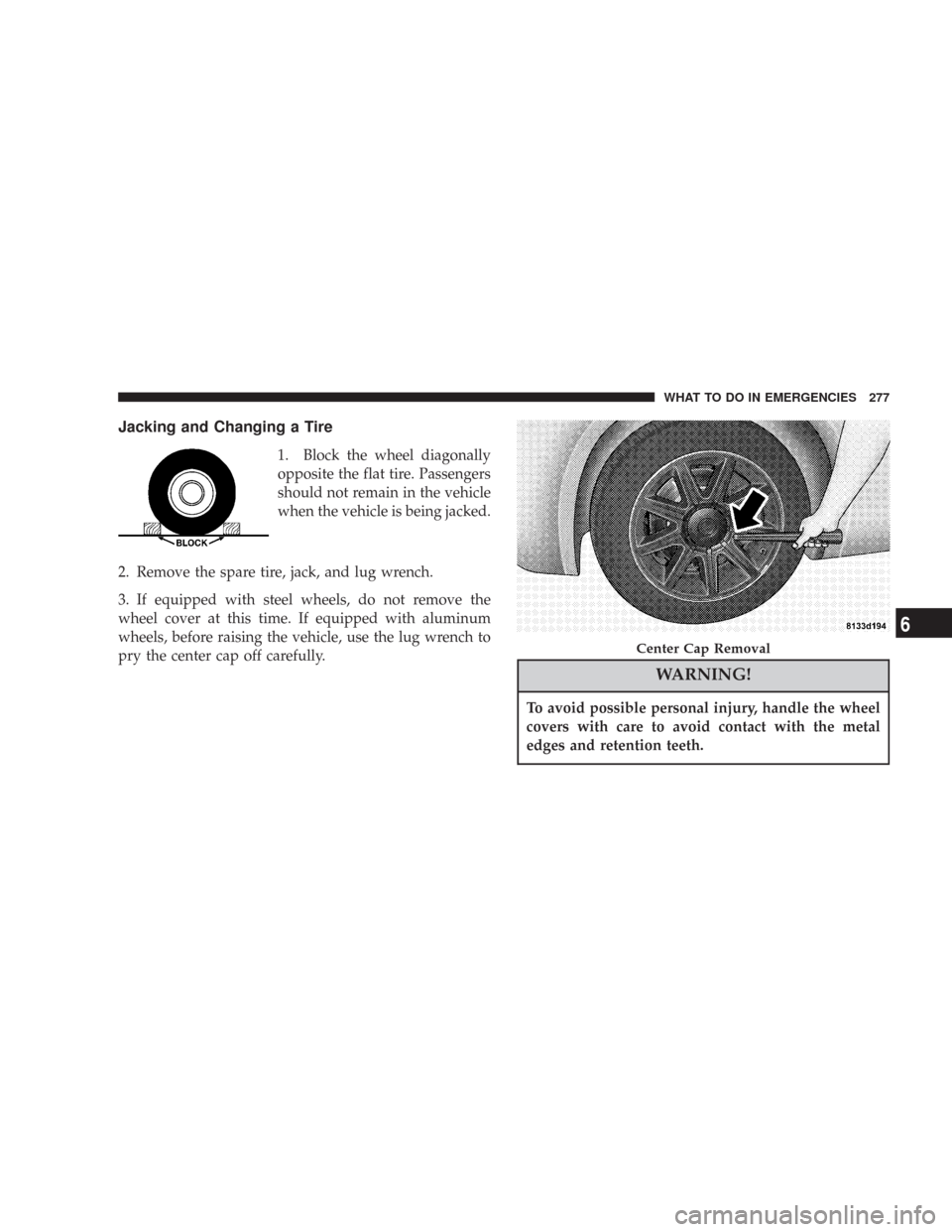
1. Block the wheel diagonally
opposite the flat tire. Passengers
should not remain in the vehicle
when the vehicle is being jacked.
2. Remove the spare tire, jack, and lug wrench.
3. If equipped with steel wheels, do not remove the
wheel cover at this time. If equipped with aluminum
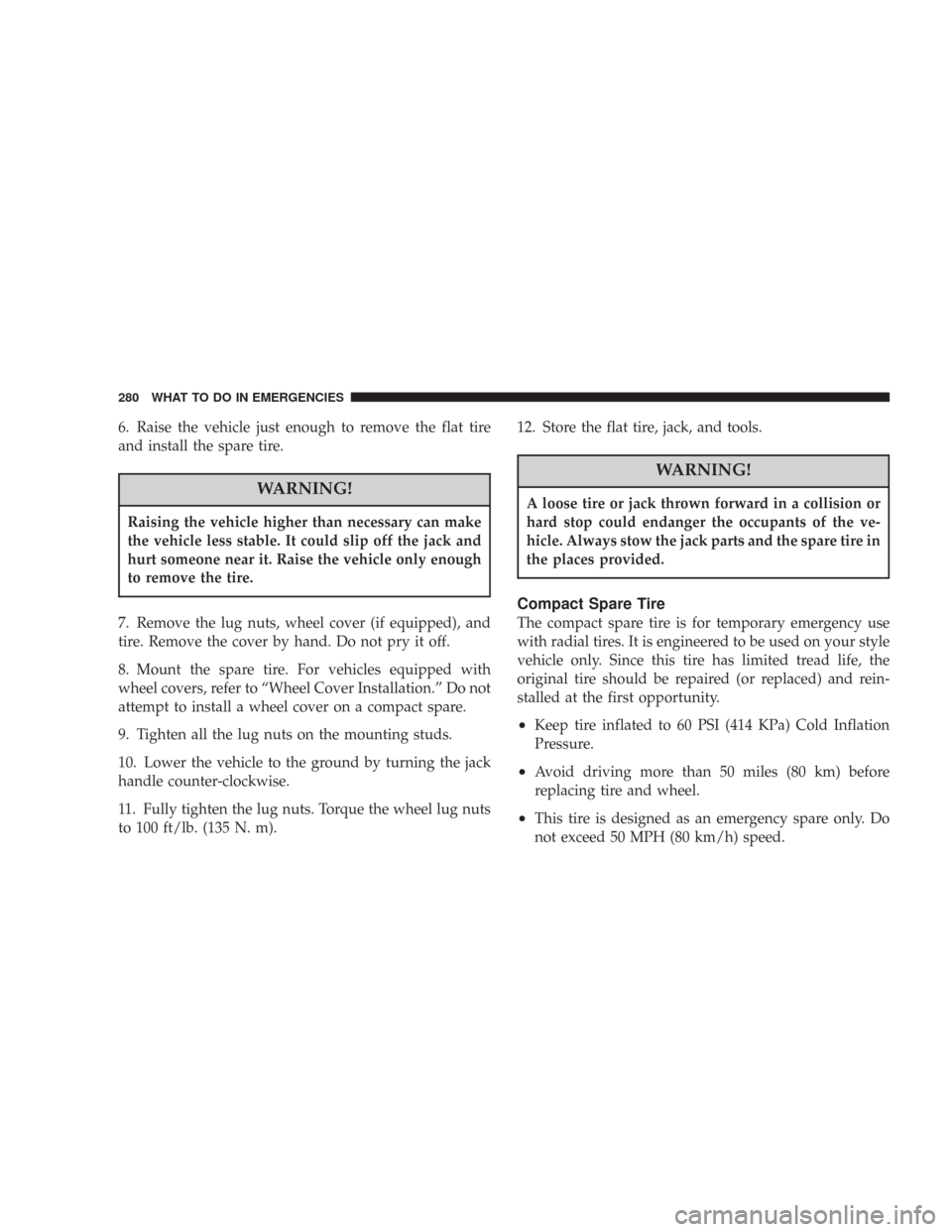
wheels, before raising the vehicle, use the lug wrench to
pry the center cap off carefully.
WARNING!
To avoid possible personal injury, handle the wheel
covers with care to avoid contact with the metal
edges and retention teeth.
Center Cap Removal
WHAT TO DO IN EMERGENCIES 277
6
Page 280 of 384
6. Raise the vehicle just enough to remove the flat tire
and install the spare tire.
WARNING!
Raising the vehicle higher than necessary can make
the vehicle less stable. It could slip off the jack and
hurt someone near it. Raise the vehicle only enough
to remove the tire.
7. Remove the lug nuts, wheel cover (if equipped), and
tire. Remove the cover by hand. Do not pry it off.
8. Mount the spare tire. For vehicles equipped with
wheel covers, refer to “Wheel Cover Installation.” Do not
attempt to install a wheel cover on a compact spare.
9. Tighten all the lug nuts on the mounting studs.
10. Lower the vehicle to the ground by turning the jack
handle counter-clockwise.
11. Fully tighten the lug nuts. Torque the wheel lug nuts
to 100 ft/lb. (135 N. m).12. Store the flat tire, jack, and tools.
WARNING!
A loose tire or jack thrown forward in a collision or
hard stop could endanger the occupants of the ve-
hicle. Always stow the jack parts and the spare tire in
the places provided.
Compact Spare Tire
The compact spare tire is for temporary emergency use
with radial tires. It is engineered to be used on your style
vehicle only. Since this tire has limited tread life, the
original tire should be repaired (or replaced) and rein-
stalled at the first opportunity.
•Keep tire inflated to 60 PSI (414 KPa) Cold Inflation
Pressure.
•Avoid driving more than 50 miles (80 km) before
replacing tire and wheel.
•This tire is designed as an emergency spare only. Do
not exceed 50 MPH (80 km/h) speed.
280 WHAT TO DO IN EMERGENCIES
Page 282 of 384
JUMP-STARTING PROCEDURES
WARNING!
•Take care to avoid the radiator cooling fan whenever the
hood is raised. It can start anytime the ignition switch is
on. You can be hurt by the fan.
•Do not attempt to push or tow your vehicle to get it
started. Vehicles equipped with an automatic transmis-
sion cannot be started this way. Unburned fuel could
enter the catalytic converter and once the engine has
started, ignite and damage the converter and vehicle. If
the vehicle has a discharged battery, booster cables may
be used to obtain a start from another vehicle. This type
of start can be dangerous if done improperly, so follow
this procedure carefully.
•Battery fluid is a corrosive acid solution; do not allow
battery fluid to contact eyes, skin, or clothing. Don’t lean
over battery when attaching clamps or allow the clamps to
touch each other. If acid splashes in eyes or on skin, flush
contaminated area immediately with large quantities of
water.
•A battery generates hydrogen gas, which is flammable
and explosive. Keep flame or spark away from the vent
holes.
•Do not use a booster battery or any other booster source
with an output that exceeds 12 volts.
•The battery in this vehicle has a vent hose that should not
be disconnected and should only be replaced with a
battery of the same type (vented).
NOTE:The battery is stored under an access cover in
the trunk. Remote battery terminals are located in the
engine compartment for jump-starting.
1. Wear eye protection and remove any metal jewelry
such as watchbands or bracelets that might make an
inadvertent electrical contact.
2. When boost is provided by a battery in another
vehicle, park that vehicle within booster cable reach, but
do not allow the vehicles to touch one another.
WARNING!
Do not permit vehicles to touch each other as this
could establish a ground connection and personal
injury could result.
3. Set the parking brake, place the automatic transmis-
sion in PARK, and turn the ignition switch to the OFF (or
LOCK) position on both vehicles.
4. Turn off the heater, radio, and all unnecessary electri-
cal loads.
282 WHAT TO DO IN EMERGENCIES
Page 283 of 384

5. Connect one end of the jumper cable to the remote
jump-start positive battery post(+)in the engine com-
partment. Connect the other end of the same cable to the
positive terminal of the booster battery. Refer to the
following illustration for jump-starting connections.
6. Connect the other cable, first to the negative terminal
of the booster battery andthen to the engine ground (-)
of the vehicle with the discharged battery.Make sure
you have a good contact on the engine ground. Refer to
the following illustration for jump-starting connections.WARNING!
•You should not try to start your vehicle by push-
ing or towing.
•Do not connect the cable to the negative post of
the discharge battery. The resulting electrical
spark could cause the battery to explode.
•During cold weather when temperatures are be-
low freezing point, electrolyte in a discharged
battery may freeze. Do not attempt jump-starting
because the battery could rupture or explode. The
battery temperature must be brought up above
freezing point before attempting jump-start.
7. Start the engine in the vehicle that has the booster
battery. Let the engine idle a few minutes. Then, start the
engine in the vehicle with the discharged battery.
NOTE:For vehicles equipped with ESP, refer to�Syn-
chronizing ESP�under�Electronic Stability Program�in
Section 5 of this manual if the ESP/BAS light (in the
instrument cluster) remains on continuously after start-
ing the engine of the vehicle with the discharged battery.
Jump-Starting
WHAT TO DO IN EMERGENCIES 283
6
Page 284 of 384

8. When removing the jumper cables, reverse the above
sequence exactly. Be careful of the moving belts and fan.
WARNING!
Any procedure other than above could result in:
1. Personal injury caused by electrolyte squirting
out the battery vent;
2. Personal injury or property damage due to battery
explosion;
3. Damage to charging system of booster vehicle or
of immobilized vehicle.
FREEING A STUCK VEHICLE
If your vehicle becomes stuck in mud, sand, or snow, it
can often be moved by a rocking motion. Turn your
steering wheel right and left to clear the area around the
front wheels. Then shift back and forth between Reverse
and Drive. Usually the least accelerator pedal pressure to
maintain the rocking motion without spinning the
wheels is most effective.
NOTE:Turn off the Electronic Stability Program (ESP)
— if equipped, or Traction Control System (TCS) — if
equipped before rocking the vehicle. For details, refer to
“Electronic Stability Program,” or “Traction Control Sys-
tem” in this manual.
284 WHAT TO DO IN EMERGENCIES