Page 364 of 467
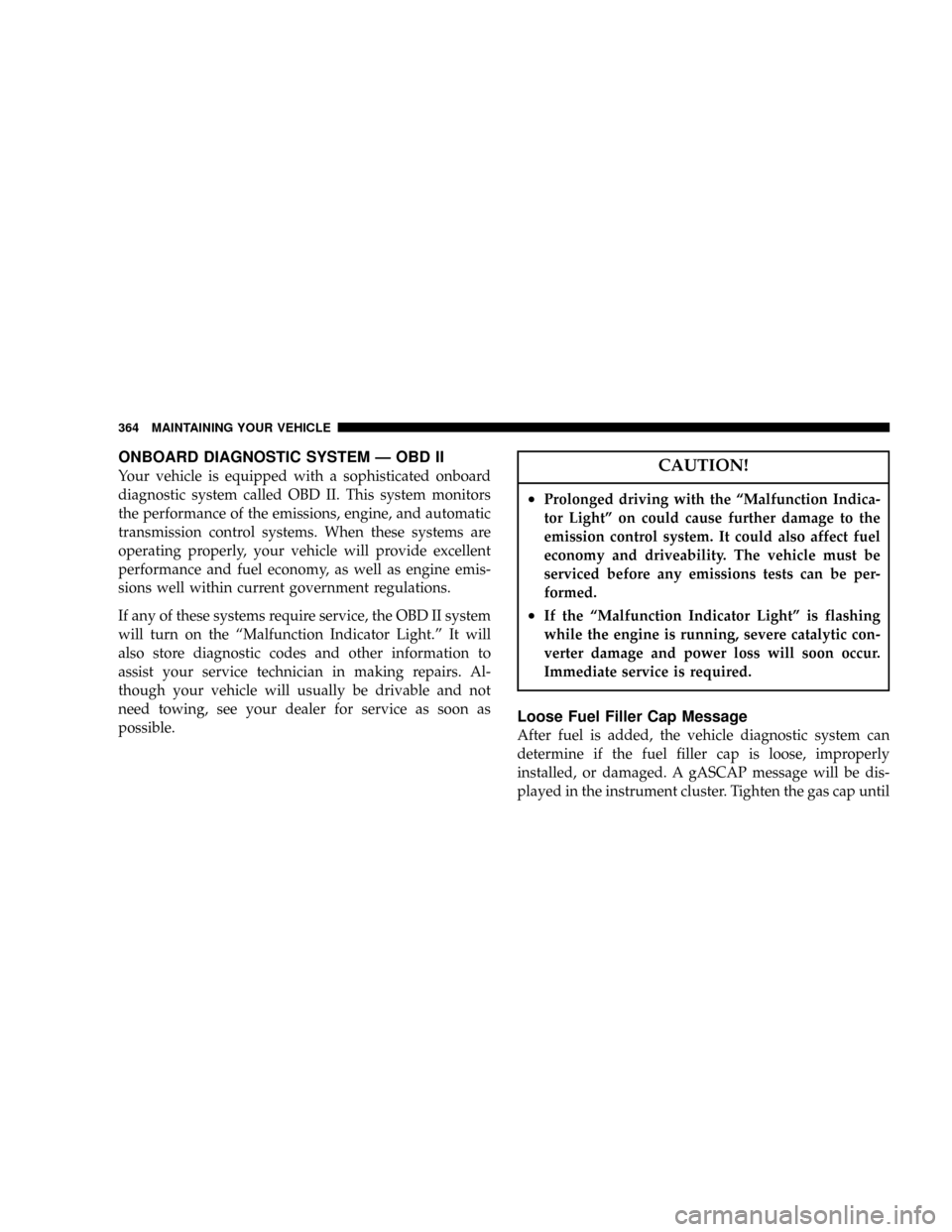
ONBOARD DIAGNOSTIC SYSTEM Ð OBD II
Your vehicle is equipped with a sophisticated onboard
diagnostic system called OBD II. This system monitors
the performance of the emissions, engine, and automatic
transmission control systems. When these systems are
operating properly, your vehicle will provide excellent
performance and fuel economy, as well as engine emis-
sions well within current government regulations.
If any of these systems require service, the OBD II system
will turn on the ªMalfunction Indicator Light.º It will
also store diagnostic codes and other information to
assist your service technician in making repairs. Al-
though your vehicle will usually be drivable and not
need towing, see your dealer for service as soon as
possible.CAUTION!
²Prolonged driving with the ªMalfunction Indica-
tor Lightº on could cause further damage to the
emission control system. It could also affect fuel
economy and driveability. The vehicle must be
serviced before any emissions tests can be per-
formed.
²If the ªMalfunction Indicator Lightº is flashing
while the engine is running, severe catalytic con-
verter damage and power loss will soon occur.
Immediate service is required.
Loose Fuel Filler Cap Message
After fuel is added, the vehicle diagnostic system can
determine if the fuel filler cap is loose, improperly
installed, or damaged. A gASCAP message will be dis-
played in the instrument cluster. Tighten the gas cap until
364 MAINTAINING YOUR VEHICLE
Page 390 of 467

WARNING!
Overfilling the brake fluid reservoir can result in
spilling brake fluid on hot engine parts and the
brake fluid catching fire.
Use only brake fluid that has been in a tightly closed
container to avoid contamination from foreign matter.
Do not allow petroleum based fluid to contaminate the
brake fluid as seal damage will result!
Automatic Transaxle
All front wheel drive vehicles have a transmission and
differential assembly contained within a single housing.
Selection Of Lubricant
It is important that the proper lubricant is used in the
transaxle to assure optimum transaxle performance. Use
only manufacturers recommended transmission fluid,refer to Fluids, Lubricants and Genuine Parts for correct
fluid type. It is important that the transmission fluid be
maintained at the prescribed level using the recom-
mended fluid.
CAUTION!
Using a transmission fluid other than the manufac-
turers recommended fluid may cause deterioration
in transmission shift quality and/or torque converter
shudder. Using a transmission fluid other than the
manufacturers recommended fluid will result in
more frequent fluid and filter changes. Refer to
Fluids, Lubricants and Genuine Parts for correct
fluid type.
390 MAINTAINING YOUR VEHICLE
Page 391 of 467

Fluid Level Check
The fluid level in the automatic transaxle should be
checked whenever the vehicle is serviced. Operation with
an improper fluid level will greatly reduce the life of the
transaxle and of the fluid.
Procedure For Checking Fluid Level
To properly check the automatic transaxle fluid level, the
following procedure must be used:
1. The vehicle must be on level ground.
2. The engine should be running at curb idle speed for at
minimum of 60 seconds.
3. Fully apply parking brake.
4. Depress the brake pedal and place the gear selector
momentarily in each gear position ending with the lever
in P (PARK).5. Remove the dipstick and determine if the fluid is hot
or warm. Hot fluid is approximately 180ÉF (82ÉC), which
is the normal operating temperature after the vehicle has
been driven at least 24 km (15 miles). The fluid cannot be
comfortable held between the finger tips. Warm is when
the fluid is between 85É to 125ÉF (29É to 52ÉC).
6. Wipe the dipstick clean and reinsert until seated.
Remove dipstick and note reading.
If the fluid is hot, reading should be in the cross hatched
area marked ªHOTº between the upper two holes in the
dipstick.
If the fluid is cold, the fluid level should be between the
lower two holes, into the area marked ªLOWº.
If the fluid level shows low, add sufficient transmission
fluid to bring to the proper level.
MAINTAINING YOUR VEHICLE 391
7
Page 392 of 467

CAUTION!
Do not overfill. Dirt and water in the transaxle can
cause serious damage. To prevent dirt and water
from entering the transaxle after checking or replen-
ishing fluid, make certain that the dipstick cap is
seated properly.
Fluid And Filter Changes
Automatic transmission fluid and filter should be
changed as follows:
Maintenance schedule ªAºÐNon Turbo Charged En-
gines± No change necessary.
Maintenance schedule ªAºÐTurbo Charged Engines±
No change necessary.Maintenance schedule ªBºÐAll Engines± Every 60,000
miles (100 000 km) change fluid and filter under the
following conditions:
²Police, taxi, limousine, commercial type operation, or
trailer towing where the vehicle is drivenregularlyfor
more than 45 minutes of continuous operation.
NOTE:Refer to Section 8 of this manual for mainte-
nance schedules.
If the transaxle is disassembled for any reason, the fluid
and filter should be changed.
Special Additives
Do not add any materials (other than leak detection dyes)
to Automatic Transmission Fluid (ATF). ATF is an engi-
neered product and its performance may be impaired by
supplemental additives.
392 MAINTAINING YOUR VEHICLE
Page 393 of 467

Manual Transaxle
Lubricant Selection
Use only manufacturers recommended transmission
fluid.Refer to Fluids, Lubricants and Genuine Parts for
the correct fluid type.
Fluid Level Check
Check the fluid level by removing the fill plug. The fluid
level should be between the bottom of the fill hole and a
point not more that 3/16º (4.7 mm) below the bottom of
the hole.
Add fluid, if necessary, to maintain the proper level.
Frequency Of Fluid Change
Under normal operating conditions, the fluid installed at
the factory will give satisfactory lubrication for the life of
the vehicle. Fluid changes are not necessary unless the
following conditions exist:
²The lubricant has become contaminated with water. If
contaminated with water, the fluid should be changed
immediately.
²If severe usage has occurred, refer to Maintenance
Schedule ªBº in Section 8 of this manual.
Appearance Care And Protection From Corrosion
Protection Of Body And Paint from Corrosion
Vehicle body care requirements vary according to geo-
graphic locations and usage. Chemicals that make roads
passable in snow and ice, and those that are sprayed on
trees and road surfaces during other seasons, are highly
corrosive to the metal in your vehicle. Outside parking,
which exposes your vehicle to airborne contaminants,
road surfaces on which the vehicle is operated, extreme
hot or cold weather and other extreme conditions will
have an adverse effect on paint, metal trim, and under-
body protection.
MAINTAINING YOUR VEHICLE 393
7
Page 412 of 467
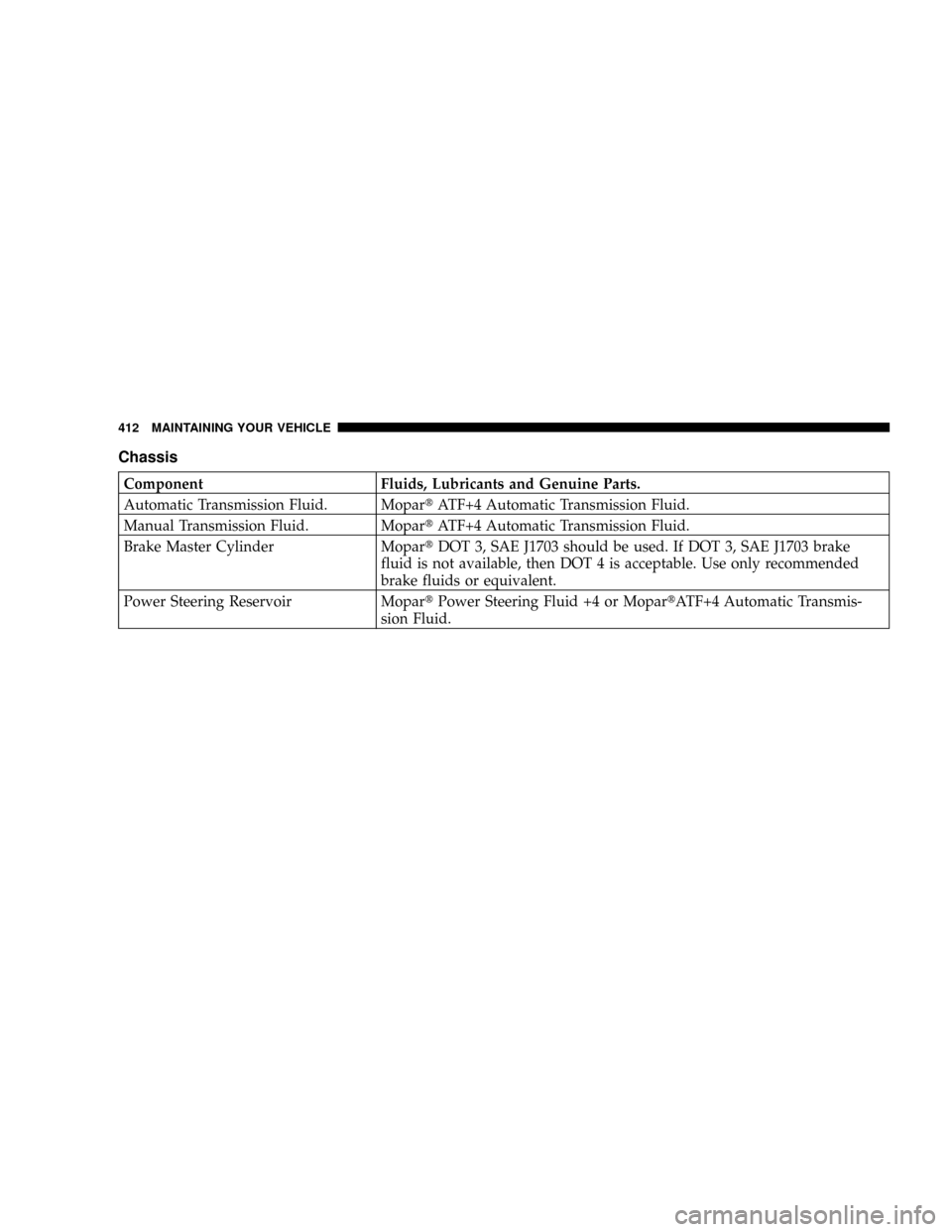
Chassis
Component Fluids, Lubricants and Genuine Parts.
Automatic Transmission Fluid. MopartATF+4 Automatic Transmission Fluid.
Manual Transmission Fluid. MopartATF+4 Automatic Transmission Fluid.
Brake Master Cylinder MopartDOT 3, SAE J1703 should be used. If DOT 3, SAE J1703 brake
fluid is not available, then DOT 4 is acceptable. Use only recommended
brake fluids or equivalent.
Power Steering Reservoir MopartPower Steering Fluid +4 or MopartATF+4 Automatic Transmis-
sion Fluid.
412 MAINTAINING YOUR VEHICLE
Page 417 of 467

SCHEDULE ªBºÐALL ENGINES
Follow schedule ªBºÐAll Engines if you usually operate
your vehicle under one or more of the following condi-
tions.
Change the automatic transmission fluid and filter every
60,000 miles (100 000 km) if the vehicle is usually
operated under one or more of the conditions marked
with anL.
Change the manual transaxle fluid every 48,000 miles
(80 000 km) if the vehicle is usually operated under one
or more of the conditions marked with an ².
²Day and night temperatures are below 32É F (0É C).
²Stop and go driving.
²Extensive engine idling.
²Driving in dusty conditions.
²Short trips of less than 10 miles (16.2 km).
²More than 50% of your driving is at sustained high
speeds during hot weather, above 90É F (32É C).
²Trailer towing.²L
²Taxi, police, or delivery service (commercial ser-
vice).²L
²Off-road or desert operation.
²If equipped for and operating with E-85 (ethanol)
fuel.
NOTE:IfANYof these apply to you then change your
engine oil every 3,000 miles (5 000 km) or 3 months,
whichever comes first, and follow schedule ªBÐAll
Enginesº of the9Maintenance Schedules9section of this
manual.
SCHEDULE ªBºÐALL ENGINES 417
8
M
A
I
N
T
E
N
A
N
C
E
S
C
H
E
D
U
L
E
S
Page 451 of 467

Special Additives...................... 392
Autostick............................. 288
Back-Up Lights......................... 408
Ball Joints............................. 379
Battery............................... 375
Keyless Transmitter Replacement (RKE).....28,34
Belts, Drive............................ 372
Belts, Engine........................... 374
Body Mechanism Lubrication............... 379
Boot, Convertible Top..................124,128
B-Pillar Location........................ 306
Brake Fluid............................ 412
Brake, Parking.......................... 294
Brake System........................295,387
Anti-Lock (ABS)....................... 296
Hoses.............................. 387
Master Cylinder....................... 388
Parking............................. 294Warning Light........................ 227
Brakes.............................295,387
Brake/Transmission Interlock............... 284
Break-In Recommendations, New Vehicle....... 112
Bulb Replacement.....................405,406
Bulbs, Light............................ 405
Calibration, Compass..................... 239
Capacities, Antifreeze (Engine Coolant)........ 410
Capacities, Fluid........................ 410
Caps, Filler
Fuel................................ 325
Oil (Engine)....................362,363,370
Car Washes............................ 394
Carbon Monoxide Warning................. 325
Cargo Compartment
Luggage Carrier....................... 213
Carrier, Luggage........................ 213
Catalytic Converter...................... 372
INDEX 451
10