Page 389 of 467

fluid reservoir. Fluid level can be expected to fall as the
brake pads wear. Brake fluid level should be checked
when pads are replaced. However, low fluid level may be
caused by a leak and a checkup may be needed.
NOTE:If your vehicle is equipped with aManual
transaxle, the Brake Fluid Reservoir supplies fluid to
both the Brake System and the Clutch Release System.
The two systems are separated in the reservoir and a leak
in one system will not affect the other system. The
Manual TransaxleClutch Release System should not
require fluid replacement during the life of the vehicle. If
the Brake Fluid Reservoir is low, and the brake system
does not indicate any leaks or other problems, it may be
a result of a leak in the Hydraulic Clutch Release System.
See your local authorized dealer for service.
Use only manufacturers recommended brake fluid, refer
to Fluids, Lubricants and Genuine Parts for correct fluid
type.WARNING!
Use of a brake fluid that may have a lower initial
boiling point or unidentified as to specification, may
result in sudden brake failure during hard pro-
longed braking. You could have an accident.
CAUTION!
Use of improper brake fluids will affect overall
clutch system performance. Improper brake fluids
may damage the clutch system resulting in loss of
clutch function and the ability to shift the transaxle.
MAINTAINING YOUR VEHICLE 389
7
Page 390 of 467

WARNING!
Overfilling the brake fluid reservoir can result in
spilling brake fluid on hot engine parts and the
brake fluid catching fire.
Use only brake fluid that has been in a tightly closed
container to avoid contamination from foreign matter.
Do not allow petroleum based fluid to contaminate the
brake fluid as seal damage will result!
Automatic Transaxle
All front wheel drive vehicles have a transmission and
differential assembly contained within a single housing.
Selection Of Lubricant
It is important that the proper lubricant is used in the
transaxle to assure optimum transaxle performance. Use
only manufacturers recommended transmission fluid,refer to Fluids, Lubricants and Genuine Parts for correct
fluid type. It is important that the transmission fluid be
maintained at the prescribed level using the recom-
mended fluid.
CAUTION!
Using a transmission fluid other than the manufac-
turers recommended fluid may cause deterioration
in transmission shift quality and/or torque converter
shudder. Using a transmission fluid other than the
manufacturers recommended fluid will result in
more frequent fluid and filter changes. Refer to
Fluids, Lubricants and Genuine Parts for correct
fluid type.
390 MAINTAINING YOUR VEHICLE
Page 391 of 467

Fluid Level Check
The fluid level in the automatic transaxle should be
checked whenever the vehicle is serviced. Operation with
an improper fluid level will greatly reduce the life of the
transaxle and of the fluid.
Procedure For Checking Fluid Level
To properly check the automatic transaxle fluid level, the
following procedure must be used:
1. The vehicle must be on level ground.
2. The engine should be running at curb idle speed for at
minimum of 60 seconds.
3. Fully apply parking brake.
4. Depress the brake pedal and place the gear selector
momentarily in each gear position ending with the lever
in P (PARK).5. Remove the dipstick and determine if the fluid is hot
or warm. Hot fluid is approximately 180ÉF (82ÉC), which
is the normal operating temperature after the vehicle has
been driven at least 24 km (15 miles). The fluid cannot be
comfortable held between the finger tips. Warm is when
the fluid is between 85É to 125ÉF (29É to 52ÉC).
6. Wipe the dipstick clean and reinsert until seated.
Remove dipstick and note reading.
If the fluid is hot, reading should be in the cross hatched
area marked ªHOTº between the upper two holes in the
dipstick.
If the fluid is cold, the fluid level should be between the
lower two holes, into the area marked ªLOWº.
If the fluid level shows low, add sufficient transmission
fluid to bring to the proper level.
MAINTAINING YOUR VEHICLE 391
7
Page 412 of 467
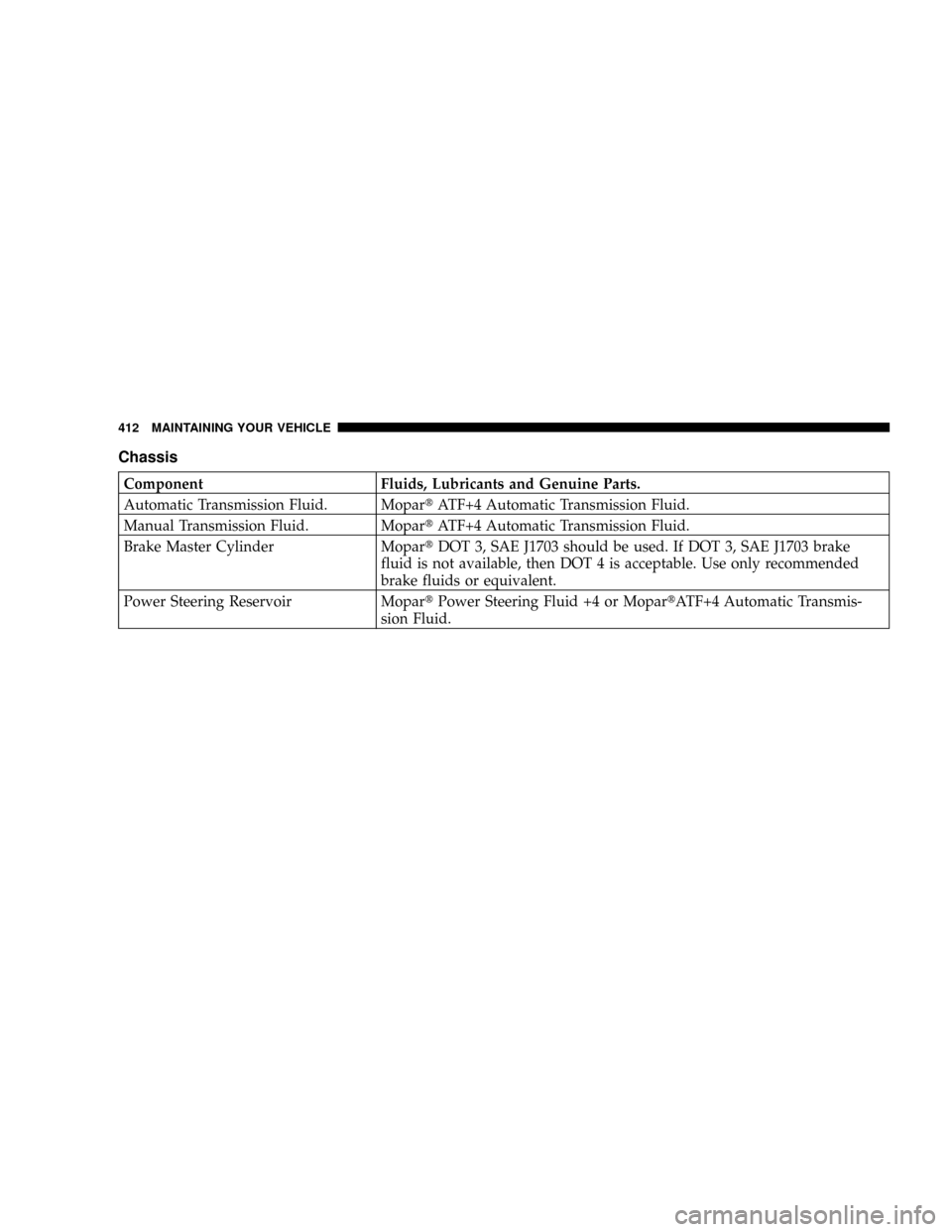
Chassis
Component Fluids, Lubricants and Genuine Parts.
Automatic Transmission Fluid. MopartATF+4 Automatic Transmission Fluid.
Manual Transmission Fluid. MopartATF+4 Automatic Transmission Fluid.
Brake Master Cylinder MopartDOT 3, SAE J1703 should be used. If DOT 3, SAE J1703 brake
fluid is not available, then DOT 4 is acceptable. Use only recommended
brake fluids or equivalent.
Power Steering Reservoir MopartPower Steering Fluid +4 or MopartATF+4 Automatic Transmis-
sion Fluid.
412 MAINTAINING YOUR VEHICLE
Page 416 of 467

At Each Stop for Fuel
²Check the engine oil level about 5 minutes after a fully
warmed engine is shut off. Checking the oil level while
the vehicle is on level ground will improve the accu-
racy of the oil level reading. Add oil only when the
level is at or below the ADD or MIN mark.
²Check the windshield washer solvent and add if
required.
Once a Month
²Check tire pressure and look for unusual wear or
damage.
²Inspect the battery and clean and tighten the terminals
as required.
²Check the fluid levels of coolant reservoir, brake
master cylinder and transaxle and add as needed.
²Check all lights and all other electrical items for correct
operation.
²Check rubber seals on each side of the radiator for
proper fit.
At Each Oil Change
²Change the engine oil filter.
²Inspect the exhaust system.
²Inspect the brake hoses.
²Inspect the CV joints and front suspension compo-
nents.
²Check the automatic transaxle fluid level.
²Check the manual transaxle fluid level and fill plug
condition.
²Check the coolant level, hoses, and clamps.
416 MAINTENANCE SCHEDULES
8
M
A
I
N
T
E
N
A
N
C
E
S
C
H
E
D
U
L
E
S
Page 421 of 467
Miles 39,000 42,000 45,000 48,000 51,000 54,000
(Kilometers) (65 000) (70 000) (75 000) (80 000) (85 000) (90 000)
Change engine oil and engine oil filter, if not
replaced at 3 months.XXXXX X
Rotate tires. X X X
Inspect the brake linings. X
Change the brake fluid. If vehicle is used for
trailer towing.X
Inspect theengine air cleaner filter,replace as
necessary.*X
Change the manual transaxle fluid.² X
Inspect theMake-up air filter.Replace as nec-
essary.X
SCHEDULE ªBºÐALL ENGINES 421
8
M
A
I
N
T
E
N
A
N
C
E
S
C
H
E
D
U
L
E
S
Page 422 of 467
Miles 57,000 60,000 63,000 66,000 69,000 72,000
(Kilometers) (95 000) (100 000) (105 000) (110 000) (115 000) (120 000)
Change engine oil and engine oil filter, if not
replaced at 3 months.XXXXX X
Rotate tires. X X X
Inspect the brake linings. X X
Replace theengine air cleaner filter.X
Replace thespark plugs and ignition cables.X
Inspect the tie rod ends and boot seals. X
Inspect thePCV valveand replace if neces-
sary. Not required if previously changed. * ³X
Replace theMake-up air filter.X
Adjust the generator drive belt tension. X
Change the automatic transaxle fluid and fil-
ter.LX
Flush and replace engine coolant at 60
months, if not done at 102,000 miles.X
422 SCHEDULE ªBºÐALL ENGINES
8
M
A
I
N
T
E
N
A
N
C
E
S
C
H
E
D
U
L
E
S
Page 424 of 467
Miles 93,000 96,000 99,000 102,000 105,000
(Kilometers) (155 000) (160 000) (165 000) (170 000) (175 000)
Change engine oil and engine oil filter, if not re-
placed at 3 months.XXXXX
Rotate tires. X X
Inspect the brake linings. X
Change the brake fluid. If vehicle is used for trailer
towing.X
Inspect theengine air cleaner filterand replace as
necessary.*X
Change the manual transaxle fluid.² X
Replace theengine timing belt.*X
Flush and replace the engine coolant, if not replaced
at 60 months.X
Inspect theMake-up air filter,replace as necessary. X
424 SCHEDULE ªBºÐALL ENGINES
8
M
A
I
N
T
E
N
A
N
C
E
S
C
H
E
D
U
L
E
S