Page 263 of 464
▫Replacement Tires.....................304
▫Alignment And Balance.................305
�Tire Chains...........................306
�Snow Tires...........................307
�Tire Rotation..........................307
�Tire Pressure Monitor System — If Equipped . . . 308
▫Tire Pressure Monitoring Base System Without
Electronic Vehicle Information Center (EVIC) —
If Equipped.........................309
▫Tire Pressure Monitoring Low Pressure
Warnings...........................310
▫Base Tire Pressure Monitoring System With
Electronic Vehicle Information Center (EVIC) —
If Equipped.........................310
▫Service Tire System Soon................312▫Using Your Compact Spare —
Basic Tire Pressure Monitoring System Only . . 313
▫Tire Pressure Monitoring Premium System –
If Equipped.........................314
▫Tire Pressure Monitoring Low Pressure
Warnings...........................314
▫Service Tire System Soon................315
▫General Information...................317
�Fuel Requirements......................318
▫Reformulated Gasoline.................318
▫Gasoline/Oxygenate Blends..............319
▫MMT In Gasoline.....................319
▫Materials Added To Fuel................320
▫Fuel System Cautions..................320
STARTING AND OPERATING 263
5
Page 264 of 464
▫Carbon Monoxide Warnings..............321
�Adding Fuel..........................321
▫Fuel Filler Cap (Gas Cap)...............321
▫Loose Fuel Filler Cap Message............323
�Flexible Fuel— (Fleet Vehicles Only).........324
▫E-85 General Information................324
▫Ethanol Fuel (E-85)....................324
▫Fuel Requirements....................324
▫Selection Of Engine Oil For Flexible Fuel
Vehicles (E-85) And Gasoline Vehicles.......325
▫Starting............................325
▫Cruising Range.......................326
▫Replacement Parts.....................326▫Maintenance.........................326
�Vehicle Loading........................326
▫Vehicle Certification Label...............327
▫Gross Vehicle Weight Rating (GVWR).......327
▫Gross Axle Weight Rating (GAWR).........327
▫Overloading.........................328
▫Loading............................328
�Trailer Towing.........................329
▫Common Towing Definitions.............330
▫Trailer Hitch Classification...............333
▫Trailer Towing Weights
(Maximum Trailer Weight Ratings).........334
▫Trailer And Tongue Weight..............335
264 STARTING AND OPERATING
Page 266 of 464
STARTING PROCEDURES
Before starting your vehicle, adjust your seat, adjust both
inside and outside mirrors, and fasten your seat belts.WARNING!
•Be sure to turn off the engine if you want to rest or
sleep in your car. Accidents can be caused by
inadvertently moving the gear selection lever or by
pressing the accelerator pedal. This may cause ex-
cessive heat in the exhaust system, resulting in
overheating and vehicle fire which may cause seri-
ous or fatal injuries.
•NEVER leave children alone in a vehicle. Leaving
children in a vehicle unattended is dangerous for a
number of reasons. A child or others could be
seriously or fatally injured. Don’t leave the keys in
the ignition. A child could operate power windows,
other controls, or move the vehicle
•Do not leave children or animals inside parked
vehicles in hot weather. Interior heat build up may
cause serious injury or death.
266 STARTING AND OPERATING
Page 268 of 464
If Engine Fails To Start
If the engine fails to start after you have followed the
normal starting procedure, it may be flooded. Push the
accelerator pedal all the way to the floor and hold it there
while cranking the engine. This should clear any excess
fuel in case the engine is flooded.
CAUTION!
To prevent damage to the starter, do not crank the
engine for more than 15 seconds at a time. Wait 10 to
15 seconds before trying again.
WARNING!
Never pour fuel or other flammable liquid into the
throttle body air inlet opening in an attempt to start
the vehicle. This could result in flash fire causing
serious personal injury.
268 STARTING AND OPERATING
Page 269 of 464
WARNING!
Do not attempt to push or tow your vehicle to get it
started. Vehicles equipped with an automatic trans-
mission cannot be started this way. Unburned fuel
could enter the catalytic converter and once the
engine has started, ignite and damage the converter
and vehicle. If the vehicle has a discharged battery,
booster cables may be used to obtain a start from a
booster battery or the battery in another vehicle. This
type of start can be dangerous if done improperly.
See section 6 of this manual for the proper jump
starting procedures and follow them carefully.
If the engine has been flooded, it may start to run, but not
have enough power to continue running when the key is
released. If this occurs, continue cranking with the accel-
erator pedal pushed all the way to the floor. Release the
accelerator pedal and the key once the engine is running
smoothly.
If the engine shows no sign of starting after two 15
second periods of cranking with the accelerator pedal
held to the floor, the normal starting procedure should be
repeated.
After Starting
The idle speed will automatically decrease as the engine
warms up.
STARTING AND OPERATING 269
5
Page 270 of 464

ENGINE BLOCK HEATER — IF EQUIPPED
The engine block heater warms engine coolant and
permits quicker starts in cold weather. Connect the cord
to a standard 110-115 volt AC electrical outlet with a
grounded, three-wire extension cord.
The engine block heater cord is routed under the hood on
the driver side of the vehicle. It has a removable cap that
is located on the driver side of the Integrated Power
Module.
WARNING!
Remember to disconnect the cord before driving.
Damage to the 110-115 volt electrical cord could
cause electrocution.
AUTOMATIC TRANSMISSION
CAUTION!
Damage to the transmission may occur if the follow-
ing precautions are not observed:
•Shift into PARK only after the vehicle has come to
a complete stop.
•Shift into or out of REVERSE only after the
vehicle has come to a complete stop and the
engine is at idle speed.
•Do not shift from REVERSE, PARK, or NEUTRAL
into any forward gear when the engine is above
idle speed.
•Before shifting into any gear, make sure your foot
is firmly on the brake pedal.
270 STARTING AND OPERATING
Page 271 of 464

WARNING!
It is dangerous to shift the selector lever out of “P” or
“N” if the engine speed is higher than idle speed. If
your foot is not firmly on the brake pedal, the
vehicle could accelerate quickly forward or in re-
verse. You could lose control of the vehicle and hit
someone or something. Only shift into gear when
the engine is idling normally and when your right
foot is firmly on the brake pedal.
Brake/Transmission Interlock System
This system prevents you from moving the gear shift out
of PARK and into any gear unless the brake pedal is
pressed. This system is active only while the ignition
switch is in the ACCESSORY or ON position. Always
depress thebrake pedal first,before moving the gear
selector out of PARK.
Automatic Transmission Ignition Interlock System
This system prevents the key from being removed unless
the shift lever is in PARK. It also prevents shifting out of
PARK unless the key is in the ACCESSORY or ON
position.
NOTE:If a malfunction occurs, the system will trap the
key in the ignition cylinder to warn you that this safety
feature is inoperable. The engine can be started and
stopped but the key cannot be removed until you obtain
service.
Four Speed Automatic Transmission
The electronically controlled transmission provides a
precise shift schedule. The transmission electronics are
self-calibrating; therefore, the first few shifts on a new
vehicle, may be somewhat abrupt. This is a normal
condition, and precision shifts will develop within a few
hundred miles.
STARTING AND OPERATING 271
5
Page 273 of 464
WARNING!
Never use Park position on an automatic transmis-
sion as a substitute for the parking brake. Always
apply parking brake fully when parked to guard
against vehicle movement and possible injury or
damage.
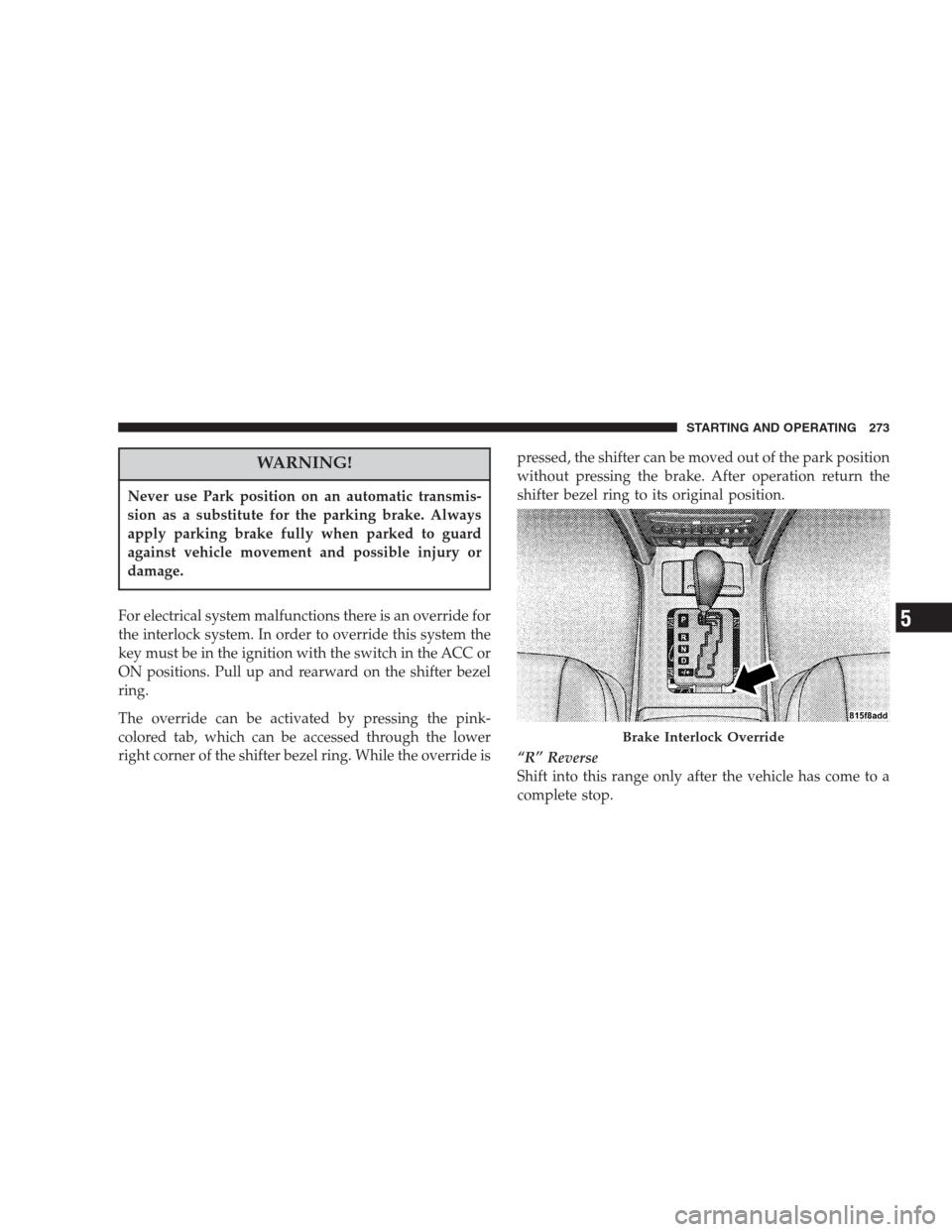
For electrical system malfunctions there is an override for
the interlock system. In order to override this system the
key must be in the ignition with the switch in the ACC or
ON positions. Pull up and rearward on the shifter bezel
ring.
The override can be activated by pressing the pink-
colored tab, which can be accessed through the lower
right corner of the shifter bezel ring. While the override ispressed, the shifter can be moved out of the park position
without pressing the brake. After operation return the
shifter bezel ring to its original position.
“R” Reverse
Shift into this range only after the vehicle has come to a
complete stop.
Brake Interlock Override
STARTING AND OPERATING 273
5