Page 40 of 464
OCCUPANT RESTRAINTS
Some of the most important safety features in your
vehicle are the restraint systems. These include the front
and rear seat belts for the driver and all passengers, front
airbags for both the driver and front passenger, and if
equipped, left and right window bags for the driver and
passengers seated next to a window and a driver inflat-
able knee blocker. If you will be carrying children too
small for adult-size seat belts, your seat belts or the
LATCH feature (refer to the Child Restraint section in this
manual), can be used to hold infant and child restraint
systems.
NOTE:The front airbags have a multi stage inflator
design. This allows the airbag to have different rates of
inflation that are based on collision severity.
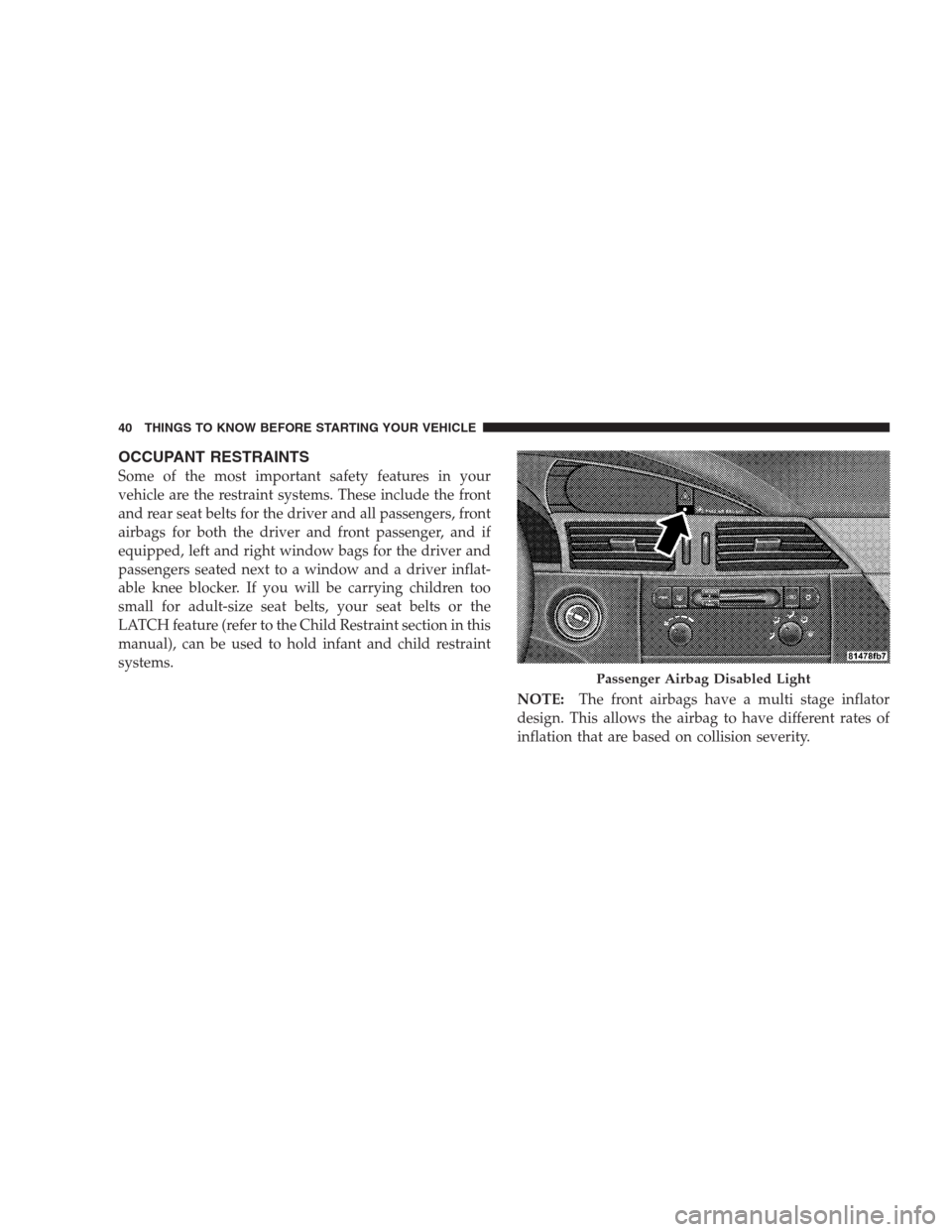
Passenger Airbag Disabled Light
40 THINGS TO KNOW BEFORE STARTING YOUR VEHICLE
Page 41 of 464
Please pay close attention to the information in this
section. It tells you how to use your restraint system
properly to keep you and your passengers as safe as
possible.
WARNING!
In a collision, you and your passengers can suffer
much greater injuries if you are not properly buck-
led up. You can strike the interior of your vehicle or
other passengers, or you can be thrown out of the
vehicle. Always be sure you and others in your
vehicle are buckled up properly.
Buckle up even though you are an excellent driver, even
on short trips. Someone on the road may be a poor driver
and cause a collision that includes you. This can happen
far away from home or on your own street.Research has shown that seat belts save lives, and they
can reduce the seriousness of injuries in a collision. Some
of the worst injuries happen when people are thrown
from the vehicle. Seat belts reduce the possibility of
ejection and the risk of injury caused by striking the
inside of the vehicle.Everyonein a motor vehicle should
be belted at all times.
Lap/Shoulder Belts
All the seats in your vehicle are equipped with Lap/
Shoulder Belts.
The belt webbing retractor is designed to lock during
very sudden stops or collisions. This feature allows the
shoulder part of the belt to move freely with you under
normal conditions. But in a collision, the belt will lock
and reduce the risk of your striking the inside of the
vehicle or being thrown out.
THINGS TO KNOW BEFORE STARTING YOUR VEHICLE 41
2
Page 46 of 464
WARNING!
A frayed or torn belt could rip apart in a collision
and leave you with no protection. Inspect the belt
system periodically, checking for cuts, frays, or loose
parts. Damaged parts must be replaced immediately.
Do not disassemble or modify the system. Seat belt
assemblies must be replaced after a collision if they
have been damaged (bent retractor, torn webbing,
etc.).
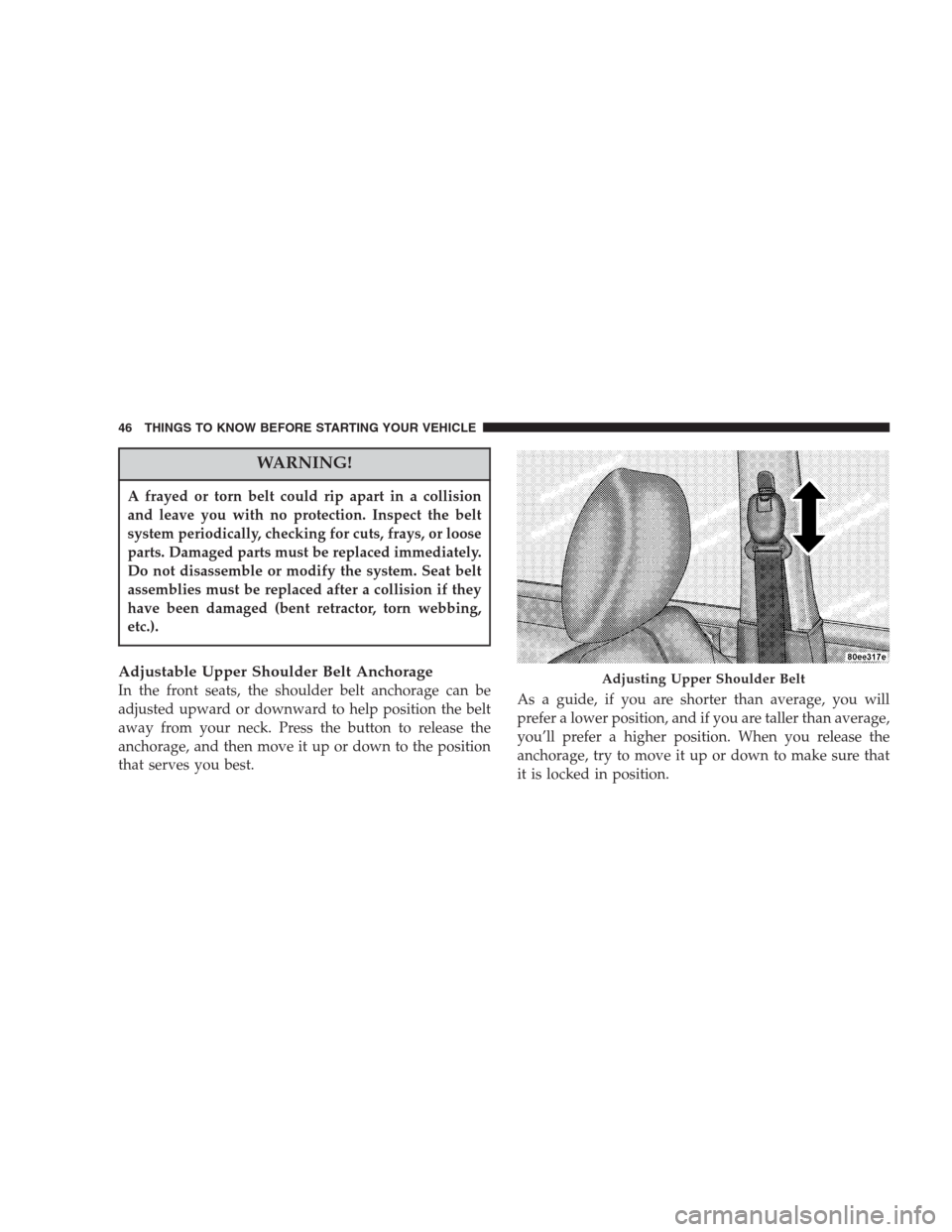
Adjustable Upper Shoulder Belt Anchorage
In the front seats, the shoulder belt anchorage can be
adjusted upward or downward to help position the belt
away from your neck. Press the button to release the
anchorage, and then move it up or down to the position
that serves you best.As a guide, if you are shorter than average, you will
prefer a lower position, and if you are taller than average,
you’ll prefer a higher position. When you release the
anchorage, try to move it up or down to make sure that
it is locked in position.Adjusting Upper Shoulder Belt
46 THINGS TO KNOW BEFORE STARTING YOUR VEHICLE
Page 48 of 464
Enhanced Seat Belt Use Reminder System
(BeltAlert) — Driver Front Seat Only
If the occupied driver’s seat belt has not been buckled
within 60 seconds of starting the vehicle and if the vehicle
speed is greater than 5 mph (8 km/h), the Enhanced
Warning System (BeltAlert) will alert the driver to buckle
their seat belt. The driver should also instruct all other
occupants to buckle their seat belts. Once the warning is
triggered, the Enhanced Warning System (BeltAlert) will
continue to chime and flash the Seat Belt Warning Light
for 96 seconds or until the driver’s seat belt is buckled.
The Enhanced Warning System (BeltAlert) will be reacti-
vated if the driver’s seat belt is unbuckled for more than
10 seconds and the vehicle speed is greater than 5 mph (8
km/h).
Belt Alert Programming
The Enhanced Warning System (BeltAlert) can be en-
abled or disabled by your authorized dealer or by
following these steps:
NOTE:The following steps must occur within the first
60 seconds of the ignition switch being turned to the
ON/RUN position. DaimlerChrysler does not recom-
mend deactivating the Enhanced Warning System
(BeltAlert).
1. Turn the ignition switch to the OFF/LOCK position,
and buckle the driver’s seat belt.
2. Turn the ignition switch to the ON/RUN position
(engine does not need to be running), and wait for the
Seat Belt Warning Light to turn off.
48 THINGS TO KNOW BEFORE STARTING YOUR VEHICLE
Page 49 of 464
3. Within 60 seconds of turning the ignition switch to the
ON/RUN position, unbuckle and then re-buckle the
driver’s seat belt at least three times within 10 seconds,
ending with the seat belt buckled.
NOTE:Watch for the Seat Belt Warning Light to turn on
while unbuckling and off while re-buckling the seat belt.
It may be necessary to retract the seat belt each time,
while unbuckling and re-buckling the seat belt.
4. Turn the ignition switch to the OFF/LOCK position. A
single chime will sound to signify that you have success-
fully completed the programming.
The Enhanced Warning System (BeltAlert) can be reacti-
vated by repeating this procedure.
NOTE:Although the Enhanced Warning System
(BeltAlert) has been deactivated, the Seat Belt Warning
Light will continue to illuminate while the driver’s or
front passenger’s seat belt remains unbuckled.Seat Belts and Pregnant Women
We recommend that pregnant women use the seat belts
throughout their pregnancies. Keeping the mother safe is
the best way to keep the baby safe.
Pregnant women should wear the lap part of the belt
across the thighs and as snug across the hips as possible.
Keep the belt low so that it does not come across the
abdomen. That way the strong bones of the hips will take
the force if there is a collision.
Seat Belt Extender
If a seat belt is too short, even when fully extended and
when the adjustable upper shoulder belt anchorage (if
equipped) is in its lowest position, your dealer can
provide you with a seat belt extender. This extender
should be used only if the existing belt is not long
enough. When it is not required, remove the extender
and stow it.
THINGS TO KNOW BEFORE STARTING YOUR VEHICLE 49
2
Page 51 of 464
Also, the front passenger airbag is certified to the Federal
regulations that define Occupant Classification (Refer to
“Occupant Classification System” in this section).
This vehicle may also be equipped with a driver inflat-
able knee blocker located on the instrument panel below
the steering column.
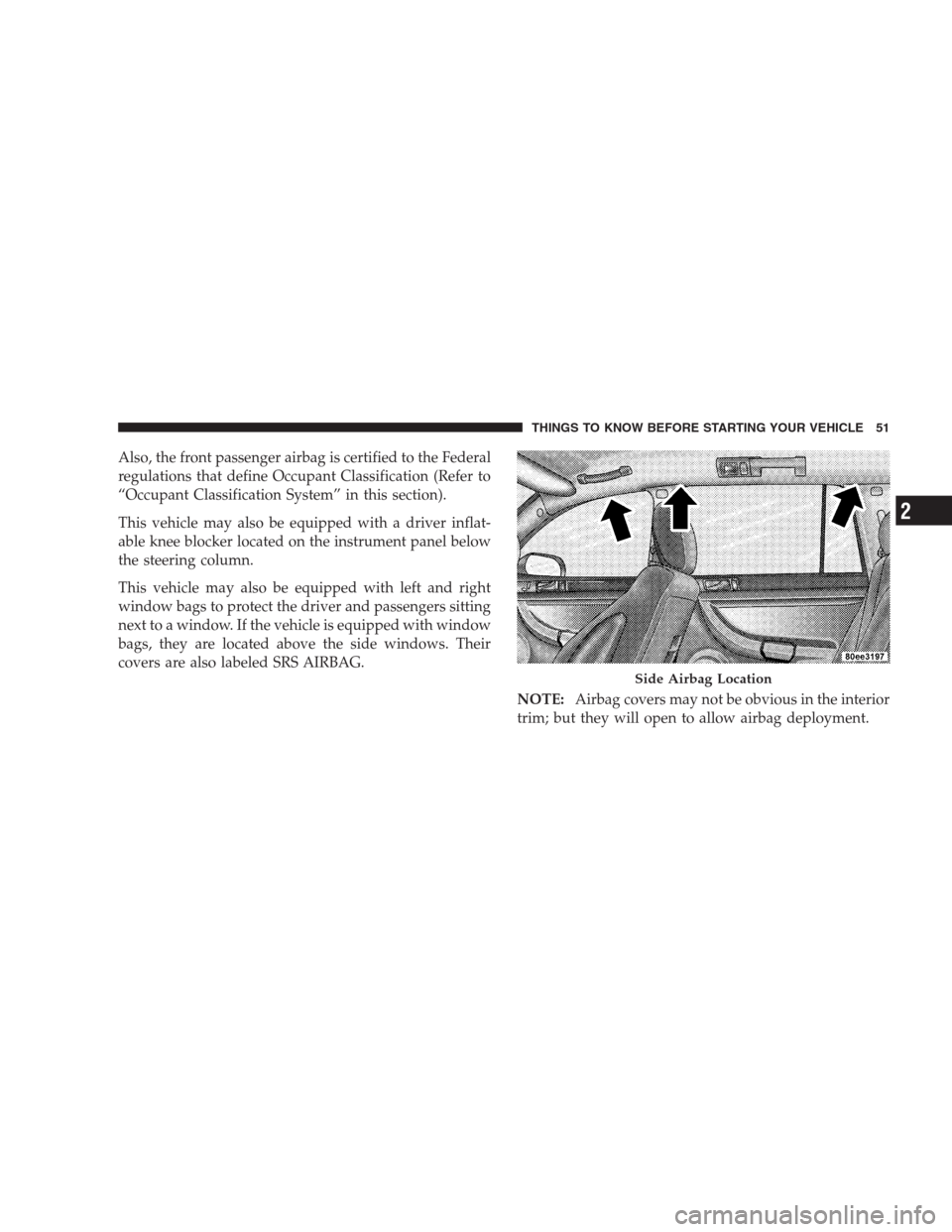
This vehicle may also be equipped with left and right
window bags to protect the driver and passengers sitting
next to a window. If the vehicle is equipped with window
bags, they are located above the side windows. Their
covers are also labeled SRS AIRBAG.
NOTE:Airbag covers may not be obvious in the interior
trim; but they will open to allow airbag deployment.
Side Airbag Location
THINGS TO KNOW BEFORE STARTING YOUR VEHICLE 51
2
Page 52 of 464
WARNING!
•Do not put anything on or around the airbag covers
or attempt to manually open them. You may damage
the airbags and you could be injured because the
airbags are not there to protect you. These protec-
tive covers for the airbag cushions are designed to
open only when the airbags are inflating.
•If your vehicle is equipped with left and right
window bags, do not stack luggage or other cargo up
high enough to block the location of the side curtain
airbag. The area where the side curtain airbag is
located should remain free from any obstructions.
•If your vehicle is equipped with left and right
window bags, do not have any accessory items
installed which will alter the roof, including adding
a sunroof to your vehicle. Do not add roof racks that
require permanent attachments (bolts or screws) for
installation on the vehicle roof. Do not drill into the
roof of the vehicle for any reason.
NOTE:Do not use a clothing bar mounted to the coat
hooks in this vehicle. A clothing bar will impede the
proper performance of the window bags.
Front airbags, along with seat belts, and front seat belt
buckle pretensioners, work with the instrument panel
knee blockers to provide improved protection for the
driver and front passenger. Left and right window bags
also work with seat belts to improve occupant protection.
The seat belts are designed to protect you in many types
of collisions. The front airbags deploy in moderate to
severe frontal collisions.
NOTE:The passenger front airbag may not deploy even
when the driver front airbag has if the Occupant Classi-
fication System (refer to “Occupant Classification Sys-
tem” in this section) has determined the seat is empty or
is occupied by a child.
52 THINGS TO KNOW BEFORE STARTING YOUR VEHICLE
Page 55 of 464
Airbag System Components
The airbag system consists of the following:
•Occupant Restraint Controller (ORC)
•AIRBAG Light
•Driver Airbag
•Front Passenger Airbag
•Supplemental Side Curtain Airbags (If Equipped)
•Front Impact Sensors
•Side Impact Sensors (If Equipped)
•Steering Wheel and Column
•Instrument Panel
•Interconnecting Wiring
•Seat Belt Reminder Light
•Knee Impact Bolster
•Driver Inflatable Knee Blocker
•Front Passenger Seat Occupant Classification System
(OCS) — If Equipped
Occupant Classification Module
Passenger Airbag Disabled (PAD) Indicator Light
Interconnecting Wiring
Bladder Assembly
Belt Tension Sensor
•Front Seat Belt Buckle Pretensioners
THINGS TO KNOW BEFORE STARTING YOUR VEHICLE 55
2