2007 CHRYSLER PACIFICA warning
[x] Cancel search: warningPage 49 of 464

3. Within 60 seconds of turning the ignition switch to the
ON/RUN position, unbuckle and then re-buckle the
driver’s seat belt at least three times within 10 seconds,
ending with the seat belt buckled.
NOTE:Watch for the Seat Belt Warning Light to turn on
while unbuckling and off while re-buckling the seat belt.
It may be necessary to retract the seat belt each time,
while unbuckling and re-buckling the seat belt.
4. Turn the ignition switch to the OFF/LOCK position. A
single chime will sound to signify that you have success-
fully completed the programming.
The Enhanced Warning System (BeltAlert) can be reacti-
vated by repeating this procedure.
NOTE:Although the Enhanced Warning System
(BeltAlert) has been deactivated, the Seat Belt Warning
Light will continue to illuminate while the driver’s or
front passenger’s seat belt remains unbuckled.Seat Belts and Pregnant Women
We recommend that pregnant women use the seat belts
throughout their pregnancies. Keeping the mother safe is
the best way to keep the baby safe.
Pregnant women should wear the lap part of the belt
across the thighs and as snug across the hips as possible.
Keep the belt low so that it does not come across the
abdomen. That way the strong bones of the hips will take
the force if there is a collision.
Seat Belt Extender
If a seat belt is too short, even when fully extended and
when the adjustable upper shoulder belt anchorage (if
equipped) is in its lowest position, your dealer can
provide you with a seat belt extender. This extender
should be used only if the existing belt is not long
enough. When it is not required, remove the extender
and stow it.
THINGS TO KNOW BEFORE STARTING YOUR VEHICLE 49
2
Page 50 of 464
WARNING!
Using a seat belt extender when not needed can
increase the risk of injury in a collision. Only use
when the lap belt is not long enough when it is worn
low and snug, and in the recommended seating
positions. Remove and store the extender when not
needed.
Driver and Front Passenger Supplemental
Restraint System - Airbag
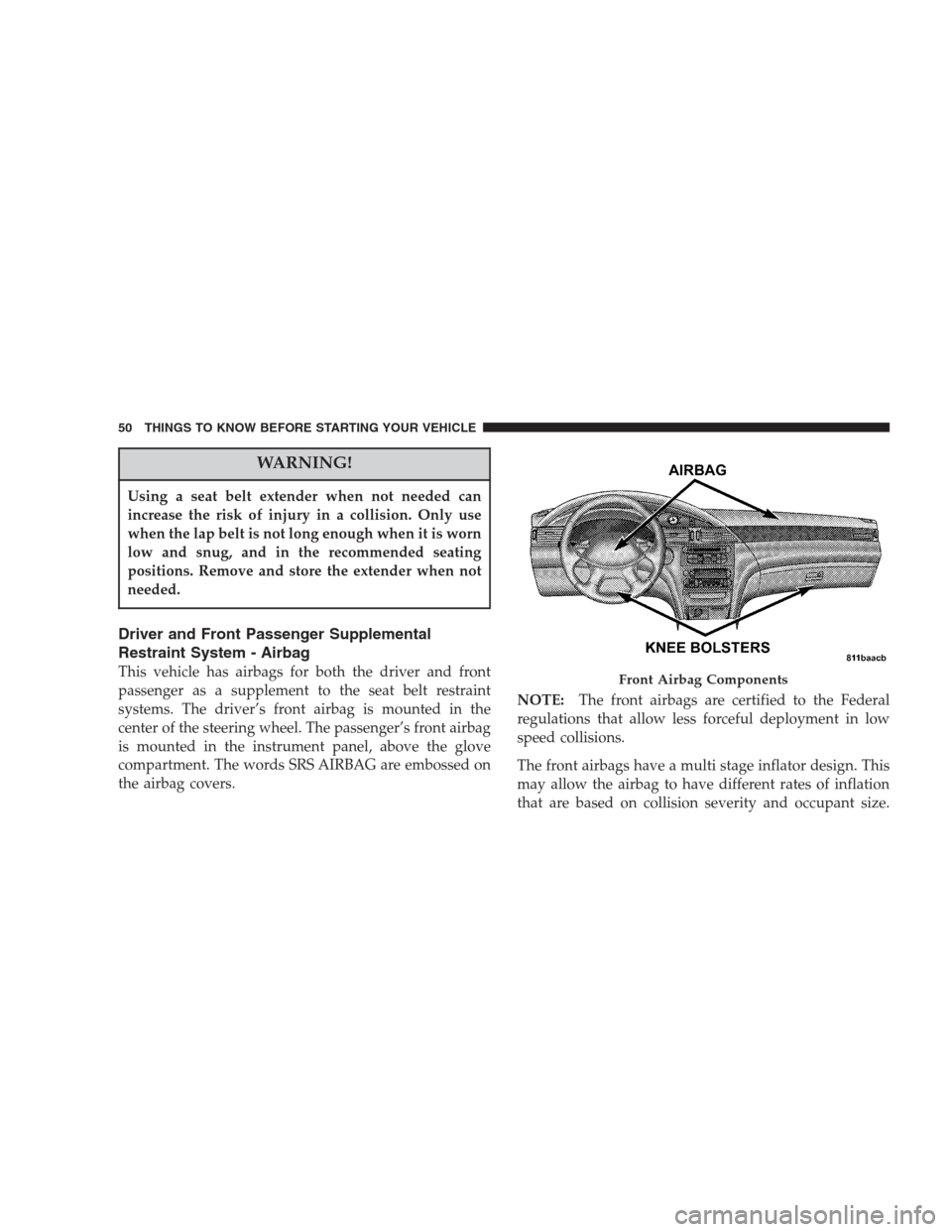
This vehicle has airbags for both the driver and front
passenger as a supplement to the seat belt restraint
systems. The driver’s front airbag is mounted in the
center of the steering wheel. The passenger’s front airbag
is mounted in the instrument panel, above the glove
compartment. The words SRS AIRBAG are embossed on
the airbag covers.NOTE:The front airbags are certified to the Federal
regulations that allow less forceful deployment in low
speed collisions.
The front airbags have a multi stage inflator design. This
may allow the airbag to have different rates of inflation
that are based on collision severity and occupant size.Front Airbag Components
50 THINGS TO KNOW BEFORE STARTING YOUR VEHICLE
Page 52 of 464
WARNING!
•Do not put anything on or around the airbag covers
or attempt to manually open them. You may damage
the airbags and you could be injured because the
airbags are not there to protect you. These protec-
tive covers for the airbag cushions are designed to
open only when the airbags are inflating.
•If your vehicle is equipped with left and right
window bags, do not stack luggage or other cargo up
high enough to block the location of the side curtain
airbag. The area where the side curtain airbag is
located should remain free from any obstructions.
•If your vehicle is equipped with left and right
window bags, do not have any accessory items
installed which will alter the roof, including adding
a sunroof to your vehicle. Do not add roof racks that
require permanent attachments (bolts or screws) for
installation on the vehicle roof. Do not drill into the
roof of the vehicle for any reason.
NOTE:Do not use a clothing bar mounted to the coat
hooks in this vehicle. A clothing bar will impede the
proper performance of the window bags.
Front airbags, along with seat belts, and front seat belt
buckle pretensioners, work with the instrument panel
knee blockers to provide improved protection for the
driver and front passenger. Left and right window bags
also work with seat belts to improve occupant protection.
The seat belts are designed to protect you in many types
of collisions. The front airbags deploy in moderate to
severe frontal collisions.
NOTE:The passenger front airbag may not deploy even
when the driver front airbag has if the Occupant Classi-
fication System (refer to “Occupant Classification Sys-
tem” in this section) has determined the seat is empty or
is occupied by a child.
52 THINGS TO KNOW BEFORE STARTING YOUR VEHICLE
Page 54 of 464
You should read the instructions provided with your
child restraint to make sure that you are using it properly.
2.All occupants should wear their lap and shoulder
belts properly.
3.The driver and front passenger seats should be
moved back as far as practical to allow the front airbags
room to inflate.
4.If your vehicle has left and right window bags, do
not lean against the door, airbags will inflate forcefully
into the space between you and the door.WARNING!
•Relying on the airbags alone could lead to more
severe injuries in a collision. The airbags work
with your seat belt to restrain you properly. In
some collisions the airbags won’t deploy at all.
Always wear your seat belts even though you
have airbags.
•Being too close to the steering wheel or instru-
ment panel during front airbag deployment could
cause serious injury. Airbags need room to inflate.
Sit back, comfortably extending your arms to
reach the steering wheel or instrument panel.
•If the vehicle has left and right window bags, they
also need room to inflate. Do not lean against the
door or window. Sit upright in the center of the
seat.
54 THINGS TO KNOW BEFORE STARTING YOUR VEHICLE
Page 56 of 464
How The Airbag System Works
•
TheOccupant Restraint Controller (ORC)determines
if a frontal collision is severe enough to require the
airbags to inflate. Based on the level of collision
severity, the front control module determines the
proper rate of inflation. The front airbag inflators are
designed to provide different rates of airbag inflation.
•The ORC may modify the rate of inflation based on the
occupant size provided by the Occupant Classification
Module.
•The ORC will not detect side, roll over, or rear impacts.
•The ORC monitors the readiness of the electronic parts
of the system whenever the ignition switch is in the
START or RUN positions. These include all of the
items listed above except the steering wheel andcolumn, instrument panel and passenger knee bol-
sters. If the key is in the OFF position, in the ACC
position, or not in the ignition, the airbags are not on
and will not inflate.
•Also, the ORC turns on the AIRBAG warn-
ing light and PAD indicator light in the
center of the instrument panel for 6 to 8
seconds for a self-check when the ignition is
first turned on. After the self-check, the AIRBAG
warning light will turn off. The PAD indicator light
will function normally (Refer to “Passenger Airbag
Disable (PAD) Indicator Light” in this section). If the
ORC detects a malfunction in any part of the system, it
turns on the AIRBAG warning light either momen-
tarily or continuously. A single chime will sound if the
light comes on again after initial start up.
56 THINGS TO KNOW BEFORE STARTING YOUR VEHICLE
Page 57 of 464

WARNING!
Ignoring the AIRBAG warning light in your instru-
ment panel could mean you won’t have the airbags
to protect you in a collision. If the light does not
come on, stays on after you start the vehicle, or if it
comes on as you drive, have the airbag system
checked right away.
•TheDriver and Passenger Airbag/Inflator Unitsare
located in the center of the steering wheel and the right
side of the instrument panel. When the ORC and
impact sensors detects a collision requiring the air-
bags, it signals the inflator units. A large quantity of
nontoxic gas is generated to inflate the front airbags.
Different airbag inflation rates may be possible based
on collision severity and occupant size. The steering
wheel hub trim cover and the upper right side of the
instrument panel separate and fold out of the way asthe airbags inflate to their full size. The airbags fully
inflate in about 50–70 milliseconds. This is about half
of the time it takes to blink your eyes. The airbags then
quickly deflate while helping to restrain the driver and
front passenger.
The driver’s and passenger’s front airbag gas is vented
through the airbag material towards the instrument
panel. In this way the airbags do not interfere with
your control of the vehicle.•TheSide Impact SRS Window Bagsare designed to
activate only in certain side collisions. When the ORC
and the side impact sensors (with side impact option)
detects a collision requiring the window bags to
inflate, it signals the inflators on the crash side of the
vehicle. A quantity of nontoxic gas is generated to
inflate the window bag. The inflating window bag
pushes the outside edge of the headliner out of the
way and covers the window. The airbag inflates in
THINGS TO KNOW BEFORE STARTING YOUR VEHICLE 57
2
Page 59 of 464

If there is a rapid change in temperature or humidity,
the OCS may not be able to properly approximate
occupant size. If your seat including your trim cover
and cushion needs to be serviced in any way (includ-
ing removal or loosening/tightening of seat attach-
ment bolts), take the vehicle to your authorized dealer.
Only manufacturer approved seat accessories may be
used.
If there is a fault present in the system, the AIRBAG
warning light will illuminate indicating that you should
take the vehicle to an authorized dealer. In the presence
of an occupant in the passenger seat, if both the PAD
indicator light and AIRBAG warning light are illumi-
nated the airbag will be disabled.
The ORC will not allow front airbag deployment in the
event of a collision for occupants classified into the
empty or child size categories. The PAD indicator light
will illuminate indicating that the Passenger Airbag isOFF when the OCS has determined that the occupant size
category is a child. Also, when the seat is empty or an
object that weighs less than a predetermined threshold is
placed on the seat, the light will remain OFF. (The PAD
indicator light is an amber light located on the center of
the instrument panel above the climate controls.)
Passenger Airbag Disabled Light
THINGS TO KNOW BEFORE STARTING YOUR VEHICLE 59
2
Page 60 of 464

For almost all sizes of properly seated adults, the airbag
will be enabled in the event of a collision. For small
teenagers and some small adults, depending on size, the
airbag may or may not be enabled in the event of a
collision. Both drivers and passengers should always use
the PAD indicator light as an indication if the front
passenger is properly positioned or not. If the PAD
indicator light comes on when an adult is in the passen-
ger seat, have the passenger re-position themselves in the
seat until the light goes out.
Remember, if the PAD indicator light is illuminated the
passenger front airbag will not inflate. For almost all
properly installed child restraints, the “PAD Indicator
Light” will be illuminated indicating that the front pas-
senger airbag is turned off and will not inflate. If the
“PAD Indicator Light” is not illuminated, DO NOT
assume the airbag is turned off and move the childrestraint to the rear seat. A deploying passenger airbag
can cause death or serious injury to a child in a rear
facing infant seat.
NOTE:Even though this vehicle is equipped with an
Occupant Classification System, children 12 years and
under should always ride buckled up in a rear seat in an
appropriate child restraint.
•TheOccupant Classification Module (OCM)is lo-
cated beneath the front passenger seat. The OCM
classifies the occupant into one of three size categories
based on the input from the Bladder Assembly and
Belt Tension Sensor. The size categories include empty,
child, and adult. The OCM sends the Occupant Clas-
sification to the ORC to identify if a front passenger
airbag is allowed. If a fault is present, the AIRBAG
warning light is illuminated.
60 THINGS TO KNOW BEFORE STARTING YOUR VEHICLE