Page 314 of 464

Monitoring Lamp to be ON, and a Chime will sound.
This sequence will repeat for every key cycle until the
original Tire Pressure Monitoring System tire has been
properly repaired (or replaced) and put back on the
vehicle in place of the compact spare tire.
Tire Pressure Monitoring Premium System – If
Equipped
The Tire Pressure Monitor System (TPMS) uses wireless
technology with wheel rim mounted electronic sensors to
monitor tire pressure levels. Sensors, mounted to each
wheel as part of the valve stem, transmit tire pressure
readings to the Receiver Module.
NOTE:It is particularly important, for you to check the
tire pressure in all of your tires regularly and to maintain
the proper pressure.
The Tire Pressure Monitor System (TPMS) consists of the
following components:
•Receiver Module
•4 Wheel Sensors
•Wheel Sensor Trigger Modules (mounted in three of
the four wheel wells)
•Various Tire Pressure Monitoring System Messages,
which display in the Electronic Vehicle Information
Center (EVIC)
•Yellow Tire Pressure Monitoring Telltale Light
Tire Pressure Monitoring Low Pressure Warnings
The Tire Pressure Monitoring System Telltale Lamp will
illuminate in the instrument cluster, and an audible
chime will be activated when one or more of the four
active road tire pressures are low. The audible chime will
sound once every ignition cycle for each condition that it
detects. In addition, the Electronic Vehicle Information
Center (EVIC) will show a graphic display of the pressure
value(s) with the low tire(s) flashing.
314 STARTING AND OPERATING
Page 315 of 464

NOTE:A low spare tire will not cause the Tire Pressure
Monitoring System Telltale Lamp to illuminate or the
chime to sound.
Should a low tire condition occur on any of the four
active road tire(s), you should stop as soon as possible,
and inflate the low tire(s) that is/are flashing on the
graphic display to the vehicle’s recommended cold plac-
ard pressure value. The system will automatically up-
date, the graphic display of the pressure value(s) will
stop flashing, and the Tire Pressure Monitoring System
Lamp will extinguish once the updated tire pressure(s)
have been received.
NOTE:The vehicle may need to be driven for up to 10
minuets above 15 mph (25 km/h) to receive this infor-
mation.Service Tire System Soon
The Tire Pressure Monitoring Telltale Lamp will flash on
and off for 60 seconds in the instrument cluster, and an
audible chime when a system fault is detected. The flash
cycle will repeat every 10 minutes, without an audible
chime, until the fault condition not longer exists.
In addition the Electronic Vehicle Information Center
(EVIC) will display a“SERVICE TIRE SYSTEM SOON”
text message for 3 seconds. This text message is then
followed by “— —”, for the pressure value indicating
which of the Tire Pressure Monitoring Sensor(s) is not
being received.
If the ignition key is cycled, this sequence will repeat,
providing the system fault still exists. Iff the system fault
no longer exists, the Tire Pressure Monitoring System
Telltale Lamp will no longer flash, the“SERVICE TIRE
SYSTEM SOON”text message will no longer display,
and a pressure value will be displayed instead of dashes.
STARTING AND OPERATING 315
5
Page 316 of 464

NOTE:Your vehicle is equipped with a compact spare
wheel and tire assembly that does not have a tire pressure
monitoring sensor. Therefore, it will not be monitored by
the Tire Pressure Monitoring System. In the event that a
compact spare tire is used to replace a low pressure road
tire, the next ignition key cycle will still show the Tire
Pressure Monitoring Lamp to be ON, a Chime will
sound, and the Electronic Vehicle Information Center
(EVIC) will still show the low tire pressure value flashing
on the graphic display. This sequence will repeat for
every key cycle until the original Tire Pressure Monitor-
ing System (TPMS) tire has been properly repaired (or
replaced) and put back on the vehicle in place of the
compact spare tire.CAUTION!
The Tire Pressure Monitoring System (TPMS) has
been optimized for the original equipment tires and
wheels. TPMS pressures have been established for
the tire size equipped on your vehicle. Undesirable
system operation or sensor damage may result when
using replacement equipment that is not of the same
size, type, and/or style. After-market wheels can
cause sensor damage. Do not use tire sealant from a
can, or balance beads if your vehicle is equipped
with a TPMS, as damage to the sensors may result.
316 STARTING AND OPERATING
Page 338 of 464
4. Tongue weight rating for the trailer hitch utilized
(This requirement may limit the ability to always
achieve the 10% to 15% range of tongue weight as a
percentage of total trailer weight).
Towing Requirements — Tires
Do not attempt to tow a trailer while using a compact
spare tire.
Proper tire inflation pressures are essential to the safe
and satisfactory operation of your vehicle. Refer to the
Tires–General Information section of this manual on
Tire Pressures for proper tire inflation procedures.
Also, check the trailer tires for proper tire inflation
pressures before trailer usage.
Check for signs of tire wear or visible tire damage
before towing a trailer. Refer to the Tires–General
Information section of this manual on Tread Wear
Indicators for the proper inspection procedure.
When replacing tires refer to the Tires–General Infor-
mation section of this manual on Replacement Tires for
proper tire replacement procedures. Replacing tires
with a higher load carrying capacity will not increase
the vehicle’s GVWR and GAWR limits.
Towing Requirements — Trailer Brakes
Donotinterconnect the hydraulic brake system or
vacuum system of your vehicle with that of the trailer.
This could cause inadequate braking and possible
personal injury.
An electronically actuated trailer brake controller is
required when towing a trailer with electronically
actuated brakes. When towing a trailer equipped with
a hydraulic surge actuated brake system, an electronic
brake controller is not required.
338 STARTING AND OPERATING
Page 343 of 464
WHAT TO DO IN EMERGENCIES
CONTENTS
�Hazard Warning Flasher..................344
�If Your Engine Overheats.................345
�Jacking And Tire Changing................346
▫Jack Location........................346
▫Spare Tire Stowage....................348
▫Preparations For Jacking................349
▫Jacking Instructions....................350
�Jump-Starting Procedure..................354�Freeing A Stuck Vehicle..................356
�Towing A Disabled Vehicle................357
▫With Ignition Key.....................357
▫Without The Ignition Key...............358
▫Towing This Vehicle Behind Another Vehicle
(Flat Towing With All Four Wheels On The
Ground)............................358
▫Towing This Vehicle Behind Another Vehicle
With A Tow Dolly.....................359
6
Page 348 of 464
Spare Tire Stowage
Five Passenger Seating
The spare tire is stowed under the rear of the vehicle by
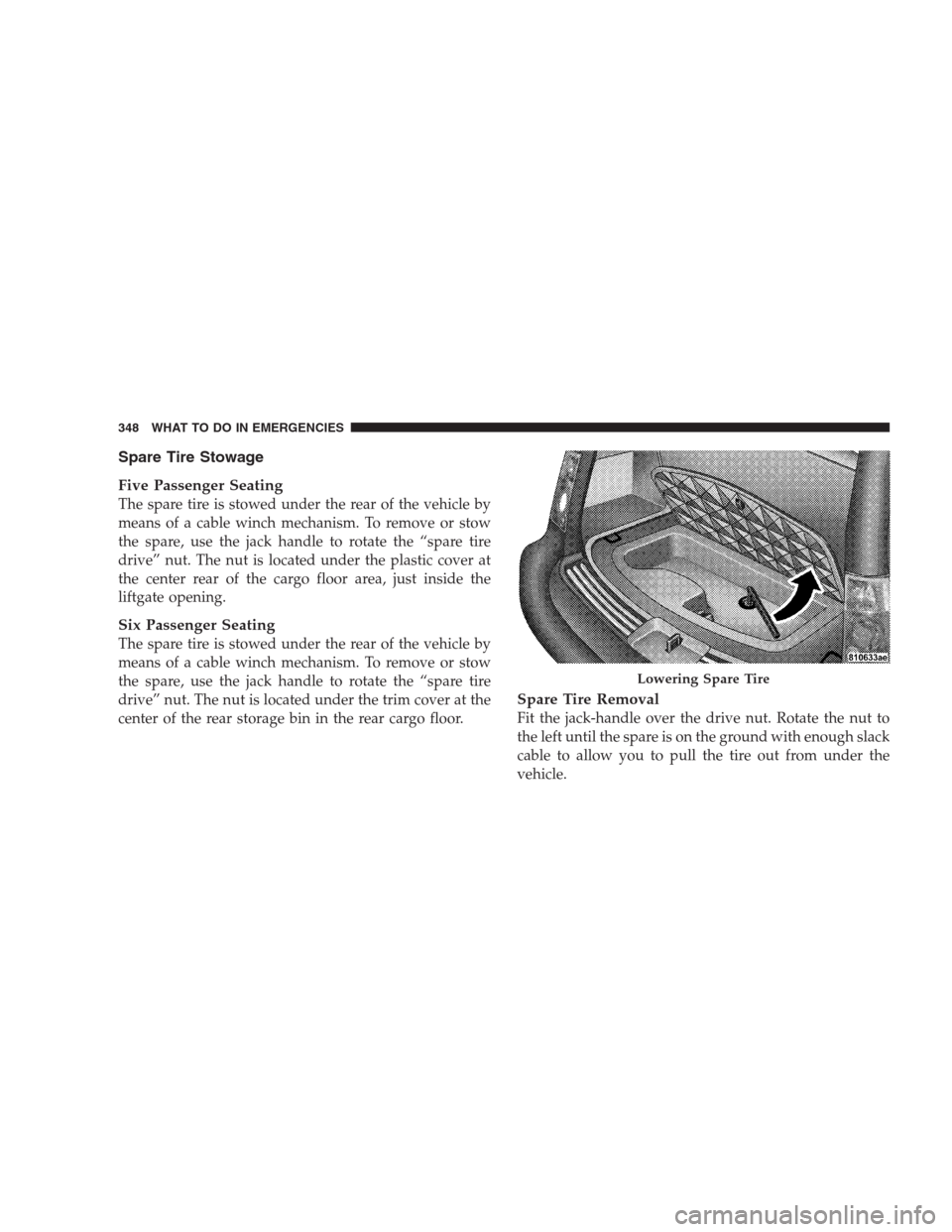
means of a cable winch mechanism. To remove or stow
the spare, use the jack handle to rotate the “spare tire
drive” nut. The nut is located under the plastic cover at
the center rear of the cargo floor area, just inside the
liftgate opening.
Six Passenger Seating
The spare tire is stowed under the rear of the vehicle by
means of a cable winch mechanism. To remove or stow
the spare, use the jack handle to rotate the “spare tire
drive” nut. The nut is located under the trim cover at the
center of the rear storage bin in the rear cargo floor.
Spare Tire Removal
Fit the jack-handle over the drive nut. Rotate the nut to
the left until the spare is on the ground with enough slack
cable to allow you to pull the tire out from under the
vehicle.
Lowering Spare Tire
348 WHAT TO DO IN EMERGENCIES
Page 349 of 464
CAUTION!
The winch mechanism is designed for use with the
jack handle only. Use of an air wrench or other
power tools is not recommended and can damage the
winch.
When the spare is clear, tilt the retainer at the end of the
cable and pull it through the center of the wheel.
Preparations For Jacking
Park the vehicle on a firm level surface, avoid ice or
slippery areas,set the parking brakeand place the gear
selector in PARK. Turn OFF the ignition.
WARNING!
Do not attempt to change a tire on the side of the
vehicle close to moving traffic. Pull far enough off
the road to avoid the danger of being hit when
operating the jack or changing the wheel.
•Turn on the Hazard Warning Flasher.
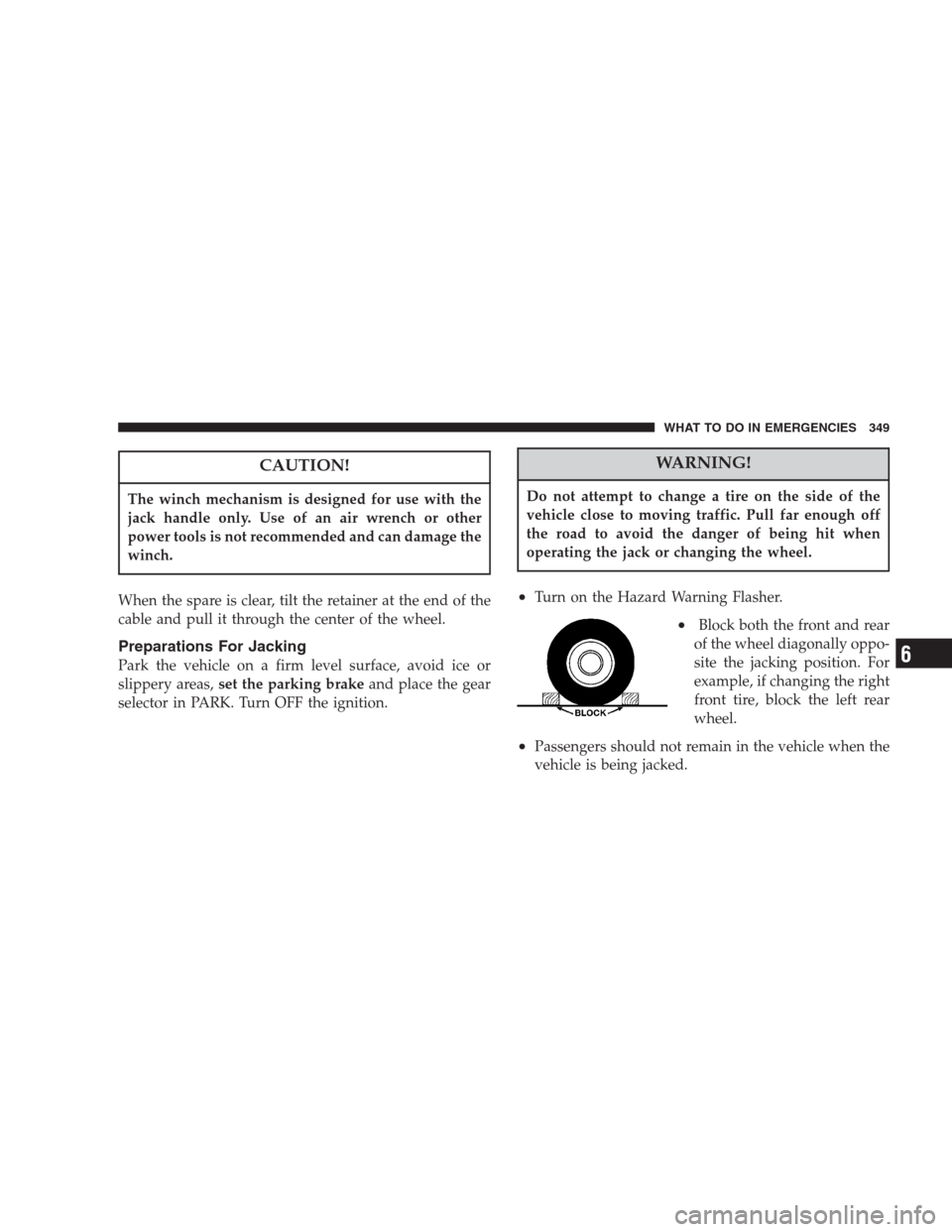
•Block both the front and rear
of the wheel diagonally oppo-
site the jacking position. For
example, if changing the right
front tire, block the left rear
wheel.
•Passengers should not remain in the vehicle when the
vehicle is being jacked.
WHAT TO DO IN EMERGENCIES 349
6
Page 350 of 464
Jacking Instructions
WARNING!
•Getting under a jacked-up vehicle is dangerous.
The vehicle could slip off the jack and fall on you.
You could be crushed. Never get any part of your
body under a vehicle that is on a jack. Never start
or run the engine while the vehicle is on a jack. If
you need to get under a raised vehicle, take it to a
service center where it can be raised on a lift.
•The jack is designed to use as a tool for changing
tires only. The jack should not be used to lift the
vehicle for service purposes. The vehicle should
be jacked on a firm level surface only. Avoid ice or
slippery areas.
WARNING!
Carefully follow these tire changing warnings to help
prevent personal injury or damage to your vehicle:
•Always park on a firm, level surface as far from the edge
of the roadway as possible before raising the vehicle.
•Block the wheel diagonally opposite the wheel to be
raised.
•Apply the parking brake firmly before jacking.
•Never start the engine with the vehicle on a jack.
•Do not let anyone sit in the vehicle when it is on a jack.
•Do not get under the vehicle when it is on a jack.
•Only use the jack in the positions indicated.
•If working on or near a roadway, be extremely careful
of motor traffic.
•To assure that spare tires, flat or inflated are securely
stowed, spares must be stowed with the value stem
facing the ground.
350 WHAT TO DO IN EMERGENCIES