Page 346 of 464
WARNING!
A hot engine cooling system is dangerous. You or
others could be badly burned by steam or boiling
coolant. You may want to call a service center if your
vehicle overheats. If you decide to look under the
hood yourself, see Section 7, Maintenance, of this
manual. Follow the warnings under the Cooling
System Pressure Cap paragraph.
JACKING AND TIRE CHANGING
Jack Location
Five Passenger Seating
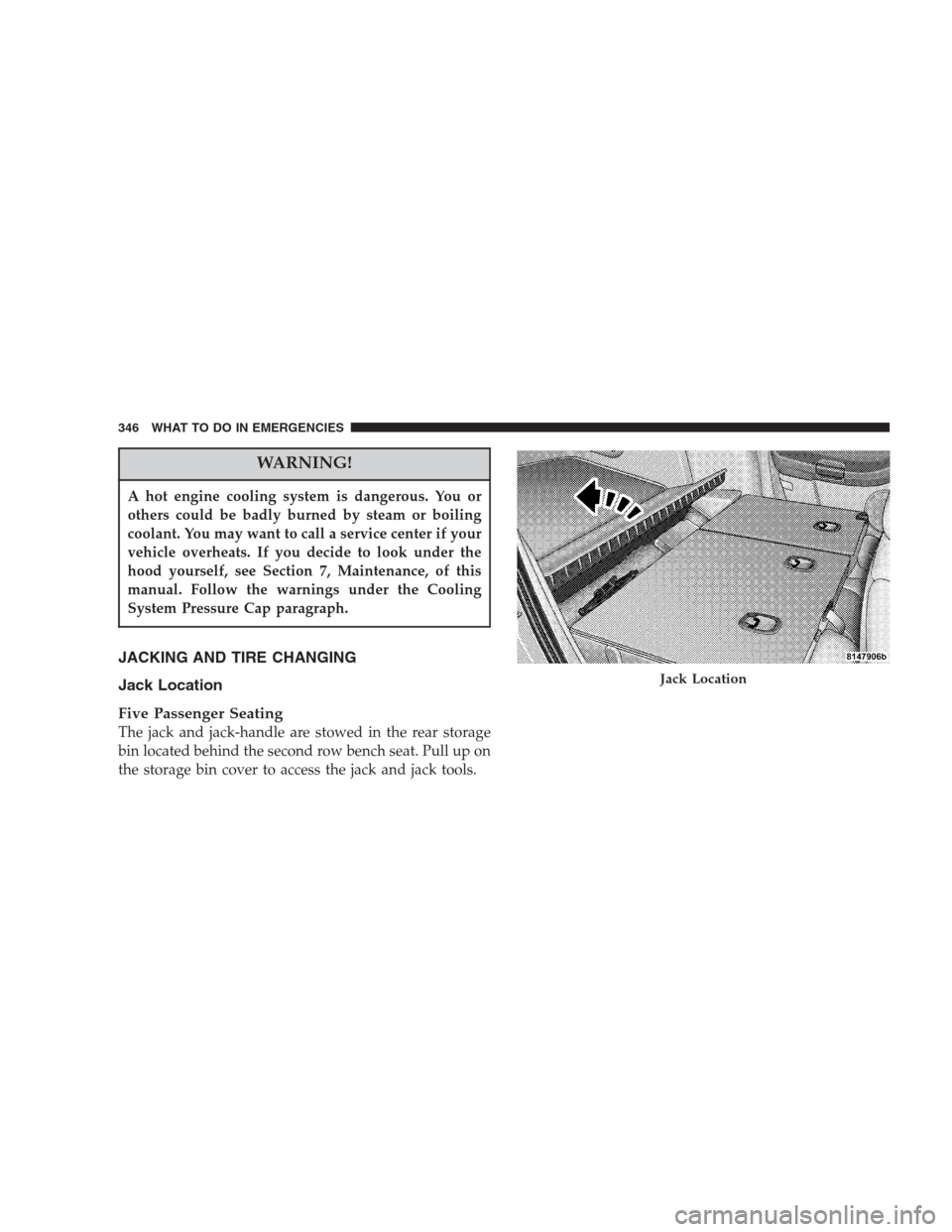
The jack and jack-handle are stowed in the rear storage
bin located behind the second row bench seat. Pull up on
the storage bin cover to access the jack and jack tools.
Jack Location
346 WHAT TO DO IN EMERGENCIES
Page 351 of 464
1. Remove the spare wheel, scissors jack and jack-handle
from stowage.
2. Carefully pry off the wheel center cap if equipped,
using the tip of the jack handle.
3. Loosen (but do not remove) the wheel lug nuts by
turning them to the left one turn while the wheel is still
on the ground.
NOTE:Do not oil wheel studs. For chrome wheels, do
not substitute with chrome plated wheel nuts.
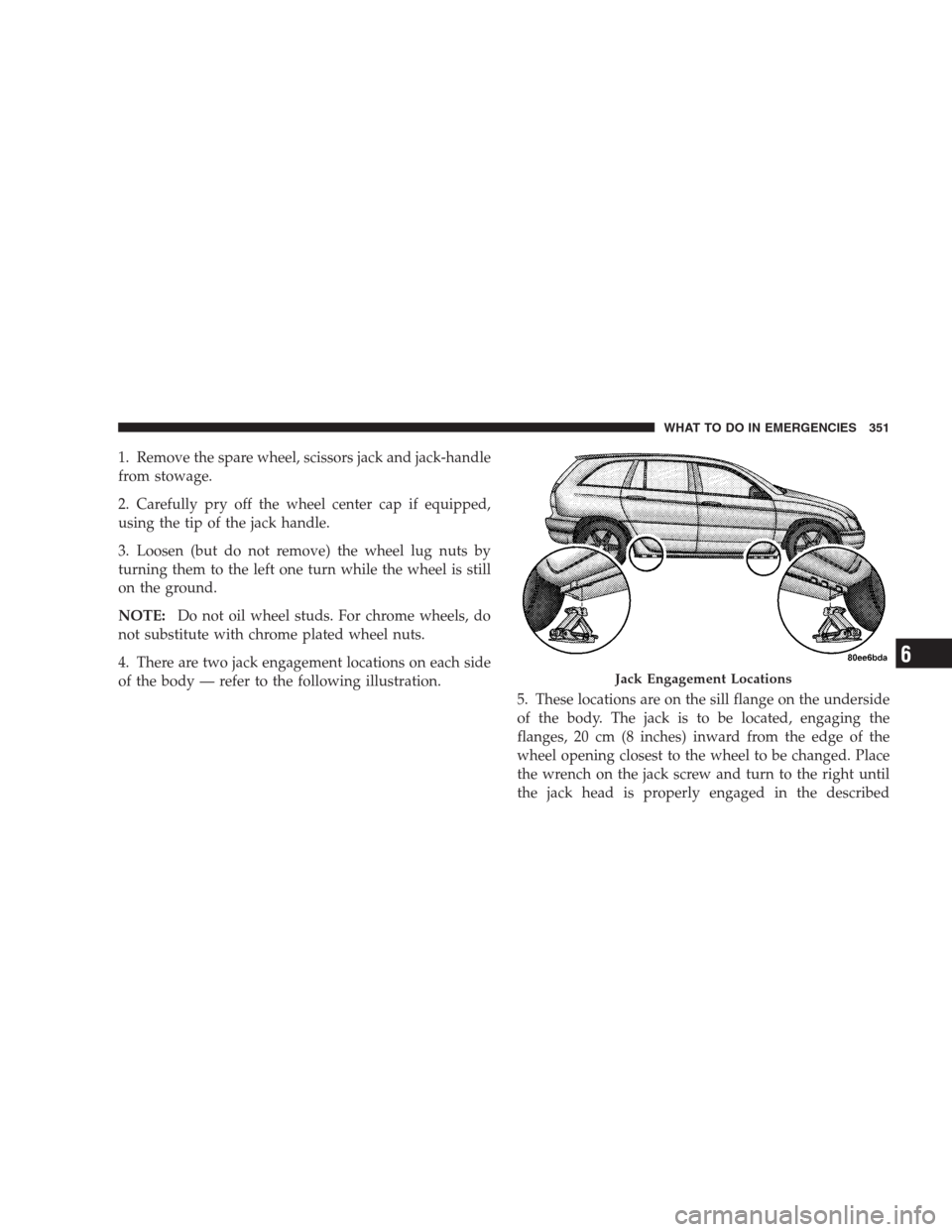
4. There are two jack engagement locations on each side
of the body — refer to the following illustration.
5. These locations are on the sill flange on the underside
of the body. The jack is to be located, engaging the
flanges, 20 cm (8 inches) inward from the edge of the
wheel opening closest to the wheel to be changed. Place
the wrench on the jack screw and turn to the right until
the jack head is properly engaged in the described
Jack Engagement Locations
WHAT TO DO IN EMERGENCIES 351
6
Page 361 of 464
MAINTAINING YOUR VEHICLE
CONTENTS
�4.0L Engines..........................364
�3.8L Engines..........................365
�Onboard Diagnostic System — OBD II........366
▫Loose Fuel Filler Cap Message............366
�Emissions Inspection And Maintenance
Programs............................367
�Replacement Parts......................368
�Dealer Service.........................369
�Maintenance Procedures..................369▫Engine Oil..........................369
▫Engine Oil Filter......................374
▫Drive Belts — Check Condition And Tension . . 374
▫Spark Plugs.........................374
▫Engine Air Cleaner Filter................374
▫Catalytic Converter....................375
▫Maintenance-Free Battery................376
▫Air Conditioner Maintenance.............378
▫Power Steering — Fluid Check............379
7
Page 369 of 464
DEALER SERVICE
Your dealer has the qualified service personnel, special
tools, and equipment to perform all service operations in an
expert manner. Service Manuals are available which include
detailed service information for your vehicle. Refer to these
manuals before attempting any procedure yourself.
NOTE:Intentional tampering with emissions control
systems can result in civil penalties being assessed
against you.
WARNING!
You can be badly injured working on or around a
motor vehicle. Only do service work for which you
have the knowledge and the proper equipment. If you
have any doubt about your ability to perform a service
job, take your vehicle to a competent mechanic.
MAINTENANCE PROCEDURES
The pages that follow contain therequiredmaintenance
services determined by the engineers who designed your
vehicle.
Besides the maintenance items for which there are fixed
maintenance intervals, there are other items that should
operate satisfactorily without periodic maintenance.
However, if a malfunction of these items does occur, it
could adversely affect the engine or vehicle performance.
These items should be inspected if a malfunction is
observed or suspected.
Engine Oil
Checking Oil Level
To assure proper engine lubrication, the engine oil must
be maintained at the correct level. Check the oil level at
regular intervals, such as every fuel stop.
MAINTAINING YOUR VEHICLE 369
7
Page 370 of 464
The best time to check the engine oil level is about 5
minutes after a fully warmed engine is shut off or before
starting the engine after it has sat overnight.
Checking the oil while the vehicle is on level ground will
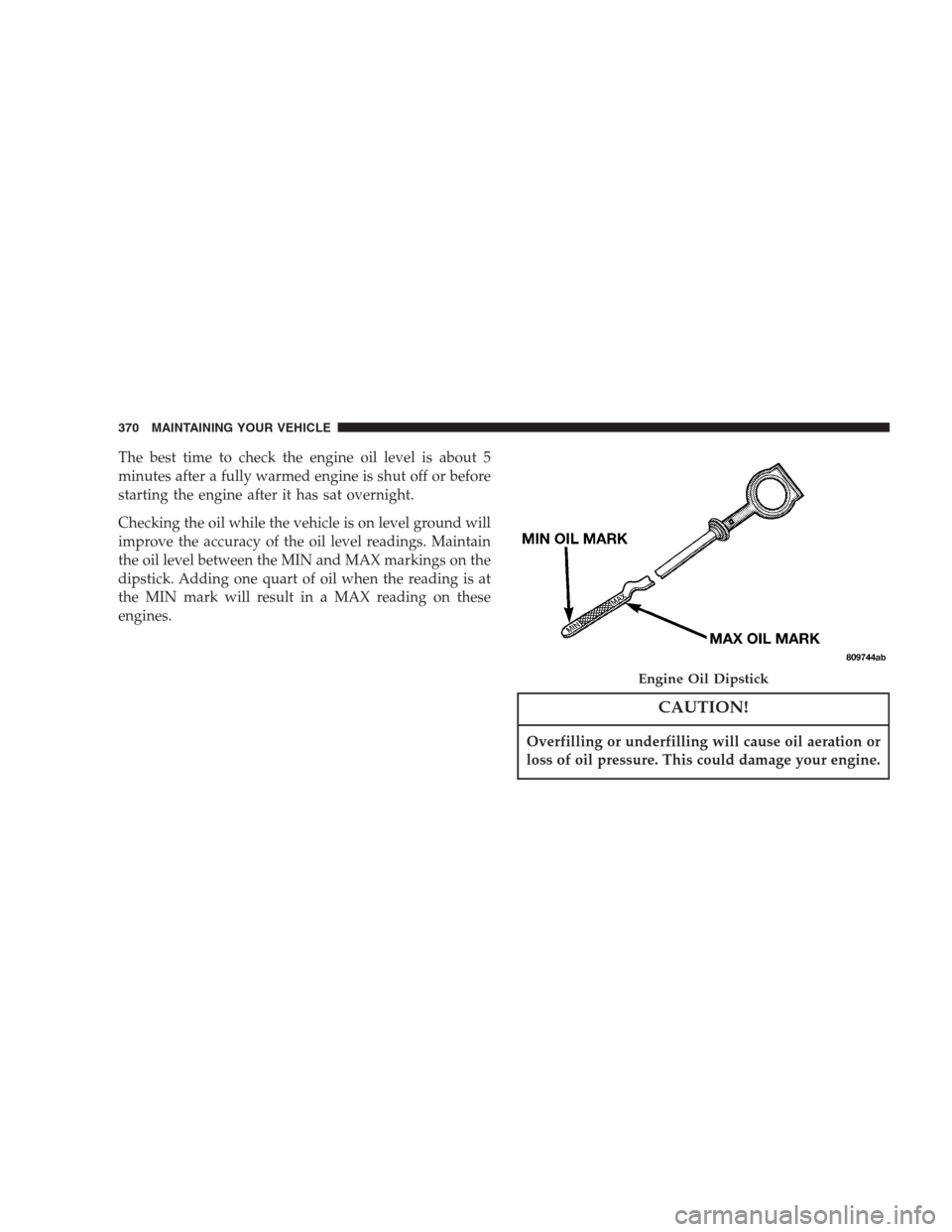
improve the accuracy of the oil level readings. Maintain
the oil level between the MIN and MAX markings on the
dipstick. Adding one quart of oil when the reading is at
the MIN mark will result in a MAX reading on these
engines.
CAUTION!
Overfilling or underfilling will cause oil aeration or
loss of oil pressure. This could damage your engine.
Engine Oil Dipstick
370 MAINTAINING YOUR VEHICLE
Page 371 of 464
Change Engine Oil
Road conditions and your kind of driving affects the
interval at which your oil should be changed. Check the
following list to see if any apply to you.
•Day or night temperatures are below 32°F (0°C).
•Stop and Go driving.
•Extensive engine idling.
•Driving in dusty conditions.
•Short trips of less than 10 miles (16 km).
•More than 50% of your driving is at sustained high
speeds during hot weather, above 90°F (32°C).
•Trailer towing.
•Taxi, Police or delivery service (commercial service).
•Off-Road or desert operation.NOTE:IfANYof these apply to you then change your
engine oil every 3,000 miles (5 000 km) or 3 months,
whichever comes first and follow schedule “B” of the
�Maintenance Schedules�section of this manual.
If none of these apply to you, then change your engine oil
at every interval shown on schedule�A�of the�Mainte-
nance Schedules�section of this manual.
NOTE:Under no circumstances should oil change in-
tervals exceed 6000 miles (10 000 km) or 6 months
whichever comes first.
Engine Oil Selection
For best performance and maximum protection under all
types of operating conditions, the manufacturer only
recommends engine oils that are API certified and meet
the requirements of DaimlerChrysler Material Standard
MS-6395.
MAINTAINING YOUR VEHICLE 371
7
Page 372 of 464
American Petroleum Institute (API) Engine Oil
Identification Symbol
This symbol means that the oil has
been certified by the American
Petroleum Institute (API). The
manufacturer only recommends
API Certified engine oils.
Engine Oil Viscosity (SAE Grade) — 4.0 Liter
Engines
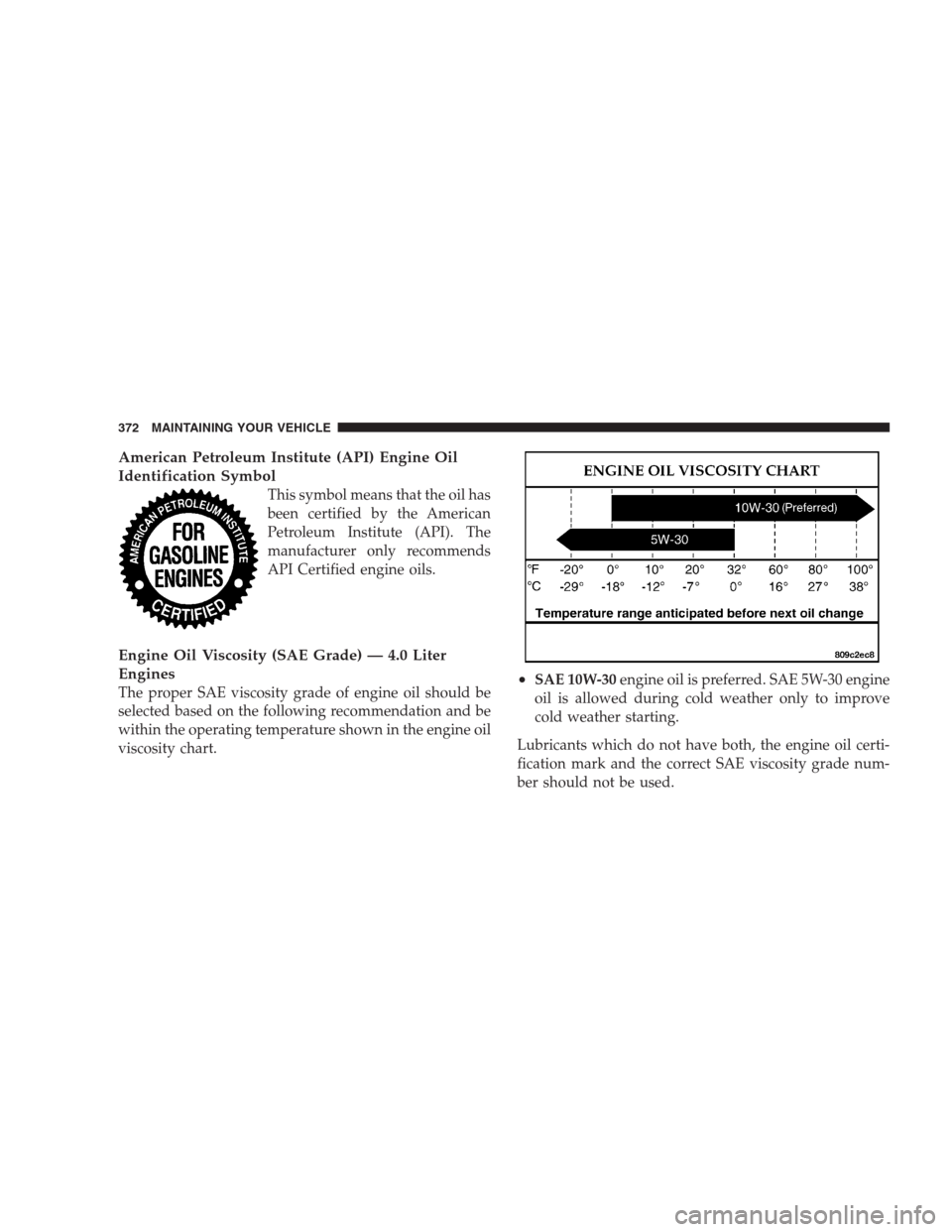
The proper SAE viscosity grade of engine oil should be
selected based on the following recommendation and be
within the operating temperature shown in the engine oil
viscosity chart.•SAE 10W-30engine oil is preferred. SAE 5W-30 engine
oil is allowed during cold weather only to improve
cold weather starting.
Lubricants which do not have both, the engine oil certi-
fication mark and the correct SAE viscosity grade num-
ber should not be used.
372 MAINTAINING YOUR VEHICLE
Page 373 of 464
Engine Oil Viscosity (SAE Grade) — 3.8 Liter
Engines
SAE 5W-20 engine oil is recommended for all operating
temperatures. This engine oil improves low temperature
starting and vehicle fuel economy. Your engine oil filler
cap also shows the recommended engine oil viscosity for
your vehicle.
For information on engine oil filler cap location, refer to
the Engine Compartment illustration in this section.
Lubricants which do not have both, the engine oil certi-
fication mark and the correct SAE viscosity grade num-
ber should not be used.
Synthetic Engine Oils
There are a number of engine oils being promoted as
either synthetic or semi-synthetic. If you chose to use
such a product, useonlythose oils that are AmericanPetroleum Institute (API) Certified and have the recom-
mended SAE viscosity grade. Follow the maintenance
schedule that describes your driving type.
Materials Added to Engine Oil
The manufacture strongly recommends against the addi-
tion of any additives (other than leak detection dyes) to
the engine oil. Engine oil is an engineered product and
it’s performance may be impaired by supplemental ad-
ditives.
Disposing of Used Engine Oil And Oil Filters
Care should be taken in disposing of used engine oil and
oil filters from your vehicle. Used oil and oil filters,
indiscriminately discarded, can present a problem to the
environment. Contact your dealer, service station, or
governmental agency for advice on how and where used
oil and oil filters can be safely discarded in your area.
MAINTAINING YOUR VEHICLE 373
7