Page 324 of 464
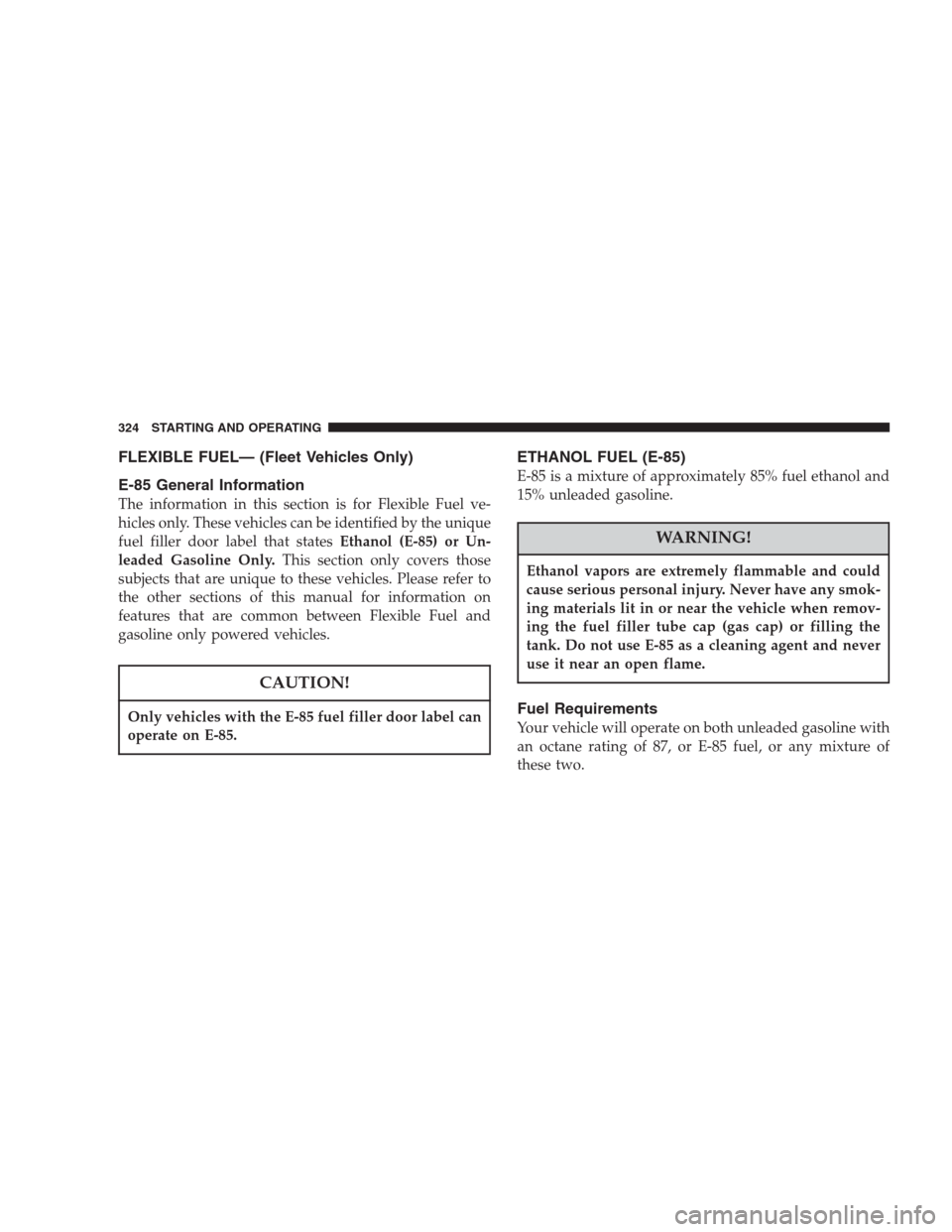
FLEXIBLE FUEL— (Fleet Vehicles Only)
E-85 General Information
The information in this section is for Flexible Fuel ve-
hicles only. These vehicles can be identified by the unique
fuel filler door label that statesEthanol (E-85) or Un-
leaded Gasoline Only.This section only covers those
subjects that are unique to these vehicles. Please refer to
the other sections of this manual for information on
features that are common between Flexible Fuel and
gasoline only powered vehicles.
CAUTION!
Only vehicles with the E-85 fuel filler door label can
operate on E-85.
ETHANOL FUEL (E-85)
E-85 is a mixture of approximately 85% fuel ethanol and
15% unleaded gasoline.
WARNING!
Ethanol vapors are extremely flammable and could
cause serious personal injury. Never have any smok-
ing materials lit in or near the vehicle when remov-
ing the fuel filler tube cap (gas cap) or filling the
tank. Do not use E-85 as a cleaning agent and never
use it near an open flame.
Fuel Requirements
Your vehicle will operate on both unleaded gasoline with
an octane rating of 87, or E-85 fuel, or any mixture of
these two.
324 STARTING AND OPERATING
Page 326 of 464
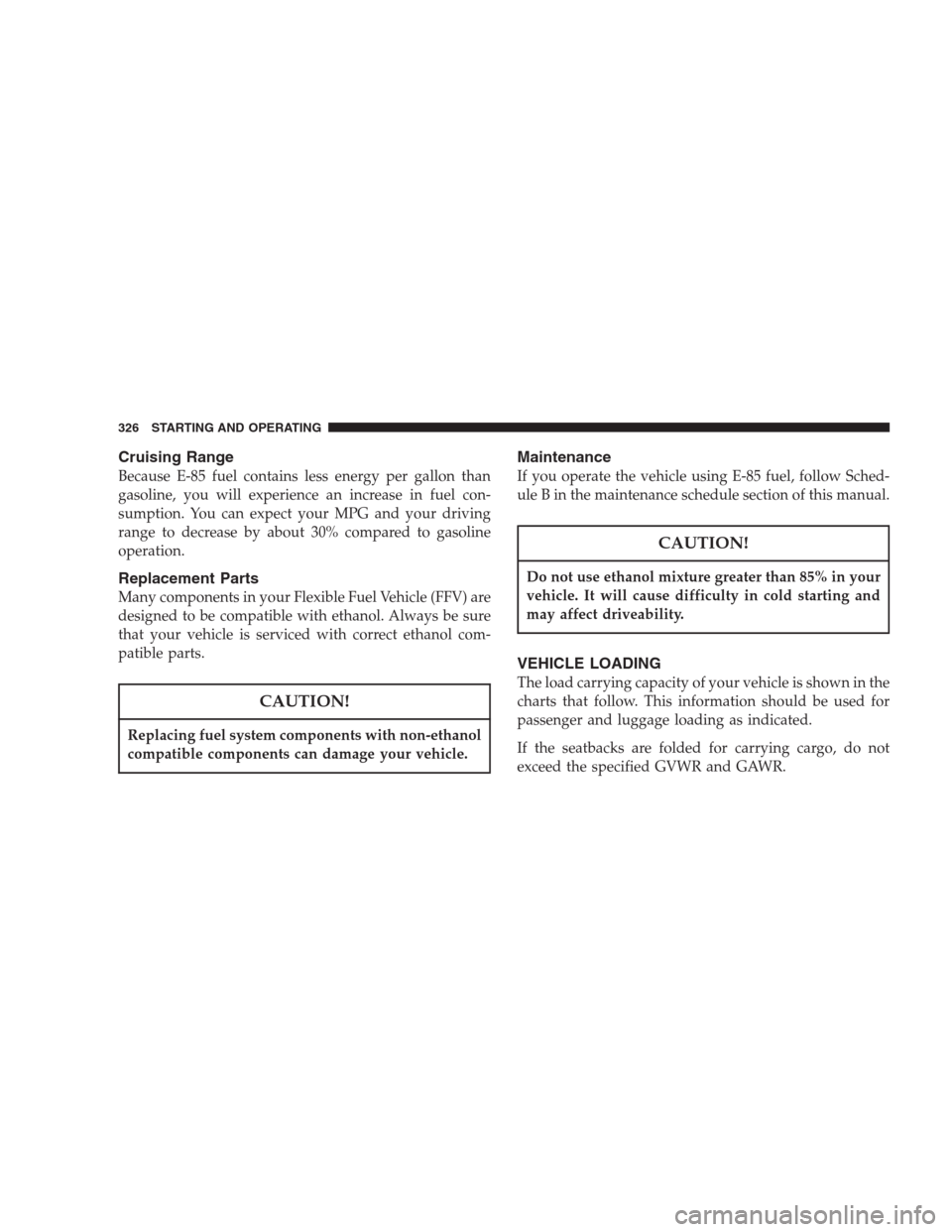
Cruising Range
Because E-85 fuel contains less energy per gallon than
gasoline, you will experience an increase in fuel con-
sumption. You can expect your MPG and your driving
range to decrease by about 30% compared to gasoline
operation.
Replacement Parts
Many components in your Flexible Fuel Vehicle (FFV) are
designed to be compatible with ethanol. Always be sure
that your vehicle is serviced with correct ethanol com-
patible parts.
CAUTION!
Replacing fuel system components with non-ethanol
compatible components can damage your vehicle.
Maintenance
If you operate the vehicle using E-85 fuel, follow Sched-
ule B in the maintenance schedule section of this manual.
CAUTION!
Do not use ethanol mixture greater than 85% in your
vehicle. It will cause difficulty in cold starting and
may affect driveability.
VEHICLE LOADING
The load carrying capacity of your vehicle is shown in the
charts that follow. This information should be used for
passenger and luggage loading as indicated.
If the seatbacks are folded for carrying cargo, do not
exceed the specified GVWR and GAWR.
326 STARTING AND OPERATING
Page 354 of 464

NOTE:When reinstalling the wheel center cap, insure
that the valve stem symbol on the back of the cap is
pointed toward the wheel valve stem. Install the center
cap using hand pressure only. Do not use a hammer.
Wheel Nuts
All wheel nuts should be tightened occasionally to elimi-
nate the possibility of wheel studs being sheared or the
bolt holes in the wheels becoming elongated. This is
especially important during the first few hundred miles
of operation, and after each time a tire is changed, to
allow the wheel nuts to become properly set. All nuts
should first be firmly seated against the wheel. The nuts
should then be tightened to recommended torque.
Tighten the nuts to final torque in increments. Progress
around the bolt circle, tightening the nut opposite to the
nut just previously tightened until final torque is
achieved. Recommended torque is 130 N·m (95 ft. lbs).
JUMP-STARTING PROCEDURE
WARNING!
•Do not attempt to push or tow your vehicle to get it started.
Vehicles equipped with an automatic transmission cannot be
started this way. Unburned fuel could enter the catalytic
converter and once the engine has started, ignite and damage
the converter and vehicle. If the vehicle has a discharged
battery, booster cables may be used to obtain a start from
another vehicle. This type of start can be dangerous if done
improperly, so follow this procedure carefully.
•Battery fluid is a corrosive acid solution; do not allow battery
fluid to contact eyes, skin or clothing. Don’t lean over battery
when attaching clamps or allow the clamps to touch each other.
If acid splashes in eyes or on skin, flush contaminated area
immediately with large quantities of water.
•A battery generates hydrogen gas which is flammable and
explosive. Keep flame or spark away from the vent holes. Do
not use a booster battery or any other booster source with an
output that exceeds 12 volts.
•Take care to avoid the radiator cooling fan whenever the hood
is raised. It can start anytime the ignition switch is on. You can
be hurt by the fan.
354 WHAT TO DO IN EMERGENCIES
Page 361 of 464
MAINTAINING YOUR VEHICLE
CONTENTS
�4.0L Engines..........................364
�3.8L Engines..........................365
�Onboard Diagnostic System — OBD II........366
▫Loose Fuel Filler Cap Message............366
�Emissions Inspection And Maintenance
Programs............................367
�Replacement Parts......................368
�Dealer Service.........................369
�Maintenance Procedures..................369▫Engine Oil..........................369
▫Engine Oil Filter......................374
▫Drive Belts — Check Condition And Tension . . 374
▫Spark Plugs.........................374
▫Engine Air Cleaner Filter................374
▫Catalytic Converter....................375
▫Maintenance-Free Battery................376
▫Air Conditioner Maintenance.............378
▫Power Steering — Fluid Check............379
7
Page 366 of 464

ONBOARD DIAGNOSTIC SYSTEM — OBD II
Your vehicle is equipped with a sophisticated onboard
diagnostic system called OBD II. This system monitors
the performance of the emissions, engine, and automatic
transmission control systems. When these systems are
operating properly, your vehicle will provide excellent
performance and fuel economy, as well as engine emis-
sions well within current government regulations.
If any of these systems require service, the OBD II system
will turn on the “Malfunction Indicator Light.” It will
also store diagnostic codes and other information to
assist your service technician in making repairs. Al-
though your vehicle will usually be drivable and not
need towing, see your dealer for service as soon as
possible.CAUTION!
•Prolonged driving with the “Malfunction Indica-
tor Light” on could cause further damage to the
emission control system. It could also affect fuel
economy and driveability. The vehicle must be
serviced before any emissions tests can be per-
formed.
•If the “Malfunction Indicator Light” is flashing
while the engine is running, severe catalytic con-
verter damage and power loss will soon occur.
Immediate service is required.
Loose Fuel Filler Cap Message
After fuel is added, the vehicle diagnostic system can
determine if the fuel filler cap is loose, improperly
installed, or damaged. A loose fuel filler cap message will
be displayed in the instrument cluster. Tighten the gas
366 MAINTAINING YOUR VEHICLE
Page 373 of 464
Engine Oil Viscosity (SAE Grade) — 3.8 Liter
Engines
SAE 5W-20 engine oil is recommended for all operating
temperatures. This engine oil improves low temperature
starting and vehicle fuel economy. Your engine oil filler
cap also shows the recommended engine oil viscosity for
your vehicle.
For information on engine oil filler cap location, refer to
the Engine Compartment illustration in this section.
Lubricants which do not have both, the engine oil certi-
fication mark and the correct SAE viscosity grade num-
ber should not be used.
Synthetic Engine Oils
There are a number of engine oils being promoted as
either synthetic or semi-synthetic. If you chose to use
such a product, useonlythose oils that are AmericanPetroleum Institute (API) Certified and have the recom-
mended SAE viscosity grade. Follow the maintenance
schedule that describes your driving type.
Materials Added to Engine Oil
The manufacture strongly recommends against the addi-
tion of any additives (other than leak detection dyes) to
the engine oil. Engine oil is an engineered product and
it’s performance may be impaired by supplemental ad-
ditives.
Disposing of Used Engine Oil And Oil Filters
Care should be taken in disposing of used engine oil and
oil filters from your vehicle. Used oil and oil filters,
indiscriminately discarded, can present a problem to the
environment. Contact your dealer, service station, or
governmental agency for advice on how and where used
oil and oil filters can be safely discarded in your area.
MAINTAINING YOUR VEHICLE 373
7
Page 411 of 464
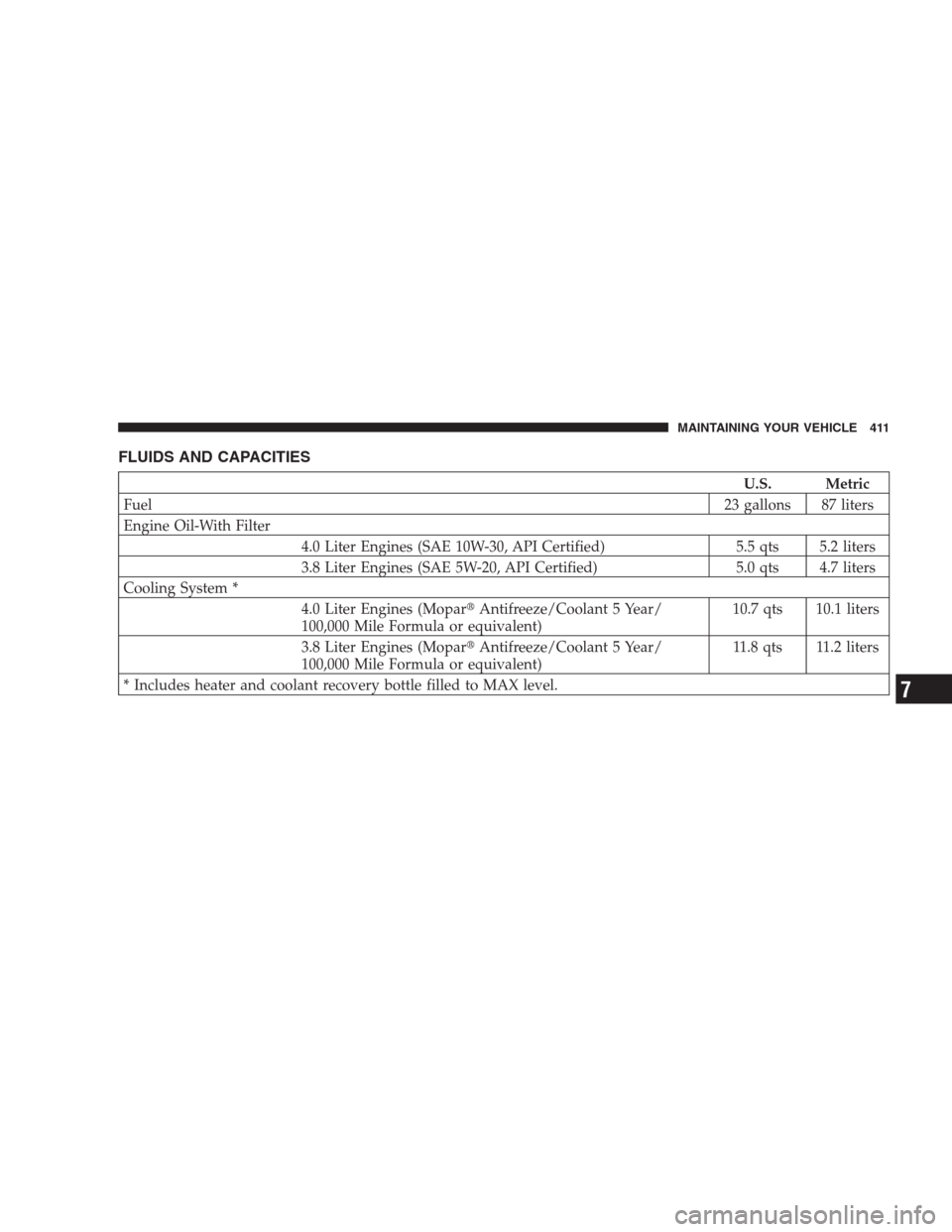
FLUIDS AND CAPACITIES
U.S. Metric
Fuel23 gallons 87 liters
Engine Oil-With Filter
4.0 Liter Engines (SAE 10W-30, API Certified) 5.5 qts 5.2 liters
3.8 Liter Engines (SAE 5W-20, API Certified) 5.0 qts 4.7 liters
Cooling System *
4.0 Liter Engines (Mopar�Antifreeze/Coolant 5 Year/
100,000 Mile Formula or equivalent)10.7 qts 10.1 liters
3.8 Liter Engines (Mopar�Antifreeze/Coolant 5 Year/
100,000 Mile Formula or equivalent)11.8 qts 11.2 liters
* Includes heater and coolant recovery bottle filled to MAX level.
MAINTAINING YOUR VEHICLE 411
7
Page 412 of 464
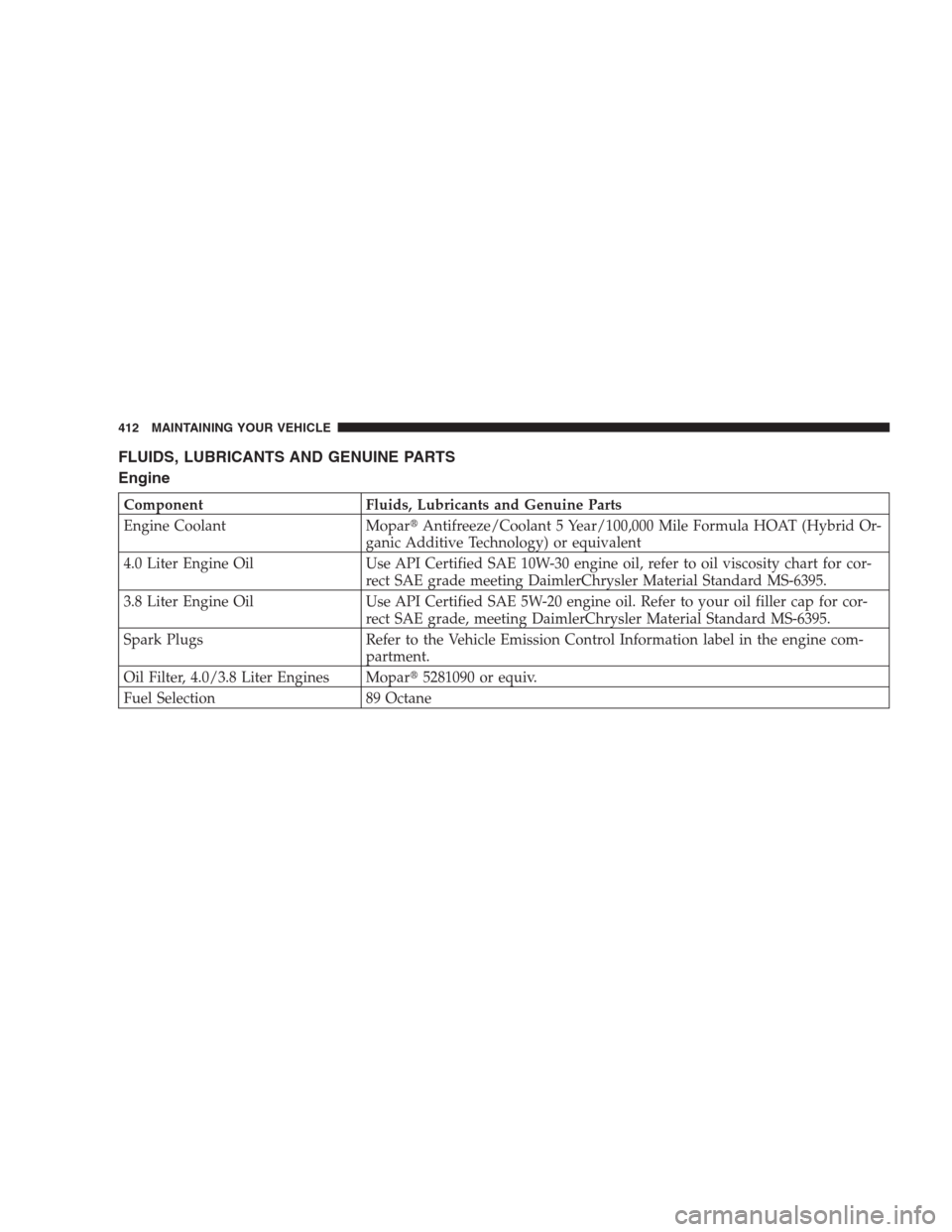
FLUIDS, LUBRICANTS AND GENUINE PARTS
Engine
Component Fluids, Lubricants and Genuine Parts
Engine Coolant Mopar�Antifreeze/Coolant 5 Year/100,000 Mile Formula HOAT (Hybrid Or-
ganic Additive Technology) or equivalent
4.0 Liter Engine Oil Use API Certified SAE 10W-30 engine oil, refer to oil viscosity chart for cor-
rect SAE grade meeting DaimlerChrysler Material Standard MS-6395.
3.8 Liter Engine Oil Use API Certified SAE 5W-20 engine oil. Refer to your oil filler cap for cor-
rect SAE grade, meeting DaimlerChrysler Material Standard MS-6395.
Spark Plugs Refer to the Vehicle Emission Control Information label in the engine com-
partment.
Oil Filter, 4.0/3.8 Liter Engines Mopar�5281090 or equiv.
Fuel Selection 89 Octane
412 MAINTAINING YOUR VEHICLE