Page 253 of 472

�Snow Tires...........................306
�Tire Rotation Recommendations............306
�Tire Pressure Monitor System (TPMS) —
If Equipped...........................307
▫Base System – If Equipped...............308
▫General Information...................311
�Fuel Requirements......................311
▫Reformulated Gasoline.................312
▫Gasoline/Oxygenate Blends..............312
▫MMT In Gasoline.....................313
▫Materials Added To Fuel................314
▫Fuel System Cautions..................314
▫Carbon Monoxide Warnings..............315�Adding Fuel..........................316
▫Fuel Filler Cap (Gas Cap)...............316
▫Loose Fuel Filler Cap Message............317
�Flexible Fuel..........................318
▫E-85 General Information................318
▫Ethanol Fuel (E-85)....................319
▫Fuel Requirements....................319
▫Selection Of Engine Oil For Flexible Fuel
Vehicles (E-85) And Gasoline Vehicles.......320
▫Starting............................320
▫Cruising Range.......................320
▫Replacement Parts.....................320
▫Maintenance.........................321
STARTING AND OPERATING 253
5
Page 304 of 472

Life of Tire
The service life of a tire is dependent upon varying
factors including but not limited to:
•Driving style
•Tire pressure
•Distance driven
WARNING!
Tires and spare tire should be replaced after six
years, regardless of the remaining tread. Failure to
follow this warning can result in sudden tire failure.
You could lose control and have an accident result-
ing in serious injury or death.
Keep dismounted tires in a cool, dry place with as little
exposure to light as possible. Protect tires from contact
with oil, grease, and gasoline.
Replacement Tires
The tires on your new vehicle provide a balance of many
characteristics. They should be inspected regularly for
wear and correct cold tire inflation pressure. The manu-
facturer strongly recommends that you use tires equiva-
lent to the originals in size, quality and performance
when replacement is needed (refer to the paragraph on
“Tread Wear Indicators”). Refer to the “Tire and Loading
Information” placard for the size designation of your tire.
The service description and load identification will be
found on the original equipment tire. Failure to use
equivalent replacement tires may adversely affect the
safety, handling, and ride of your vehicle. We recommend
that you contact your original equipment or an autho-
rized tire dealer with any questions you may have on tire
specifications or capability.
304 STARTING AND OPERATING
Page 320 of 472

NOTE:When the ambient temperature is above 90°F,
you may experience hard starting and rough idle follow-
ing start up even if the above recommendations are
followed.
Selection Of Engine Oil For Flexible Fuel Vehicles
(E-85) and Gasoline Vehicles
Whether operating the vehicle on an E-85 ethanol fuel or
unleaded gasoline the engine oil requirements are the
same. Refer to the “Maintenance Procedures” section of
this manual for the proper quality and viscosity engine
oil.
Starting
The characteristics of E-85 fuel make it unsuitable for use
when ambient temperatures fall below 0°F. In the range
of 0°F to 32°F, you may experience an increase in the time
it takes for your engine to start, and a deterioration in
drivability (sags and/or hesitations) until the engine is
fully warmed up.
Cruising Range
Because E-85 fuel contains less energy per gallon than
gasoline, you will experience an increase in fuel con-
sumption. You can expect your MPG and your driving
range to decrease by about 30% compared to gasoline
operation.
Replacement Parts
Many components in your Flexible Fuel Vehicle (FFV) are
designed to be compatible with ethanol. Always be sure
that your vehicle is serviced with correct ethanol com-
patible parts.
CAUTION!
Replacing fuel system components with non-ethanol
compatible components can damage your vehicle.
320 STARTING AND OPERATING
Page 352 of 472
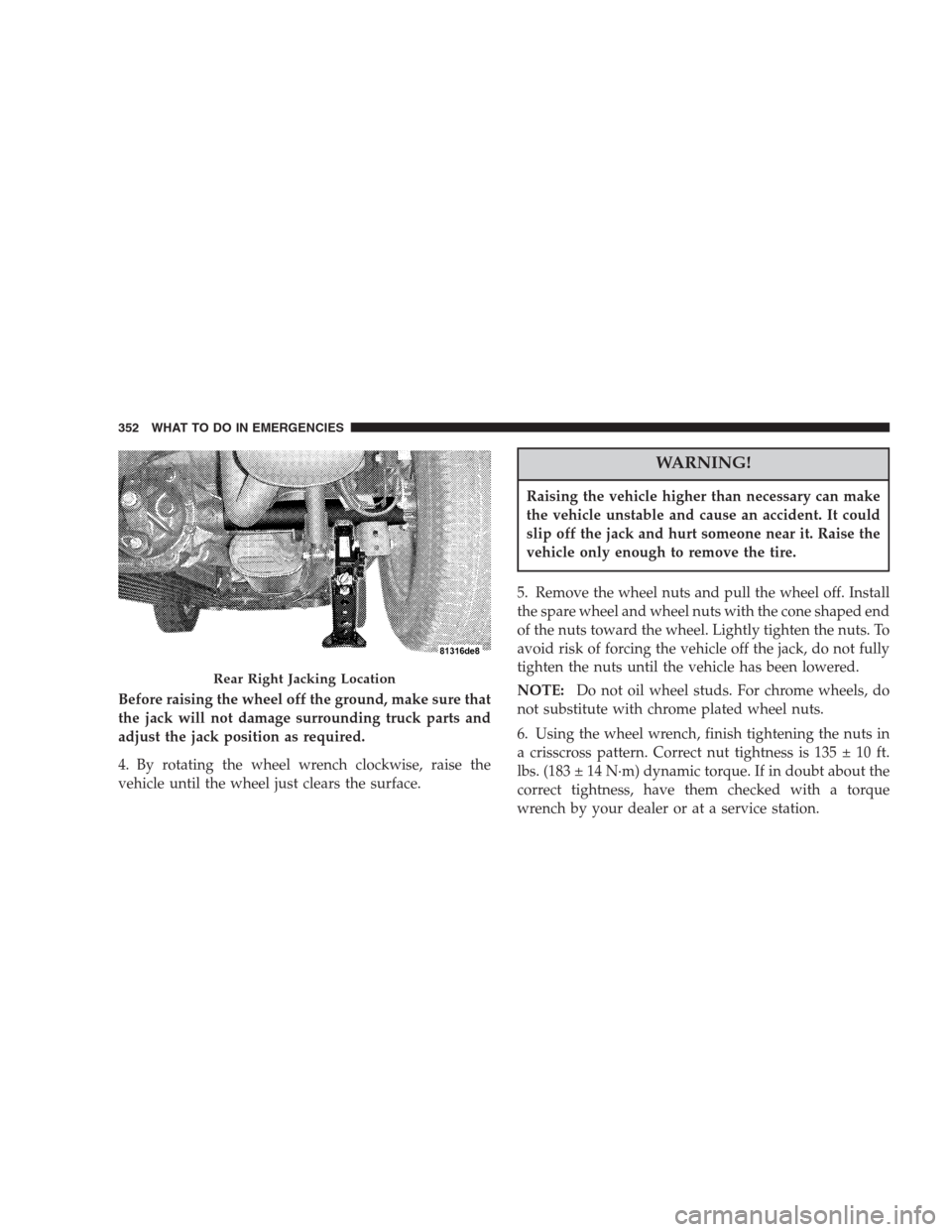
Before raising the wheel off the ground, make sure that
the jack will not damage surrounding truck parts and
adjust the jack position as required.
4. By rotating the wheel wrench clockwise, raise the
vehicle until the wheel just clears the surface.
WARNING!
Raising the vehicle higher than necessary can make
the vehicle unstable and cause an accident. It could
slip off the jack and hurt someone near it. Raise the
vehicle only enough to remove the tire.
5. Remove the wheel nuts and pull the wheel off. Install
the spare wheel and wheel nuts with the cone shaped end
of the nuts toward the wheel. Lightly tighten the nuts. To
avoid risk of forcing the vehicle off the jack, do not fully
tighten the nuts until the vehicle has been lowered.
NOTE:Do not oil wheel studs. For chrome wheels, do
not substitute with chrome plated wheel nuts.
6. Using the wheel wrench, finish tightening the nuts in
a crisscross pattern. Correct nut tightness is 135 ± 10 ft.
lbs. (183 ± 14 N·m) dynamic torque. If in doubt about the
correct tightness, have them checked with a torque
wrench by your dealer or at a service station.
Rear Right Jacking Location
352 WHAT TO DO IN EMERGENCIES
Page 353 of 472

WARNING!
A loose tire or jack thrown forward in a collision or
hard stop could injure someone in the vehicle.
Always stow the jack, tools and the extra tire and
wheel in the places provided.
7. Remove wheel blocks. Do not install chrome or alu-
minum wheel center caps on the spare wheel. This may
result in cap damage.
8. Lower the jack to its fully closed position. Stow the
replaced tire, jack, and tools as previously described.
9. Adjust the tire pressure when possible.
NOTE:Do not oil wheel studs. For chrome wheels, do
not substitute with chrome plated wheel nuts.
WARNING!
Carefully follow these tire changing warnings to help
prevent personal injury or damage to your vehicle:
•Always park on a firm, level surface as far from the
edge of the roadway as possible before raising the
vehicle.
•Block the wheel diagonally opposite the wheel to be
raised.
•Apply the parking brake firmly before jacking.
•Never start the engine with the vehicle on a jack.
•Do not let anyone sit in the vehicle when it is on a jack.
•Do not get under the vehicle when it is on a jack.
•Only use the jack in the positions indicated.
•If working on or near a roadway, be extremely careful
of motor traffic.
•To assure that spare tires, flat or inflated are securely
stowed, spares must be stowed with the value stem
facing the ground.
WHAT TO DO IN EMERGENCIES 353
6
Page 359 of 472
MAINTAINING YOUR VEHICLE
CONTENTS
�Engine Compartment 4.7L V-8..............362
�Engine Compartment 5.7L HEMI V-8.........363
�Onboard Diagnostic System — OBD II........364
▫Loose Fuel Filler Cap Message............364
�Emissions Inspection And Maintenance
Programs............................365
�Replacement Parts......................366
�Dealer Service.........................367
�Maintenance Procedures..................367▫Engine Oil..........................368
▫Engine Oil Filter......................371
▫Drive Belts — Check Condition And Tension . . 372
▫Spark Plugs.........................372
▫Engine Air Cleaner Filter................373
▫Engine Fuel Filter.....................373
▫Catalytic Converter....................373
▫Maintenance Free Battery................375
▫Air Conditioner Maintenance.............376
7
Page 368 of 472
could adversely affect the engine or vehicle performance.
These items should be inspected if a malfunction is
observed or suspected.
Engine Oil
Checking Oil Level
To assure proper lubrication of your vehicle’s engine, the
engine oil must be maintained at the correct level. The
best time to check the engine oil level is about 5 minutes
after a fully warmed up engine is shut off or before
starting the engine after it has sat overnight.
Checking the oil while the vehicle is on level ground will
improve the accuracy of the oil level readings. Always
maintain the oil level within the SAFE zone on the
dipstick. Adding one quart of oil when the reading is at
the bottom of the SAFE zone will result in a reading at the
top of the safe zone on these engines.
CAUTION!
Overfilling or underfilling the crankcase will cause
oil aeration or loss of oil pressure. This could dam-
age your engine.
368 MAINTAINING YOUR VEHICLE
Page 369 of 472

Change Engine Oil
Road conditions and your style of driving affect the
interval at which your oil should be changed. Check the
following to determine ifANYapply to you:
•Day or night temperatures are below 32°F (0°C).
•Stop and Go driving.
•Extensive engine idling.
•Driving in dusty conditions.
•Short trips of less than 10 miles (16.2 km).
•More than 50% of your driving is at sustained high
speeds during hot weather, above 90°F (32°C).
•Trailer towing, Taxi, Police or delivery service (com-
mercial service).
•Off-Road or desert operation.
•If equipped for and operating with E-85 (ethanol)
fuel.
NOTE:IfANYof these apply to you then change your
engine oil every 3,000 miles (5 000 km) or 3 months,
whichever comes first and follow schedule “B” of the
�Maintenance Schedules�section of this manual.
If none of these apply to you, then change your engine oil
at every interval shown on schedule�A�of the�Mainte-
nance Schedules�section of this manual.
NOTE:Under no circumstances should oil change in-
tervals exceed 6,000 miles (10 000 km) or 6 months
whichever comes first.
4x4 Models, If Used Primarily For Off-Road Operation
Every 50 hours of use.
MAINTAINING YOUR VEHICLE 369
7

