Page 255 of 360
WHAT TO DO IN EMERGENCIES
CONTENTS
�Hazard Warning Flasher.................256
�If Your Engine Overheats................256
�TIREFIT Tire Repair....................257
�Jump-Starting Procedures................262
�Freeing A Stuck Vehicle.................265
�Towing A Disabled Vehicle...............266▫Without The Ignition Key...............266
▫Towing This Vehicle Behind Another Vehicle
(Flat Towing With All Four Wheels On The
Ground)............................266
▫Towing This Vehicle Behind Another Vehicle
WithATowDolly .....................267
6
Page 259 of 360
WARNING!
•Do not attempt to repair a tire on the side of the vehicle
close to traffic. Pull far enough off the road to avoid the
danger of being hit when operating the jack or repairing
a tire.
•Cuts or punctures larger than approximately 0.16 in. (4
mm), tire damage caused by driving with extremely low
tire pressure or on a flat tire, or a damaged wheel can
pose a hazard while driving. TIREFIT should not be
used in such circumstances. Do not drive the vehicle
under such circumstances. Contact your nearest autho-
rized dealer for assistance.
•Take care not to allow the contents of TIREFIT to come
in contact with hair, eyes or clothing. TIREFIT is harm-
ful if inhaled, swallowed, or absorbed through the skin:
It causes skin, eye, and respiratory irritation. Any con-
tact with eyes or skin should be flushed immediately
with plenty of water. If clothing comes in contact with
TIREFIT, change clothing as soon as possible.
•In case of allergic reaction or rash, consult a physician
immediately. Keep TIREFIT out of reach of children. If
swallowed, rinse mouth immediately with plenty of
water and drink plenty of water. Do not induce vomit-
ing! Consult a physician immediately.
•Keep away from open flame or heat source.
Sealing tire with TIREFIT
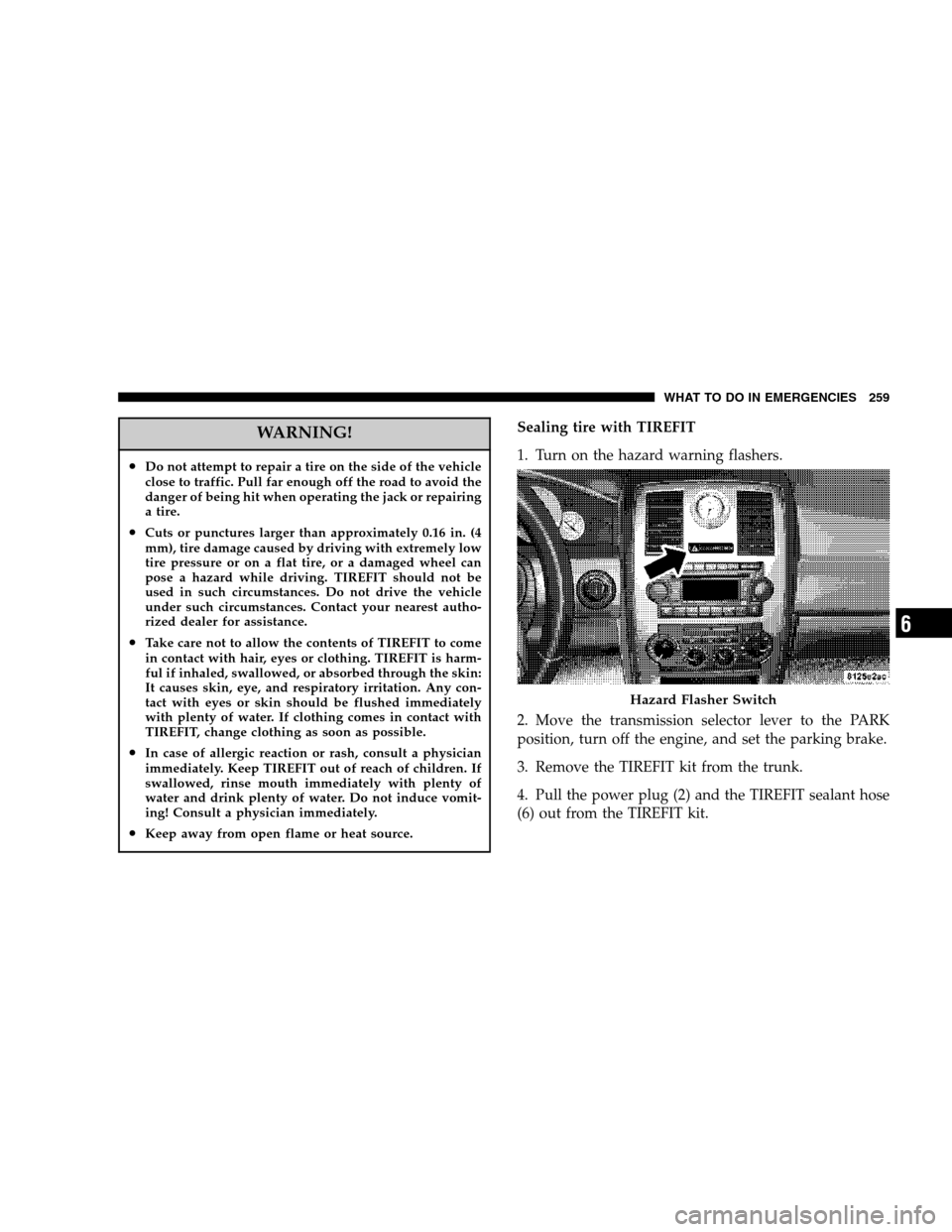
1. Turn on the hazard warning flashers.
2. Move the transmission selector lever to the PARK
position, turn off the engine, and set the parking brake.
3. Remove the TIREFIT kit from the trunk.
4. Pull the power plug (2) and the TIREFIT sealant hose
(6) out from the TIREFIT kit.
Hazard Flasher Switch
WHAT TO DO IN EMERGENCIES 259
6
Page 262 of 360

•Do not operate the electric air pump for more than
eight minutes to avoid overheating. The air pump may
be used again once it has cooled down.
•Replace the TIREFIT sealant bottle (5) once every four
years to assure optimum operation of the system.
•If TIREFIT is liquid, clean water and a damp cloth will
remove the material from the vehicle or tire and wheel
components. Once TIREFIT sealing material has dried,
it can easily be peeled off and properly discarded.
•Do not exceed 55 mph (90 km/h) until the tire has
been inspected.
JUMP-STARTING PROCEDURES
WARNING!
•Take care to avoid the radiator cooling fan whenever the
hood is raised. It can start anytime the ignition switch is on.
You can be hurt by the fan.
•Do not attempt to push or tow your vehicle to get it started.
Vehicles equipped with an automatic transmission cannot
be started this way. Unburned fuel could enter the catalytic
converter and once the engine has started, ignite and
damage the converter and vehicle. If the vehicle has a
discharged battery, booster cables may be used to obtain a
start from another vehicle. This type of start can be danger-
ous if done improperly, so follow this procedure carefully.
•Battery fluid is a corrosive acid solution; do not allow
battery fluid to contact eyes, skin, or clothing. Don’t lean
over battery when attaching clamps or allow the clamps to
touch each other. If acid splashes in eyes or on skin, flush
contaminated area immediately with large quantities of
water.
•A battery generates hydrogen gas, which is flammable and
explosive. Keep flame or spark away from the vent holes.
•Do not use a booster battery or any other booster source
with an output that exceeds 12 volts.
•The battery in this vehicle has a vent hose that should not
be disconnected and should only be replaced with a battery
of the same type (vented).
262 WHAT TO DO IN EMERGENCIES
Page 265 of 360

FREEING A STUCK VEHICLE
If your vehicle becomes stuck in mud, sand, or snow, it
can often be moved by a rocking motion. Turn your
steering wheel right and left to clear the area around the
front wheels. Then shift back and forth between Reverse
and Drive. Usually the least accelerator pedal pressure to
maintain the rocking motion without spinning the
wheels is most effective.
NOTE:Turn off the Electronic Stability Program (ESP)
before rocking the vehicle. For details, refer to “Electronic
Stability Program,” or “Traction Control” in this manual.
CAUTION!
•When “rocking” a stuck vehicle by moving be-
tween “First” and R (Reverse), do not spin the
wheels faster than 15 mph (24 km/h), or drivetrain
damage may result.
•Racing the engine or spinning the wheels too fast
may lead to transmission overheating and failure.
It can also damage the tires. Do not spin the
wheels above 35 mph (55 km/h).
WARNING!
Fast spinning tires can be dangerous. Forces gener-
ated by excessive wheel speeds may cause tire dam-
age or failure. A tire could explode and injure
someone. Do not spin your vehicle’s wheels faster
than 35 mph (55 km/h) when you are stuck, and don’t
let anyone near a spinning wheel, no matter what the
speed.
WHAT TO DO IN EMERGENCIES 265
6
Page 266 of 360

TOWING A DISABLED VEHICLE
WITHOUT THE IGNITION KEY
Special care must be taken when the vehicle is towed
with the ignition in the LOCK position. The only ap-
proved method of towing without the ignition key is
with a flat bed truck. Proper towing equipment is neces-
sary to prevent damage to the vehicle.
TOWING THIS VEHICLE BEHIND ANOTHER
VEHICLE (Flat towing with all four wheels on the
ground)
Flat towing of vehicles equipped with an automatic
transmission, is only permitted within the following
limitations:
With The Ignition Key
Your vehicle may be towed under the following condi-
tions: The gear selector must be in NEUTRAL, the
distance to be traveled must not exceed 30 miles (48 km),
and the towing speed must not exceed 30 mph (48
km/h). Exceeding these towing limits may cause a trans-
mission geartrain failure. If the transmission is not op-
erative, or if the vehicle is to be towed more than 30 miles
(48 km), the vehicle must be transported using a flat bed
truck.
266 WHAT TO DO IN EMERGENCIES
Page 270 of 360

▫Windshield Washers/Headlight Washers.....285
▫Exhaust System......................286
▫Cooling System.......................287
▫Hoses And Vacuum/Vapor Harnesses.......291
▫Fuel System.........................292
▫Brake System........................292
▫Automatic Transmission................294
▫Front And Rear Wheel Bearings...........295
▫Appearance Care And Protection From
Corrosion...........................296
▫Cleaning The Center Console Cup Holders . . . 299
�Fuses (Power Distribution Centers).........300
▫Fuses (Front Power Distribution Center).....300▫Fuses (Rear Power Distribution Center)......302
�Vehicle Storage........................306
�Replacement Bulbs.....................307
�Bulb Replacement......................307
▫Low Beam Headlight, High Beam Headlight,
And Park/Turn Light..................307
▫Tail/Stop, Tail, Turn Signal Light, And Backup
Light ..............................309
▫License Light........................312
�Fluids And Capacities...................313
�Fluids, Lubricants, And Genuine Parts......314
▫Engine.............................314
▫Chassis............................315
270 MAINTAINING YOUR VEHICLE
Page 295 of 360

CAUTION!
•Using a transmission fluid other than the manu-
facturer’s recommended fluid may cause deterio-
ration in transmission shift quality and/or torque
converter shudder. Using a transmission fluid
other than that recommended by the manufac-
turer will result in more frequent fluid and filter
changes. Refer to “Fluids, Lubricants, and Genu-
ine Parts” for the correct fluid type.
•The fluid level is preset at the factory and it does
not require adjustment under normal operating
conditions. If a transmission fluid leak occurs,
visit your authorized dealer immediately. Severe
damage to the transmission may occur. Your au-
thorized dealer has the proper tools to adjust the
fluid level accurately.
Fluid and Filter Changes
Automatic transmission fluid and filter should be
changed as follows:
Normal Usage — No change necessarySevere Usage (fluid and filter) — Refer to Maintenance
Schedule “B”
Severe Usage is defined as:
•Police, taxi, limousine, commercial type operation, or
trailer towing where the vehicle is drivenregularlyfor
more than 45 minutes of continuous operation.
If the transmission is disassembled for any reason, the
fluid and filter should be changed.
Special Additives
Automatic Transmission Fluid (ATF) is an engineered
product and its performance may be impaired by supple-
mental additives. Therefore, do not add any fluid addi-
tives to the transmission. The only exception to this
policy is the use of special dyes to aid in detecting fluid
leaks. In addition, avoid using transmission sealers as
they may adversely affect seals.
Front and Rear Wheel Bearings
Front and rear wheel bearings are permanently sealed.
No regular maintenance is required for these compo-
nents.
MAINTAINING YOUR VEHICLE 295
7
Page 297 of 360

CAUTION!
Do not use abrasive or strong cleaning materials
such as steel wool or scouring powder, which will
scratch metal and painted surfaces.
Special Care
•
If you drive on salted or dusty roads or if you drive
near the ocean, hose off the undercarriage at least once
a month.
•It is important that the drain holes in the lower edges
of the doors, rocker panels, and trunk be kept clear
and open.
•If you detect any stone chips or scratches in the paint,
touch them up immediately. The cost of such repairs is
considered the responsibility of the owner.
•If your vehicle is damaged due to an accident or
similar cause, which destroys the paint and protective
coating, have your vehicle repaired as soon as pos-
sible. The cost of such repairs is considered the respon-
sibility of the owner.
•If you carry special cargo such as chemicals, fertilizers,
de-icer salt, etc., be sure that such materials are well
packaged and sealed.
•If a lot of driving is done on gravel roads, consider
mud or stone shields behind each wheel.
•Use Mopar�touch up paint or equivalent on scratches
as soon as possible. Your dealer has touch up paint to
match the color of your vehicle.
Wheel and Wheel Trim Care
All wheels and wheel trim, especially aluminum and
chrome plated wheels should be cleaned regularly with a
mild soap and water to prevent corrosion. To remove
heavy soil and/or excessive brake dust, use Mopar�
Wheel Cleaner (05066247AB) or equivalent or select a
nonabrasive, non-acidic cleaner. Do not use scouring
pads, steel wool, a bristle brush, or metal polishes. Only
Mopar�or equivalent is recommended. Do not use oven
cleaner. Avoid automatic car washes that use acidic
solutions or harsh brushes that may damage the wheels’
protective finish.
MAINTAINING YOUR VEHICLE 297
7