Page 270 of 360

▫Windshield Washers/Headlight Washers.....285
▫Exhaust System......................286
▫Cooling System.......................287
▫Hoses And Vacuum/Vapor Harnesses.......291
▫Fuel System.........................292
▫Brake System........................292
▫Automatic Transmission................294
▫Front And Rear Wheel Bearings...........295
▫Appearance Care And Protection From
Corrosion...........................296
▫Cleaning The Center Console Cup Holders . . . 299
�Fuses (Power Distribution Centers).........300
▫Fuses (Front Power Distribution Center).....300▫Fuses (Rear Power Distribution Center)......302
�Vehicle Storage........................306
�Replacement Bulbs.....................307
�Bulb Replacement......................307
▫Low Beam Headlight, High Beam Headlight,
And Park/Turn Light..................307
▫Tail/Stop, Tail, Turn Signal Light, And Backup
Light ..............................309
▫License Light........................312
�Fluids And Capacities...................313
�Fluids, Lubricants, And Genuine Parts......314
▫Engine.............................314
▫Chassis............................315
270 MAINTAINING YOUR VEHICLE
Page 292 of 360
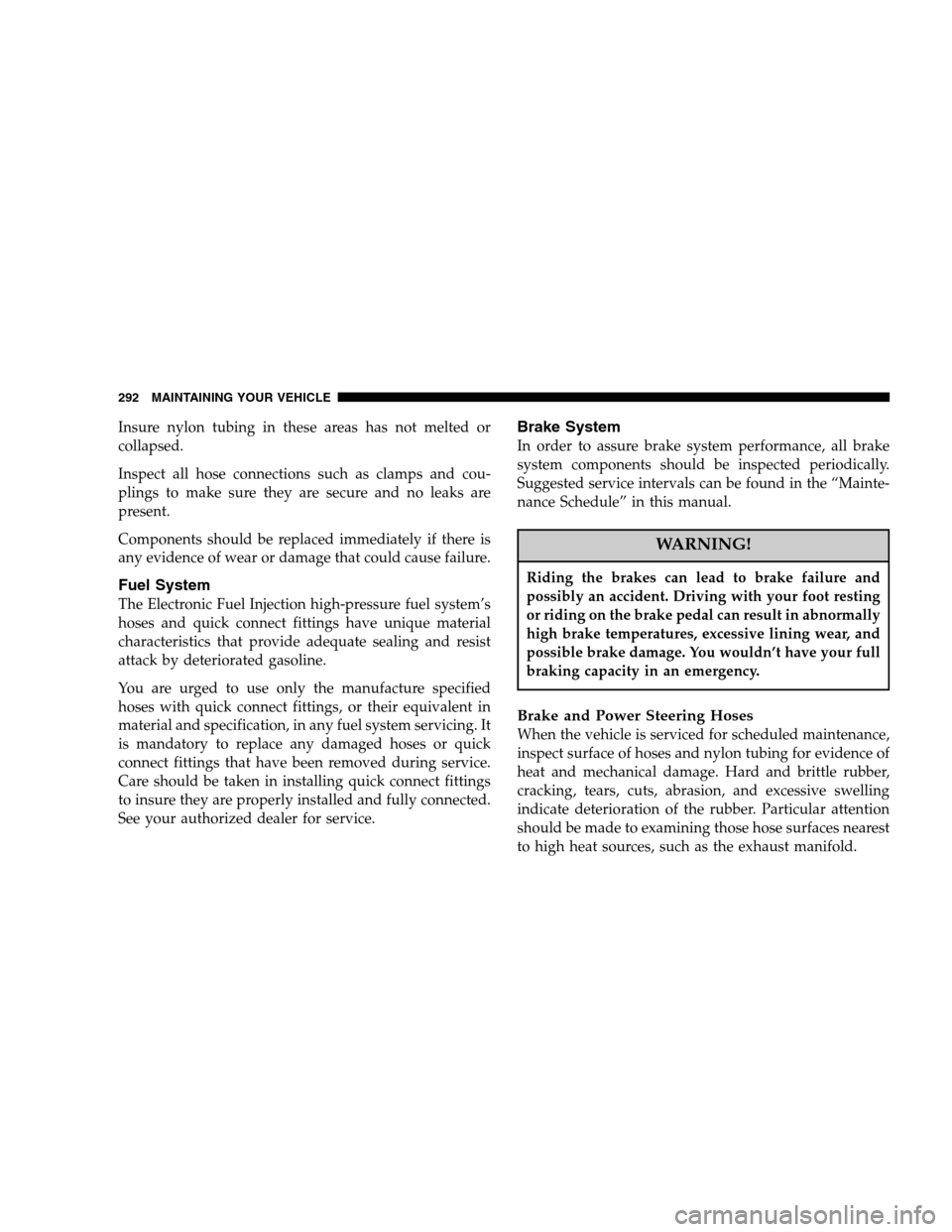
Insure nylon tubing in these areas has not melted or
collapsed.
Inspect all hose connections such as clamps and cou-
plings to make sure they are secure and no leaks are
present.
Components should be replaced immediately if there is
any evidence of wear or damage that could cause failure.
Fuel System
The Electronic Fuel Injection high-pressure fuel system’s
hoses and quick connect fittings have unique material
characteristics that provide adequate sealing and resist
attack by deteriorated gasoline.
You are urged to use only the manufacture specified
hoses with quick connect fittings, or their equivalent in
material and specification, in any fuel system servicing. It
is mandatory to replace any damaged hoses or quick
connect fittings that have been removed during service.
Care should be taken in installing quick connect fittings
to insure they are properly installed and fully connected.
See your authorized dealer for service.
Brake System
In order to assure brake system performance, all brake
system components should be inspected periodically.
Suggested service intervals can be found in the “Mainte-
nance Schedule” in this manual.
WARNING!
Riding the brakes can lead to brake failure and
possibly an accident. Driving with your foot resting
or riding on the brake pedal can result in abnormally
high brake temperatures, excessive lining wear, and
possible brake damage. You wouldn’t have your full
braking capacity in an emergency.
Brake and Power Steering Hoses
When the vehicle is serviced for scheduled maintenance,
inspect surface of hoses and nylon tubing for evidence of
heat and mechanical damage. Hard and brittle rubber,
cracking, tears, cuts, abrasion, and excessive swelling
indicate deterioration of the rubber. Particular attention
should be made to examining those hose surfaces nearest
to high heat sources, such as the exhaust manifold.
292 MAINTAINING YOUR VEHICLE
Page 293 of 360
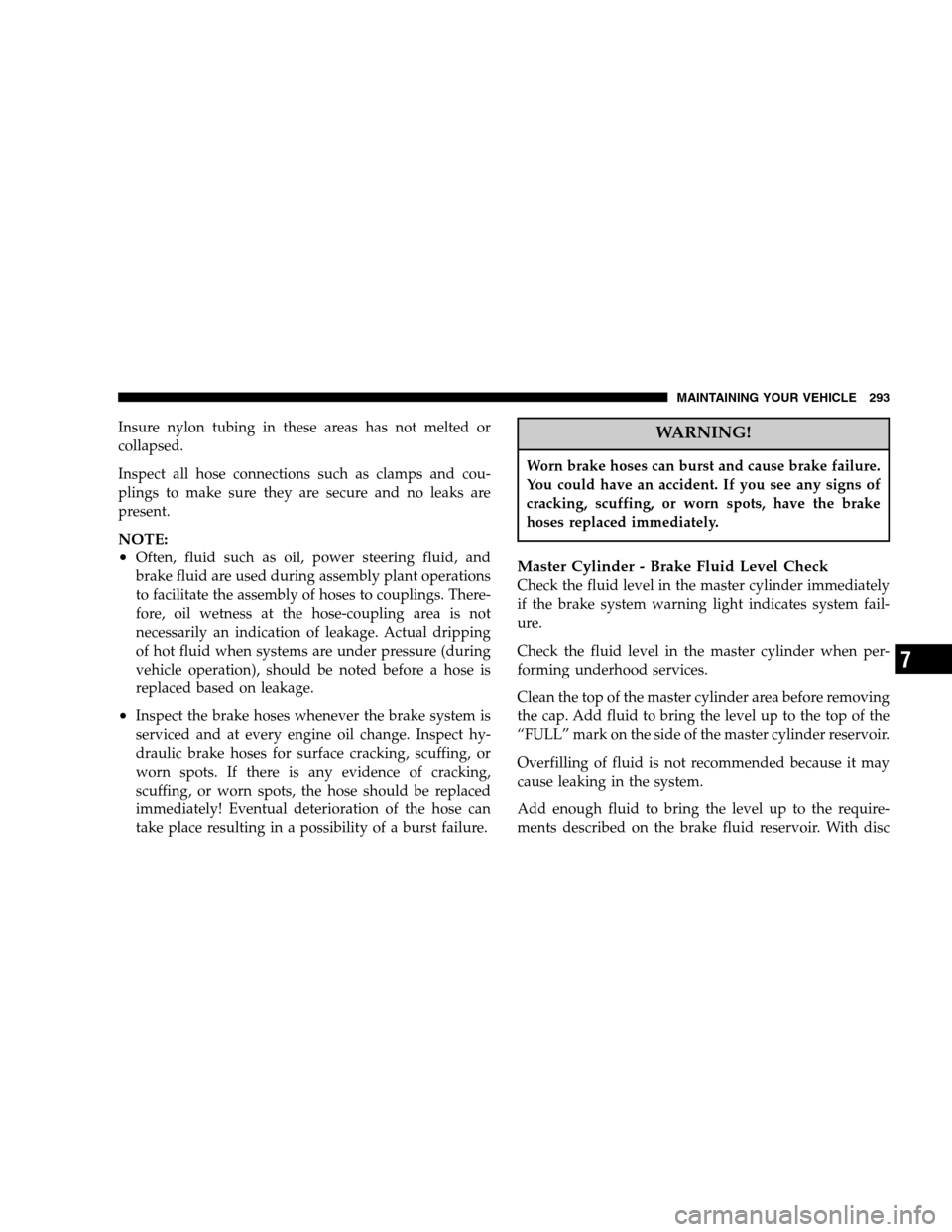
Insure nylon tubing in these areas has not melted or
collapsed.
Inspect all hose connections such as clamps and cou-
plings to make sure they are secure and no leaks are
present.
NOTE:
•
Often, fluid such as oil, power steering fluid, and
brake fluid are used during assembly plant operations
to facilitate the assembly of hoses to couplings. There-
fore, oil wetness at the hose-coupling area is not
necessarily an indication of leakage. Actual dripping
of hot fluid when systems are under pressure (during
vehicle operation), should be noted before a hose is
replaced based on leakage.
•Inspect the brake hoses whenever the brake system is
serviced and at every engine oil change. Inspect hy-
draulic brake hoses for surface cracking, scuffing, or
worn spots. If there is any evidence of cracking,
scuffing, or worn spots, the hose should be replaced
immediately! Eventual deterioration of the hose can
take place resulting in a possibility of a burst failure.
WARNING!
Worn brake hoses can burst and cause brake failure.
You could have an accident. If you see any signs of
cracking, scuffing, or worn spots, have the brake
hoses replaced immediately.
Master Cylinder - Brake Fluid Level Check
Check the fluid level in the master cylinder immediately
if the brake system warning light indicates system fail-
ure.
Check the fluid level in the master cylinder when per-
forming underhood services.
Clean the top of the master cylinder area before removing
the cap. Add fluid to bring the level up to the top of the
“FULL” mark on the side of the master cylinder reservoir.
Overfilling of fluid is not recommended because it may
cause leaking in the system.
Add enough fluid to bring the level up to the require-
ments described on the brake fluid reservoir. With disc
MAINTAINING YOUR VEHICLE 293
7
Page 294 of 360
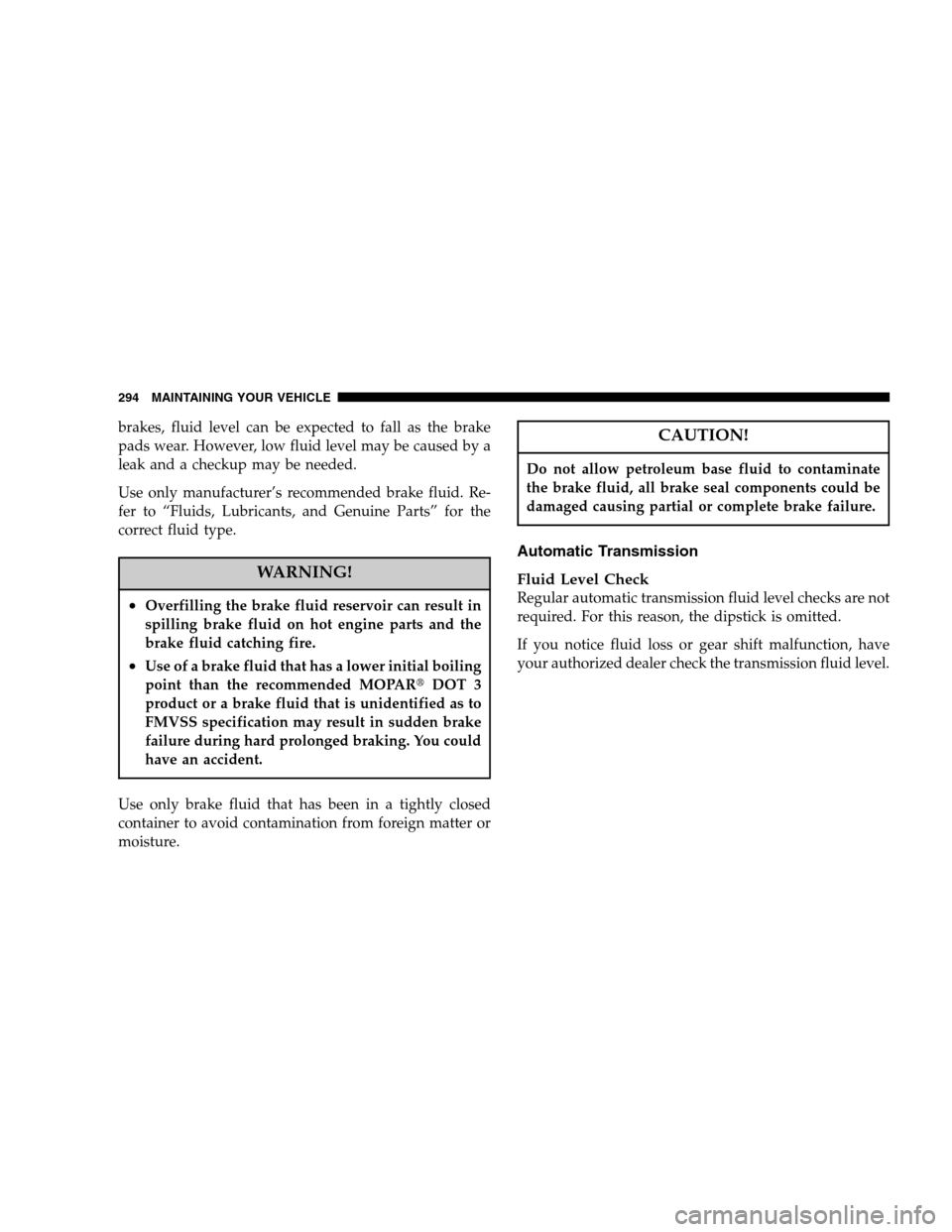
brakes, fluid level can be expected to fall as the brake
pads wear. However, low fluid level may be caused by a
leak and a checkup may be needed.
Use only manufacturer’s recommended brake fluid. Re-
fer to “Fluids, Lubricants, and Genuine Parts” for the
correct fluid type.
WARNING!
•Overfilling the brake fluid reservoir can result in
spilling brake fluid on hot engine parts and the
brake fluid catching fire.
•Use of a brake fluid that has a lower initial boiling
point than the recommended MOPAR�DOT 3
product or a brake fluid that is unidentified as to
FMVSS specification may result in sudden brake
failure during hard prolonged braking. You could
have an accident.
Use only brake fluid that has been in a tightly closed
container to avoid contamination from foreign matter or
moisture.
CAUTION!
Do not allow petroleum base fluid to contaminate
the brake fluid, all brake seal components could be
damaged causing partial or complete brake failure.
Automatic Transmission
Fluid Level Check
Regular automatic transmission fluid level checks are not
required. For this reason, the dipstick is omitted.
If you notice fluid loss or gear shift malfunction, have
your authorized dealer check the transmission fluid level.
294 MAINTAINING YOUR VEHICLE
Page 297 of 360
CAUTION!
Do not use abrasive or strong cleaning materials
such as steel wool or scouring powder, which will
scratch metal and painted surfaces.
Special Care
•
If you drive on salted or dusty roads or if you drive
near the ocean, hose off the undercarriage at least once
a month.
•It is important that the drain holes in the lower edges
of the doors, rocker panels, and trunk be kept clear
and open.
•If you detect any stone chips or scratches in the paint,
touch them up immediately. The cost of such repairs is
considered the responsibility of the owner.
•If your vehicle is damaged due to an accident or
similar cause, which destroys the paint and protective
coating, have your vehicle repaired as soon as pos-
sible. The cost of such repairs is considered the respon-
sibility of the owner.
•If you carry special cargo such as chemicals, fertilizers,
de-icer salt, etc., be sure that such materials are well
packaged and sealed.
•If a lot of driving is done on gravel roads, consider
mud or stone shields behind each wheel.
•Use Mopar�touch up paint or equivalent on scratches
as soon as possible. Your dealer has touch up paint to
match the color of your vehicle.
Wheel and Wheel Trim Care
All wheels and wheel trim, especially aluminum and
chrome plated wheels should be cleaned regularly with a
mild soap and water to prevent corrosion. To remove
heavy soil and/or excessive brake dust, use Mopar�
Wheel Cleaner (05066247AB) or equivalent or select a
nonabrasive, non-acidic cleaner. Do not use scouring
pads, steel wool, a bristle brush, or metal polishes. Only
Mopar�or equivalent is recommended. Do not use oven
cleaner. Avoid automatic car washes that use acidic
solutions or harsh brushes that may damage the wheels’
protective finish.
MAINTAINING YOUR VEHICLE 297
7
Page 301 of 360
Cavity Car-
tridge
FuseMini
FuseDescription
10 — 5 Amp
OrangePowertrain Control
Module (PCM)/Starter
11 — 25 Amp
ClearAuto Shutdown/
Powertrain Control
Module (PCM)
12 — — —
13 — — —
14 — 25 Amp
ClearPowertrain Control
Module (PCM)
15 — 20 Amp
yellowInjectors, Ignition Coils
16 — — —
17 30 Amp
Pink— Anti-lock Brakes System
(ABS) Valves/
Powertrain Control
Module (PCM)
18 30 Amp
Pink— Windshield Wiper/
WasherCavity Car-
tridge
FuseMini
FuseDescription
19 50 Amp
Red— Radiator Fan
20 20 Amp
Blue— Starter
21 50 Amp
Red— Anti-lock Brakes System
(ABS) Pump Motor
22 40 Amp
Green— AC Clutch/Radiator Fan
High — Low
23 50 Amp
Red— High Intensity Lighting
(HID)
24 60 Amp
Yellow— Radiator Fan
25 30 Amp
Pink— Front Control Module
(FCM)
26 — — —
27 30 Amp
Pink— Front Control Module
(FCM)
MAINTAINING YOUR VEHICLE 301
7
Page 304 of 360
Cavity Car-
tridge
FuseMini
FuseDescription
26 — — —
27 — 10 Amp
RedAirbag/Airbag Control
Module (ACM)
28 — 10 Amp
RedCurtain Airbag - if
equipped
29 — 5 Amp
OrangeAnti-lock Brakes
Module/Cluster/Front
Control Module (FCM)/
Powertrain Control
Module (PCM)/Sentry
Key Remote Keyless
Entry/Stop Lights
30 — 10 Amp
RedDoor Modules/Power
Mirrors - if equipped/
Steering Control Module
31 — — —
32 — — —
33 — — —
34 — — —Cavity Car-
tridge
FuseMini
FuseDescription
35 — 5 Amp
OrangeAmplifier - if equipped/
Antenna/Ignition
Delay/Overhead
Console/Passenger Door
Lock & Express Power
Window Switch - if
equipped/Power Mir-
rors - if equipped/Rain
Sensor - if equipped/
Rear Defrost
36 — 20 Amp
YellowHands Free Phone - if
equipped/Media System
Monitor DVD - if
equipped/Radio/
Satellite Receiver - if
equipped
37 — 15 Amp
BlueTransmission - NAG1
38 — 5 Amp
OrangeAnalog Clock/Cargo
Light/Overhead Con-
sole
304 MAINTAINING YOUR VEHICLE
Page 315 of 360
Chassis
Component Fluids, Lubricants, and Genuine Parts
Automatic Transmission Mopar�ATF+4 Automatic Transmission Fluid.
Brake Master Cylinder Mopar�DOT 3, SAE J1703 should be used. If DOT 3, SAE J1703 brake
fluid is not available, then DOT 4 is acceptable. Use only recommended
brake fluids.
Power Steering Reservoir Mopar�Power Steering Fluid + 4, Mopar�ATF+4 Automatic Transmission
Fluid.
Rear Axle API Certified GL-5 SAE 75W140 Synthetic Gear Lubricant or equivalent.
MAINTAINING YOUR VEHICLE 315
7