Page 276 of 634
SERVICE BATTERY CHARGING
SYSTEM
On some vehicles, this message displays if there is
a problem with the battery charging system. Under
certain conditions, the charging system light may
also turn on in the instrument panel cluster. See
Charging System Light on page 248. Driving with
this problem could drain the battery. Turn off all
unnecessary accessories. Have the electrical
system checked as soon as possible. See your
dealer.
SERVICE BRAKE SYSTEM
This message displays along with the brake
system warning light if there is a problem with the
brake system. SeeBrake System Warning
Light on page 249. If this message appears, stop
as soon as possible and turn off the vehicle.
Restart the vehicle and check for the message on
the DIC display. If the message is still displayed
or appears again when you begin driving, the
brake system needs service as soon as possible.
See your dealer.
SERVICE BRAKES SOON
This message displays if there is a problem with
the brake system. If this message appears, stop as
soon as possible and turn off the vehicle. Restart
the vehicle and check for the message on the
DIC display. If the message is still displayed
or appears again when you begin driving, the
brake system needs service. See your dealer.
SERVICE PARK ASSIST
If your vehicle has the Ultrasonic Rear Parking
Assist (URPA) system, this message displays
if there is a problem with the URPA system. Do
not use this system to help you park. See
Ultrasonic Rear Parking Assist (URPA) on
page 222for more information. See your dealer
for service.
276
Page 381 of 634

Q:What should I do if my vehicle stalls, or
is about to stall, and I cannot make it up
the hill?
A:If this happens, there are some things you
should do, and there are some things you
must not do. First, here is what youshoulddo:
Push the brake pedal to stop the vehicle
and keep it from rolling backwards. Also, apply
the parking brake.
If your engine is still running, shift the
transmission to REVERSE (R), release the
parking brake, and slowly back down the hill in
REVERSE (R).
If your engine has stopped running, you will
need to restart it. With the brake pedal
pressed and the parking brake still applied,
shift the transmission to PARK (P) and restart
the engine. Then, shift to REVERSE (R),
release the parking brake, and slowly back
down the hill as straight as possible in
REVERSE (R).
As you are backing down the hill, put your left
hand on the steering wheel at the 12 o’clock
position. This way, you will be able to tell
if your wheels are straight and maneuver as
you back down. It is best that you back
down the hill with your wheels straight rather
than in the left or right direction. Turning
the wheel too far to the left or right will
increase the possibility of a rollover.
381
Page 382 of 634
Here are some things youmust notdo if you stall,
or are about to stall, when going up a hill.
Never attempt to prevent a stall by shifting
into NEUTRAL (N) to rev-up the engine
and regain forward momentum. This will not
work. Your vehicle will roll backwards
very quickly and you could go out of control.
Instead, apply the regular brake to stop
the vehicle. Then apply the parking brake.
Shift to REVERSE (R), release the parking
brake, and slowly back straight down.{CAUTION:
Shifting the transfer case to NEUTRAL
can cause your vehicle to roll even if the
transmission is in PARK (P). This is
because the NEUTRAL position on the
transfer case overrides the transmission.
You or someone else could be injured. If
you are going to leave your vehicle, set
the parking brake and shift the
transmission to PARK (P). But do not shift
the transfer case to NEUTRAL.
Never attempt to turn around if you are about
to stall when going up a hill. If the hill is steep
enough to stall your vehicle, it is steep
enough to cause you to roll over if you turn
around. If you cannot make it up the hill, you
must back straight down the hill.
382
Page 383 of 634
Q:Suppose, after stalling, I try to back down
the hill and decide I just cannot do it. What
should I do?
A:Set the parking brake, put your transmission
in PARK (P) and turn off the engine. Leave
the vehicle and go get some help. Exit on the
uphill side and stay clear of the path the
vehicle would take if it rolled downhill. Do not
shift the transfer case to NEUTRAL when
you leave the vehicle. Leave it in some gear.
Driving Downhill
When off-roading takes you downhill, you will want
to consider a number of things:
How steep is the downhill? Will I be able to
maintain vehicle control?
What is the surface like? Smooth? Rough?
Slippery? Hard-packed dirt? Gravel?
Are there hidden surface obstacles? Ruts?
Logs? Boulders?
What is at the bottom of the hill? Is there a
hidden creek bank or even a river bottom
with large rocks?
If you decide you can go down a hill safely, then
try to keep your vehicle headed straight down, and
use a low gear. This way, engine drag can help
your brakes and they will not have to do all
the work. Descend slowly, keeping your vehicle
under control at all times.
{CAUTION:
Heavy braking when going down a hill can
cause your brakes to overheat and fade.
This could cause loss of control and a
serious accident. Apply the brakes lightly
when descending a hill and use a low
gear to keep vehicle speed under control.
383
Page 384 of 634
Q:Are there some things I should not do
when driving down a hill?
A:Yes! These are important because if you
ignore them you could lose control and
have a serious accident.
When driving downhill, avoid turns that take
you across the incline of the hill. A hill that
is not too steep to drive down may be
too steep to drive across. You could roll over
if you do not drive straight down.
Never go downhill with the transmission in
NEUTRAL (N). This is called “free-wheeling.”
Your brakes will have to do all the work
and could overheat and fade.
Q:Am I likely to stall when going downhill?
A:It is much more likely to happen going
uphill. But if it happens going downhill, here is
what to do.
1. Stop your vehicle by applying the regular
brakes. Apply the parking brake.
2. Shift to PARK (P) and, while still braking,
restart the engine.
3. Shift back to a low gear, release the parking
brake, and drive straight down.
4. If the engine will not start, get out and get help.
384
Page 419 of 634
Four-Wheel-Drive Vehicles
Use the following procedure to tow your vehicle:
1. Shift the transmission to PARK (P).
2. Turn the engine off, but leave the ignition on.
3. Firmly set the parking brake.
4. Securely attach the vehicle being towed to the
tow vehicle.
{CAUTION:
Shifting a four-wheel-drive vehicle’s
transfer case into NEUTRAL can cause
your vehicle to roll even if the
transmission is in PARK (P). You or
others could be injured. Make sure the
parking brake is rmly set before you shift
the transfer case to NEUTRAL.
5. Shift the transfer case to NEUTRAL (N). See
Four-Wheel Drive on page 150for the proper
procedure to select the NEUTRAL (N)
position for your vehicle.
6. Release the parking brake only after the
vehicle being towed is rmly attached to
the towing vehicle.
7. Turn the ignition off.
419
Page 420 of 634
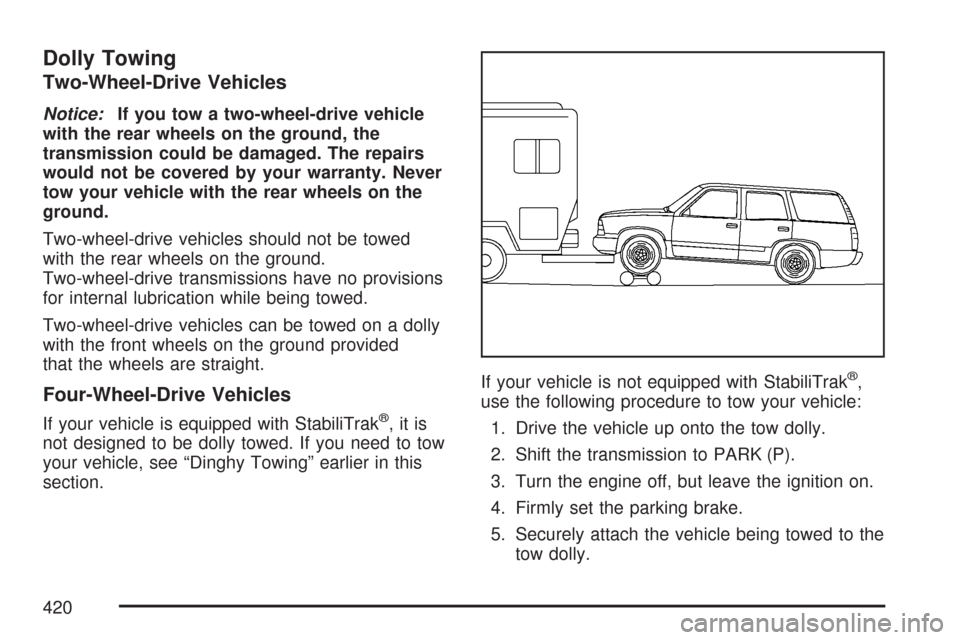
Dolly Towing
Two-Wheel-Drive Vehicles
Notice:If you tow a two-wheel-drive vehicle
with the rear wheels on the ground, the
transmission could be damaged. The repairs
would not be covered by your warranty. Never
tow your vehicle with the rear wheels on the
ground.
Two-wheel-drive vehicles should not be towed
with the rear wheels on the ground.
Two-wheel-drive transmissions have no provisions
for internal lubrication while being towed.
Two-wheel-drive vehicles can be towed on a dolly
with the front wheels on the ground provided
that the wheels are straight.
Four-Wheel-Drive Vehicles
If your vehicle is equipped with StabiliTrak®,itis
not designed to be dolly towed. If you need to tow
your vehicle, see “Dinghy Towing” earlier in this
section.If your vehicle is not equipped with StabiliTrak
®,
use the following procedure to tow your vehicle:
1. Drive the vehicle up onto the tow dolly.
2. Shift the transmission to PARK (P).
3. Turn the engine off, but leave the ignition on.
4. Firmly set the parking brake.
5. Securely attach the vehicle being towed to the
tow dolly.
420
Page 421 of 634
{CAUTION:
Shifting a four-wheel-drive vehicle’s
transfer case into NEUTRAL can cause
your vehicle to roll even if the
transmission is in PARK (P). You or
others could be injured. Make sure the
parking brake is rmly set before you shift
the transfer case to NEUTRAL.
6. Shift the transfer case to NEUTRAL. See
Four-Wheel Drive on page 150for the
proper procedure to select the NEUTRAL
position for your vehicle.
7. Release the parking brake only after the
vehicle being towed is rmly attached to
the towing vehicle.
Level Control
Automatic Level Control
The automatic level control rear suspension is
available on two-wheel drive and four-wheel drive
light-duty vehicles and comes as a part of the
Autoride
®suspension, if equipped.
This type of level control is fully automatic and will
provide a better leveled riding position as well
as better handling under a variety of passenger
and loading conditions. An air compressor
connected to the rear shocks will raise or lower
the rear of the vehicle to maintain proper vehicle
height. The system is activated when the
ignition key is turned to RUN and will automatically
adjust vehicle height thereafter. The system
may exhaust (lower vehicle height) for up to
ten minutes after the ignition key has been turned
off. You may hear the air compressor operating
when the height is being adjusted.
If a weight-distributing hitch is being used, it is
recommended to allow the shocks to inate,
thereby leveling the vehicle prior to adjusting
the hitch.
421