2007 CHEVROLET SUBURBAN warning light
[x] Cancel search: warning lightPage 489 of 634

Brake Wear
Your vehicle has four-wheel disc brakes.
Disc brake pads have built-in wear indicators that
make a high-pitched warning sound when the
brake pads are worn and new pads are needed.
The sound may come and go or be heard all
the time your vehicle is moving, except when you
are pushing on the brake pedal rmly.
{CAUTION:
The brake wear warning sound means that
soon the brakes will not work well. That
could lead to an accident. When you hear
the brake wear warning sound, have your
vehicle serviced.
Notice:Continuing to drive with worn-out
brake pads could result in costly brake repair.Some driving conditions or climates may cause a
brake squeal when the brakes are rst applied
or lightly applied. This does not mean something
is wrong with your brakes.
Properly torqued wheel nuts are necessary to help
prevent brake pulsation. When tires are rotated,
inspect brake pads for wear and evenly tighten
wheel nuts in the proper sequence to GM torque
specications.
Brake linings should always be replaced as
complete axle sets.
Brake Pedal Travel
See your dealer if the brake pedal does not return
to normal height, or if there is a rapid increase
in pedal travel. This could be a sign of brake
trouble.
Brake Adjustment
Every time you make a brake stop, your disc
brakes adjust for wear.
489
Page 517 of 634
For additional information and details about the
DIC operation and displays seeDIC Operation and
Displays (With DIC Buttons) on page 261orDIC
Operation and Displays (Without DIC Buttons)
on page 267andDIC Warnings and Messages on
page 270.
You may notice, during cooler weather conditions,
that the tire pressure monitor light, located on
the instrument panel cluster, and the CHECK TIRE
PRESSURE message will appear when the
vehicle is rst started and then turn off as you
start to drive the vehicle. This could be an early
indicator that the tire pressures are getting low and
need to be inated to the proper pressure.
Each tire, including the spare (if provided), should
be checked monthly when cold and inated to
the ination pressure recommended by the vehicle
manufacturer on the vehicle placard or tire
ination pressure label. (If your vehicle has tires of
a different size than the size indicated on the
vehicle placard or tire ination pressure label, you
should determine the proper tire ination
pressure for those tires.)As an added safety
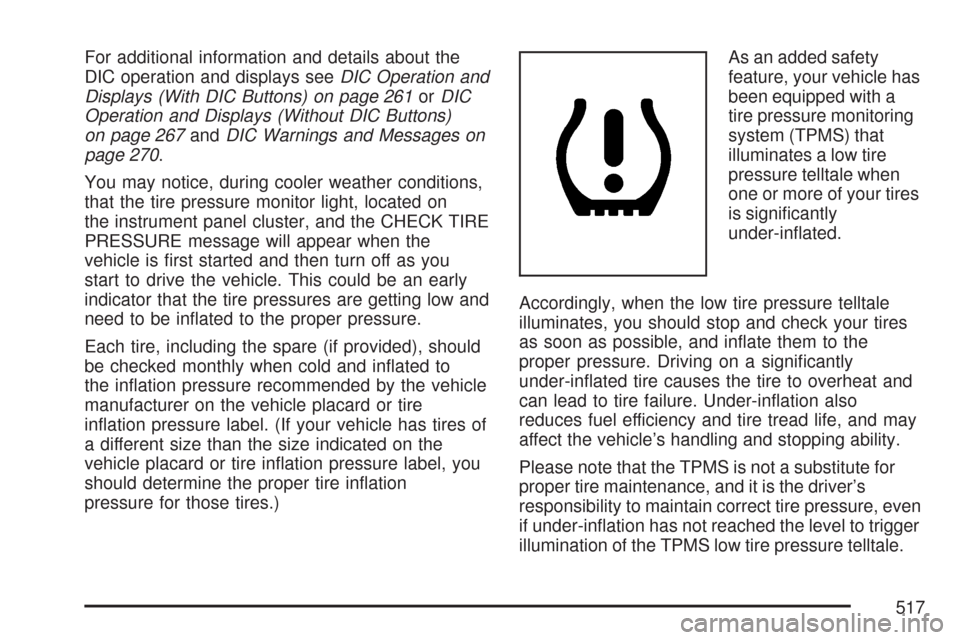
feature, your vehicle has
been equipped with a
tire pressure monitoring
system (TPMS) that
illuminates a low tire
pressure telltale when
one or more of your tires
is signicantly
under-inated.
Accordingly, when the low tire pressure telltale
illuminates, you should stop and check your tires
as soon as possible, and inate them to the
proper pressure. Driving on a signicantly
under-inated tire causes the tire to overheat and
can lead to tire failure. Under-ination also
reduces fuel efficiency and tire tread life, and may
affect the vehicle’s handling and stopping ability.
Please note that the TPMS is not a substitute for
proper tire maintenance, and it is the driver’s
responsibility to maintain correct tire pressure, even
if under-ination has not reached the level to trigger
illumination of the TPMS low tire pressure telltale.
517
Page 518 of 634
Your vehicle has also been equipped with a TPMS
malfunction indicator to indicate when the
system is not operating properly. The TPMS
malfunction indicator is combined with the low tire
pressure telltale. When the system detects a
malfunction, the telltale will ash for approximately
one minute and then remain continuously
illuminated. This sequence will continue upon
subsequent vehicle start-ups as long as the
malfunction exists.
When the malfunction indicator is illuminated, the
system may not be able to detect or signal low
tire pressure as intended. TPMS malfunctions may
occur for a variety of reasons, including the
installation of replacement or alternate tires or
wheels on the vehicle that prevent the TPMS from
functioning properly. Always check the TPMS
malfunction telltale after replacing one or more
tires or wheels on your vehicle to ensure that the
replacement or alternate tires and wheels allow
the TPMS to continue to function properly.The CHECK TIRE PRESSURE warning message
and low tire pressure light (telltale) will come
on each time the vehicle is started until the tires
are inated to the correct ination pressure.
The Tire and Loading Information label (tire
information placard) shows the size of your
vehicle’s original tires and the correct ination
pressure for your vehicle’s tires when they
are cold. SeeInation - Tire Pressure on
page 515. For the location of the tire and loading
information label, seeLoading Your Vehicle
on page 407.
Your vehicle’s TPMS can alert you about a low
tire pressure condition but it does not replace
normal tire maintenance. SeeTire Inspection and
Rotation on page 521andTires on page 507.
Notice:Do not use a tire sealant if your
vehicle has Tire Pressure Monitors. The liquid
sealant can damage the tire pressure monitor
sensors.
518
Page 527 of 634
Uniform Tire Quality Grading
Quality grades can be found where applicable on
the tire sidewall between tread shoulder and
maximum section width. For example:
Treadwear 200 Traction AA Temperature A
The following information relates to the system
developed by the United States National Highway
Traffic Safety Administration (NHTSA), which
grades tires by treadwear, traction, and
temperature performance. This applies only to
vehicles sold in the United States. The grades are
molded on the sidewalls of most passenger car
tires. The Uniform Tire Quality Grading (UTQG)
system does not apply to deep tread, winter-type
snow tires, space-saver, or temporary use
spare tires, tires with nominal rim diameters of
10 to 12 inches (25 to 30 cm), or to some
limited-production tires.
While the tires available on General Motors
passenger cars and light trucks may vary with
respect to these grades, they must also conform
to federal safety requirements and additional
General Motors Tire Performance Criteria (TPC)
standards.
Treadwear
The treadwear grade is a comparative rating
based on the wear rate of the tire when tested
under controlled conditions on a specied
government test course. For example, a tire
graded 150 would wear one and a half (1.5) times
as well on the government course as a tire
graded 100. The relative performance of tires
depends upon the actual conditions of their use,
however, and may depart signicantly from
the norm due to variations in driving habits, service
practices, and differences in road characteristics
and climate.
Traction – AA, A, B, C
The traction grades, from highest to lowest, are
AA, A, B, and C. Those grades represent the tire’s
ability to stop on wet pavement as measured
under controlled conditions on specied
government test surfaces of asphalt and concrete.
A tire marked C may have poor traction
performance.
Warning:The traction grade assigned to this tire
is based on straight-ahead braking traction
tests, and does not include acceleration, cornering,
hydroplaning, or peak traction characteristics.
527
Page 619 of 634
A
Accessories and Modications..................... 444
Adding a Snow Plow or Similar
Equipment................................................ 412
Adding Equipment to Your
Airbag-Equipped Vehicle........................... 107
Additives, Fuel............................................ 448
Add-On Electrical Equipment....................... 563
Adjustable Throttle and Brake Pedal............ 143
Air Cleaner/Filter, Engine............................. 464
Air Conditioning..................................227, 231
Airbag
Passenger Status Indicator....................... 246
Readiness Light....................................... 245
Airbag Sensing and Diagnostic
Module (SDM).......................................... 609
Airbag System............................................... 90
What Will You See After an
Airbag Inates?...................................... 99
When Should an Airbag Inate?................. 96
Where Are the Airbags?............................. 93
Airbag Systems
Adding Equipment to Your
Airbag-Equipped Vehicle....................... 107
How Does an Airbag Restrain?.................. 99Airbag Systems (cont.)
Passenger Sensing System...................... 101
Servicing Your Airbag-Equipped Vehicle..... 106
What Makes an Airbag Inate?.................. 98
Antenna, Rear Side Window........................ 354
Antenna, XM™ Satellite Radio Antenna
System.................................................... 354
Anti-Lock Brake System.............................. 361
Anti-Lock Brake, System Warning Light....... 251
Appearance Care
Aluminum or Chrome-Plated Wheels........ 559
Care of Safety Belts................................ 556
Chemical Paint Spotting........................... 561
Cleaning Exterior Lamps/Lenses.............. 557
Cleaning the Inside of Your Vehicle.......... 553
Fabric/Carpet........................................... 554
Finish Care.............................................. 557
Finish Damage......................................... 560
Instrument Panel, Vinyl, and Other
Plastic Surfaces.................................... 556
Leather.................................................... 555
Sheet Metal Damage............................... 560
Tires........................................................ 560
Underbody Maintenance........................... 560
Vehicle Care/Appearance Materials.......... 561
Washing Your Vehicle.............................. 557
619
Page 620 of 634
Appearance Care (cont.)
Weatherstrips........................................... 556
Windshield, Backglass, and
Wiper Blades........................................ 558
Ashtray....................................................... 227
Audio System.............................................. 290
Audio Steering Wheel Controls................. 351
Care of Your CD and DVD Player............ 353
Care of Your CDs and DVDs................... 353
Navigation/Radio System,
see Navigation Manual......................... 337
Radio with CD......................................... 294
Rear Seat Audio (RSA)............................ 348
Setting the Time.....................291, 292, 293
Theft-Deterrent Feature............................ 350
Understanding Radio Reception............... 352
XM™ Satellite Radio Antenna System...... 354
Audio System(s)
Radio with CD and DVD.......................... 305
Rear Side Window Antenna..................... 354
Automatic Headlamp System....................... 217
Automatic Transmission
Fluid........................................................ 466
Operation................................................. 145
Autoride
®..................................................... 422
Auxiliary Roof Mounted Lamp Switch.......... 218
B
Battery........................................................ 490
Electric Power Management..................... 220
Run-Down Protection............................... 221
Before Leaving on a Long Trip.................... 396
Bench Seat, Split (60/40).............................. 20
Brake
Emergencies............................................ 363
Parking.................................................... 156
Brakes........................................................ 486
System Warning Light.............................. 249
Braking....................................................... 360
Braking in Emergencies............................... 363
Break-In, New Vehicle................................. 139
Bucket Seats, Rear....................................... 26
Bulb Replacement....................................... 502
Halogen Bulbs......................................... 502
Headlamp Aiming..................................... 499
License Plate Lamps................................ 504
Replacement Bulbs.................................. 504
Taillamps, Turn Signal, Stoplamps and
Back-up Lamps..................................... 502
Buying New Tires........................................ 524
620
Page 621 of 634
C
Calibration..........................................162, 166
California Fuel............................................. 447
California Proposition 65 Warning................ 445
Canadian Owners........................................... 3
Capacities and Specications...................... 572
Carbon Monoxide.....125, 127, 160, 400, 422
Care of
Safety Belts............................................. 556
Your CD and DVD Player........................ 353
Your CDs and DVDs................................ 353
Cargo Cover............................................... 192
Cargo Management System........................ 194
CD, MP3 ............................................321, 327
Center Console Storage Area...................... 190
Center Front Passenger Position,
Safety Belts............................................... 53
Center Seat.................................................. 19
Chains, Tire................................................. 530
Charging System Light................................ 248
Check
Engine Light............................................ 253
Checking Things Under the Hood................ 456
Chemical Paint Spotting.............................. 561Child Restraints
Child Restraint Systems............................. 68
Infants and Young Children........................ 64
Lower Anchors and Tethers for Children....... 74
Older Children........................................... 61
Securing a Child Restraint in a
Rear Seat Position ................................. 82
Securing a Child Restraint in the
Center Front Seat Position..................... 85
Securing a Child Restraint in the
Right Front Seat Position........................ 85
Where to Put the Restraint........................ 72
Cigarette Lighter.......................................... 227
Cleaning
Aluminum or Chrome-Plated Wheels........ 559
Exterior Lamps/Lenses............................. 557
Fabric/Carpet........................................... 554
Finish Care.............................................. 557
Inside of Your Vehicle.............................. 553
Instrument Panel, Vinyl, and Other
Plastic Surfaces.................................... 556
Leather.................................................... 555
Tires........................................................ 560
Underbody Maintenance........................... 560
Washing Your Vehicle.............................. 557
621
Page 623 of 634
Dome Lamp Override.................................. 219
Dome Lamps............................................... 219
Door
Delayed Locking...................................... 123
Locks....................................................... 122
Power Door Locks................................... 123
Programmable Automatic Door Locks....... 123
Rear Door Security Locks........................ 124
Driver
Position, Safety Belt................................... 43
Driver Information Center (DIC)................... 260
DIC Operation and Displays............261, 267
DIC Vehicle Customization....................... 280
DIC Warnings and Messages................... 270
Driving
At Night................................................... 389
City.......................................................... 393
Defensive................................................. 356
Drunken................................................... 357
Freeway................................................... 394
Hill and Mountain Roads.......................... 398
In Rain and on Wet Roads...................... 390
Off-Road.................................................. 372
Recovery Hooks....................................... 406
Rocking Your Vehicle to Get it Out.......... 405
Winter...................................................... 400Dual Automatic Climate Control System....... 231
DVD
Rear Seat Entertainment System............. 337
E
Electrical System
Add-On Equipment................................... 563
Center Instrument Panel Fuse Block........ 566
Fuses and Circuit Breakers...................... 564
Instrument Panel Fuse Block................... 565
Power Windows and Other Power
Options................................................. 564
Underhood Fuse Block............................. 567
Windshield Wiper Fuses........................... 564
Engine
Air Cleaner/Filter...................................... 464
Check and Service Engine Soon Light..... 253
Coolant.................................................... 470
Coolant Heater......................................... 143
Coolant Temperature Gage...................... 252
Drive Belt Routing.................................... 593
Engine Compartment Overview................ 458
Exhaust................................................... 160
Fan Noise................................................ 483
Oil ........................................................... 459
623