2007 CHEVROLET SILVERADO mirror
[x] Cancel search: mirrorPage 416 of 684
Before changing lanes, check your mirrors.
Then use your turn signal.
Just before you leave the lane, glance quickly
over your shoulder to make sure there is not
another vehicle in your blind spot.
Once you are moving on the freeway, make
certain you allow a reasonable following distance.
Expect to move slightly slower at night.
When you want to leave the freeway, move to the
proper lane well in advance. If you miss your
exit, do not, under any circumstances, stop and
back up. Drive on to the next exit.
The exit ramp can be curved, sometimes quite
sharply. The exit speed is usually posted.
Reduce your speed according to your
speedometer, not to your sense of motion. After
driving for any distance at higher speeds, you may
tend to think you are going slower than you
actually are.Before Leaving on a Long Trip
Make sure you are ready. Try to be well rested.
If you must start when you are not fresh — such as
after a day’s work — do not plan to make too
many miles that rst part of the journey. Wear
comfortable clothing and shoes you can easily
drive in.
Is your vehicle ready for a long trip? If you keep it
serviced and maintained, it is ready to go. If it
needs service, have it done before starting out.
Of course, you will nd experienced and able
service experts in GM dealerships all across
North America. They will be ready and willing to
help if you need it.
416
Page 417 of 684
Here are some things you can check before a trip:
Windshield Washer Fluid:Is the reservoir
full? Are all windows clean inside and outside?
Wiper Blades:Are they in good shape?
Fuel, Engine Oil, Other Fluids:Have you
checked all levels?
Lamps:Are they all working? Are the lenses
clean?
Tires:They are vitally important to a safe,
trouble-free trip. Is the tread good enough
for long-distance driving? Are the tires
all inated to the recommended pressure?
Weather Forecasts:What is the weather
outlook along your route? Should you
delay your trip a short time to avoid a major
storm system?
Maps:Do you have up-to-date maps?
Highway Hypnosis
Is there actually such a condition as highway
hypnosis? Or is it just plain falling asleep at the
wheel? Call it highway hypnosis, lack of
awareness, or whatever.
There is something about an easy stretch of road
with the same scenery, along with the hum of the
tires on the road, the drone of the engine, and the
rush of the wind against the vehicle that can make
you sleepy. Do not let it happen to you! If it does,
your vehicle can leave the road in less than a
second, and you could crash and be injured.
What can you do about highway hypnosis?
First, be aware that it can happen.
Then here are some tips:
Make sure your vehicle is well ventilated,
with a comfortably cool interior.
Keep your eyes moving. Scan the road ahead
and to the sides. Check your vehicle’s mirrors
and instruments frequently.
If you get sleepy, pull off the road into a rest,
service, or parking area and take a nap, get
some exercise, or both. For safety, treat
drowsiness on the highway as an emergency.
417
Page 476 of 684
Before you start, check all trailer hitch parts and
attachments, safety chains, electrical connector,
lamps, tires and mirror adjustment. If the trailer has
electric brakes, start your vehicle and trailer
moving and then apply the trailer brake controller
by hand to be sure the brakes are working.
This lets you check your electrical connection at
the same time.
During your trip, check occasionally to be sure
that the load is secure, and that the lamps and any
trailer brakes are still working.
While towing a trailer or when exposed to long
periods of sunshine, the oor of the truck bed may
become very warm. Avoid putting items in the
truck bed that might be affected by high ambient
temperatures.
Following Distance
Stay at least twice as far behind the vehicle ahead
as you would when driving your vehicle without a
trailer. This can help you avoid situations that
require heavy braking and sudden turns.
Passing
You’ll need more passing distance up ahead when
you’re towing a trailer. And, because you’re a good
deal longer, you’ll need to go much farther beyond
the passed vehicle before you can return to your
lane.
Backing Up
Hold the bottom of the steering wheel with one
hand. Then, to move the trailer to the left, just move
that hand to the left. To move the trailer to the right,
move your hand to the right. Always back up slowly
and, if possible, have someone guide you.
Making Turns
Notice:Making very sharp turns while
trailering could cause the trailer to come in
contact with the vehicle. Your vehicle could be
damaged. Avoid making very sharp turns while
trailering.
When you’re turning with a trailer, make wider
turns than normal. Do this so your trailer
won’t strike soft shoulders, curbs, road signs,
trees or other objects. Avoid jerky or sudden
maneuvers. Signal well in advance.
476
Page 613 of 684
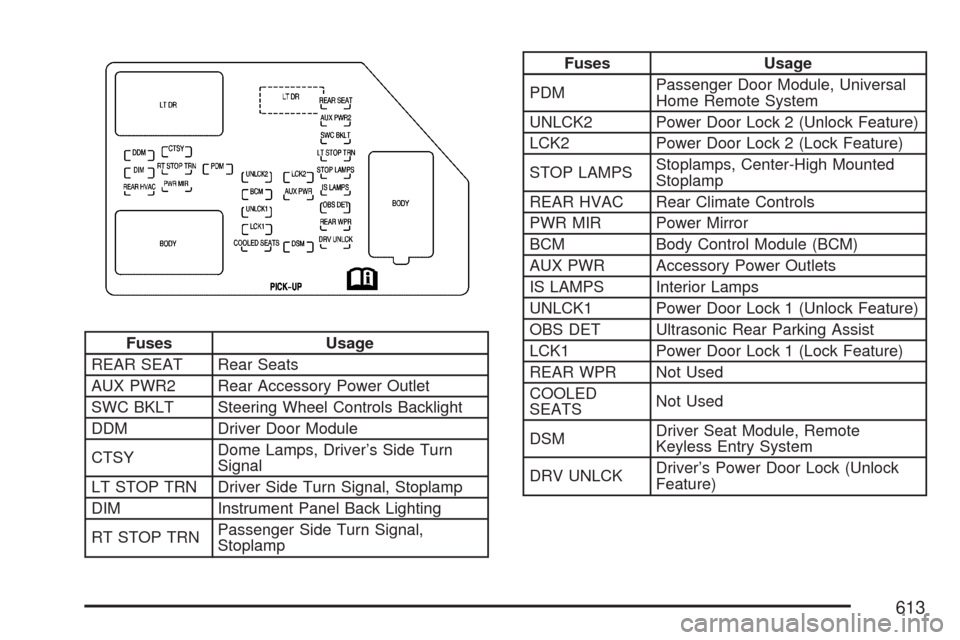
Fuses Usage
REAR SEAT Rear Seats
AUX PWR2 Rear Accessory Power Outlet
SWC BKLT Steering Wheel Controls Backlight
DDM Driver Door Module
CTSYDome Lamps, Driver’s Side Turn
Signal
LT STOP TRN Driver Side Turn Signal, Stoplamp
DIM Instrument Panel Back Lighting
RT STOP TRNPassenger Side Turn Signal,
Stoplamp
Fuses Usage
PDMPassenger Door Module, Universal
Home Remote System
UNLCK2 Power Door Lock 2 (Unlock Feature)
LCK2 Power Door Lock 2 (Lock Feature)
STOP LAMPSStoplamps, Center-High Mounted
Stoplamp
REAR HVAC Rear Climate Controls
PWR MIR Power Mirror
BCM Body Control Module (BCM)
AUX PWR Accessory Power Outlets
IS LAMPS Interior Lamps
UNLCK1 Power Door Lock 1 (Unlock Feature)
OBS DET Ultrasonic Rear Parking Assist
LCK1 Power Door Lock 1 (Lock Feature)
REAR WPR Not Used
COOLED
SEATSNot Used
DSMDriver Seat Module, Remote
Keyless Entry System
DRV UNLCKDriver’s Power Door Lock (Unlock
Feature)
613
Page 618 of 684

Fuses Usage
35 Sunroof
36Key Ignition System, Theft Deterrent
System
37 Windshield Wiper
38 SEO B2 Uptter Usage (Battery)
39 Electric Adjustable Pedals
40 Climate Controls (Battery)
41 Airbag System (Ignition)
42 Amplier
43 Audio System
44Miscellaneous (Ignition), Cruise
Control
45 Tailgate Open/Close Assist
46 Airbag System (Battery)
47OnStar
®, Rear Seat Entertainment
Display
Fuses Usage
48 Instrument Panel Cluster
49 Power Take-Off
50Auxiliary Climate Control (Ignition),
Compass-Temperature Mirror
51Center High-Mounted Stoplamp
(CHMSL)
52 Rear Defogger
53 Heated Mirrors
54 SEO B1 Uptter Usage (Battery)
55Cigarette Lighter, Auxiliary Power
Outlet
56Automatic Level Control Compressor
Relay, SEO Uptter Usage
57 Climate Controls (Ignition)
58Engine Control Module, Secondary
Fuel Pump (Ignition)
618
Page 677 of 684
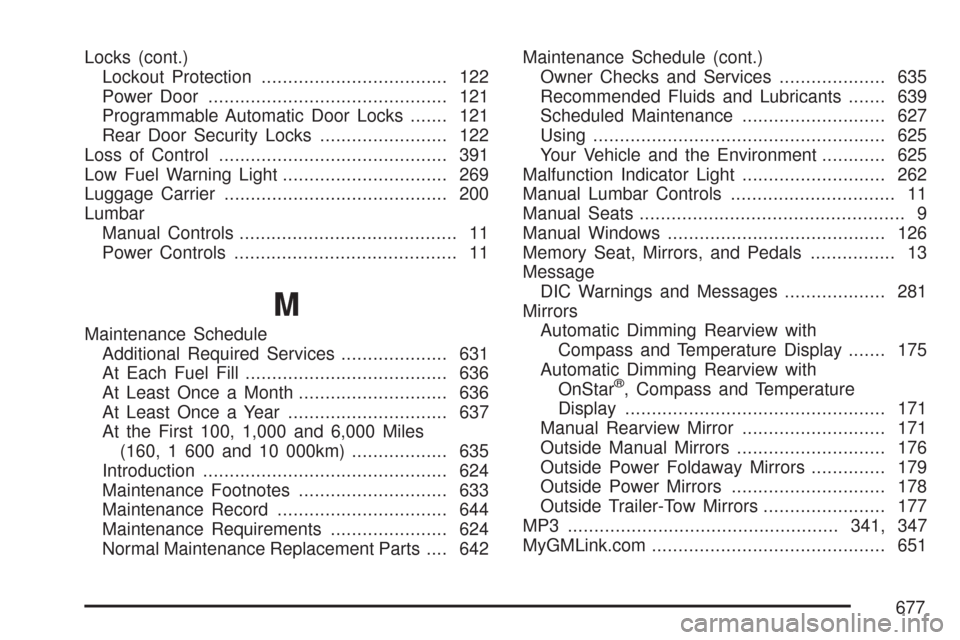
Locks (cont.)
Lockout Protection................................... 122
Power Door............................................. 121
Programmable Automatic Door Locks....... 121
Rear Door Security Locks........................ 122
Loss of Control........................................... 391
Low Fuel Warning Light............................... 269
Luggage Carrier.......................................... 200
Lumbar
Manual Controls......................................... 11
Power Controls.......................................... 11
M
Maintenance Schedule
Additional Required Services.................... 631
At Each Fuel Fill...................................... 636
At Least Once a Month............................ 636
At Least Once a Year.............................. 637
At the First 100, 1,000 and 6,000 Miles
(160, 1 600 and 10 000km).................. 635
Introduction.............................................. 624
Maintenance Footnotes............................ 633
Maintenance Record................................ 644
Maintenance Requirements...................... 624
Normal Maintenance Replacement Parts.... 642Maintenance Schedule (cont.)
Owner Checks and Services.................... 635
Recommended Fluids and Lubricants....... 639
Scheduled Maintenance........................... 627
Using....................................................... 625
Your Vehicle and the Environment............ 625
Malfunction Indicator Light........................... 262
Manual Lumbar Controls............................... 11
Manual Seats.................................................. 9
Manual Windows......................................... 126
Memory Seat, Mirrors, and Pedals................ 13
Message
DIC Warnings and Messages................... 281
Mirrors
Automatic Dimming Rearview with
Compass and Temperature Display....... 175
Automatic Dimming Rearview with
OnStar
®, Compass and Temperature
Display................................................. 171
Manual Rearview Mirror........................... 171
Outside Manual Mirrors............................ 176
Outside Power Foldaway Mirrors.............. 179
Outside Power Mirrors............................. 178
Outside Trailer-Tow Mirrors....................... 177
MP3 ...................................................341, 347
MyGMLink.com............................................ 651
677
Page 678 of 684
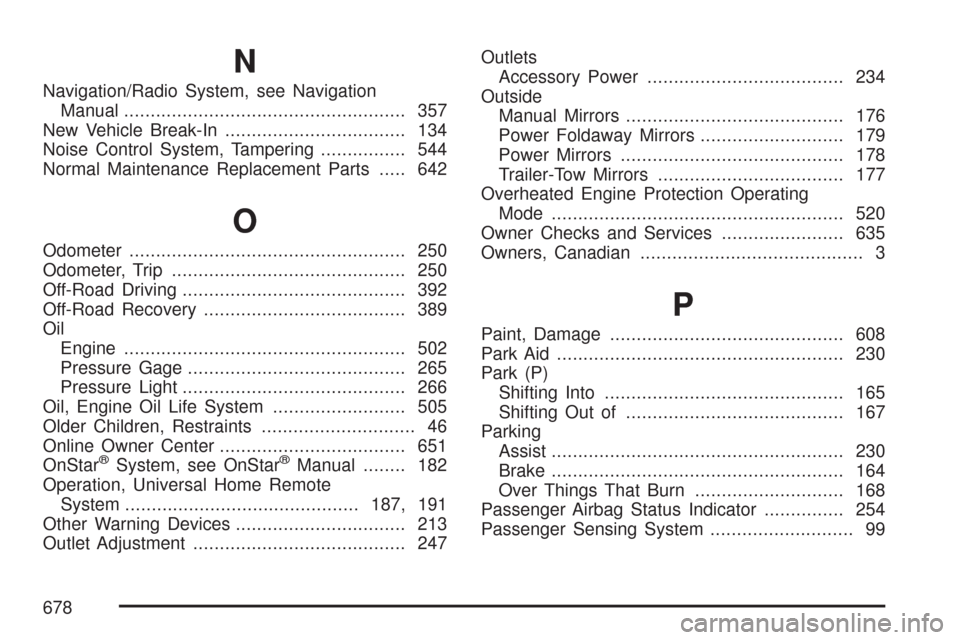
N
Navigation/Radio System, see Navigation
Manual..................................................... 357
New Vehicle Break-In.................................. 134
Noise Control System, Tampering................ 544
Normal Maintenance Replacement Parts..... 642
O
Odometer.................................................... 250
Odometer, Trip............................................ 250
Off-Road Driving.......................................... 392
Off-Road Recovery...................................... 389
Oil
Engine..................................................... 502
Pressure Gage......................................... 265
Pressure Light.......................................... 266
Oil, Engine Oil Life System......................... 505
Older Children, Restraints............................. 46
Online Owner Center................................... 651
OnStar
®System, see OnStar®Manual........ 182
Operation, Universal Home Remote
System............................................187, 191
Other Warning Devices................................ 213
Outlet Adjustment........................................ 247Outlets
Accessory Power..................................... 234
Outside
Manual Mirrors......................................... 176
Power Foldaway Mirrors........................... 179
Power Mirrors.......................................... 178
Trailer-Tow Mirrors................................... 177
Overheated Engine Protection Operating
Mode....................................................... 520
Owner Checks and Services....................... 635
Owners, Canadian.......................................... 3
P
Paint, Damage............................................ 608
Park Aid...................................................... 230
Park (P)
Shifting Into............................................. 165
Shifting Out of......................................... 167
Parking
Assist....................................................... 230
Brake....................................................... 164
Over Things That Burn............................ 168
Passenger Airbag Status Indicator............... 254
Passenger Sensing System........................... 99
678
Page 679 of 684
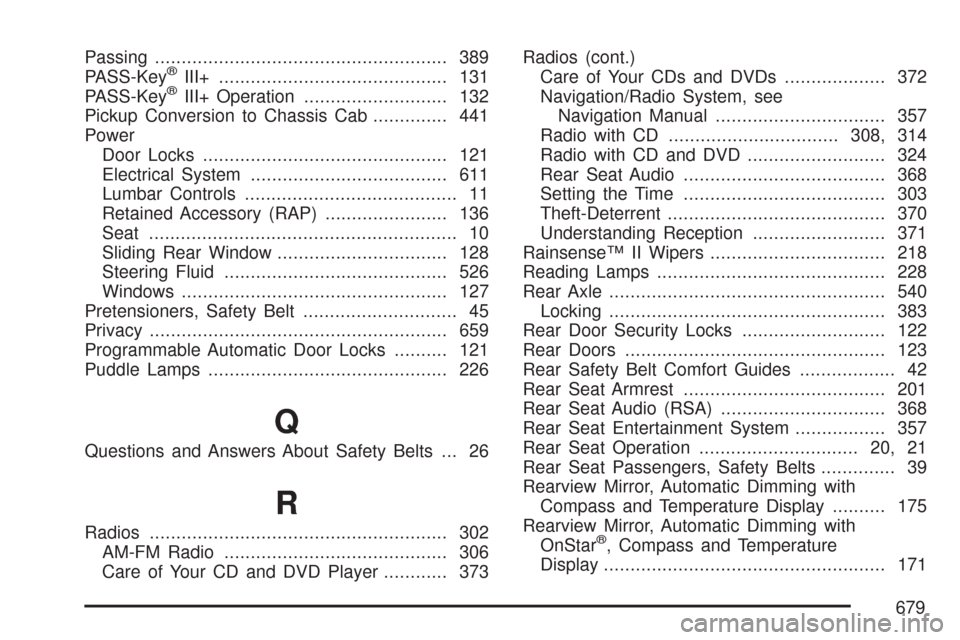
Passing....................................................... 389
PASS-Key®III+........................................... 131
PASS-Key®III+ Operation........................... 132
Pickup Conversion to Chassis Cab.............. 441
Power
Door Locks.............................................. 121
Electrical System..................................... 611
Lumbar Controls........................................ 11
Retained Accessory (RAP)....................... 136
Seat.......................................................... 10
Sliding Rear Window................................ 128
Steering Fluid.......................................... 526
Windows.................................................. 127
Pretensioners, Safety Belt............................. 45
Privacy........................................................ 659
Programmable Automatic Door Locks.......... 121
Puddle Lamps............................................. 226
Q
Questions and Answers About Safety Belts ... 26
R
Radios........................................................ 302
AM-FM Radio.......................................... 306
Care of Your CD and DVD Player............ 373Radios (cont.)
Care of Your CDs and DVDs................... 372
Navigation/Radio System, see
Navigation Manual................................ 357
Radio with CD................................308, 314
Radio with CD and DVD.......................... 324
Rear Seat Audio...................................... 368
Setting the Time...................................... 303
Theft-Deterrent......................................... 370
Understanding Reception......................... 371
Rainsense™ II Wipers................................. 218
Reading Lamps........................................... 228
Rear Axle.................................................... 540
Locking.................................................... 383
Rear Door Security Locks........................... 122
Rear Doors................................................. 123
Rear Safety Belt Comfort Guides.................. 42
Rear Seat Armrest...................................... 201
Rear Seat Audio (RSA)............................... 368
Rear Seat Entertainment System................. 357
Rear Seat Operation.............................. 20, 21
Rear Seat Passengers, Safety Belts.............. 39
Rearview Mirror, Automatic Dimming with
Compass and Temperature Display.......... 175
Rearview Mirror, Automatic Dimming with
OnStar®, Compass and Temperature
Display..................................................... 171
679