Page 424 of 684
You will need a well-charged battery to restart the
vehicle, and possibly for signaling later on with
your headlamps. Let the heater run for a while.
Then, shut the engine off and close the window
almost all the way to preserve the heat. Start
the engine again and repeat this only when you
feel really uncomfortable from the cold. But do it as
little as possible. Preserve the fuel as long as
you can. To help keep warm, you can get out of
the vehicle and do some fairly vigorous exercises
every half hour or so until help comes.If Your Vehicle is Stuck in Sand,
Mud, Ice, or Snow
In order to free your vehicle when it is stuck, you
need to spin the wheels, but you do not want
to spin the wheels too fast. The method known as
rocking can help you get out when you are
stuck, but you must use caution.
{CAUTION:
If you let your vehicle’s tires spin at high
speed, they can explode, and you or others
could be injured. And, the transmission or
other parts of the vehicle can overheat.
That could cause an engine compartment
re or other damage. When you are stuck,
spin the wheels as little as possible. Do not
spin the wheels above 35 mph (55 km/h) as
shown on the speedometer.
424
Page 443 of 684
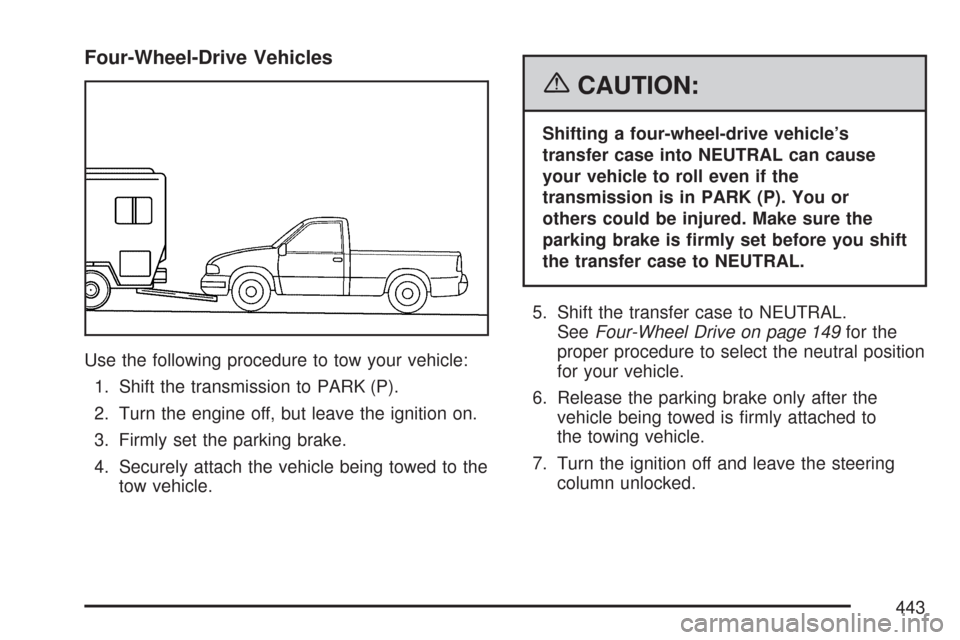
Four-Wheel-Drive Vehicles
Use the following procedure to tow your vehicle:
1. Shift the transmission to PARK (P).
2. Turn the engine off, but leave the ignition on.
3. Firmly set the parking brake.
4. Securely attach the vehicle being towed to the
tow vehicle.
{CAUTION:
Shifting a four-wheel-drive vehicle’s
transfer case into NEUTRAL can cause
your vehicle to roll even if the
transmission is in PARK (P). You or
others could be injured. Make sure the
parking brake is rmly set before you shift
the transfer case to NEUTRAL.
5. Shift the transfer case to NEUTRAL.
SeeFour-Wheel Drive on page 149for the
proper procedure to select the neutral position
for your vehicle.
6. Release the parking brake only after the
vehicle being towed is rmly attached to
the towing vehicle.
7. Turn the ignition off and leave the steering
column unlocked.
443
Page 444 of 684
Dolly Towing
Front Towing
(Front Wheels Off the Ground)
Two-Wheel-Drive Vehicles
Notice:If you tow a two-wheel-drive vehicle
with the rear wheels on the ground, the
transmission could be damaged. The repairs
would not be covered by your warranty.
Never tow your vehicle with the rear wheels on
the ground.
Two-wheel-drive vehicles should not be towed
with the rear wheels on the ground.
Two-wheel-drive transmissions have no provisions
for internal lubrication while being towed.
To dolly tow a two-wheel-drive vehicle, you must
tow the vehicle with the rear wheels on the
dolly. See “Rear Towing (Rear Wheels Off the
Ground)” later in this section for more information.
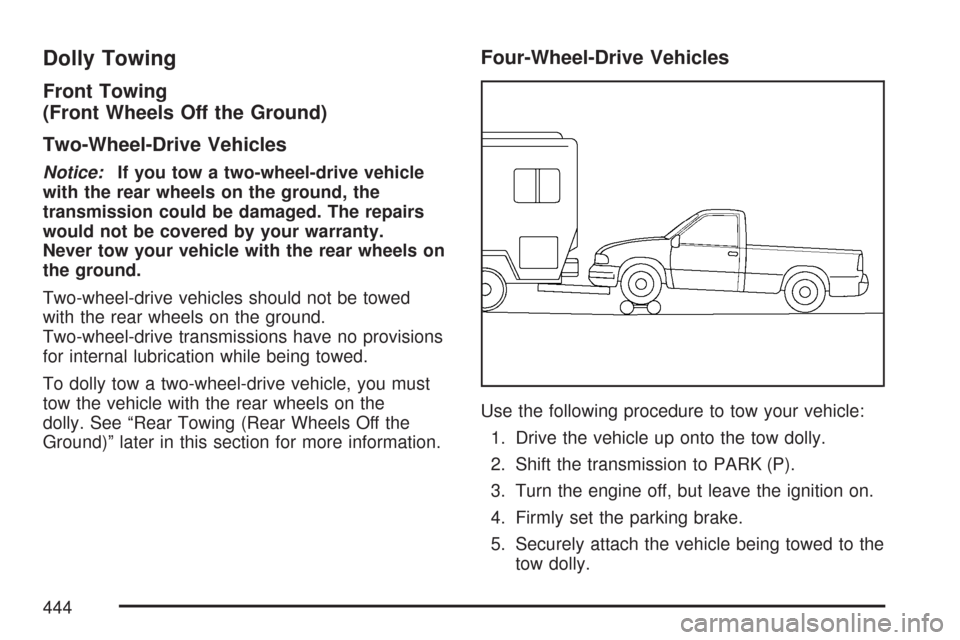
Four-Wheel-Drive Vehicles
Use the following procedure to tow your vehicle:
1. Drive the vehicle up onto the tow dolly.
2. Shift the transmission to PARK (P).
3. Turn the engine off, but leave the ignition on.
4. Firmly set the parking brake.
5. Securely attach the vehicle being towed to the
tow dolly.
444
Page 447 of 684
Towing a Trailer
If your vehicle has a diesel engine, see the
DURAMAX®Diesel manual for more information.
Do not tow a trailer during break-in. SeeNew
Vehicle Break-In on page 134for more information.
{CAUTION:
If you do not use the correct equipment
and drive properly, you can lose control
when you pull a trailer. For example, if the
trailer is too heavy, the brakes may not
work well — or even at all. You and your
passengers could be seriously injured.
Pull a trailer only if you have followed all
the steps in this section. Ask your dealer
for advice and information about towing a
trailer with your vehicle.Notice:Pulling a trailer improperly can
damage your vehicle and result in costly
repairs not covered by your warranty. To pull
a trailer correctly, follow the advice in this
part, and see your dealer for important
information about towing a trailer with your
vehicle.
To identify the trailering capacity of your vehicle,
you should read the information in “Weight of
the Trailer” that appears later in this section.
Trailering is different than just driving your vehicle
by itself. Trailering means changes in acceleration,
braking, handling, durability and fuel economy.
Successful, safe trailering takes correct equipment,
and it has to be used properly.
That’s the reason for this part. In it are many
time-tested, important trailering tips and safety
rules. Many of these are important for your safety
and that of your passengers. So please read
this section carefully before you pull a trailer.
447
Page 448 of 684
If You Do Decide To Pull A Trailer
If you do, here are some important points:
There are many different laws, including speed
limit restrictions, having to do with trailering.
Make sure your rig will be legal, not only where
you live but also where you’ll be driving.
A good source for this information can be state
or provincial police.
Consider using a sway control. See “Hitches”
later in this section.
Don’t tow a trailer at all during the rst
500 miles (800 km) your new vehicle is driven.
Your engine, axle or other parts could be
damaged.
Then, during the rst 500 miles (800 km) that
you tow a trailer, don’t drive over 50 mph
(80 km/h) and don’t make starts at full throttle.
This helps your engine and other parts of
your vehicle wear in at the heavier loads.
You can tow in DRIVE (D). You may want to
shift the transmission to THIRD (3), or
FOURTH (4) with the Allison or Hydra-matic
6-speed transmissions, or if necessary, a lower
gear selection if the transmission shifts too
often, such as under heavy loads and/or hilly
conditions. SeeTow/Haul Mode Light on
page 268.
Three important considerations have to do with
weight:
The weight of the trailer
The weight of the trailer tongue
The weight on your vehicle’s tires
448
Page 449 of 684
Tow/Haul Mode
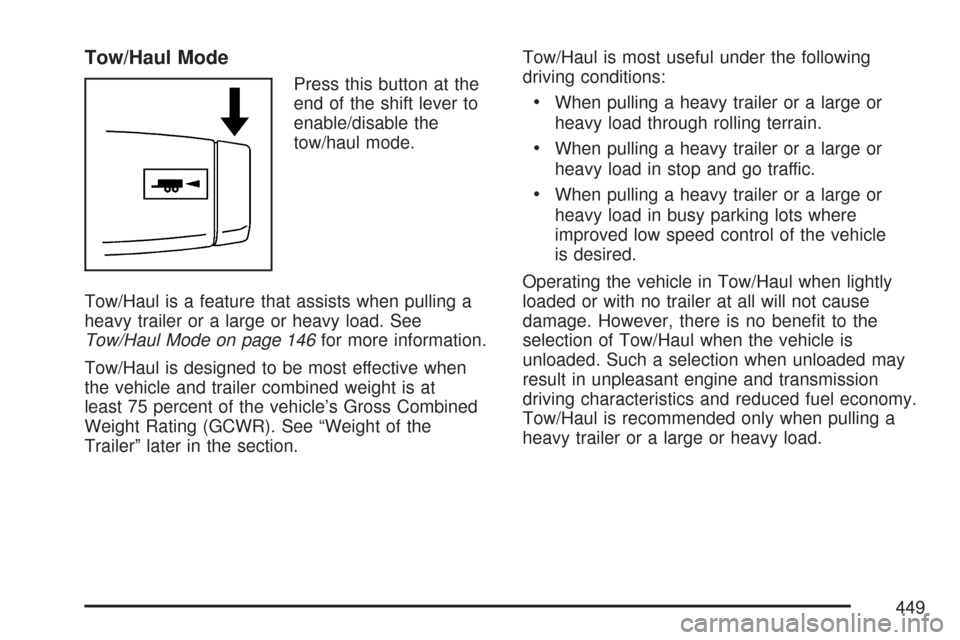
Press this button at the
end of the shift lever to
enable/disable the
tow/haul mode.
Tow/Haul is a feature that assists when pulling a
heavy trailer or a large or heavy load. See
Tow/Haul Mode on page 146for more information.
Tow/Haul is designed to be most effective when
the vehicle and trailer combined weight is at
least 75 percent of the vehicle’s Gross Combined
Weight Rating (GCWR). See “Weight of the
Trailer” later in the section.Tow/Haul is most useful under the following
driving conditions:
When pulling a heavy trailer or a large or
heavy load through rolling terrain.
When pulling a heavy trailer or a large or
heavy load in stop and go traffic.
When pulling a heavy trailer or a large or
heavy load in busy parking lots where
improved low speed control of the vehicle
is desired.
Operating the vehicle in Tow/Haul when lightly
loaded or with no trailer at all will not cause
damage. However, there is no benet to the
selection of Tow/Haul when the vehicle is
unloaded. Such a selection when unloaded may
result in unpleasant engine and transmission
driving characteristics and reduced fuel economy.
Tow/Haul is recommended only when pulling a
heavy trailer or a large or heavy load.
449
Page 451 of 684
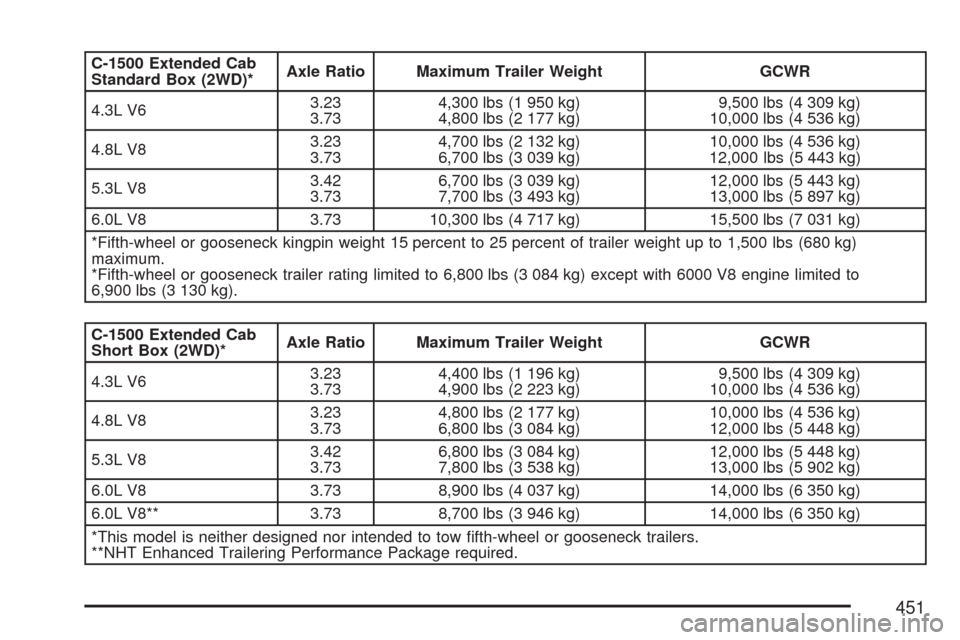
C-1500 Extended Cab
Standard Box (2WD)*Axle Ratio Maximum Trailer Weight GCWR
4.3L V63.23
3.734,300 lbs (1 950 kg)
4,800 lbs (2 177 kg)9,500 lbs (4 309 kg)
10,000 lbs (4 536 kg)
4.8L V83.23
3.734,700 lbs (2 132 kg)
6,700 lbs (3 039 kg)10,000 lbs (4 536 kg)
12,000 lbs (5 443 kg)
5.3L V83.42
3.736,700 lbs (3 039 kg)
7,700 lbs (3 493 kg)12,000 lbs (5 443 kg)
13,000 lbs (5 897 kg)
6.0L V8 3.73 10,300 lbs (4 717 kg) 15,500 lbs (7 031 kg)
*Fifth-wheel or gooseneck kingpin weight 15 percent to 25 percent of trailer weight up to 1,500 lbs (680 kg)
maximum.
*Fifth-wheel or gooseneck trailer rating limited to 6,800 lbs (3 084 kg) except with 6000 V8 engine limited to
6,900 lbs (3 130 kg).
C-1500 Extended Cab
Short Box (2WD)*Axle Ratio Maximum Trailer Weight GCWR
4.3L V63.23
3.734,400 lbs (1 196 kg)
4,900 lbs (2 223 kg)9,500 lbs (4 309 kg)
10,000 lbs (4 536 kg)
4.8L V83.23
3.734,800 lbs (2 177 kg)
6,800 lbs (3 084 kg)10,000 lbs (4 536 kg)
12,000 lbs (5 448 kg)
5.3L V83.42
3.736,800 lbs (3 084 kg)
7,800 lbs (3 538 kg)12,000 lbs (5 448 kg)
13,000 lbs (5 902 kg)
6.0L V8 3.73 8,900 lbs (4 037 kg) 14,000 lbs (6 350 kg)
6.0L V8** 3.73 8,700 lbs (3 946 kg) 14,000 lbs (6 350 kg)
*This model is neither designed nor intended to tow fth-wheel or gooseneck trailers.
**NHT Enhanced Trailering Performance Package required.
451
Page 453 of 684
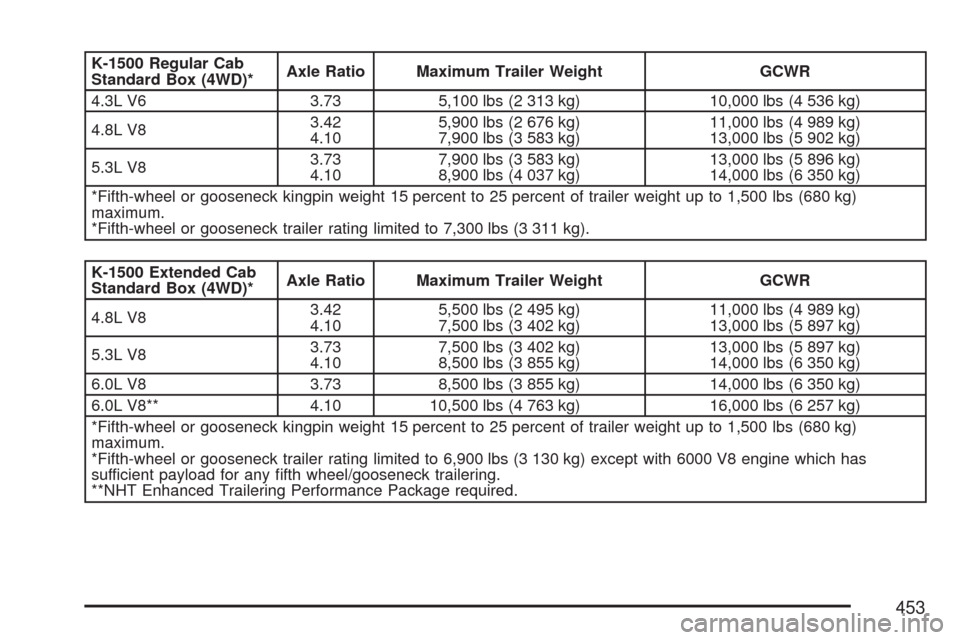
K-1500 Regular Cab
Standard Box (4WD)*Axle Ratio Maximum Trailer Weight GCWR
4.3L V6 3.73 5,100 lbs (2 313 kg) 10,000 lbs (4 536 kg)
4.8L V83.42
4.105,900 lbs (2 676 kg)
7,900 lbs (3 583 kg)11,000 lbs (4 989 kg)
13,000 lbs (5 902 kg)
5.3L V83.73
4.107,900 lbs (3 583 kg)
8,900 lbs (4 037 kg)13,000 lbs (5 896 kg)
14,000 lbs (6 350 kg)
*Fifth-wheel or gooseneck kingpin weight 15 percent to 25 percent of trailer weight up to 1,500 lbs (680 kg)
maximum.
*Fifth-wheel or gooseneck trailer rating limited to 7,300 lbs (3 311 kg).
K-1500 Extended Cab
Standard Box (4WD)*Axle Ratio Maximum Trailer Weight GCWR
4.8L V83.42
4.105,500 lbs (2 495 kg)
7,500 lbs (3 402 kg)11,000 lbs (4 989 kg)
13,000 lbs (5 897 kg)
5.3L V83.73
4.107,500 lbs (3 402 kg)
8,500 lbs (3 855 kg)13,000 lbs (5 897 kg)
14,000 lbs (6 350 kg)
6.0L V8 3.73 8,500 lbs (3 855 kg) 14,000 lbs (6 350 kg)
6.0L V8** 4.10 10,500 lbs (4 763 kg) 16,000 lbs (6 257 kg)
*Fifth-wheel or gooseneck kingpin weight 15 percent to 25 percent of trailer weight up to 1,500 lbs (680 kg)
maximum.
*Fifth-wheel or gooseneck trailer rating limited to 6,900 lbs (3 130 kg) except with 6000 V8 engine which has
sufficient payload for any fth wheel/gooseneck trailering.
**NHT Enhanced Trailering Performance Package required.
453