2007 CHEVROLET MALIBU service
[x] Cancel search: servicePage 212 of 510
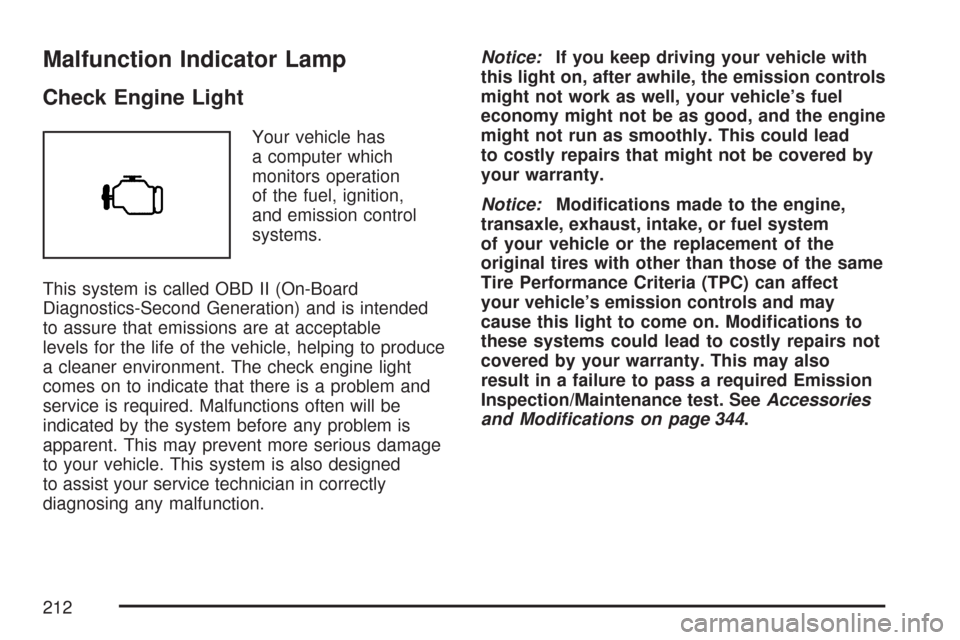
Malfunction Indicator Lamp
Check Engine Light
Your vehicle has
a computer which
monitors operation
of the fuel, ignition,
and emission control
systems.
This system is called OBD II (On-Board
Diagnostics-Second Generation) and is intended
to assure that emissions are at acceptable
levels for the life of the vehicle, helping to produce
a cleaner environment. The check engine light
comes on to indicate that there is a problem and
service is required. Malfunctions often will be
indicated by the system before any problem is
apparent. This may prevent more serious damage
to your vehicle. This system is also designed
to assist your service technician in correctly
diagnosing any malfunction.Notice:If you keep driving your vehicle with
this light on, after awhile, the emission controls
might not work as well, your vehicle’s fuel
economy might not be as good, and the engine
might not run as smoothly. This could lead
to costly repairs that might not be covered by
your warranty.
Notice:Modications made to the engine,
transaxle, exhaust, intake, or fuel system
of your vehicle or the replacement of the
original tires with other than those of the same
Tire Performance Criteria (TPC) can affect
your vehicle’s emission controls and may
cause this light to come on. Modications to
these systems could lead to costly repairs not
covered by your warranty. This may also
result in a failure to pass a required Emission
Inspection/Maintenance test. SeeAccessories
and Modifications on page 344.
212
Page 213 of 510
This light should come on, as a check to show
you it is working, when the ignition is on and the
engine is not running. If the light does not
come on, have it repaired. This light will also
come on during a malfunction in one of two ways:
Light Flashing— A misre condition has
been detected. A misre increases vehicle
emissions and may damage the emission
control system on your vehicle. Diagnosis
and service may be required.
Light On Steady— An emission control
system malfunction has been detected on
your vehicle. Diagnosis and service may
be required.
If the Light is Flashing
The following may prevent more serious damage
to your vehicle:
Reducing vehicle speed
Avoiding hard accelerations
Avoiding steep uphill grades
If you are towing a trailer, reduce the
amount of cargo being hauled as soon
as it is possibleIf the light stops ashing and remains on steady,
see “If the Light Is On Steady” following.
If the light continues to ash, when it is safe to do
so, stop the vehicle. Find a safe place to park
your vehicle. Turn the key off, wait at least
10 seconds and restart the engine. If the light
remains on steady, see “If the Light Is On Steady”
following. If the light is still ashing, follow the
previous steps, and see your dealer for service
as soon as possible.
If the Light Is On Steady
You may be able to correct the emission system
malfunction by considering the following:
Did you recently put fuel into your vehicle?
If so, reinstall the fuel cap, making sure to fully
install the cap. SeeFilling the Tank on page 349.
The diagnostic system can determine if the
fuel cap has been left off or improperly installed.
A loose or missing fuel cap will allow fuel to
evaporate into the atmosphere. A few driving
trips with the cap properly installed should turn
the light off.
213
Page 215 of 510
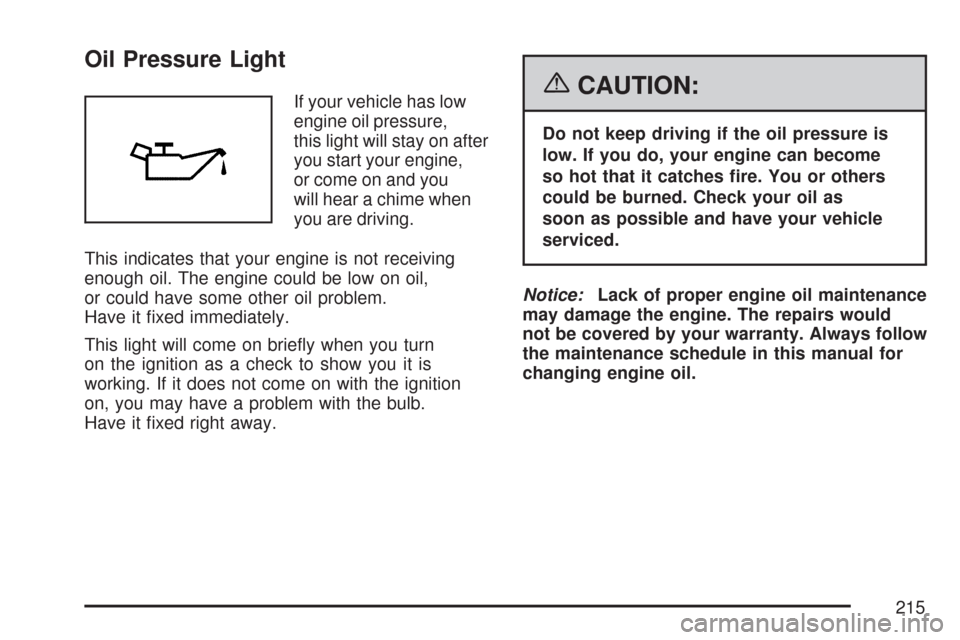
Oil Pressure Light
If your vehicle has low
engine oil pressure,
this light will stay on after
you start your engine,
or come on and you
will hear a chime when
you are driving.
This indicates that your engine is not receiving
enough oil. The engine could be low on oil,
or could have some other oil problem.
Have it xed immediately.
This light will come on briey when you turn
on the ignition as a check to show you it is
working. If it does not come on with the ignition
on, you may have a problem with the bulb.
Have it xed right away.{CAUTION:
Do not keep driving if the oil pressure is
low. If you do, your engine can become
so hot that it catches re. You or others
could be burned. Check your oil as
soon as possible and have your vehicle
serviced.
Notice:Lack of proper engine oil maintenance
may damage the engine. The repairs would
not be covered by your warranty. Always follow
the maintenance schedule in this manual for
changing engine oil.
215
Page 217 of 510
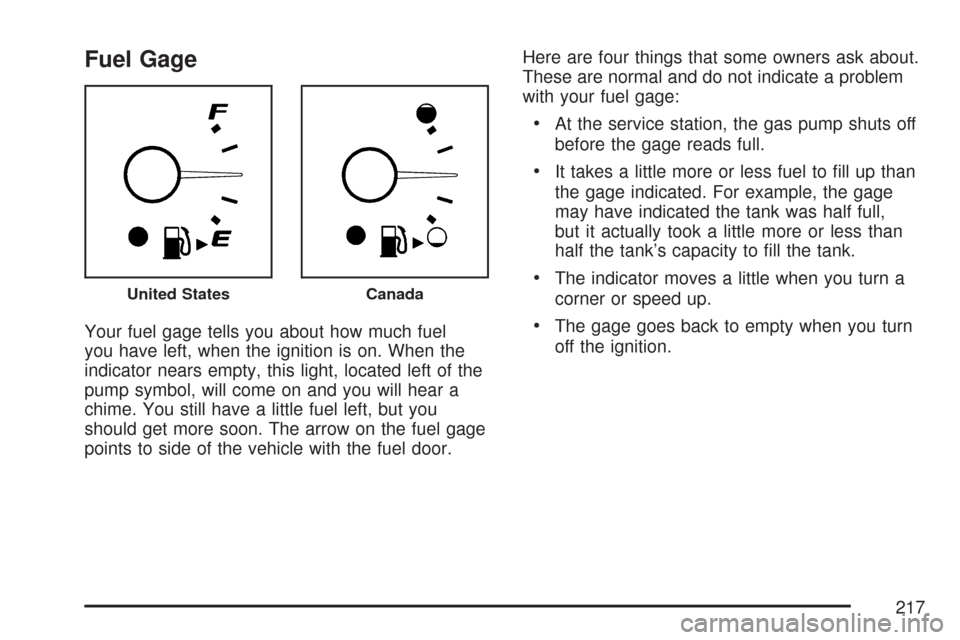
Fuel Gage
Your fuel gage tells you about how much fuel
you have left, when the ignition is on. When the
indicator nears empty, this light, located left of the
pump symbol, will come on and you will hear a
chime. You still have a little fuel left, but you
should get more soon. The arrow on the fuel gage
points to side of the vehicle with the fuel door.Here are four things that some owners ask about.
These are normal and do not indicate a problem
with your fuel gage:
At the service station, the gas pump shuts off
before the gage reads full.
It takes a little more or less fuel to ll up than
the gage indicated. For example, the gage
may have indicated the tank was half full,
but it actually took a little more or less than
half the tank’s capacity to ll the tank.
The indicator moves a little when you turn a
corner or speed up.
The gage goes back to empty when you turn
off the ignition.
United StatesCanada
217
Page 222 of 510
DIC Warnings and Messages
These messages appear if there is a problem
detected in one of your vehicle’s systems.
A message will clear when that condition is no
longer present on the vehicle. To acknowledge a
message and clear it from the display, press
any of the three DIC buttons. If the condition is
still present, the warning message will come back
on the next time the vehicle is turned off and
back on. With most messages, a warning chime
sounds when the message displays. Your
vehicle may have other warning messages.
AUTO (Automatic) LIGHTS OFF:This message
displays if the automatic headlamp system is
disabled with the headlamp switch.
AUTO (Automatic) LIGHTS ON:This message
displays if the automatic headlamp system is
enabled with the headlamp switch.BRAKE FLUID:This message displays to
inform the driver that the brake uid level is low
while the ignition is in ON. The brake system
warning light on the instrument panel cluster
also comes on. SeeBrake System Warning Light
on page 206for more information. Have the
brake system serviced by your dealer/retailer
as soon as possible.
CHANGE OIL SOON:This message displays
when the life of the engine oil has expired and it
should be changed.
When you acknowledge the CHANGE OIL SOON
message by clearing it from the display, you still
must reset the engine oil life system separately.
SeeEngine Oil Life System on page 362,Engine
Oil on page 359, andScheduled Maintenance
on page 460for more information.
222
Page 223 of 510
CHECK GAS CAP:This message displays if the
fuel cap has not been fully tightened. Recheck
the fuel cap to make sure that it is on properly.
A few driving trips with the cap properly installed
should turn the message off.
DOOR AJAR:This message displays if one or
more of the vehicle’s doors are not closed properly.
Make sure that the door is closed completely.
ENGINE DISABLED:This message displays
if the starting of the engine is disabled. Have
your vehicle serviced immediately by your
dealer/retailer.
ENG (Engine) PWR (Power) REDUCED:This
message displays to inform you that the vehicle
has reduced engine power to avoid damaging
the engine. Reduced engine power can affect the
vehicle’s ability to accelerate. If this message
is on, but there is no reduction in performance,
proceed to your destination. The performance
may be reduced the next time the vehicle is driven.The vehicle may be driven at a reduced speed
while this message is on, but acceleration
and speed may be reduced. Anytime this message
stays on, the vehicle should be taken to your
dealer/retailer for service as soon as possible.
GATE AJAR:If your vehicle has a liftgate,
this message displays when the liftgate is not
closed completely. Make sure that the liftgate
is closed completely. SeeLiftgate (MAXX)
on page 110for more information.
ICE POSSIBLE:This message displays when the
outside air temperature is cold enough to create
icy road conditions. Adjust your driving accordingly.
KEY FOB BATT (Battery) LOW:This message
displays if the Remote Keyless Entry (RKE)
transmitter battery is low. Replace the battery
in the transmitter. See “Battery Replacement”
underRemote Keyless Entry (RKE) System
Operation on page 97.
223
Page 224 of 510
LOW FUEL:This message displays along with
a low fuel warning light on the instrument panel
cluster when your vehicle is low on fuel. Rell
the fuel tank as soon as possible. SeeFuel on
page 346andFilling the Tank on page 349.
LOW WASHER FLUID:This message displays
when your vehicle is low on windshield washer uid.
Rell the windshield washer uid reservoir as soon
as possible. See “Adding Washer Fluid” under
Windshield Washer Fluid on page 380.
POWER STEERING:This message displays
if a problem has been detected with the electric
power steering, if your vehicle has this feature.
Have your vehicle serviced immediately by your
dealer/retailer.PUSH PARK PEDAL:This message displays if
the parking brake is left engaged. SeeParking
Brake on page 132for more information.
SERVICE AIR BAG:This message displays
if there is a problem with the airbag system.
Have your vehicle serviced immediately by
your dealer/retailer.
TRUNK AJAR:If your vehicle has a trunk, this
message displays when the trunk lid is not closed
completely. Make sure that the trunk lid is closed
completely. SeeTrunk (Sedan) on page 108
for more information.
224
Page 233 of 510
Radio Messages
CALIBRATE:The audio system has been
calibrated for your vehicle from the factory.
If CALIBRATE displays, it means that the
radio has not been congured properly for
your vehicle and must be returned to your
dealer/retailer for service.
LOCKED:This message displays when the
THEFTLOCK
®system has locked up. Take the
vehicle to your dealer/retailer for service.
If any error occurs repeatedly or if an error
cannot be corrected, contact your dealer/retailer.
Playing a CD
Insert a CD partway into the slot, label side up.
The player pulls it in and the CD should begin
playing. If you want to insert a CD with the
ignition off, rst press the eject button or the
DISP knob.
As each new track starts to play, the track
number displays.If the ignition or radio is turned off with a CD
in the player, it stays in the player. When
the ignition or radio is turned on, the CD starts
playing, where it stopped, if it was the last
selected audio source.
The CD player can play the smaller 3 inch (8 cm)
single CDs with an adapter ring. Full-size CDs
and the smaller CDs are loaded in the same
manner.
If playing a CD-R, the sound quality can be
reduced due to CD-R quality, the method of
recording, the quality of the music that has been
recorded, and the way the CD-R has been
handled. There can be an increase in skipping,
difficulty in nding tracks, and/or difficulty in
loading and ejecting. If these problems occur,
check the bottom surface of the CD. If the surface
of the CD is damaged, such as cracked, broken,
or scratched, the CD will not play properly.
If the surface of the CD is soiled, seeCare of
Your CDs and DVDs on page 285for more
information.
If there is no apparent damage, try a known
good CD.
233