Page 355 of 510
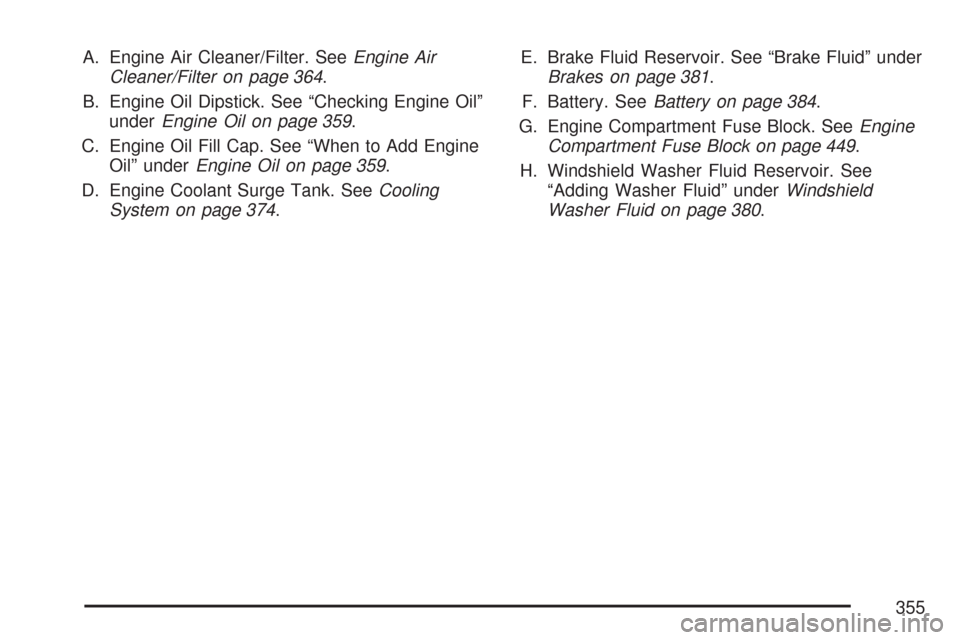
A. Engine Air Cleaner/Filter. SeeEngine Air
Cleaner/Filter on page 364.
B. Engine Oil Dipstick. See “Checking Engine Oil”
underEngine Oil on page 359.
C. Engine Oil Fill Cap. See “When to Add Engine
Oil” underEngine Oil on page 359.
D. Engine Coolant Surge Tank. SeeCooling
System on page 374.E. Brake Fluid Reservoir. See “Brake Fluid” under
Brakes on page 381.
F. Battery. SeeBattery on page 384.
G. Engine Compartment Fuse Block. SeeEngine
Compartment Fuse Block on page 449.
H. Windshield Washer Fluid Reservoir. See
“Adding Washer Fluid” underWindshield
Washer Fluid on page 380.
355
Page 357 of 510
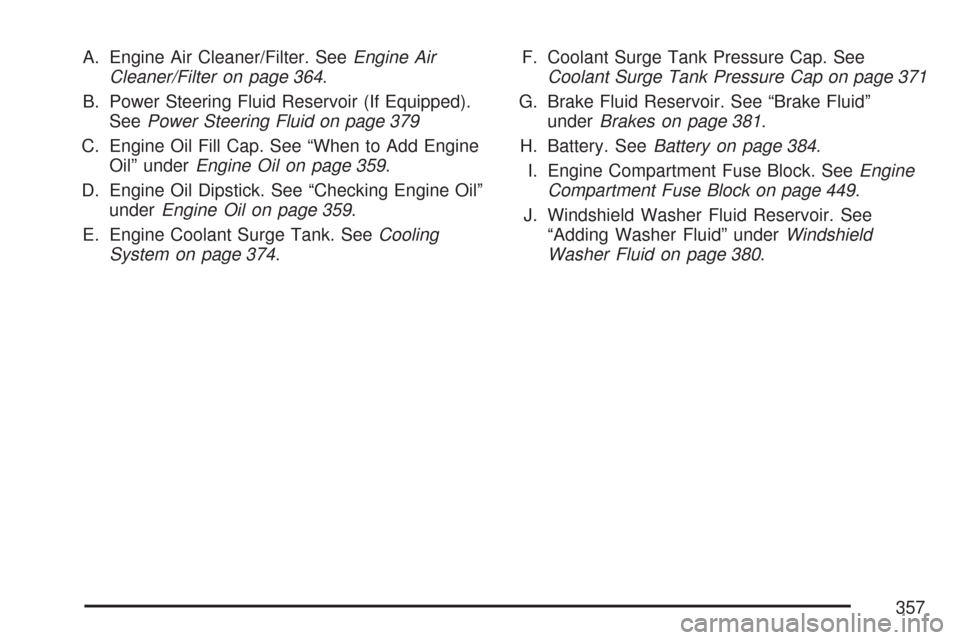
A. Engine Air Cleaner/Filter. SeeEngine Air
Cleaner/Filter on page 364.
B. Power Steering Fluid Reservoir (If Equipped).
SeePower Steering Fluid on page 379
C. Engine Oil Fill Cap. See “When to Add Engine
Oil” underEngine Oil on page 359.
D. Engine Oil Dipstick. See “Checking Engine Oil”
underEngine Oil on page 359.
E. Engine Coolant Surge Tank. SeeCooling
System on page 374.F. Coolant Surge Tank Pressure Cap. See
Coolant Surge Tank Pressure Cap on page 371
G. Brake Fluid Reservoir. See “Brake Fluid”
underBrakes on page 381.
H. Battery. SeeBattery on page 384.
I. Engine Compartment Fuse Block. SeeEngine
Compartment Fuse Block on page 449.
J. Windshield Washer Fluid Reservoir. See
“Adding Washer Fluid” underWindshield
Washer Fluid on page 380.
357
Page 359 of 510
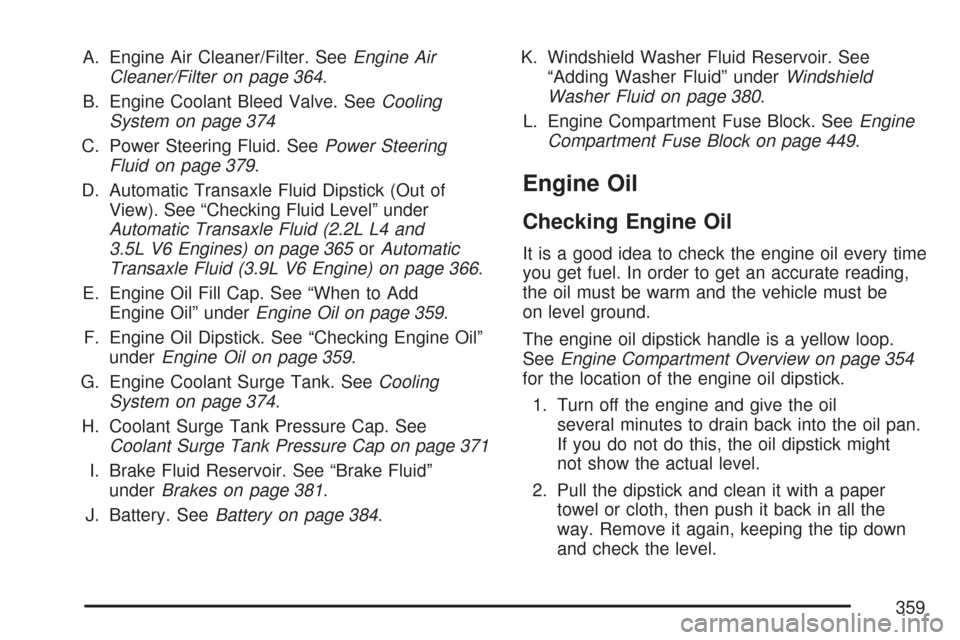
A. Engine Air Cleaner/Filter. SeeEngine Air
Cleaner/Filter on page 364.
B. Engine Coolant Bleed Valve. SeeCooling
System on page 374
C. Power Steering Fluid. SeePower Steering
Fluid on page 379.
D. Automatic Transaxle Fluid Dipstick (Out of
View). See “Checking Fluid Level” under
Automatic Transaxle Fluid (2.2L L4 and
3.5L V6 Engines) on page 365orAutomatic
Transaxle Fluid (3.9L V6 Engine) on page 366.
E. Engine Oil Fill Cap. See “When to Add
Engine Oil” underEngine Oil on page 359.
F. Engine Oil Dipstick. See “Checking Engine Oil”
underEngine Oil on page 359.
G. Engine Coolant Surge Tank. SeeCooling
System on page 374.
H. Coolant Surge Tank Pressure Cap. See
Coolant Surge Tank Pressure Cap on page 371
I. Brake Fluid Reservoir. See “Brake Fluid”
underBrakes on page 381.
J. Battery. SeeBattery on page 384.K. Windshield Washer Fluid Reservoir. See
“Adding Washer Fluid” underWindshield
Washer Fluid on page 380.
L. Engine Compartment Fuse Block. SeeEngine
Compartment Fuse Block on page 449.
Engine Oil
Checking Engine Oil
It is a good idea to check the engine oil every time
you get fuel. In order to get an accurate reading,
the oil must be warm and the vehicle must be
on level ground.
The engine oil dipstick handle is a yellow loop.
SeeEngine Compartment Overview on page 354
for the location of the engine oil dipstick.
1. Turn off the engine and give the oil
several minutes to drain back into the oil pan.
If you do not do this, the oil dipstick might
not show the actual level.
2. Pull the dipstick and clean it with a paper
towel or cloth, then push it back in all the
way. Remove it again, keeping the tip down
and check the level.
359
Page 362 of 510
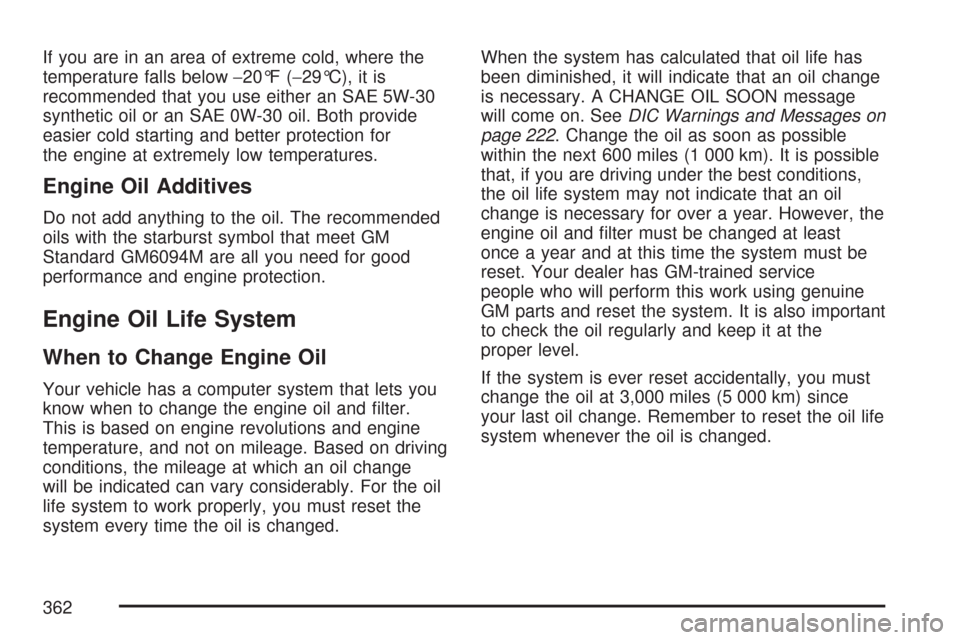
If you are in an area of extreme cold, where the
temperature falls below−20°F (−29°C), it is
recommended that you use either an SAE 5W-30
synthetic oil or an SAE 0W-30 oil. Both provide
easier cold starting and better protection for
the engine at extremely low temperatures.
Engine Oil Additives
Do not add anything to the oil. The recommended
oils with the starburst symbol that meet GM
Standard GM6094M are all you need for good
performance and engine protection.
Engine Oil Life System
When to Change Engine Oil
Your vehicle has a computer system that lets you
know when to change the engine oil and lter.
This is based on engine revolutions and engine
temperature, and not on mileage. Based on driving
conditions, the mileage at which an oil change
will be indicated can vary considerably. For the oil
life system to work properly, you must reset the
system every time the oil is changed.When the system has calculated that oil life has
been diminished, it will indicate that an oil change
is necessary. A CHANGE OIL SOON message
will come on. SeeDIC Warnings and Messages on
page 222. Change the oil as soon as possible
within the next 600 miles (1 000 km). It is possible
that, if you are driving under the best conditions,
the oil life system may not indicate that an oil
change is necessary for over a year. However, the
engine oil and lter must be changed at least
once a year and at this time the system must be
reset. Your dealer has GM-trained service
people who will perform this work using genuine
GM parts and reset the system. It is also important
to check the oil regularly and keep it at the
proper level.
If the system is ever reset accidentally, you must
change the oil at 3,000 miles (5 000 km) since
your last oil change. Remember to reset the oil life
system whenever the oil is changed.
362
Page 365 of 510
{CAUTION:
Operating the engine with the air
cleaner/lter off can cause you or others
to be burned. The air cleaner not only
cleans the air; it helps to stop ames if
the engine backres. If it is not there and
the engine backres, you could be
burned. Do not drive with it off, and be
careful working on the engine with the air
cleaner/lter off.
Notice:If the air cleaner/lter is off, a backre
can cause a damaging engine re. And, dirt
can easily get into your engine, which will
damage it. Always have the air cleaner/lter in
place when you are driving.
Automatic Transaxle Fluid
(2.2L L4 and 3.5L V6 Engines)
It is not necessary to check the transaxle uid
level. A transaxle uid leak is the only reason for
uid loss. If a leak occurs, take your vehicle to
the dealership service department and have
it repaired as soon as possible.
Change the uid and lter at the intervals listed in
Additional Required Services on page 462, and
be sure to use the transaxle uid listed in
Recommended Fluids and Lubricants on page 468.
Notice:Use of the incorrect automatic
transaxle uid may damage your vehicle, and
the damages may not be covered by your
warranty. Always use the automatic transaxle
uid listed inRecommended Fluids and
Lubricants on page 468.
365
Page 366 of 510
Automatic Transaxle Fluid
(3.9L V6 Engine)
When to Check and Change Automatic
Transaxle Fluid
A good time to check the automatic transaxle uid
level is when the engine oil is changed.
Change the uid and lter at the intervals listed in
Additional Required Services on page 462, and
be sure to use the transaxle uid listed in
Recommended Fluids and Lubricants on page 468.
How to Check Automatic Transaxle
Fluid
Because this operation can be a little difficult, you
may choose to have this done at the dealership
service department.
If you do it yourself, be sure to follow all the
instructions here, or you could get a false reading
on the dipstick.Notice:Too much or too little uid can damage
the transaxle. Too much can mean that some of
the uid could come out and fall on hot engine
or exhaust system parts, starting a re. Too
little uid could cause the transaxle to overheat.
Be sure to get an accurate reading if you check
the transaxle uid.
Wait at least 30 minutes before checking the
transaxle uid level if you have been driving:
When outside temperatures are above
90°F (32°C).
At high speed for quite a while.
In heavy traffic — especially in hot weather.
While pulling a trailer.
To get the right reading, the uid should be at
normal operating temperature, which is 180°F to
200°F (82°C to 93°C).
Get the vehicle warmed up by driving about
15 miles (24 km) when outside temperatures are
above 50°F (10°C). If it is colder than 50°F (10°C),
you may have to drive longer.
366
Page 367 of 510
Checking the Fluid Level
Prepare the vehicle as follows:
1. Park the vehicle on a level place. Keep the
engine running.
2. With the parking brake applied, place the shift
lever in PARK (P).
3. With your foot on the brake pedal, move the
shift lever through each gear, pausing for
about three seconds in each one. Then,
position the shift lever in PARK (P).
4. Let the engine run at idle for three to
ve minutes.
Then, without shutting off the engine, follow
these steps:
The transaxle uid
dipstick handle has this
symbol on it, and is
located near the rear of
the engine compartment.SeeEngine Compartment Overview on page 354
for more information on location.
1. Pull out the dipstick and wipe it with a clean
rag or paper towel.
2. Push it back in all the way, wait three seconds
and then pull it back out again.
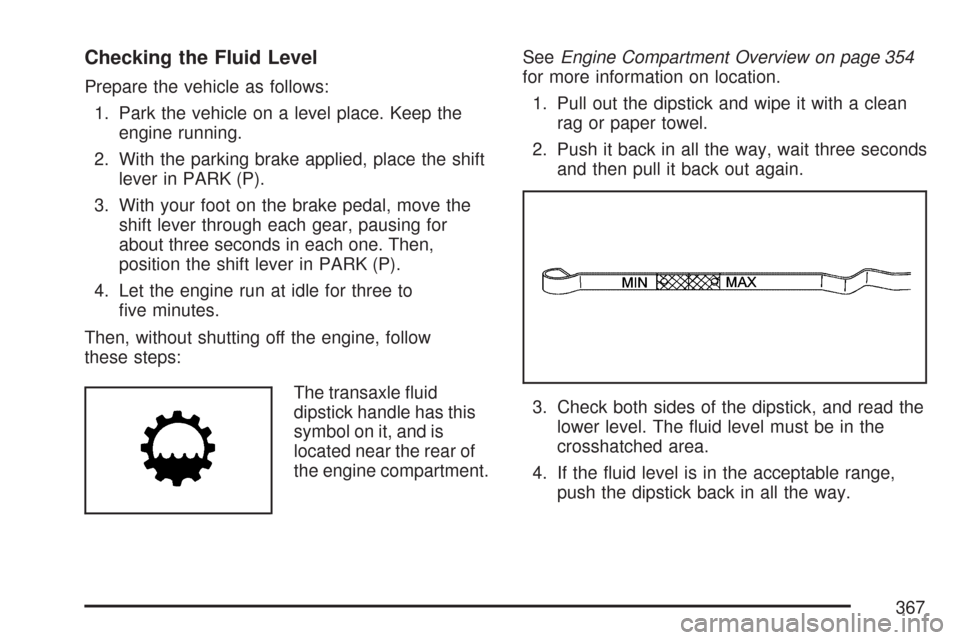
3. Check both sides of the dipstick, and read the
lower level. The uid level must be in the
crosshatched area.
4. If the uid level is in the acceptable range,
push the dipstick back in all the way.
367
Page 368 of 510
How to Add Automatic Transaxle Fluid
Refer to the Maintenance Schedule to determine
what kind of transaxle uid to use. See
Recommended Fluids and Lubricants on page 468.
If the uid level is low, add only enough of the
proper uid to bring the level into the crosshatched
area on the dipstick.
1. Pull out the dipstick.
2. Using a long-neck funnel, add enough uid at
the dipstick hole to bring it to the proper level.
It does not take much uid, generally less
than one pint (0.5 L). Do not overll.
Notice:Use of the incorrect automatic
transaxle uid may damage your vehicle, and
the damages may not be covered by your
warranty. Always use the automatic transaxle
uid listed inRecommended Fluids and
Lubricants on page 468.
3. After adding uid, recheck the uid level as
described under “How to Check Automatic
Transaxle Fluid,” earlier in this section.
4. When the correct uid level is obtained, push
the dipstick back in all the way.
Engine Coolant
The cooling system in your vehicle is lled with
DEX-COOL®engine coolant. This coolant is
designed to remain in your vehicle for ve years or
150,000 miles (240 000 km), whichever occurs
rst, if you add only DEX-COOL
®extended
life coolant.
The following explains the cooling system and
how to add coolant when it is low. If there is
a problem with engine overheating, seeEngine
Overheating on page 371.
A 50/50 mixture of clean, drinkable water and
DEX-COOL
®coolant will:
Give freezing protection down to
−34°F (−37°C).
Give boiling protection up to 265°F (129°C).
Protect against rust and corrosion.
Help keep the proper engine temperature.
Let the warning lights and gages work as they
should.
368