Page 138 of 430

Engine Coolant Temperature Gage............ 173
Low Coolant Warning Light....................... 173
Wait to Start Indicator............................... 174
Malfunction Indicator Lamp........................ 174
Oil Pressure Gage..................................... 175
Low Oil Level Light................................... 176
Change Engine Oil Light........................... 176
Engine Overspeed Warning Light.............. 177
Engine Shutdown Warning Light................ 177
Transmission Temperature Gage............... 178
Exhaust Brake Indicator Light.................... 178
Differential Lock Indicator Light.................. 178
Reduced Engine Power Light.................... 179
Highbeam On Light................................... 179
Daytime Running Lamps (DRL)
Indicator Light........................................ 179
Low Washer Fluid Warning Light............... 180
Check Gages Warning Light...................... 180
Fuel Gage................................................. 181Water in Fuel Warning Light...................... 182
Air Filter Restriction Indicator..................... 182
Air Pressure Gage..................................... 183
Hourmeter Gage........................................ 183
Audio System(s)......................................... 184
Setting the Time........................................ 185
AM-FM Radio............................................ 186
Radio with Cassette.................................. 189
Radio with CD........................................... 195
Theft-Deterrent Feature
(Non-RDS Radios)................................. 201
Radio Reception........................................ 201
Care of the Cassette Tape Player............. 202
Care of Your CDs..................................... 203
Care of the CD Player.............................. 204
Fixed Mast Antenna.................................. 204
Chime Level Adjustment............................ 204
Section 3 Instrument Panel
138
Page 159 of 430

<(Maximum Air Conditioning):Turn the right
knob to this setting for maximum cooling. This
setting puts the system in recirculation mode and
helps to maximize your air conditioner’s
performance and your vehicle’s fuel economy.
This setting also cools the air the fastest.
Y(Air Conditioning):This setting is used for
normal cooling on hot days. It cools outside air and
directs it through the instrument panel vents.
)(Bi-Level Air Conditioning):This setting
divides airflow between the floor vents and
instrument panel vents. The air conditioning
compressor will cycle continuously in this setting
as long as the outside temperature is warm
enough to activate the compressor.
Defogging and Defrosting
Fog on the inside of windows is a result of high
humidity (moisture) condensing on the cool window
glass. This can be minimized if the climate
control is used properly. There are two modes to
clear fog or frost from your windshield and
side windows.Use the defog mode to clear the windows of fog or
moisture and warm the passengers. Use the defrost
mode to remove fog or frost from the windshield
more quickly. For best results, clear all snow and
ice from the windshield before defrosting.
Turn the mode knob on the right of the climate
control panel to select the defog or defrost mode.
-(Defog):With this setting, the outside air
comes out of both the floor and defroster outlets.
Adjust the temperature knob for warmer or
cooler air. The air conditioning compressor may
operate in this setting to dehumidify the air.
0(Defrost):This setting operates the defroster.
Most of the air comes out near the windshield,
with some going to the floor outlets and front side
windows. The air conditioning compressor may
operate in this setting to dehumidify the air.
The defog setting is useful for cold weather with a
large number of passengers or very humid
conditions to help keep the windshield clear. Use
defrost to remove fog or ice from the windshield
quickly in extremely cold conditions. The
temperature knob should be in the red area and
the fan control toward high. Do not drive the
vehicle until all the windows are clear.
159
Page 162 of 430
Instrument Panel Cluster
Your instrument panel cluster is designed to let you know at a glance how your vehicle is running. You
will know how fast you are going, about how much fuel is left and many other things you will need to drive
safely and economically.
United States Isuzu 6H Diesel Engine shown, Canada, 6.6L Diesel and Gasoline Engine similar
162
Page 174 of 430
Wait to Start Indicator
If your vehicle has the DURAMAX®6.6L diesel
engine, it will have glow plugs and an air
intake heater. If your vehicle has the Isuzu 6H
diesel engine, it will have glow plugs and an inlet
heater. If your vehicle has a Caterpillar
®engine,
it will have an inlet heater.
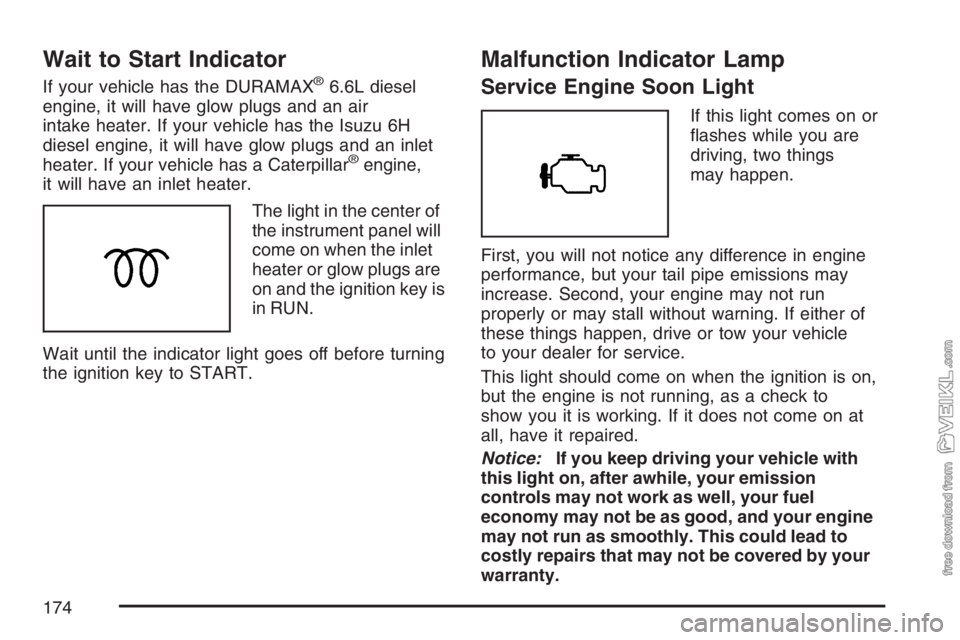
The light in the center of
the instrument panel will
come on when the inlet
heater or glow plugs are
on and the ignition key is
in RUN.
Wait until the indicator light goes off before turning
the ignition key to START.
Malfunction Indicator Lamp
Service Engine Soon Light
If this light comes on or
flashes while you are
driving, two things
may happen.
First, you will not notice any difference in engine
performance, but your tail pipe emissions may
increase. Second, your engine may not run
properly or may stall without warning. If either of
these things happen, drive or tow your vehicle
to your dealer for service.
This light should come on when the ignition is on,
but the engine is not running, as a check to
show you it is working. If it does not come on at
all, have it repaired.
Notice:If you keep driving your vehicle with
this light on, after awhile, your emission
controls may not work as well, your fuel
economy may not be as good, and your engine
may not run as smoothly. This could lead to
costly repairs that may not be covered by your
warranty.
174
Page 181 of 430
Fuel Gage
Your fuel gage is
located on the right side
of your instrument
panel cluster.
When the ignition is on, your fuel gage lets you
know about how much fuel you have left. When the
gage first shows empty, you’ll still have a little fuel
left, but you should get more fuel soon.
If your vehicle has dual fuel tanks, the reading on
the gage is the total fuel left in both tanks.Here are four concerns of some operators. None
of these shows a problem with your fuel gage:•The gage moves a little when you turn a
corner or speed up.
•The gage does not go back to empty when
you turn off the ignition.
•At the gas station, the pump shuts off before
the gage reads full.
•It takes a little more or less fuel to fill up than
the gage indicated.
If you have a Caterpillar
®diesel engine, also see
your Caterpillar®Operation & Maintenance
Manual.
181
Page 182 of 430
Water in Fuel Warning Light
This light is located
above the climate
controls in the center of
the instrument panel.
If your vehicle has the 6.6L DURAMAX
®or Isuzu
6H diesel engine, this light will come on to
warn you that there is water in the fuel system.
For more information on how this light works, see
Water in Fuel on page 256.
Air Filter Restriction Indicator
If your vehicle has this
feature, the gage is
located above the
switchbank in the center
of the instrument
panel. It monitors the
engine air filter.
As the filter gets dirty, the yellow indicator will
begin to rise. When it reaches 25 inches of
vacuum on the scale, the filter should be replaced.
After replacing the filter, reset the gage by
pressing in the yellow reset button at the bottom
of the gage.
If you have a Caterpillar
®diesel engine, also see
your Caterpillar®Operation & Maintenance Manual.
182
Page 235 of 430
{CAUTION:
Snow can trap exhaust gases under your
vehicle. This can cause deadly CO (carbon
monoxide) gas to get inside. CO could
overcome you and kill you. You cannot
see it or smell it, so you might not know it
is in your vehicle. Clear away snow from
around the base of your vehicle if any is
blocking your exhaust pipe. And check
around again from time to time to be sure
snow does not collect there.
Open a window just a little on the side of
the vehicle that is away from the wind.
This will help keep CO out.Run your engine only as long as you must. This
saves fuel. When you run the engine, make it
go a little faster than just idle. That is, push the
accelerator slightly. This uses less fuel for the heat
that you get and it keeps the battery (or batteries)
charged. You will need a well-charged battery (or
batteries) to restart the vehicle, and possibly for
signaling later on with your headlamps. Let the
heater run for a while.
If you have a diesel engine, you may have to run
it at a higher speed to get enough heat.
Then, shut the engine off and close the window
almost all the way to preserve the heat. Start
the engine again and repeat this only when you
feel really uncomfortable from the cold. But do it
as little as possible. Preserve the fuel as long
as you can. To help keep warm, you can get
out of the vehicle and do some fairly vigorous
exercises every half hour or so until help comes.
235
Page 238 of 430

Loading Your Vehicle
It is the responsibility of the Final Stage
manufacturer to install a Certification label on
your vehicle. This label shows how much weight
your vehicle can properly carry. It may also
show the size of the vehicle’s original tires, and
the inflation pressures needed to obtain the
gross weight capacity of your vehicle. This is
called the Gross Vehicle Weight Rating (GVWR).
The tire information could also be shown on a
separate Tire Information label.
The GVWR includes the weight of the vehicle,
all occupants, fuel, and cargo.
The Certification label also tells you the maximum
weight for the front and rear axles, called the
Gross Axle Weight Rating (GAWR). To find out
the actual loads on your front and rear axles,
go to a weigh station and weigh your vehicle.
Your dealer can help you with this. Be sure
to spread out your load equally on both sides
of the center line.Never exceed the GVWR for your vehicle, or the
GAWR for either the front or rear axle.
And, if you do have a heavy load, spread it out.
{CAUTION:
Do not load your vehicle any heavier than
the Gross Vehicle Weight Rating (GVWR),
or either the maximum front or rear Gross
Axle Weight Rating (GAWR). If you do,
parts on your vehicle can break, and it
can change the way your vehicle handles.
These could cause you to lose control
and crash. Also, overloading can shorten
the life of your vehicle.
238


