2007 CHEVROLET IMPALA towing
[x] Cancel search: towingPage 285 of 460
But trailering is different than just driving your
vehicle by itself. Trailering means changes in
handling, durability and fuel economy. Successful,
safe trailering takes correct equipment, and it has to
be used properly.
That’s the reason for this part. In it are many
time-tested, important trailering tips and safety
rules. Many of these are important for your safety
and that of your passengers. So please read
this section carefully before you pull a trailer.
Load-pulling components such as the engine,
transmission, wheel assemblies and tires
are forced to work harder against the drag of the
added weight. The engine is required to operate
at relatively higher speeds and under greater
loads, generating extra heat. What’s more,
the trailer adds considerably to wind resistance,
increasing the pulling requirements.
If You Do Decide To Pull A Trailer
If you do, here are some important points:
There are many different laws, including speed
limit restrictions, having to do with trailering.
Make sure your rig will be legal, not only where
you live but also where you’ll be driving.
A good source for this information can be
state or provincial police.
Consider using a sway control. You can ask a
hitch dealer/retailer about sway controls.
Don’t tow a trailer at all during the rst
1,000 miles (1 600 km) your new vehicle
is driven. Your engine, axle or other parts
could be damaged.
Then, during the rst 500 miles (800 km) that
you tow a trailer, don’t drive over 50 mph
(80 km/h) and don’t make starts at full throttle.
This helps your engine and other parts of
your vehicle wear in at the heavier loads.
Obey speed limit restrictions when towing a
trailer. Don’t drive faster than the maximum
posted speed for trailers, or no more than
55 mph (90 km/h), to save wear on your
vehicle’s parts.
Three important considerations have to do
with weight:
the weight of the trailer
the weight of the trailer tongue
and the total weight on your vehicle’s tires
285
Page 288 of 460
Trailer Brakes
Does your trailer have its own brakes? Be sure to
read and follow the instructions for the trailer
brakes so you’ll be able to install, adjust
and maintain them properly.
If your vehicle has anti-lock brakes, do not try
to tap into your vehicle’s brake system. If you
do, both brake systems won’t work well, or
at all.
Even if your vehicle doesn’t have anti-lock
brakes, don’t tap into your vehicle’s brake
system if the trailer’s brake system will
use more than 0.02 cubic inch (0.3 cc) of uid
from your vehicle’s master cylinder. If it
does, both braking systems won’t work well.
You could even lose your brakes.
Will the trailer brake parts take 3,000 psi
(20 650 kPa) of pressure? If not, the
trailer brake system must not be used with
your vehicle.
If everything checks out this far, then make
the brake uid tap at the upper rear master
cylinder port. But don’t use copper tubing
for this. If you do, it will bend and break off.
Use steel brake tubing.
Driving with a Trailer
Towing a trailer requires a certain amount of
experience. Before setting out for the open road,
you’ll want to get to know your rig. Acquaint
yourself with the feel of handling and braking with
the added weight of the trailer. And always
keep in mind that the vehicle you are driving is
now a good deal longer and not nearly as
responsive as your vehicle is by itself.
Before you start, check the trailer hitch and
platform (and attachments), safety chains,
electrical connector, lamps, tires and mirror
adjustment. If the trailer has electric brakes, start
your vehicle and trailer moving and then apply
the trailer brake controller by hand to be sure the
brakes are working. This lets you check your
electrical connection at the same time.
During your trip, check occasionally to be sure
that the load is secure, and that the lamps and any
trailer brakes are still working.
288
Page 289 of 460
Following Distance
Stay at least twice as far behind the vehicle ahead
as you would when driving your vehicle without
a trailer. This can help you avoid situations
that require heavy braking and sudden turns.
Passing
You’ll need more passing distance up ahead when
you’re towing a trailer. And, because you’re a
good deal longer, you’ll need to go much farther
beyond the passed vehicle before you can
return to your lane.
Backing Up
Hold the bottom of the steering wheel with
one hand. Then, to move the trailer to the left, just
move that hand to the left. To move the trailer
to the right, move your hand to the right. Always
back up slowly and, if possible, have someone
guide you.
Making Turns
Notice:Making very sharp turns while
trailering could cause the trailer to come in
contact with the vehicle. Your vehicle could be
damaged. Avoid making very sharp turns
while trailering.
When you’re turning with a trailer, make wider
turns than normal. Do this so your trailer
won’t strike soft shoulders, curbs, road signs,
trees or other objects. Avoid jerky or sudden
maneuvers. Signal well in advance.
Turn Signals When Towing a Trailer
When you tow a trailer, your vehicle may
need additional wiring. Check with your
dealer/retailer. The arrows on your instrument
panel will ash whenever you signal a turn or lane
change. Properly hooked up, the trailer lamps
will also ash, telling other drivers you’re about to
turn, change lanes or stop.
When towing a trailer, the arrows on your
instrument panel will ash for turns even if the bulbs
on the trailer are burned out. Thus, you may think
drivers behind you are seeing your signal when
they are not. It’s important to check occasionally to
be sure the trailer bulbs are still working.
289
Page 290 of 460
Driving On Grades
Reduce speed and shift to a lower gearbefore
you start down a long or steep downgrade. If you
don’t shift down, you might have to use your
brakes so much that they would get hot and no
longer work well.
On a long uphill grade, shift down and reduce
your speed to around 45 mph (70 km/h) to reduce
the possibility of engine and transmission
overheating.
Notice:When the outside temperature is
above 100° F (38° C) and/or there is a steep,
continuous grade, the recommended speed
when towing is 55 mph (88 km/h) or less.
Extended higher than normal engine and
transmission temperatures may damage your
vehicle.
If you have overdrive, you may want to drive in
THIRD (3) instead of DRIVE (D).
Parking on Hills
{CAUTION:
You really should not park your vehicle,
with a trailer attached, on a hill. If
something goes wrong, your rig could
start to move. People can be injured, and
both your vehicle and the trailer can be
damaged.
But if you ever have to park your rig on a hill,
here’s how to do it:
1. Apply your regular brakes, but don’t shift into
PARK (P) yet.
2. Have someone place chocks under the trailer
wheels.
3. When the wheel chocks are in place, release
the regular brakes until the chocks absorb
the load.
4. Reapply the regular brakes. Then apply your
parking brake, and then shift to PARK (P).
5. Release the regular brakes.
290
Page 291 of 460
When You Are Ready to Leave After
Parking on a Hill
1. Apply your regular brakes and hold the pedal
down while you:
start your engine,
shift into a gear, and
release the parking brake.
2. Let up on the brake pedal.
3. Drive slowly until the trailer is clear of
the chocks.
4. Stop and have someone pick up and store
the chocks.
Maintenance When Trailer Towing
Your vehicle will need service more often when
you’re pulling a trailer. See the Maintenance
Schedule for more on this. Things that are
especially important in trailer operation are
automatic transmission uid (don’t overll),
engine oil, drive belts, cooling system and brake
system. Each of these is covered in this manual,
and the Index will help you nd them quickly.
If you’re trailering, it’s a good idea to review
this information before you start your trip.
Check periodically to see that all hitch nuts and
bolts are tight.
Engine Cooling When Trailer Towing
Your cooling system may temporarily overheat
during severe operating conditions. SeeEngine
Overheating on page 323.
291
Page 326 of 460
Overheated Engine Protection
Operating Mode
This emergency operating mode allows your
vehicle to be driven to a safe place in an
emergency situation. If an overheated engine
condition exists, an overheat protection mode
which alternates ring groups of cylinders helps
prevent engine damage. In this mode, you
will notice a signicant loss in power and engine
performance. The coolant temperature gage
will indicate an overheat condition exists. Driving
extended miles (km) and/or towing a trailer in
the overheat protection mode should be avoided.
Notice:After driving in the overheated
engine protection operating mode, to avoid
engine damage, allow the engine to cool before
attempting any repair. The engine oil will be
severely degraded. Repair the cause of coolant
loss, change the oil and reset the oil life
system. SeeEngine Oil on page 310.
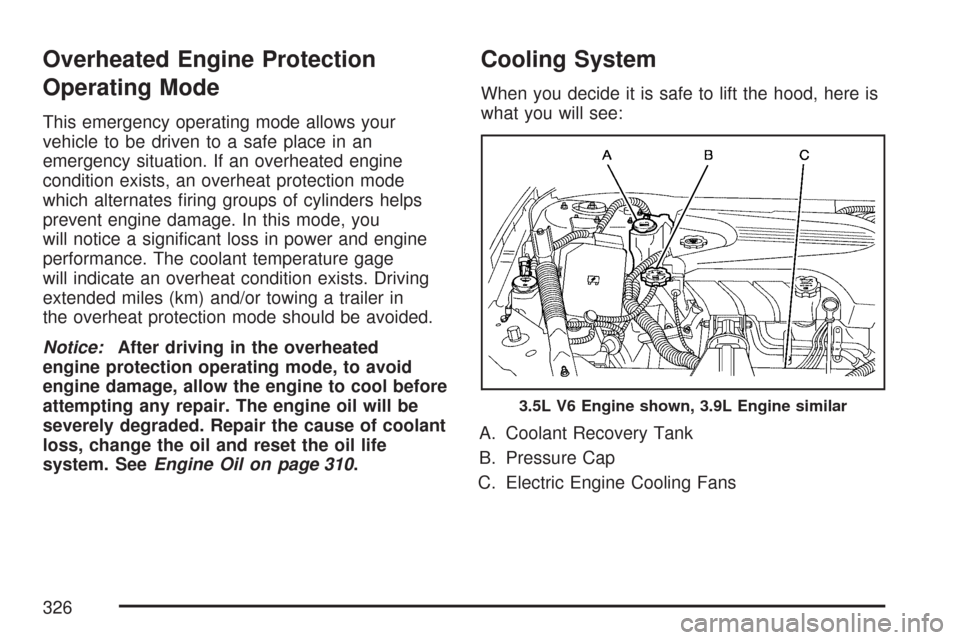
Cooling System
When you decide it is safe to lift the hood, here is
what you will see:
A. Coolant Recovery Tank
B. Pressure Cap
C. Electric Engine Cooling Fans
3.5L V6 Engine shown, 3.9L Engine similar
326
Page 413 of 460
(f)Lubricate all key lock cylinders. Lubricate
all hinges and latches, including those for the body
doors, hood, secondary latch, pivots, spring
anchor, release pawl, rear compartment, glove
box door, console door, and any folding seat
hardware. More frequent lubrication may
be required when exposed to a corrosive
environment. Applying silicone grease on
weatherstrips with a clean cloth will make them
last longer, seal better, and not stick or squeak.
(g)If you drive regularly under dusty conditions,
the lter may require replacement more often.
(h)Change automatic transmission uid and lter
if the vehicle is mainly driven under one or
more of these conditions:
In heavy city traffic where the outside
temperature regularly reaches 90°F (32°C)
or higher.
In hilly or mountainous terrain.
When doing frequent trailer towing.
Uses such as found in taxi, police, or delivery
service.(i)Drain, ush, and rell cooling system.
This service can be complex; you should have
your dealer/retailer perform this service. See
Engine Coolant on page 320for what to use.
Inspect hoses. Clean radiator, condenser, pressure
cap, and ller neck. Pressure test the cooling
system and pressure cap.
(j)Check throttle system for interference or
binding and for damaged or missing parts. Replace
parts as needed. Replace any components that
have high effort or excessive wear. Do not
lubricate accelerator or cruise control cables.
(k)A uid loss in any vehicle system could indicate
a problem. Have the system inspected and repaired
and the uid level checked. Add uid if needed.
(m)If you drive regularly under dusty conditions,
inspect the lter at each engine oil change.
(n)Visually inspect belt for fraying, excessive
cracks, or obvious damage. Replace belt if
necessary.
413
Page 434 of 460
For prompt and efficient assistance when calling,
please provide the following to the Roadside
Assistance Representative:
Your name, home address, and home
telephone number.
Telephone number of your location.
Location of the vehicle.
Model, year, color, and license plate number.
Odometer reading, Vehicle Identication
Number (VIN), and delivery date of the vehicle.
Description of the problem.
While we hope you never have the occasion to use
our service, it is added security while traveling for
you and your family. Remember, we are only a
phone call away. U.S. customers call Chevrolet
Roadside Assistance:1-800-CHEV-USA
(1-800-243-8872), text telephone (TTY) users,
call1-888-889-2438, Canadian customers call
1-800-268-6800.
Chevrolet and General Motors of Canada Limited
reserve the right to limit services or reimbursement
to an owner or driver when, in their sole discretion,
the claims become excessive in frequency or type
of occurrence.Roadside Assistance is not part of or included in
the coverage provided by the New Vehicle Limited
Warranty. Chevrolet and General Motors of
Canada Limited reserve the right to make any
changes or discontinue the Roadside Assistance
program at any time without notication.
Towing and Road Service Exclusions
Specically excluded from Roadside Assistance
coverage are towing or services for vehicles
operated on a non-public roadway or highway,
nes, impound towing caused by a violation
of local, Municipal, State, Provincial, or Federal
law, and mounting, dismounting or changing
of snow tires, chains, or other traction devices.
Courtesy Transportation
To enhance your ownership experience, we
and our participating dealers are proud to offer
Courtesy Transportation, a customer support
program for new vehicles.
For warranty repairs during the Bumper-to-Bumper
(U.S.) or Base Warranty Coverage period
(Canada), provided by the New Vehicle Limited
Warranty, interim transportation may be available
under the Courtesy Transportation program.
434