2007 CHEVROLET IMPALA check engine
[x] Cancel search: check enginePage 270 of 460
Highway Hypnosis
Is there actually such a condition as highway
hypnosis? Or is it just plain falling asleep at the
wheel? Call it highway hypnosis, lack of
awareness, or whatever.
There is something about an easy stretch of road
with the same scenery, along with the hum of the
tires on the road, the drone of the engine, and the
rush of the wind against the vehicle that can make
you sleepy. Do not let it happen to you! If it does,
your vehicle can leave the road in less than a
second, and you could crash and be injured.
What can you do about highway hypnosis?
First, be aware that it can happen.
Then here are some tips:
Make sure your vehicle is well ventilated, with
a comfortably cool interior.
Keep your eyes moving. Scan the road ahead
and to the sides. Check your rearview mirrors
and your instruments frequently.
If you get sleepy, pull off the road into a rest,
service, or parking area and take a nap, get
some exercise, or both. For safety, treat
drowsiness on the highway as an emergency.
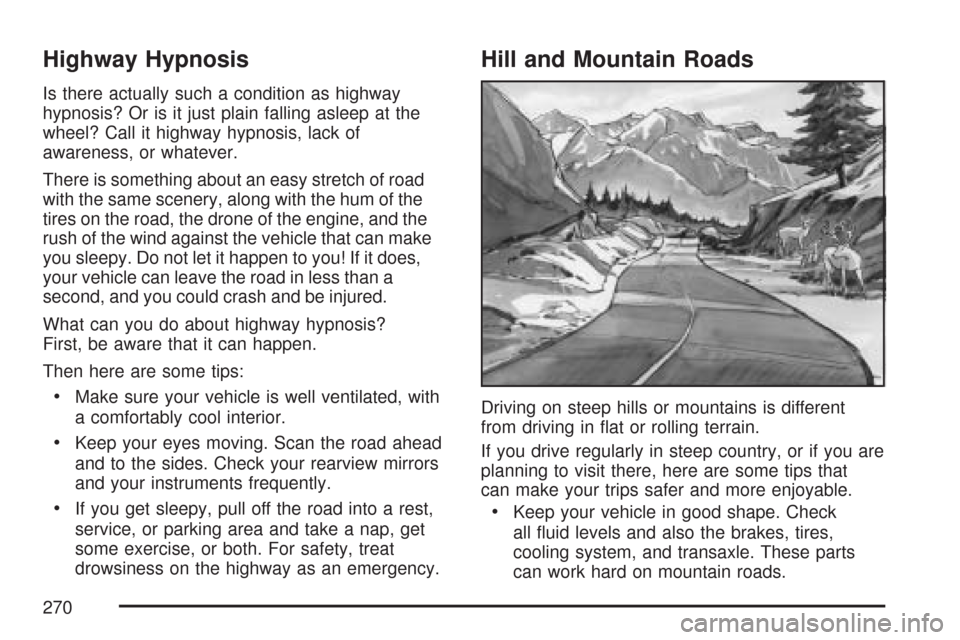
Hill and Mountain Roads
Driving on steep hills or mountains is different
from driving in at or rolling terrain.
If you drive regularly in steep country, or if you are
planning to visit there, here are some tips that
can make your trips safer and more enjoyable.
Keep your vehicle in good shape. Check
all uid levels and also the brakes, tires,
cooling system, and transaxle. These parts
can work hard on mountain roads.
270
Page 275 of 460
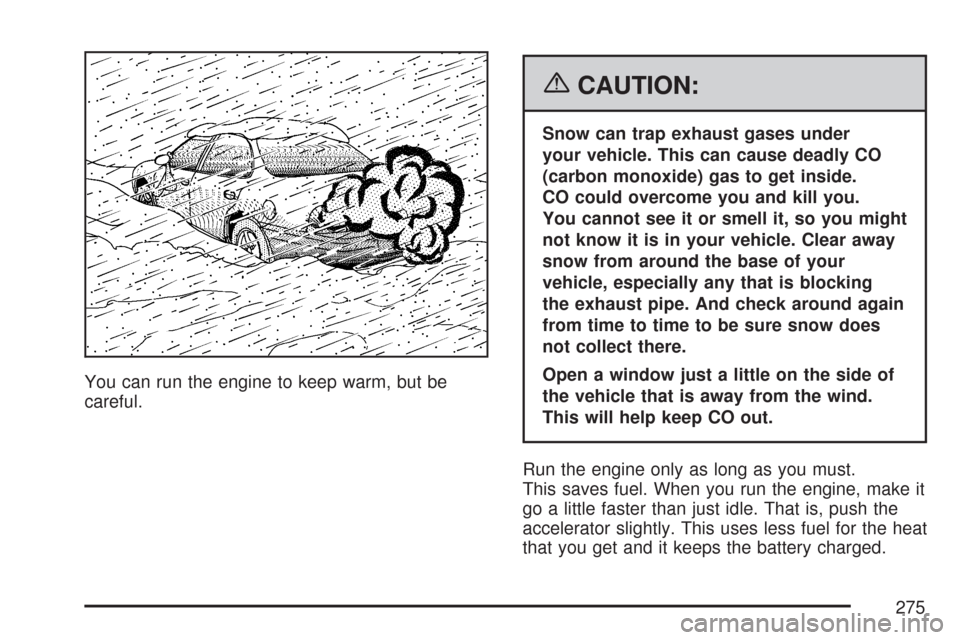
You can run the engine to keep warm, but be
careful.
{CAUTION:
Snow can trap exhaust gases under
your vehicle. This can cause deadly CO
(carbon monoxide) gas to get inside.
CO could overcome you and kill you.
You cannot see it or smell it, so you might
not know it is in your vehicle. Clear away
snow from around the base of your
vehicle, especially any that is blocking
the exhaust pipe. And check around again
from time to time to be sure snow does
not collect there.
Open a window just a little on the side of
the vehicle that is away from the wind.
This will help keep CO out.
Run the engine only as long as you must.
This saves fuel. When you run the engine, make it
go a little faster than just idle. That is, push the
accelerator slightly. This uses less fuel for the heat
that you get and it keeps the battery charged.
275
Page 291 of 460
When You Are Ready to Leave After
Parking on a Hill
1. Apply your regular brakes and hold the pedal
down while you:
start your engine,
shift into a gear, and
release the parking brake.
2. Let up on the brake pedal.
3. Drive slowly until the trailer is clear of
the chocks.
4. Stop and have someone pick up and store
the chocks.
Maintenance When Trailer Towing
Your vehicle will need service more often when
you’re pulling a trailer. See the Maintenance
Schedule for more on this. Things that are
especially important in trailer operation are
automatic transmission uid (don’t overll),
engine oil, drive belts, cooling system and brake
system. Each of these is covered in this manual,
and the Index will help you nd them quickly.
If you’re trailering, it’s a good idea to review
this information before you start your trip.
Check periodically to see that all hitch nuts and
bolts are tight.
Engine Cooling When Trailer Towing
Your cooling system may temporarily overheat
during severe operating conditions. SeeEngine
Overheating on page 323.
291
Page 293 of 460
Service........................................................ 296
Accessories and Modications................... 296
California Proposition 65 Warning.............. 297
Doing Your Own Service Work.................. 297
Adding Equipment to the Outside of
Your Vehicle.......................................... 298
Fuel............................................................. 298
Gasoline Octane........................................ 298
Gasoline Specications.............................. 299
California Fuel........................................... 299
Additives................................................... 299
Fuel E85 (85% Ethanol)............................ 300
Fuels in Foreign Countries........................ 301
Filling the Tank......................................... 302
Filling a Portable Fuel Container............... 304
Checking Things Under the Hood.............. 304
Hood Release........................................... 305
Engine Compartment Overview.................. 306
Engine Oil................................................. 310
Engine Oil Life System.............................. 314
Engine Air Cleaner/Filter............................ 316
Automatic Transaxle Fluid......................... 317Engine Coolant.......................................... 320
Pressure Cap............................................ 323
Engine Overheating................................... 323
Overheated Engine Protection
Operating Mode..................................... 326
Cooling System......................................... 326
Power Steering Fluid................................. 332
Windshield Washer Fluid........................... 333
Brakes...................................................... 334
Battery...................................................... 337
Jump Starting............................................ 338
Headlamp Aiming........................................ 343
Bulb Replacement....................................... 343
Halogen Bulbs........................................... 344
Headlamps, Front Turn Signal,
Sidemarker, and Parking Lamps............. 344
Taillamps, Turn Signal, Sidemarker,
Stoplamps and Back-up Lamps.............. 346
License Plate Lamp................................... 348
Replacement Bulbs................................... 349
Windshield Wiper Blade Replacement....... 349
Section 5 Service and Appearance Care
293
Page 298 of 460
Adding Equipment to the Outside of
Your Vehicle
Things you might add to the outside of your
vehicle can affect the airow around it. This may
cause wind noise and affect windshield washer
performance. Check with your dealer before
adding equipment to the outside of your vehicle.
Fuel
Use of the recommended fuel is an important part
of the proper maintenance of your vehicle. To
help keep the engine clean and maintain optimum
vehicle performance, GM recommends the use
of gasoline advertised as TOP TIER Detergent
Gasoline.
The 8th digit of the Vehicle Identication Number
(VIN) shows the code letter or number that
identies your vehicle’s engine. The VIN is at the
top left of the instrument panel. SeeVehicle
Identication Number (VIN) on page 396.
If your vehicle has the 3.5L V6 engine (VIN Code K
only), you can use either regular unleaded gasoline
or ethanol fuel containing up to 85% ethanol (E85);
also seeFuel E85 (85% Ethanol) on page 300.In
all other engines, use only regular unleaded
gasoline.
Gasoline Octane
For all vehicles except those with the 5.3L V8
engine (VIN Code C), use regular unleaded
gasoline with a posted octane rating of 87 or
higher. If the octane rating is less than 87,
you might notice an audible knocking noise
when you drive, commonly referred to as spark
knock. If this occurs, use a gasoline rated at
87 octane or higher as soon as possible.
If you are using gasoline rated at 87 octane
or higher and you hear heavy knocking,
the engine needs service.
If your vehicle has the 5.3L V8 engine
(VIN Code C), use premium unleaded gasoline
with a posted octane rating of 91 or higher.
You can also use regular unleaded gasoline
rated at 87 octane or higher, but your vehicle’s
acceleration could be slightly reduced, and you
might notice a slight audible knocking noise,
commonly referred to as spark knock. If the octane
is less than 87, you might notice a heavy knocking
noise when you drive. If this occurs, use a gasoline
rated at 87 octane or higher as soon as possible.
Otherwise, you could damage the engine. If you are
using gasoline rated at 87 octane or higher and you
hear heavy knocking, the engine needs service.
298
Page 299 of 460
Gasoline Specications
At a minimum, gasoline should meet ASTM
specication D 4814 in the United States or
CAN/CGSB-3.5 in Canada. Some gasolines may
contain an octane-enhancing additive called
methylcyclopentadienyl manganese tricarbonyl
(MMT). General Motors recommends against the
use of gasolines containing MMT. SeeAdditives
on page 299for additional information.
California Fuel
If your vehicle is certied to meet California
Emissions Standards, it is designed to operate on
fuels that meet California specications. See the
underhood emission control label. If this fuel is not
available in states adopting California emissions
standards, your vehicle will operate satisfactorily on
fuels meeting federal specications, but emission
control system performance may be affected. The
malfunction indicator lamp may turn on and your
vehicle may fail a smog-check test. SeeMalfunction
Indicator Lamp on page 185. If this occurs, return to
your authorized GM dealer for diagnosis. If it is
determined that the condition is caused by the type
of fuel used, repairs may not be covered by your
warranty.
Additives
To provide cleaner air, all gasolines in the United
States are now required to contain additives
that will help prevent engine and fuel system
deposits from forming, allowing your emission
control system to work properly. In most cases,
you should not have to add anything to your fuel.
However, some gasolines contain only the
minimum amount of additive required to meet U.S.
Environmental Protection Agency regulations.
To help keep fuel injectors and intake valves clean,
or if your vehicle experiences problems due to
dirty injectors or valves, look for gasoline that is
advertised as TOP TIER Detergent Gasoline. Also,
your dealer has additives that will help correct
and prevent most deposit-related problems.
299
Page 301 of 460
At a minimum, E85 should meet ASTM
Specication D 5798. By denition, this means
that fuel labeled E85 will have an ethanol content
between 70% and 85%. Filling the fuel tank with
fuel mixtures that do not meet ASTM specications
can affect driveability and could cause the check
engine light to come on.
To ensure quick starts in the wintertime, the E85
fuel must be formulated properly for your climate
according to ASTM specication D 5798. If you
have trouble starting on E85, it could be because
the E85 fuel is not properly formulated for your
climate. If this happens, switching to gasoline or
adding gasoline to the fuel tank can improve
starting. For good starting and heater efficiency
below 32°F (0°C), the fuel mix in the fuel tank
should contain no more than 70% ethanol. It is best
not to alternate repeatedly between gasoline and
E85. If you do switch fuels, it is recommended that
you add as much fuel as possible — do not add
less than three gallons (11 L) when refueling. You
should drive the vehicle immediately after refueling
for at least seven miles (11 km) to allow the vehicle
to adapt to the change in ethanol concentration.
E85 has less energy per gallon than gasoline,
so you will need to rell the fuel tank more often
when using E85 than when you are using gasoline.
SeeFilling the Tank on page 302.Notice:Some additives are not compatible
with E85 fuel and can harm your vehicle’s fuel
system. Do not add anything to E85. Damage
caused by additives would not be covered
by your new vehicle warranty.
Notice:Your vehicle was not designed for
fuel that contains methanol. Do not use
fuel containing methanol. It can corrode metal
parts in the fuel system and also damage
plastic and rubber parts. That damage would
not be covered under your warranty.
Fuels in Foreign Countries
If you plan on driving in another country outside
the United States or Canada, the proper fuel might
be hard to nd. Never use leaded gasoline or
any other fuel not recommended in the previous
text on fuel. Costly repairs caused by use of
improper fuel would not be covered by your
warranty.
To check the fuel availability, ask an auto club, or
contact a major oil company that does business
in the country where you will be driving.
301
Page 304 of 460
Filling a Portable Fuel Container
{CAUTION:
Never ll a portable fuel container while it
is in your vehicle. Static electricity
discharge from the container can ignite the
gasoline vapor. You can be badly burned
and your vehicle damaged if this occurs.
To help avoid injury to you and others:
Dispense gasoline only into approved
containers.
Do not ll a container while it is inside a
vehicle, in a vehicle’s trunk, pickup
bed, or on any surface other than the
ground.
Bring the ll nozzle in contact with
the inside of the ll opening before
operating the nozzle. Contact should
be maintained until the lling is
complete.
Do not smoke while pumping gasoline.
Do not use a cellular phone while
pumping gasoline.
Checking Things Under
the Hood
{CAUTION:
An electric fan under the hood can start up
and injure you even when the engine is not
running. Keep hands, clothing, and tools
away from any underhood electric fan.
{CAUTION:
Things that burn can get on hot engine
parts and start a re. These include
liquids like fuel, oil, coolant, brake uid,
windshield washer and other uids, and
plastic or rubber. You or others could be
burned. Be careful not to drop or spill
things that will burn onto a hot engine.
304