Page 285 of 458

Parking on Hills
{CAUTION:
You really should not park your
vehicle, with a trailer attached, on a hill.
If something goes wrong, your rig could
start to move. People can be injured,
and both your vehicle and the trailer
can be damaged.
But if you ever have to park your rig on a hill,
here’s how to do it:
1. Apply your regular brakes, but don’t shift
into PARK (P) yet. Then turn your wheels
into the curb if facing downhill or into traffic
if facing uphill.
2. Have someone place chocks under the
trailer wheels.3. When the wheel chocks are in place, release
the regular brakes until the chocks absorb
the load.
4. Reapply the regular brakes. Then apply your
parking brake and then shift to PARK (P).
5. Release the regular brakes.
When You Are Ready to Leave After
Parking on a Hill
1. Apply your regular brakes and hold the pedal
down while you:
•start your engine,
•shift into a gear, and
•release the parking brake.
2. Let up on the brake pedal.
3. Drive slowly until the trailer is clear of
the chocks.
4. Stop and have someone pick up and store
the chocks.
285
Page 342 of 458
Front Turn Signal, Sidemarker and
Parking Lamps
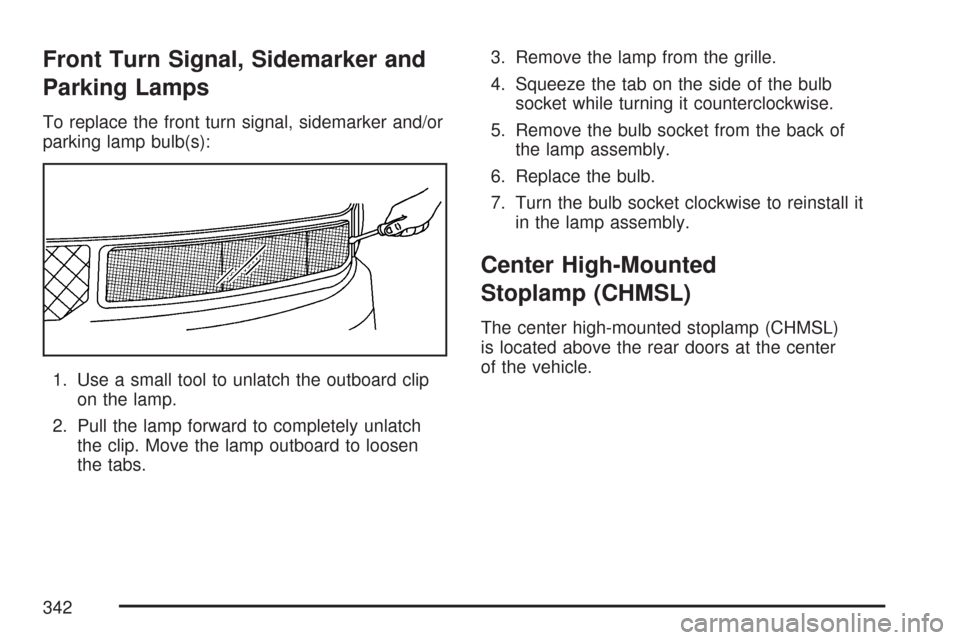
To replace the front turn signal, sidemarker and/or
parking lamp bulb(s):
1. Use a small tool to unlatch the outboard clip
on the lamp.
2. Pull the lamp forward to completely unlatch
the clip. Move the lamp outboard to loosen
the tabs.3. Remove the lamp from the grille.
4. Squeeze the tab on the side of the bulb
socket while turning it counterclockwise.
5. Remove the bulb socket from the back of
the lamp assembly.
6. Replace the bulb.
7. Turn the bulb socket clockwise to reinstall it
in the lamp assembly.
Center High-Mounted
Stoplamp (CHMSL)
The center high-mounted stoplamp (CHMSL)
is located above the rear doors at the center
of the vehicle.
342
Page 384 of 458

Fabric/Carpet
Use a vacuum cleaner with a soft brush
attachment frequently to remove dust and loose
dirt. A canister vacuum with a beater bar in
the nozzle may only be used on floor carpet and
carpeted floor mats. For soils, always try to remove
them first with plain water or club soda. Before
cleaning, gently remove as much of the soil
as possible using one of the following techniques:
•For liquids: gently blot the remaining soil with a
paper towel. Allow the soil to absorb into the
paper towel until no more can be removed.
•For solid dry soils: remove as much as possible
and then vacuum.
To clean, use the following instructions:
1. Saturate a lint-free, clean white cloth with
water or club soda.
2. Wring the cloth to remove excess moisture.3. Start on the outside edge of the soil and
gently rub toward the center. Continue
cleaning, using a clean area of the cloth
each time it becomes soiled.
4. Continue to gently rub the soiled area until
the cleaning cloth remains clean.
5. If the soil is not completely removed, use a
mild soap solution and repeat the cleaning
process that was used with plain water.
If any of the soil remains, a commercial fabric
cleaner or spot lifter may be necessary. When a
commercial upholstery cleaner or spot lifter is to
be used, test a small hidden area for colorfastness
first. If the locally cleaned area gives any
impression that a ring formation may result,
clean the entire surface.
After the cleaning process has been completed,
a paper towel can be used to blot excess moisture
from the fabric or carpet.
384