2007 CHEVROLET EXPRESS CARGO VAN belt
[x] Cancel search: beltPage 169 of 458
Passenger Safety Belt
Reminder Light
If your vehicle has this feature, several seconds
after the key is turned to RUN or START, a chime
will sound for several seconds to remind the front
passenger to buckle their safety belt. This would
only occur if the passenger airbag is enabled. See
Passenger Sensing System on page 89for more
information. The passenger safety belt light will also
come on and stay on for several seconds, then it
will flash for several more.
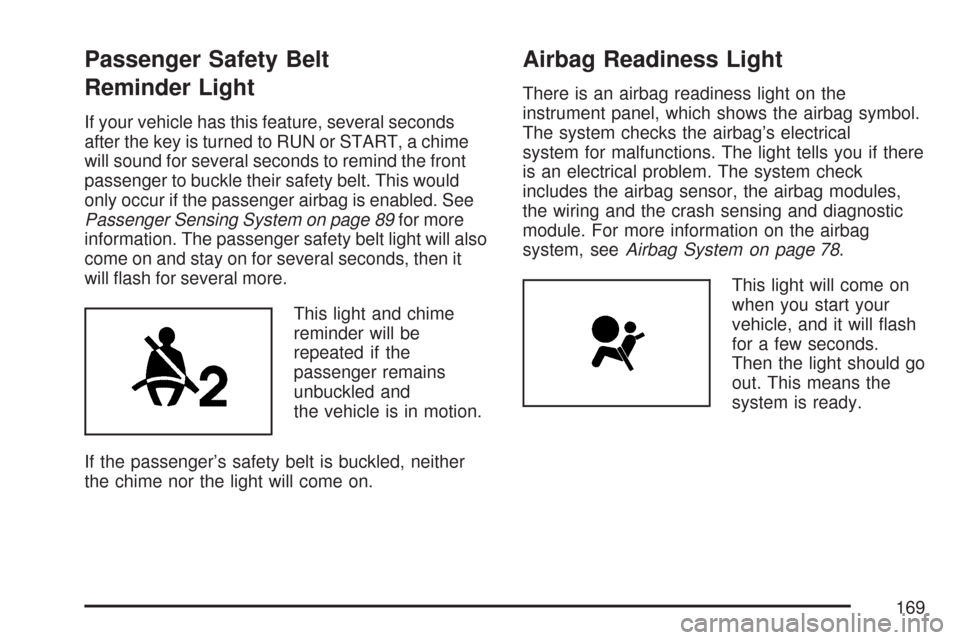
This light and chime
reminder will be
repeated if the
passenger remains
unbuckled and
the vehicle is in motion.
If the passenger’s safety belt is buckled, neither
the chime nor the light will come on.
Airbag Readiness Light
There is an airbag readiness light on the
instrument panel, which shows the airbag symbol.
The system checks the airbag’s electrical
system for malfunctions. The light tells you if there
is an electrical problem. The system check
includes the airbag sensor, the airbag modules,
the wiring and the crash sensing and diagnostic
module. For more information on the airbag
system, seeAirbag System on page 78.
This light will come on
when you start your
vehicle, and it will flash
for a few seconds.
Then the light should go
out. This means the
system is ready.
169
Page 174 of 458
If the word OFF or the off symbol is lit on the
airbag status indicator, it means that the
passenger sensing system has turned off the right
front passenger’s frontal airbag. SeePassenger
Sensing System on page 89for more on this,
including important safety information.
If, after several seconds, all status indicator lights
remain on, or if there are no lights at all, there
may be a problem with the lights or the passenger
sensing system. See your dealer for service.
{CAUTION:
If the off indicator and the airbag
readiness light ever come on together, it
means that something may be wrong with
the airbag system. If this ever happens,
have the vehicle serviced promptly,
because an adult-size person sitting in the
right front passenger seat may not have
the protection of the frontal airbag. See
Airbag Readiness Light on page 169.
Charging System Light
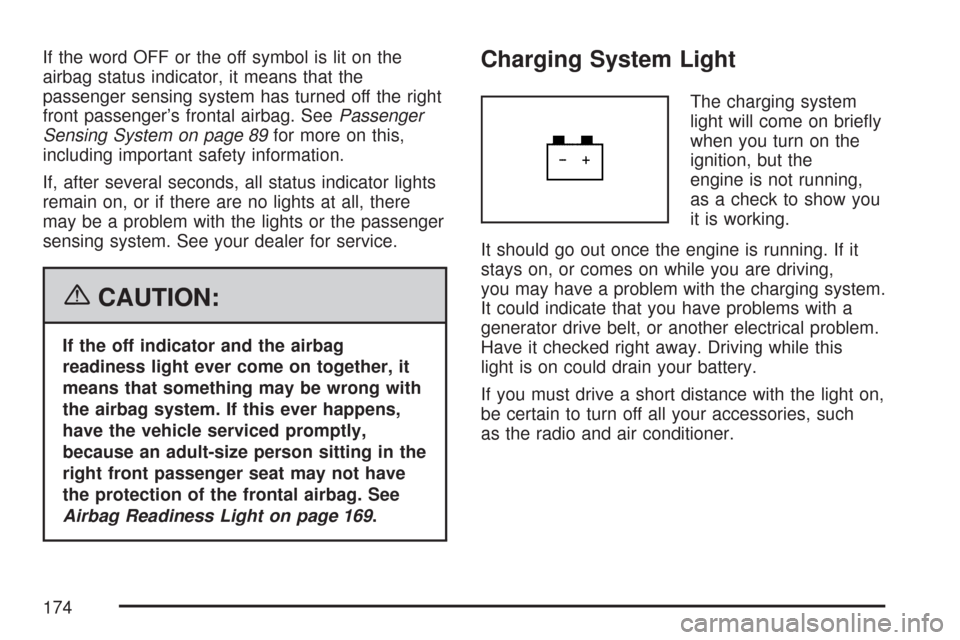
The charging system
light will come on briefly
when you turn on the
ignition, but the
engine is not running,
as a check to show you
it is working.
It should go out once the engine is running. If it
stays on, or comes on while you are driving,
you may have a problem with the charging system.
It could indicate that you have problems with a
generator drive belt, or another electrical problem.
Have it checked right away. Driving while this
light is on could drain your battery.
If you must drive a short distance with the light on,
be certain to turn off all your accessories, such
as the radio and air conditioner.
174
Page 188 of 458
While your vehicle is parked:
•Familiarize yourself with all of its controls.
•Familiarize yourself with its operation.
•Set up your audio system by presetting your
favorite radio stations, setting the tone, and
adjusting the speakers. Then, when driving
conditions permit, you can tune to your favorite
radio stations using the presets and steering
wheel controls if the vehicle has them.
Notice:Before adding any sound equipment to
your vehicle, such as an audio system, CD
player, CB radio, mobile telephone, or two-way
radio, make sure that it can be added by
checking with your dealer/retailer. Also, check
federal rules covering mobile radio and
telephone units. If sound equipment can be
added, it is very important to do it properly.
Added sound equipment may interfere with the
operation of your vehicle’s engine, radio, or
other systems, and even damage them. Your
vehicle’s systems may interfere with the
operation of sound equipment that has
been added.Notice:The chime signals related to safety
belts, parking brake, and other functions
of your vehicle operate through the
radio/entertainment system. If that equipment
is replaced or additional equipment is added
to your vehicle, the chimes may not work. Make
sure that replacement or additional equipment
is compatible with your vehicle before
installing it. SeeAccessories and Modifications
on page 290.
Your vehicle may have a feature called Retained
Accessory Power (RAP). With RAP, the audio
system can be played even after the ignition
is turned off. SeeRetained Accessory Power
(RAP) on page 121for more information.
188
Page 225 of 458
When cleaning the cassette tape player with the
recommended non-abrasive cleaning cassette,
it is possible that the cassette might eject, because
the cut tape detection feature on the radio can
recognize it as a broken tape, in error. To prevent
the cleaning cassette from being ejected, use
the following steps:
1. Turn the ignition on.
2. Turn the radio off.
3. Press and hold the TAPE DISC button for
five seconds. READY displays and the
cassette symbol flashes for five seconds.
4. Insert the scrubbing action cleaning cassette.
5. Eject the cleaning cassette after the
manufacturer’s recommended cleaning time.
When the cleaning cassette has been ejected,
the cut tape detection feature activates again.
A non-scrubbing action, wet-type cleaner which
uses a cassette with a fabric belt to clean the tape
head can be used. This type of cleaning cassette
does not eject on its own. A non-scrubbing
action cleaner might not clean as thoroughly
as the scrubbing type cleaner. The use of a
non-scrubbing action, dry-type cleaning cassette
is not recommended.After the player is cleaned, press and hold the
eject button for five seconds to reset the CLEAN
indicator. The radio displays --- or CLEANED
to show the indicator was reset.
Cassettes are subject to wear and the sound
quality can degrade over time. Always make sure
the cassette tape is in good condition before
the tape player is serviced.
Care of Your CDs
Handle CDs carefully. Store them in their original
cases or other protective cases and away from
direct sunlight and dust. The CD player scans the
bottom surface of the disc. If the surface of a CD is
damaged, such as cracked, broken, or scratched,
the CD does not play properly or not at all. If the
surface of a CD is soiled, take a soft, lint free cloth
or dampen a clean, soft cloth in a mild, neutral
detergent solution mixed with water, and clean it.
Make sure the wiping process starts from the center
to the edge.
Do not touch the bottom side of a CD while handling
it; this could damage the surface. Pick up CDs by
grasping the outer edges or the edge of the hole
and the outer edge.
225
Page 228 of 458
Your Driving, the Road, and
Your Vehicle
Defensive Driving
The best advice anyone can give about driving is:
Drive defensively.
Please start with a very important safety device in
your vehicle: Buckle up. SeeSafety Belts: They
Are for Everyone on page 17.
{CAUTION:
Defensive driving really means “Be ready
for anything.” On city streets, rural roads,
or expressways, it means “Always expect
the unexpected.” Assume that pedestrians
or other drivers are going to be careless
and make mistakes. Anticipate what they
might do and be ready. Rear-end collisions
are about the most preventable of
accidents. Yet they are common. Allow
enough following distance. Defensive
driving requires that a driver concentrate
on the driving task. Anything that distracts
from the driving task makes proper
defensive driving more difficult and can
even cause a collision, with resulting
injury. Ask a passenger to help do these
things, or pull off the road in a safe place to
do them. These simple defensive driving
techniques could save your life.
228
Page 240 of 458
Steering in Emergencies
There are times when steering can be more
effective than braking. For example, you come
over a hill and find a truck stopped in your lane,
or a car suddenly pulls out from nowhere, or
a child darts out from between parked cars and
stops right in front of you. You can avoid
these problems by braking — if you can stop in
time. But sometimes you cannot; there is not room.
That is the time for evasive action — steering
around the problem.
Your vehicle can perform very well in emergencies
like these. First apply the brakes. SeeBraking
on page 232. It is better to remove as much speed
as you can from a possible collision. Then steer
around the problem, to the left or right depending
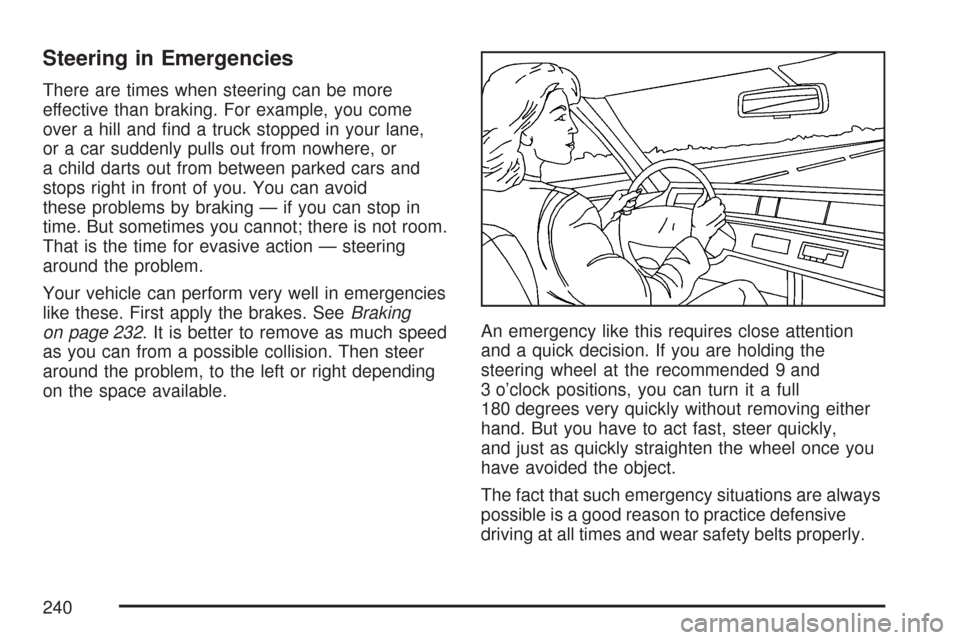
on the space available.An emergency like this requires close attention
and a quick decision. If you are holding the
steering wheel at the recommended 9 and
3 o’clock positions, you can turn it a full
180 degrees very quickly without removing either
hand. But you have to act fast, steer quickly,
and just as quickly straighten the wheel once you
have avoided the object.
The fact that such emergency situations are always
possible is a good reason to practice defensive
driving at all times and wear safety belts properly.
240
Page 286 of 458
Maintenance When Trailer Towing
Your vehicle will need service more often when
you’re pulling a trailer. See the Maintenance
Schedule for more on this. Things that are
especially important in trailer operation are
automatic transmission fluid (don’t overfill), engine
oil, axle lubricant, belt, cooling system and
brake system. Each of these is covered in this
manual, and the Index will help you find them
quickly. If you’re trailering, it’s a good idea
to review these sections before you start your trip.
Check periodically to see that all hitch nuts and
bolts are tight.
Trailer Wiring Harness
The optional heavy-duty trailer wiring package
includes a seven-wire harness assembly at the rear
of the vehicle and a four-wire harness assembly
under the left hand side of the instrument panel.
The seven-wire harness assembly is taped together
and located in a frame pocket at the driver side rear
left corner of the frame. The seven-wire harness
includes a 30-amp feed wire.Both harnesses come without connectors and
should be wired by a qualified electrical technician.
The technician can use the following color code
chart when connecting the wiring harness to your
trailer and trailer brake controller.
Seven-Wire Harness
•Light Green: Back-up lamps
•Brown: Parking lamps
•Yellow: Left stoplamp and turn signal
•Dark Green: Right stoplamp and turn signal
•Dark Blue: Use for electric trailer brakes
•Red/Black Stripe: Trailer accessory
•White (heavy gage): Ground wire
Four-Wire Harness (Trailer Brake Controller)
•Black: Ground
•Red/White Stripe: Fused Battery
•Dark Blue: Trailer Brake Feed
•Light Blue: Fused Stoplamp/CHMSL
286
Page 288 of 458
Windshield Wiper Blade Replacement....... 344
Tires............................................................ 346
Tire Sidewall Labeling............................... 347
Tire Terminology and Definitions............... 351
Inflation - Tire Pressure............................. 354
Dual Tire Operation................................... 355
Tire Inspection and Rotation...................... 356
When It Is Time for New Tires.................. 358
Buying New Tires...................................... 358
Different Size Tires and Wheels................ 360
Uniform Tire Quality Grading..................... 361
Wheel Alignment and Tire Balance............ 362
Wheel Replacement.................................. 362
Tire Chains............................................... 364
If a Tire Goes Flat.................................... 365
Changing a Flat Tire................................. 366
Removing the Spare Tire and Tools.......... 367
Removing the Flat Tire and Installing
the Spare Tire....................................... 370
Secondary Latch System........................... 377
Storing a Flat or Spare Tire and Tools...... 380
Spare Tire................................................. 382Appearance Care........................................ 382
Cleaning the Inside of Your Vehicle.......... 382
Fabric/Carpet............................................. 384
Instrument Panel, Vinyl, and Other
Plastic Surfaces..................................... 385
Care of Safety Belts.................................. 385
Weatherstrips............................................ 385
Washing Your Vehicle............................... 386
Cleaning Exterior Lamps/Lenses................ 386
Finish Care............................................... 386
Windshield and Wiper Blades.................... 387
Aluminum Wheels...................................... 388
Tires......................................................... 389
Sheet Metal Damage................................. 389
Finish Damage.......................................... 389
Underbody Maintenance............................ 390
Chemical Paint Spotting............................ 390
Vehicle Care/Appearance Materials............ 391
Vehicle Identication.................................. 392
Vehicle Identification Number (VIN)........... 392
Service Parts Identification Label............... 392
Section 5 Service and Appearance Care
288