Page 365 of 458
If a Tire Goes Flat
It is unusual for a tire to blowout while you are
driving, especially if you maintain your vehicle’s
tires properly. If air goes out of a tire, it is
much more likely to leak out slowly. But if you
should ever have a blowout, here are a few tips
about what to expect and what to do:
If a front tire fails, the flat tire will create a drag
that pulls the vehicle toward that side. Take
your foot off the accelerator pedal and grip the
steering wheel firmly. Steer to maintain lane
position, and then gently brake to a stop well
out of the traffic lane.
A rear blowout, particularly on a curve, acts much
like a skid and may require the same correction
you would use in a skid. In any rear blowout
remove your foot from the accelerator pedal.
Get the vehicle under control by steering the
way you want the vehicle to go. It may be very
bumpy and noisy, but you can still steer. Gently
brake to a stop, well off the road if possible.{CAUTION:
Lifting a vehicle and getting under it to
do maintenance or repairs is dangerous
without the appropriate safety equipment
and training. The jack provided with your
vehicle is designed only for changing a
at tire. If it is used for anything else, you
or others could be badly injured or killed
if the vehicle slips off the jack. Use the
jack provided with your vehicle only for
changing a at tire.
If a tire goes flat, the next part shows how to use
the jacking equipment to change a flat tire safely.
365
Page 366 of 458
Changing a Flat Tire
If a tire goes flat, avoid further tire and wheel
damage by driving slowly to a level place.
Turn on your vehicle’s hazard warning flashers.
SeeHazard Warning Flashers on page 146
for more information.
{CAUTION:
Changing a tire can be dangerous. The
vehicle can slip off the jack and roll over
or fall on you or other people. You and
they could be badly injured or even killed.
Find a level place to change your tire.
To help prevent the vehicle from moving:
1. Set the parking brake rmly.
2. Put the shift lever in PARK (P).
CAUTION: (Continued)
CAUTION: (Continued)
3. Turn off the engine and do not restart
while the vehicle is raised.
4. Do not allow passengers to remain in
the vehicle.
To be even more certain the vehicle will
not move, you should put blocks at the
front and rear of the tire farthest away
from the one being changed. That would
be the tire, on the other side, at the
opposite end of the vehicle.
366
Page 376 of 458
{CAUTION:
Incorrect wheel nuts or improperly
tightened wheel nuts can cause the wheel
to come loose and even come off. This
could lead to an accident. Be sure to use
the correct wheel nuts. If you have to
replace them, be sure to get new GM
original equipment wheel nuts. Stop
somewhere as soon as you can and have
the nuts tightened with a torque wrench
to the proper torque specication. See
Capacities and Specifications on page 398
for wheel nut torque specication.
Notice:Improperly tightened wheel nuts can
lead to brake pulsation and rotor damage.
To avoid expensive brake repairs, evenly
tighten the wheel nuts in the proper sequence
and to the proper torque specication. See
Capacities and Specifications on page 398
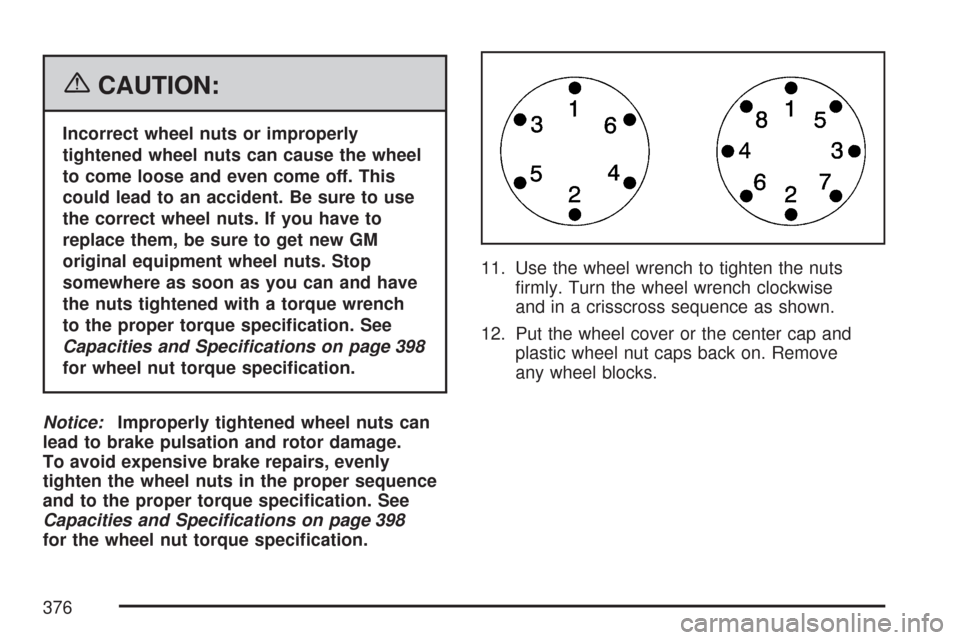
for the wheel nut torque specication.11. Use the wheel wrench to tighten the nuts
firmly. Turn the wheel wrench clockwise
and in a crisscross sequence as shown.
12. Put the wheel cover or the center cap and
plastic wheel nut caps back on. Remove
any wheel blocks.
376
Page 394 of 458
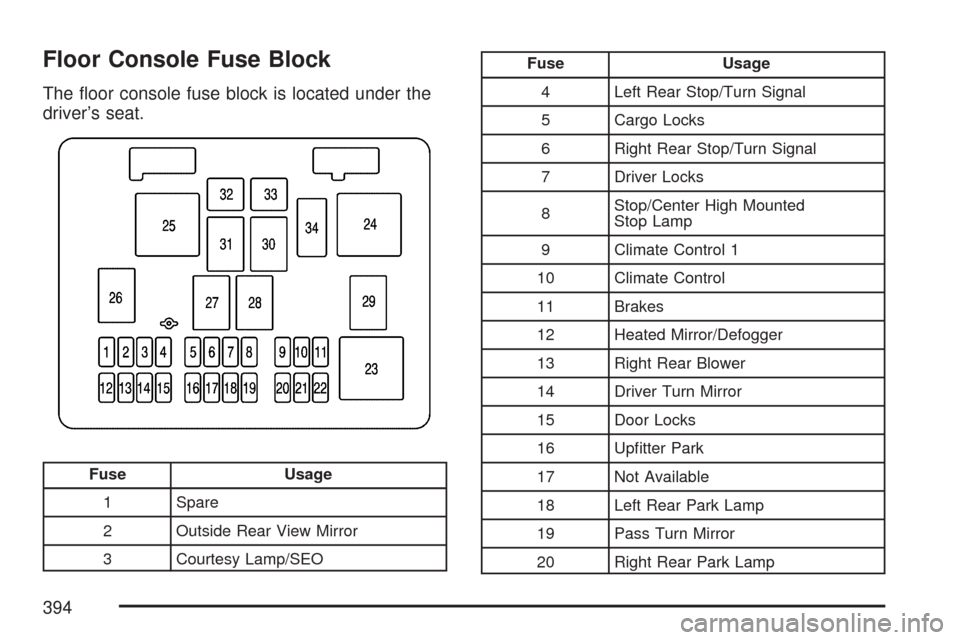
Floor Console Fuse Block
The floor console fuse block is located under the
driver’s seat.
Fuse Usage
1 Spare
2 Outside Rear View Mirror
3 Courtesy Lamp/SEO
Fuse Usage
4 Left Rear Stop/Turn Signal
5 Cargo Locks
6 Right Rear Stop/Turn Signal
7 Driver Locks
8Stop/Center High Mounted
Stop Lamp
9 Climate Control 1
10 Climate Control
11 Brakes
12 Heated Mirror/Defogger
13 Right Rear Blower
14 Driver Turn Mirror
15 Door Locks
16 Upfitter Park
17 Not Available
18 Left Rear Park Lamp
19 Pass Turn Mirror
20 Right Rear Park Lamp
394
Page 396 of 458
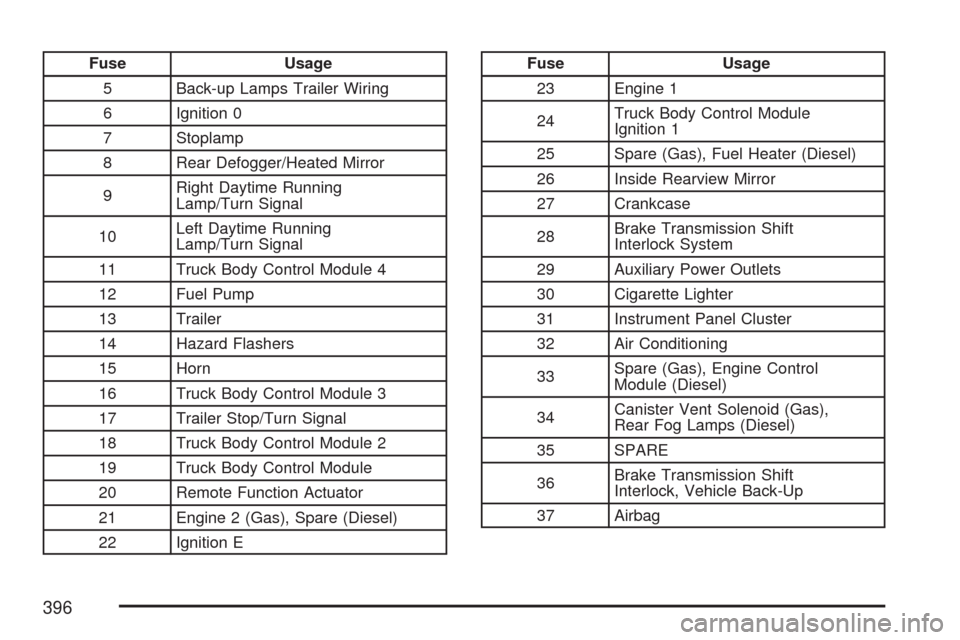
Fuse Usage
5 Back-up Lamps Trailer Wiring
6 Ignition 0
7 Stoplamp
8 Rear Defogger/Heated Mirror
9Right Daytime Running
Lamp/Turn Signal
10Left Daytime Running
Lamp/Turn Signal
11 Truck Body Control Module 4
12 Fuel Pump
13 Trailer
14 Hazard Flashers
15 Horn
16 Truck Body Control Module 3
17 Trailer Stop/Turn Signal
18 Truck Body Control Module 2
19 Truck Body Control Module
20 Remote Function Actuator
21 Engine 2 (Gas), Spare (Diesel)
22 Ignition EFuse Usage
23 Engine 1
24Truck Body Control Module
Ignition 1
25 Spare (Gas), Fuel Heater (Diesel)
26 Inside Rearview Mirror
27 Crankcase
28Brake Transmission Shift
Interlock System
29 Auxiliary Power Outlets
30 Cigarette Lighter
31 Instrument Panel Cluster
32 Air Conditioning
33Spare (Gas), Engine Control
Module (Diesel)
34Canister Vent Solenoid (Gas),
Rear Fog Lamps (Diesel)
35 SPARE
36Brake Transmission Shift
Interlock, Vehicle Back-Up
37 Airbag
396
Page 397 of 458
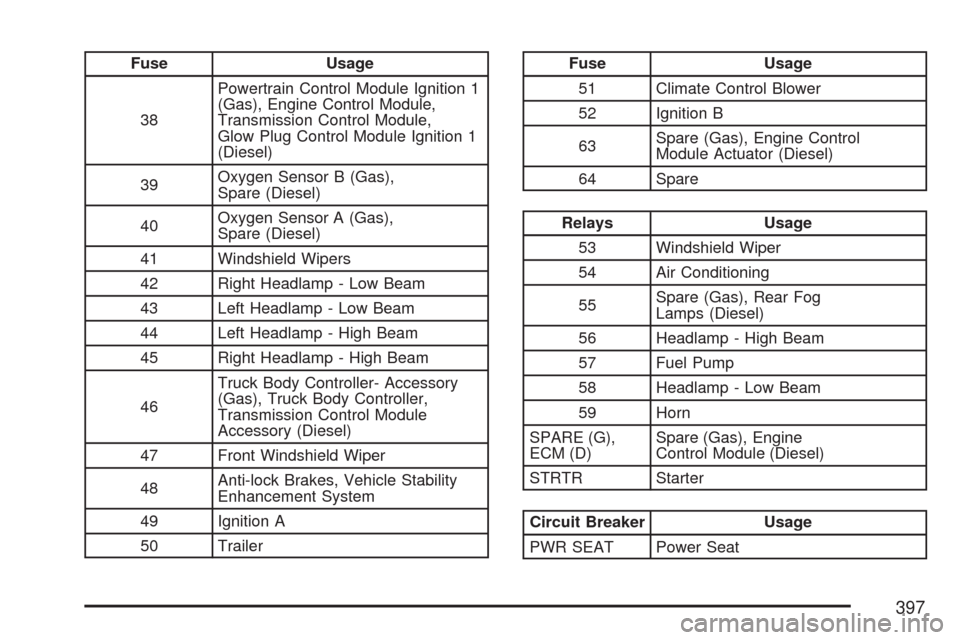
Fuse Usage
38Powertrain Control Module Ignition 1
(Gas), Engine Control Module,
Transmission Control Module,
Glow Plug Control Module Ignition 1
(Diesel)
39Oxygen Sensor B (Gas),
Spare (Diesel)
40Oxygen Sensor A (Gas),
Spare (Diesel)
41 Windshield Wipers
42 Right Headlamp - Low Beam
43 Left Headlamp - Low Beam
44 Left Headlamp - High Beam
45 Right Headlamp - High Beam
46Truck Body Controller- Accessory
(Gas), Truck Body Controller,
Transmission Control Module
Accessory (Diesel)
47 Front Windshield Wiper
48Anti-lock Brakes, Vehicle Stability
Enhancement System
49 Ignition A
50 TrailerFuse Usage
51 Climate Control Blower
52 Ignition B
63Spare (Gas), Engine Control
Module Actuator (Diesel)
64 Spare
Relays Usage
53 Windshield Wiper
54 Air Conditioning
55Spare (Gas), Rear Fog
Lamps (Diesel)
56 Headlamp - High Beam
57 Fuel Pump
58 Headlamp - Low Beam
59 Horn
SPARE (G),
ECM (D)Spare (Gas), Engine
Control Module (Diesel)
STRTR Starter
Circuit Breaker Usage
PWR SEAT Power Seat
397
Page 406 of 458
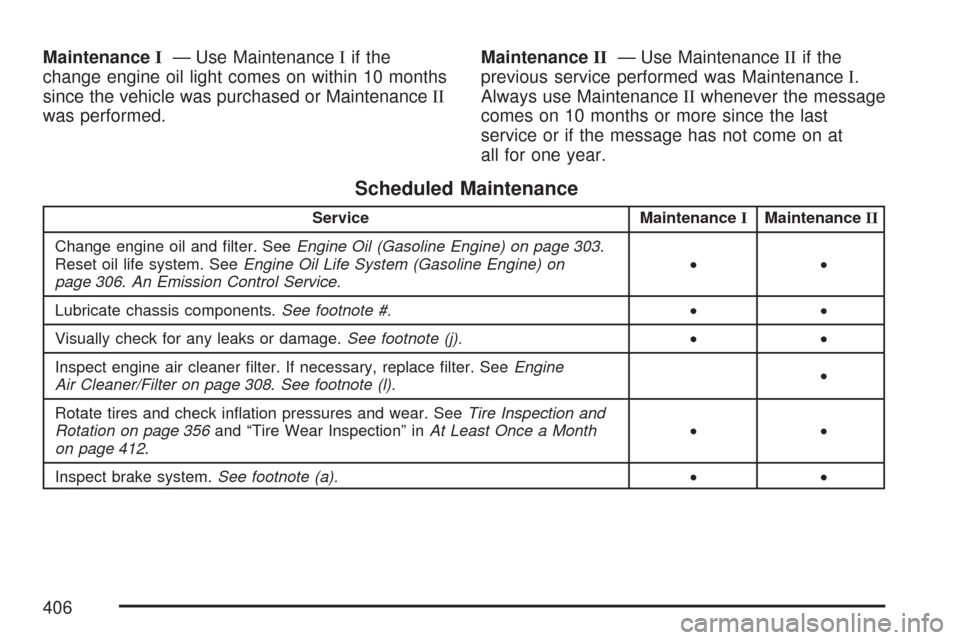
MaintenanceI— Use MaintenanceIif the
change engine oil light comes on within 10 months
since the vehicle was purchased or MaintenanceII
was performed.MaintenanceII— Use MaintenanceIIif the
previous service performed was MaintenanceI.
Always use MaintenanceIIwhenever the message
comes on 10 months or more since the last
service or if the message has not come on at
all for one year.
Scheduled Maintenance
Service MaintenanceIMaintenanceII
Change engine oil and filter. SeeEngine Oil (Gasoline Engine) on page 303.
Reset oil life system. SeeEngine Oil Life System (Gasoline Engine) on
page 306.An Emission Control Service.••
Lubricate chassis components.See footnote #.••
Visually check for any leaks or damage.See footnote (j).••
Inspect engine air cleaner filter. If necessary, replace filter. SeeEngine
Air Cleaner/Filter on page 308.See footnote (l).•
Rotate tires and check inflation pressures and wear. SeeTire Inspection and
Rotation on page 356and “Tire Wear Inspection” inAt Least Once a Month
on page 412.••
Inspect brake system.See footnote (a).••
406
Page 409 of 458
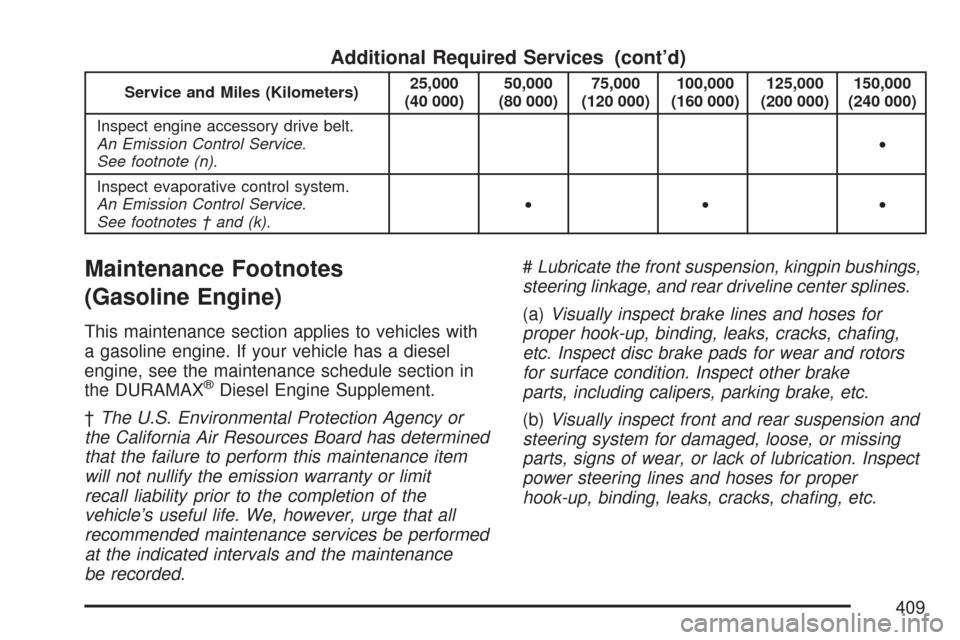
Additional Required Services (cont’d)
Service and Miles (Kilometers)25,000
(40 000)50,000
(80 000)75,000
(120 000)100,000
(160 000)125,000
(200 000)150,000
(240 000)
Inspect engine accessory drive belt.
An Emission Control Service.
See footnote (n).•
Inspect evaporative control system.
An Emission Control Service.
See footnotes † and (k).•••
Maintenance Footnotes
(Gasoline Engine)
This maintenance section applies to vehicles with
a gasoline engine. If your vehicle has a diesel
engine, see the maintenance schedule section in
the DURAMAX
®Diesel Engine Supplement.
†The U.S. Environmental Protection Agency or
the California Air Resources Board has determined
that the failure to perform this maintenance item
will not nullify the emission warranty or limit
recall liability prior to the completion of the
vehicle’s useful life. We, however, urge that all
recommended maintenance services be performed
at the indicated intervals and the maintenance
be recorded.#Lubricate the front suspension, kingpin bushings,
steering linkage, and rear driveline center splines.
(a)Visually inspect brake lines and hoses for
proper hook-up, binding, leaks, cracks, chang,
etc. Inspect disc brake pads for wear and rotors
for surface condition. Inspect other brake
parts, including calipers, parking brake, etc.
(b)Visually inspect front and rear suspension and
steering system for damaged, loose, or missing
parts, signs of wear, or lack of lubrication. Inspect
power steering lines and hoses for proper
hook-up, binding, leaks, cracks, chang, etc.
409