2007 CHEVROLET EXPRESS CARGO VAN light
[x] Cancel search: lightPage 184 of 458
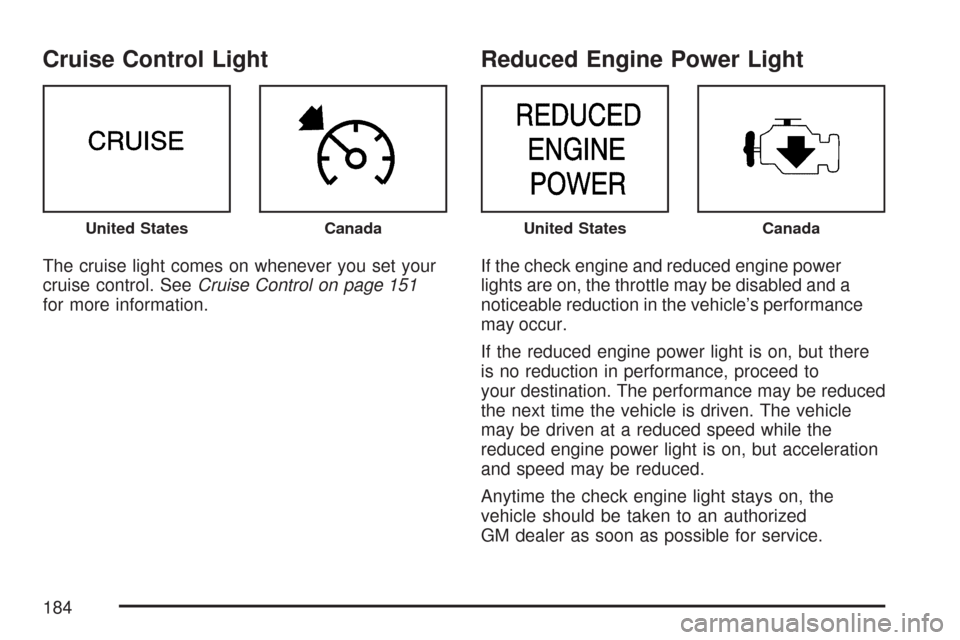
Cruise Control Light
The cruise light comes on whenever you set your
cruise control. SeeCruise Control on page 151
for more information.
Reduced Engine Power Light
If the check engine and reduced engine power
lights are on, the throttle may be disabled and a
noticeable reduction in the vehicle’s performance
may occur.
If the reduced engine power light is on, but there
is no reduction in performance, proceed to
your destination. The performance may be reduced
the next time the vehicle is driven. The vehicle
may be driven at a reduced speed while the
reduced engine power light is on, but acceleration
and speed may be reduced.
Anytime the check engine light stays on, the
vehicle should be taken to an authorized
GM dealer as soon as possible for service.
United StatesCanadaUnited StatesCanada
184
Page 185 of 458
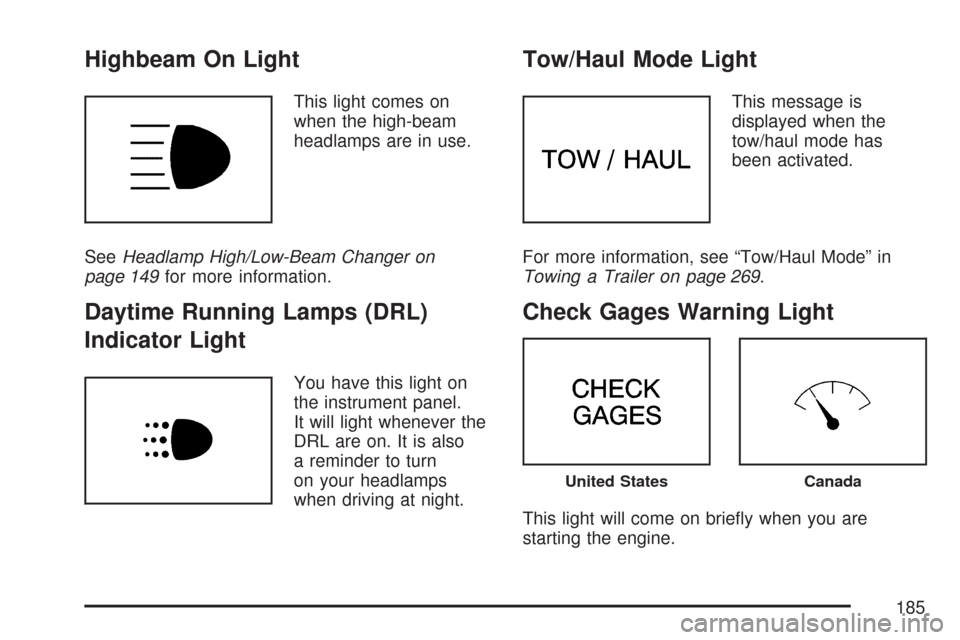
Highbeam On Light
This light comes on
when the high-beam
headlamps are in use.
SeeHeadlamp High/Low-Beam Changer on
page 149for more information.
Daytime Running Lamps (DRL)
Indicator Light
You have this light on
the instrument panel.
It will light whenever the
DRL are on. It is also
a reminder to turn
on your headlamps
when driving at night.
Tow/Haul Mode Light
This message is
displayed when the
tow/haul mode has
been activated.
For more information, see “Tow/Haul Mode” in
Towing a Trailer on page 269.
Check Gages Warning Light
This light will come on briefly when you are
starting the engine.
United StatesCanada
185
Page 186 of 458
If the light comes on and stays on while you
are driving, check your coolant temperature and
engine oil pressure gages to see if they are in the
warning zones.
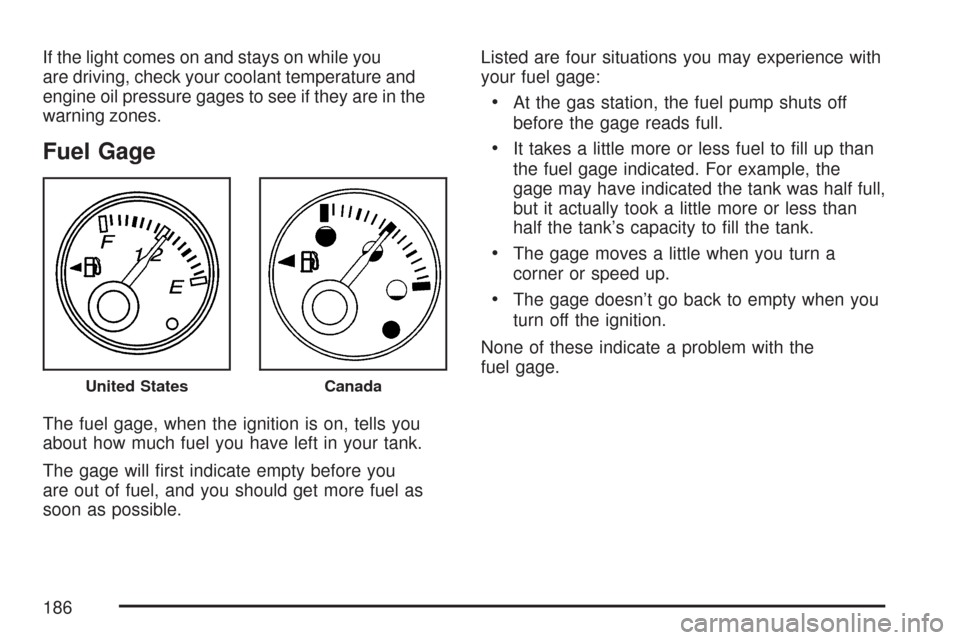
Fuel Gage
The fuel gage, when the ignition is on, tells you
about how much fuel you have left in your tank.
The gage will first indicate empty before you
are out of fuel, and you should get more fuel as
soon as possible.Listed are four situations you may experience with
your fuel gage:
•At the gas station, the fuel pump shuts off
before the gage reads full.
•It takes a little more or less fuel to fill up than
the fuel gage indicated. For example, the
gage may have indicated the tank was half full,
but it actually took a little more or less than
half the tank’s capacity to fill the tank.
•The gage moves a little when you turn a
corner or speed up.
•The gage doesn’t go back to empty when you
turn off the ignition.
None of these indicate a problem with the
fuel gage.
United StatesCanada
186
Page 218 of 458
LOAD:Press this button to load CDs into the CD
player. This CD player holds up to six CDs.
To insert one CD, do the following:
1. Turn the ignition on.
2. Press and release the LOAD button.
3. Wait for the indicator light, located to the right
of the slot, to turn green.
4. Load a CD. Insert the CD partway into the slot,
label side up. The player pulls the CD in.
To insert multiple CDs, do the following:
1. Turn the ignition on.
2. Press and hold the LOAD button for
two seconds.
You will hear a beep and the indicator light,
located to the right of the slot, begins to flash
and MULTI LOAD # appears on the display.
3. Once the light stops flashing and turns green,
INSERT CD # appears on the display, load a
CD. Insert the CD partway into the slot,
label side up. The player pulls the CD in.
Once the CD is loaded, the indicator
light begins flashing again. Once the light
stops flashing and turns green, you can load
another CD. The CD player takes up to
six CDs. Do not try to load more than six.To load more than one CD but less than six,
complete Steps 1 through 3. When finished loading
CDs, press the LOAD button to cancel the
loading function. The radio begins to play the last
CD loaded.
If more than one CD has been loaded, a number
for each CD appears on the display.
Playing a Specic Loaded CD
For every CD loaded, a number appears on the
display. To play a specific CD, first press the
CD AUX button (if not already in CD mode), then
press the numbered pushbutton that corresponds
to the CD. A small bar appears under the CD
number that is playing and the track number
appears on the display.
If an error appears on the display, see “CD
Messages” later in this section.
218
Page 219 of 458
CDZ(Eject):Press this button to eject CD(s).
To eject the CD that is currently playing, press
and release this button.
To eject multiple CDs, do the following:
1. Press and hold the CD eject button for
five seconds.
You will hear a beep and the indicator light,
located to the right of the slot, begins to flash
and EJECT ALL appears on the display.
2. Once the light stops flashing, REMOVE CD #
appears on the display. The CD ejects and
can be removed.
Once the CD is removed, the indicator light
begins flashing again and another CD ejects.
To stop ejecting the CDs, press the LOAD
or the eject button.
If the CD is not removed, after 25 seconds, the
CD automatically pulls back into the player. If CD
is pushed back into the player, before the
25 second time period is complete, the player
senses an error and tries to eject the CD several
times before stopping.Do not repeatedly press the CD eject button to
eject a CD after you have tried to push it in
manually. The player’s 25-second eject timer
resets at each press of eject, causing the player to
not eject the CD until the 25-second time period
has elapsed.
{REV (Reverse):Press and hold this button to
reverse quickly within a track. You will hear
sound at a reduced volume. The elapsed time of
the track appears on the display. Release the
button to play the passage.
FWD
|(Forward):Press and hold this button to
advance quickly within a track. You will hear
sound at a reduced volume. The elapsed time of
the track appears on the display. Release the
button to play the passage.
219
Page 223 of 458
CD Messages
CHECK CD:If this message appears on the
display and/or the CD comes out, it could be for
one of the following reasons:
•It is very hot. When the temperature returns to
normal, the CD should play.
•You are driving on a very rough road.
When the road becomes smoother, the CD
should play.
•The CD is dirty, scratched, wet, or
upside down.
•The air is very humid. If so, wait about an
hour and try again.
•There may have been a problem while
burning the CD.
•The label may be caught in the CD player.
If the CD is not playing correctly, for any other
reason, try a known good CD.
If any error occurs repeatedly or if an error cannot
be corrected, contact your dealer. If the radio
displays an error message, write it down and
provide it to your dealer when reporting the
problem.
Theft-Deterrent Feature
(Non-RDS Radios)
THEFTLOCK®is designed to discourage theft
of your vehicle’s radio. The feature works
automatically by learning a portion of the
Vehicle Identification Number (VIN). If the
radio is moved to a different vehicle, it does
not operate and LOC displays.
With THEFTLOCK
®activated, the radio does
not operate if stolen.
Theft-Deterrent Feature
(RDS Radios)
THEFTLOCK®is designed to discourage theft
of your vehicle’s radio. The feature works
automatically by learning a portion of the
Vehicle Identification Number (VIN). If the
radio is moved to a different vehicle, it does
not operate and LOCKED displays.
When the radio and vehicle are turned off, the
blinking red light indicates that THEFTLOCK
®
is armed.
With THEFTLOCK®activated, the radio does
not operate if stolen.
223
Page 224 of 458
Radio Reception
Frequency interference and static during normal
radio reception can occur if items such as cell
phone chargers, vehicle convenience accessories,
and external electronic devices are plugged into
the accessory power outlet. If there is interference
or static, unplug the item from the accessory
power outlet.
AM
The range for most AM stations is greater than for
FM, especially at night. The longer range can cause
station frequencies to interfere with each other. For
better radio reception, most AM radio stations boost
the power levels during the day, and then reduce
these levels during the night. Static can also occur
when things like storms and power lines interfere
with radio reception. When this happens, try
reducing the treble on your radio.
FM Stereo
FM stereo gives the best sound, but FM signals
reach only about 10 to 40 miles (16 to 65 km).
Tall buildings or hills can interfere with FM signals,
causing the sound to fade in and out.
Care of the Cassette Tape Player
A tape player that is not cleaned regularly
can cause reduced sound quality, ruined
cassettes, or a damaged mechanism. Cassette
tapes should be stored in their cases away
from contaminants, direct sunlight, and extreme
heat. If they are not, they might not operate
properly or may cause failure of the tape player.
The tape player should be cleaned regularly after
every 50 hours of use. The radio might display
CLEAN to indicate that the tape player has been
used for 50 hours without resetting the tape clean
timer. If this message displays, the cassette tape
player needs to be cleaned. It still plays tapes, but it
should be cleaned as soon as possible to prevent
damage to the tapes and player. If there is a
reduction in sound quality, try a known good
cassette to see if the tape or the tape player is at
fault. If this other cassette has no improvement in
sound quality, clean the tape player.
For best results, use a scrubbing action,
non-abrasive cleaning cassette with pads which
scrub the tape head as the hubs of the cleaner
cassette turn. The recommended cleaning cassette
is available through your dealer.
224
Page 225 of 458
When cleaning the cassette tape player with the
recommended non-abrasive cleaning cassette,
it is possible that the cassette might eject, because
the cut tape detection feature on the radio can
recognize it as a broken tape, in error. To prevent
the cleaning cassette from being ejected, use
the following steps:
1. Turn the ignition on.
2. Turn the radio off.
3. Press and hold the TAPE DISC button for
five seconds. READY displays and the
cassette symbol flashes for five seconds.
4. Insert the scrubbing action cleaning cassette.
5. Eject the cleaning cassette after the
manufacturer’s recommended cleaning time.
When the cleaning cassette has been ejected,
the cut tape detection feature activates again.
A non-scrubbing action, wet-type cleaner which
uses a cassette with a fabric belt to clean the tape
head can be used. This type of cleaning cassette
does not eject on its own. A non-scrubbing
action cleaner might not clean as thoroughly
as the scrubbing type cleaner. The use of a
non-scrubbing action, dry-type cleaning cassette
is not recommended.After the player is cleaned, press and hold the
eject button for five seconds to reset the CLEAN
indicator. The radio displays --- or CLEANED
to show the indicator was reset.
Cassettes are subject to wear and the sound
quality can degrade over time. Always make sure
the cassette tape is in good condition before
the tape player is serviced.
Care of Your CDs
Handle CDs carefully. Store them in their original
cases or other protective cases and away from
direct sunlight and dust. The CD player scans the
bottom surface of the disc. If the surface of a CD is
damaged, such as cracked, broken, or scratched,
the CD does not play properly or not at all. If the
surface of a CD is soiled, take a soft, lint free cloth
or dampen a clean, soft cloth in a mild, neutral
detergent solution mixed with water, and clean it.
Make sure the wiping process starts from the center
to the edge.
Do not touch the bottom side of a CD while handling
it; this could damage the surface. Pick up CDs by
grasping the outer edges or the edge of the hole
and the outer edge.
225