Page 268 of 458
Dolly Towing
Rear Towing (Rear Wheels Off the Ground)
Two-Wheel-Drive Vehicles
Use the following procedure to tow your vehicle
from the rear:
1. Drive the vehicle onto the dolly.
2. Firmly set the parking brake. SeeParking
Brake on page 128for more information.
3. Put the automatic transmission in PARK (P).
4. Follow the dolly manufacturer’s instructions to
attach and secure the vehicle being towed to
the dolly and then the loaded dolly to the tow
vehicle. Make sure the wheels are straight
before towing.
Use an adequate clamping device to ensure
that the front wheels are locked into the
straight position.5. Release the parking brake only after the
vehicle being towed is firmly attached to
the tow vehicle.
6. Turn the ignition to LOCK.
If the tow vehicle will not be started or driven
for six weeks or more, remove the battery
cable from the negative terminal (post) of the
battery to prevent your battery from draining
while towing.
All-Wheel-Drive Vehicles
Your vehicle was not designed to be towed with
two wheels on the ground. To properly tow
these vehicles, they should be placed on a
platform trailer with all four wheels off the ground.
Notice:Towing an all-wheel-drive vehicle
with all four wheels on the ground, or even
with only two of its wheels on the ground, will
damage drivetrain components. Do not tow
an all-wheel-drive vehicle if any of its wheels
will be on the ground.
268
Page 276 of 458
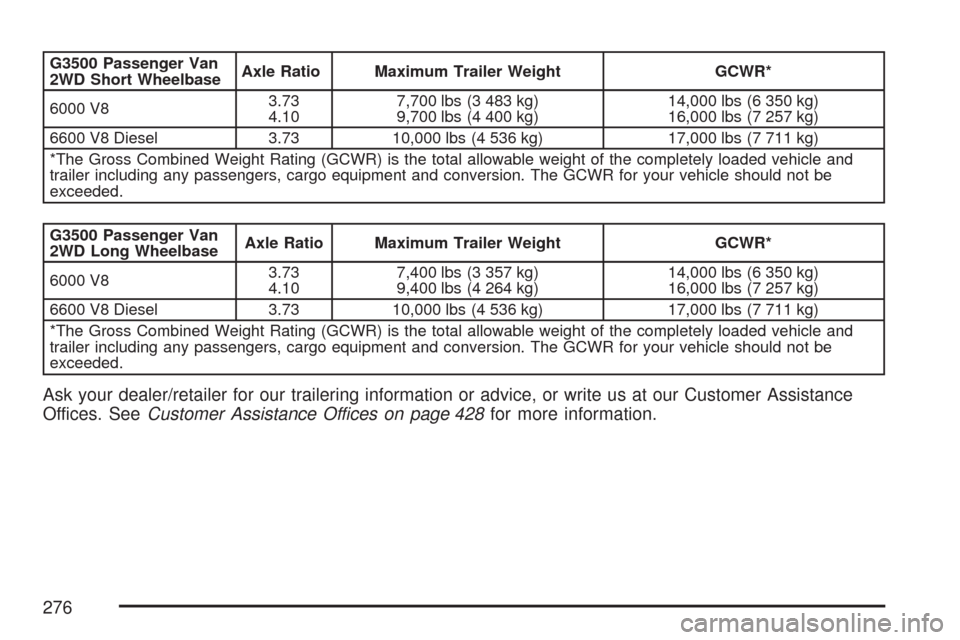
G3500 Passenger Van
2WD Short WheelbaseAxle Ratio Maximum Trailer Weight GCWR*
6000 V83.73
4.107,700 lbs (3 483 kg)
9,700 lbs (4 400 kg)14,000 lbs (6 350 kg)
16,000 lbs (7 257 kg)
6600 V8 Diesel 3.73 10,000 lbs (4 536 kg) 17,000 lbs (7 711 kg)
*The Gross Combined Weight Rating (GCWR) is the total allowable weight of the completely loaded vehicle and
trailer including any passengers, cargo equipment and conversion. The GCWR for your vehicle should not be
exceeded.
G3500 Passenger Van
2WD Long WheelbaseAxle Ratio Maximum Trailer Weight GCWR*
6000 V83.73
4.107,400 lbs (3 357 kg)
9,400 lbs (4 264 kg)14,000 lbs (6 350 kg)
16,000 lbs (7 257 kg)
6600 V8 Diesel 3.73 10,000 lbs (4 536 kg) 17,000 lbs (7 711 kg)
*The Gross Combined Weight Rating (GCWR) is the total allowable weight of the completely loaded vehicle and
trailer including any passengers, cargo equipment and conversion. The GCWR for your vehicle should not be
exceeded.
Ask your dealer/retailer for our trailering information or advice, or write us at our Customer Assistance
Offices. SeeCustomer Assistance Offices on page 428for more information.
276
Page 283 of 458
During your trip, check occasionally to be sure
that the load is secure, and that the lamps and any
trailer brakes are still working.
Following Distance
Stay at least twice as far behind the vehicle ahead
as you would when driving your vehicle without
a trailer. This can help you avoid situations
that require heavy braking and sudden turns.
Passing
You’ll need more passing distance up ahead when
you’re towing a trailer. And, because you’re a
good deal longer, you’ll need to go much farther
beyond the passed vehicle before you can
return to your lane.
Backing Up
Hold the bottom of the steering wheel with
one hand. Then, to move the trailer to the left, just
move that hand to the left. To move the trailer
to the right, move your hand to the right. Always
back up slowly and, if possible, have someone
guide you.
Making Turns
Notice:Making very sharp turns while
trailering could cause the trailer to come in
contact with the vehicle. Your vehicle could be
damaged. Avoid making very sharp turns
while trailering.
When you’re turning with a trailer, make wider
turns than normal. Do this so your trailer
won’t strike soft shoulders, curbs, road signs,
trees or other objects. Avoid jerky or sudden
maneuvers. Signal well in advance.
283
Page 315 of 458
{CAUTION:
You can be burned if you spill coolant
on hot engine parts. Coolant contains
ethylene glycol, and it will burn if the
engine parts are hot enough. Do not spill
coolant on a hot engine.
Occasionally check the coolant level in the
radiator. For information on how to add coolant to
the radiator, seeCooling System on page 317.
Radiator Pressure Cap
The radiator pressure cap is located near the
center of the engine compartment. SeeEngine
Compartment Overview on page 302for more
information on location.
Notice:If the pressure cap is not tightly
installed, coolant loss and possible engine
damage may occur. Be sure the cap is
properly and tightly secured.
Engine Overheating
If your vehicle has the DURAMAX®Diesel engine,
see the DURAMAX®Diesel manual for more
information.
You will find an engine coolant temperature gage
on your vehicle’s instrument panel. SeeEngine
Coolant Temperature Gage on page 178for more
information.
315
Page 356 of 458
Tire Inspection and Rotation
Tires should be rotated every 5,000 to 8,000 miles
(8 000 to 13 000 km).
Any time you notice unusual wear, rotate your
tires as soon as possible and check wheel
alignment. Also check for damaged tires or wheels.
SeeWhen It Is Time for New Tires on page 358
andWheel Replacement on page 362for
more information.
Make sure the spare tire is stored securely. Push,
pull, and then try to rotate or turn the tire. If it
moves, use the ratchet/wheel wrench to tighten the
cable. SeeChanging a Flat Tire on page 366.
If your vehicle has dual rear wheels, also see
Dual Tire Operation on page 355.
The purpose of regular rotation is to achieve more
uniform wear for all tires on the vehicle. The
first rotation is the most important. SeeScheduled
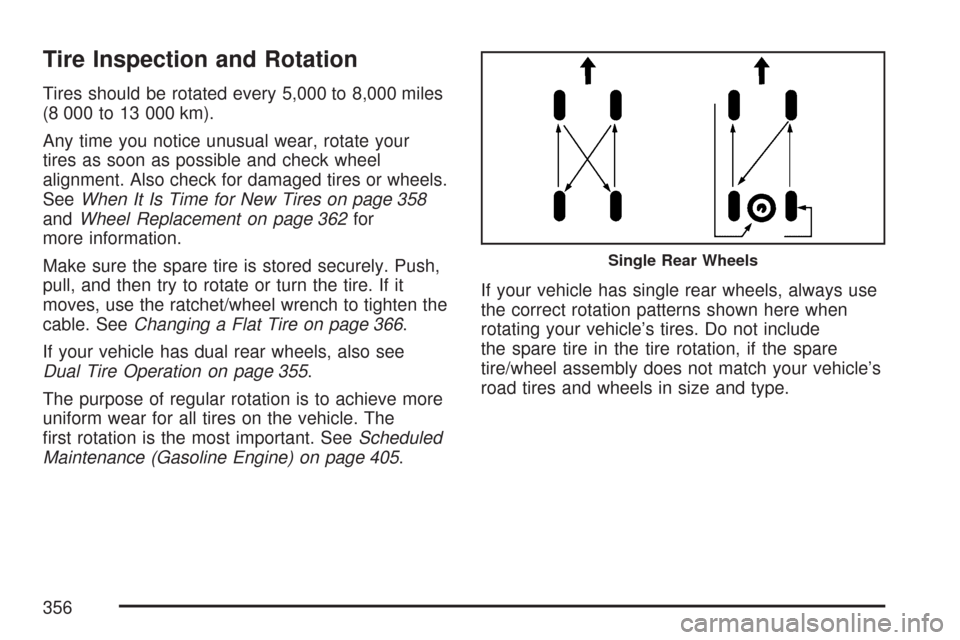
Maintenance (Gasoline Engine) on page 405.If your vehicle has single rear wheels, always use
the correct rotation patterns shown here when
rotating your vehicle’s tires. Do not include
the spare tire in the tire rotation, if the spare
tire/wheel assembly does not match your vehicle’s
road tires and wheels in size and type.
Single Rear Wheels
356
Page 364 of 458
Tire Chains
{CAUTION:
If your vehicle has dual wheels or
P245/75R16 or LT245/75R16 size tires,
do not use tire chains. They can damage
your vehicle because there is not
enough clearance. Tire chains used on
a vehicle without the proper amount of
clearance can cause damage to the brakes,
suspension, or other vehicle parts. The
area damaged by the tire chains could
cause you to lose control of your vehicle
and you or others may be injured in
a crash.
Use another type of traction device only
if its manufacturer recommends it for
use on your vehicle and tire size
combination and road conditions.
Follow that manufacturer’s instructions.
CAUTION: (Continued)
CAUTION: (Continued)
To help avoid damage to your vehicle,
drive slowly, readjust, or remove the
device if it is contacting your vehicle,
and do not spin the vehicle’s wheels.
If you do nd traction devices that will t,
install them on the rear tires.
Notice:If your vehicle does not have
dual wheels and has a tire size other than
P245/75R16 or LT245/75R16, use tire chains
only where legal and only when you must.
Use chains that are the proper size for your
tires. Install them on the tires of the rear axle.
Do not use chains on the tires of the front axle.
Tighten them as tightly as possible with the
ends securely fastened. Drive slowly and follow
the chain manufacturer’s instructions. If you
can hear the chains contacting your vehicle,
stop and retighten them. If the contact
continues, slow down until it stops. Driving
too fast or spinning the wheels with chains on
will damage your vehicle.
364
Page 367 of 458
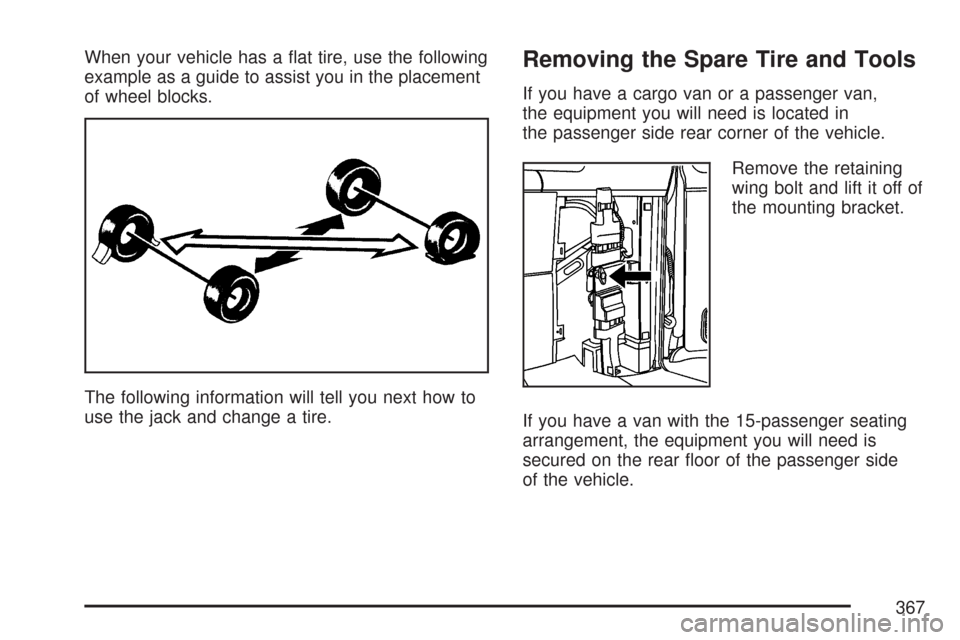
When your vehicle has a flat tire, use the following
example as a guide to assist you in the placement
of wheel blocks.
The following information will tell you next how to
use the jack and change a tire.Removing the Spare Tire and Tools
If you have a cargo van or a passenger van,
the equipment you will need is located in
the passenger side rear corner of the vehicle.
Remove the retaining
wing bolt and lift it off of
the mounting bracket.
If you have a van with the 15-passenger seating
arrangement, the equipment you will need is
secured on the rear floor of the passenger side
of the vehicle.
367
Page 381 of 458
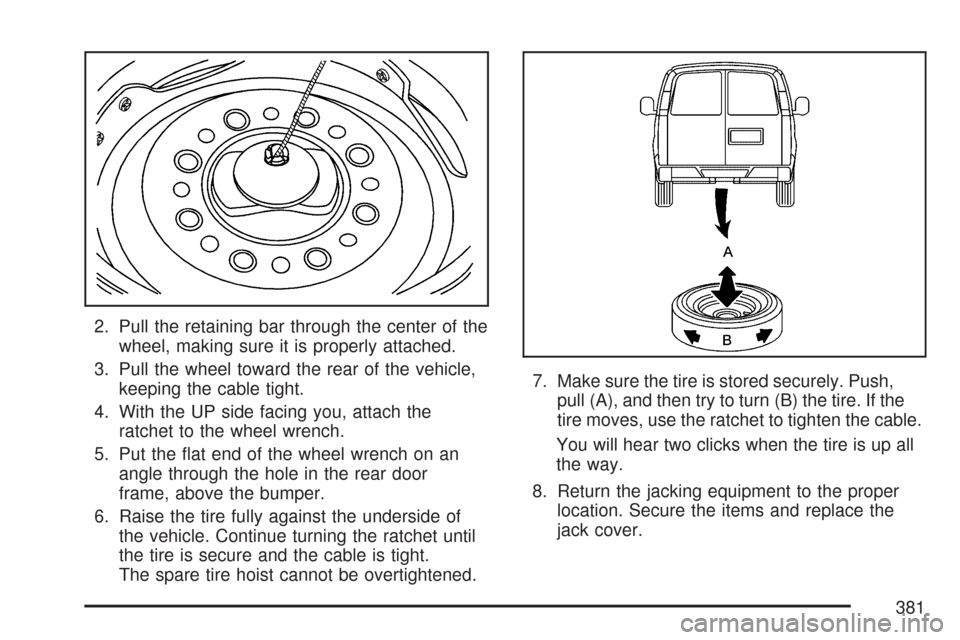
2. Pull the retaining bar through the center of the
wheel, making sure it is properly attached.
3. Pull the wheel toward the rear of the vehicle,
keeping the cable tight.
4. With the UP side facing you, attach the
ratchet to the wheel wrench.
5. Put the flat end of the wheel wrench on an
angle through the hole in the rear door
frame, above the bumper.
6. Raise the tire fully against the underside of
the vehicle. Continue turning the ratchet until
the tire is secure and the cable is tight.
The spare tire hoist cannot be overtightened.7. Make sure the tire is stored securely. Push,
pull (A), and then try to turn (B) the tire. If the
tire moves, use the ratchet to tighten the cable.
You will hear two clicks when the tire is up all
the way.
8. Return the jacking equipment to the proper
location. Secure the items and replace the
jack cover.
381