Page 336 of 458
All-Wheel Drive
Lubricant checks in this section also apply to
these vehicles. However, there are two additional
systems that need lubrication.
Transfer Case
When to Check Lubricant
Refer to the Maintenance Schedule to determine
how often to check the lubricant. SeeScheduled
Maintenance (Gasoline Engine) on page 405.
How to Check Lubricant
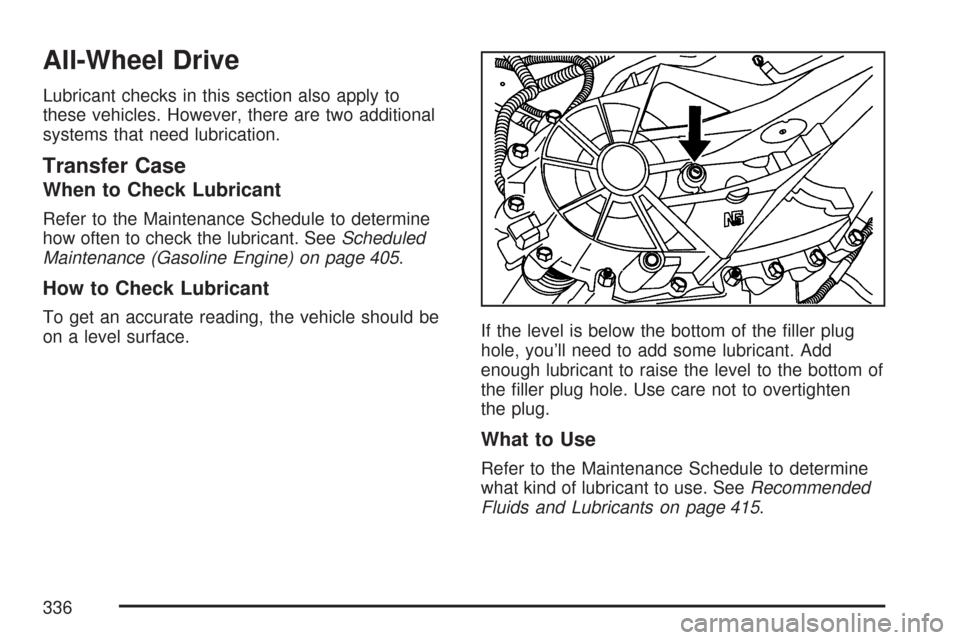
To get an accurate reading, the vehicle should be
on a level surface.If the level is below the bottom of the filler plug
hole, you’ll need to add some lubricant. Add
enough lubricant to raise the level to the bottom of
the filler plug hole. Use care not to overtighten
the plug.
What to Use
Refer to the Maintenance Schedule to determine
what kind of lubricant to use. SeeRecommended
Fluids and Lubricants on page 415.
336
Page 337 of 458
Rear Axle
When to Check Lubricant
Refer to the Maintenance Schedule to determine
how often to check the lubricant. SeeScheduled
Maintenance (Gasoline Engine) on page 405.
How to Check Lubricant
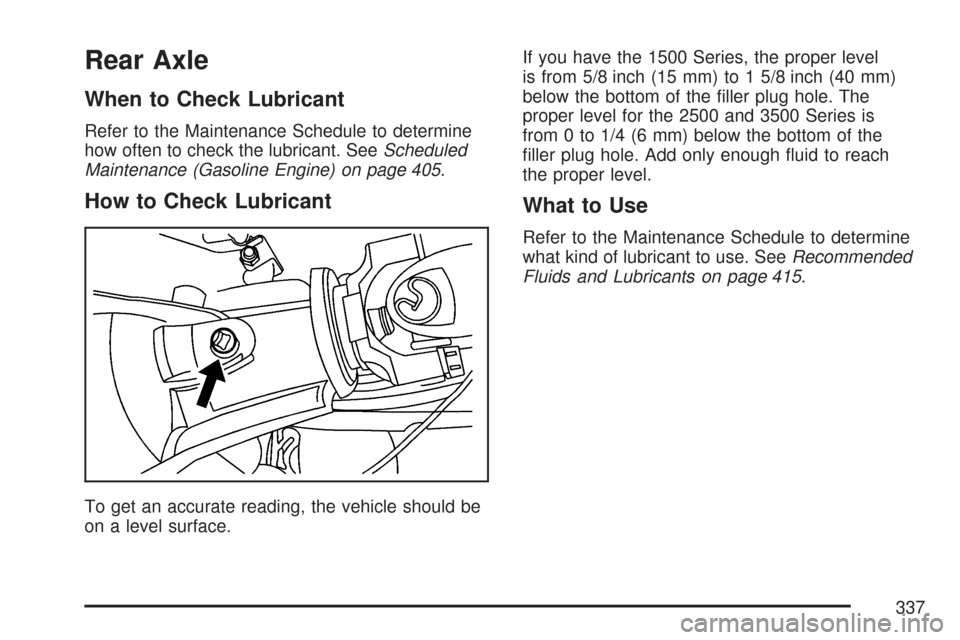
To get an accurate reading, the vehicle should be
on a level surface.If you have the 1500 Series, the proper level
is from 5/8 inch (15 mm) to 1 5/8 inch (40 mm)
below the bottom of the filler plug hole. The
proper level for the 2500 and 3500 Series is
from 0 to 1/4 (6 mm) below the bottom of the
filler plug hole. Add only enough fluid to reach
the proper level.
What to Use
Refer to the Maintenance Schedule to determine
what kind of lubricant to use. SeeRecommended
Fluids and Lubricants on page 415.
337
Page 338 of 458
Front Axle
When to Check and Change Lubricant
Refer to the Maintenance Schedule to determine
how often to check the lubricant and when
to change it. SeeScheduled Maintenance
(Gasoline Engine) on page 405.
How to Check Lubricant
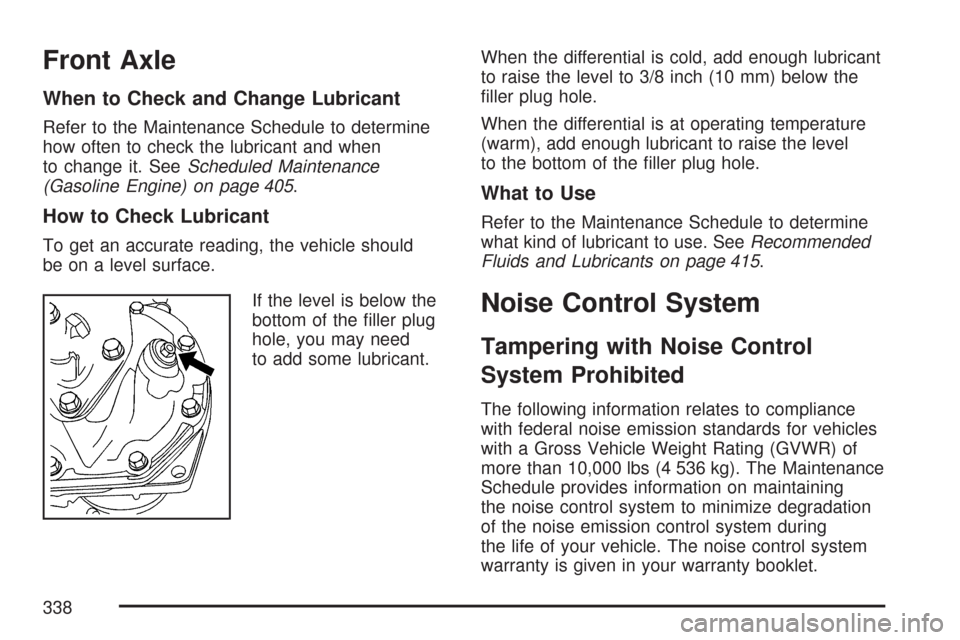
To get an accurate reading, the vehicle should
be on a level surface.
If the level is below the
bottom of the filler plug
hole, you may need
to add some lubricant.When the differential is cold, add enough lubricant
to raise the level to 3/8 inch (10 mm) below the
filler plug hole.
When the differential is at operating temperature
(warm), add enough lubricant to raise the level
to the bottom of the filler plug hole.
What to Use
Refer to the Maintenance Schedule to determine
what kind of lubricant to use. SeeRecommended
Fluids and Lubricants on page 415.
Noise Control System
Tampering with Noise Control
System Prohibited
The following information relates to compliance
with federal noise emission standards for vehicles
with a Gross Vehicle Weight Rating (GVWR) of
more than 10,000 lbs (4 536 kg). The Maintenance
Schedule provides information on maintaining
the noise control system to minimize degradation
of the noise emission control system during
the life of your vehicle. The noise control system
warranty is given in your warranty booklet.
338
Page 355 of 458
Radial tires may look properly inflated even when
they’re underinflated. Check the tire’s inflation
pressure when the tires are cold. Cold means your
vehicle has been sitting for at least three hours
or driven no more than 1 mile (1.6 km).
Remove the valve cap from the tire valve stem.
Press the tire gage firmly onto the valve to
get a pressure measurement. If the cold tire
inflation pressure matches the recommended
pressure on the tire and loading information label,
no further adjustment is necessary. If the
pressure is low, add air until you reach the
recommended amount.
If you overfill the tire, release air by pushing on
the metal stem in the center of the tire valve.
Recheck the tire pressure with the tire gage.
Be sure to put the valve caps back on the valve
stems. They help prevent leaks by keeping out
dirt and moisture.
Dual Tire Operation
When the vehicle is new, or whenever a wheel,
wheel bolt or wheel nut is replaced, check
the wheel nut torque after 100, 1,000 and
6,000 miles (160, 1 600 and 10 000 km) of driving.For proper wheel nut tightening information, see
“Removing the Flat Tire and Installing the Spare
Tire” later in this section, underChanging a Flat
Tire on page 366. Also see “Wheel Nut Torque”
underCapacities and Specications on page 398.
The outer tire on a dual wheel setup generally
wears faster than the inner tire. Your tires will wear
more evenly and last longer if you rotate the
tires periodically. SeeTire Inspection and Rotation
on page 356. Also seeScheduled Maintenance
(Gasoline Engine) on page 405.
{CAUTION:
If you operate your vehicle with a tire
that is badly underinated, the tire can
overheat. An overheated tire can lose
air suddenly or catch re. You or
others could be injured. Be sure all tires
(including the spare) are properly inated.
SeeTires on page 346andInation - Tire
Pressure on page 354for more information on
proper tire inflation.
355
Page 356 of 458
Tire Inspection and Rotation
Tires should be rotated every 5,000 to 8,000 miles
(8 000 to 13 000 km).
Any time you notice unusual wear, rotate your
tires as soon as possible and check wheel
alignment. Also check for damaged tires or wheels.
SeeWhen It Is Time for New Tires on page 358
andWheel Replacement on page 362for
more information.
Make sure the spare tire is stored securely. Push,
pull, and then try to rotate or turn the tire. If it
moves, use the ratchet/wheel wrench to tighten the
cable. SeeChanging a Flat Tire on page 366.
If your vehicle has dual rear wheels, also see
Dual Tire Operation on page 355.
The purpose of regular rotation is to achieve more
uniform wear for all tires on the vehicle. The
first rotation is the most important. SeeScheduled
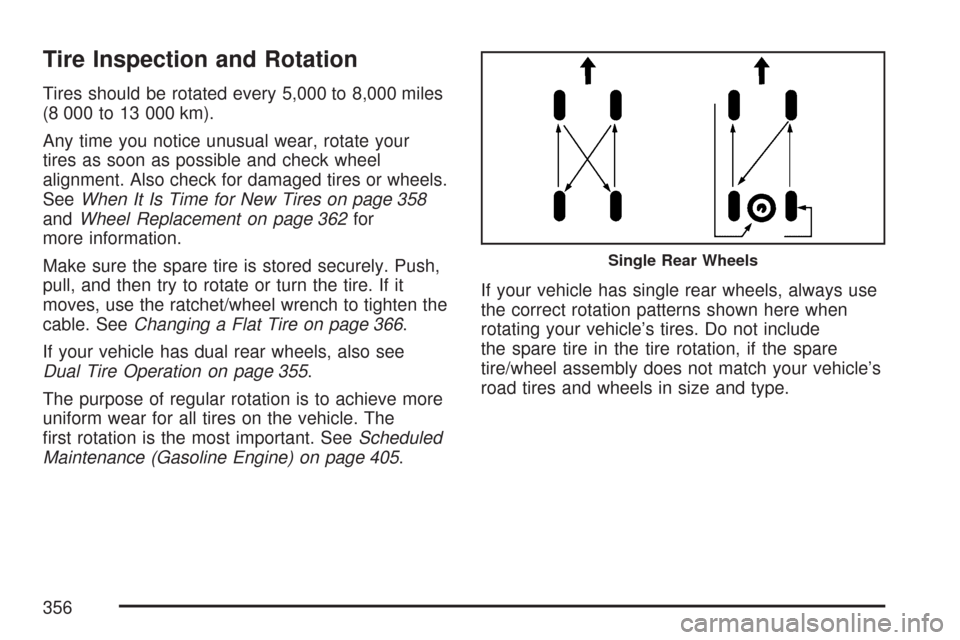
Maintenance (Gasoline Engine) on page 405.If your vehicle has single rear wheels, always use
the correct rotation patterns shown here when
rotating your vehicle’s tires. Do not include
the spare tire in the tire rotation, if the spare
tire/wheel assembly does not match your vehicle’s
road tires and wheels in size and type.
Single Rear Wheels
356
Page 393 of 458
Electrical System
Add-On Electrical Equipment
Notice:Do not add anything electrical to your
vehicle unless you check with your dealer
rst. Some electrical equipment can damage
your vehicle and the damage would not
be covered by your warranty. Some add-on
electrical equipment can keep other
components from working as they should.
Your vehicle has an air bag system. Before
attempting to add anything electrical to your
vehicle, seeServicing Your Airbag-Equipped
Vehicle on page 96.
Headlamp Wiring
The headlamp wiring is protected by fuses in the
engine compartment fuse block. An electrical
overload will cause the lamps to flicker on and off,
or in some cases to remain off. If this happens,
have your headlamp wiring checked right away.
Windshield Wiper Fuses
The windshield wiper motor is protected by a
circuit breaker and a fuse. If the motor overheats
due to heavy snow, etc., the wiper will stop
until the motor cools. Although the circuit is
protected from electrical overload, overload due
to heavy snow, etc., may cause wiper linkage
damage. Always clear ice and heavy snow from
the windshield before using the windshield wipers.
If the overload is caused by some electrical
problem and not snow, etc., be sure to get it fixed.
Fuses and Circuit Breakers
The wiring circuits in your vehicle are protected
from short circuits by a combination of fuses
and circuit breakers. This greatly reduces
the chance of fires caused by electrical problems.
Look at the silver-colored band inside the fuse.
If the band is broken or melted, replace the fuse.
Be sure you replace a bad fuse with a new
one of the identical size and rating.
393
Page 399 of 458
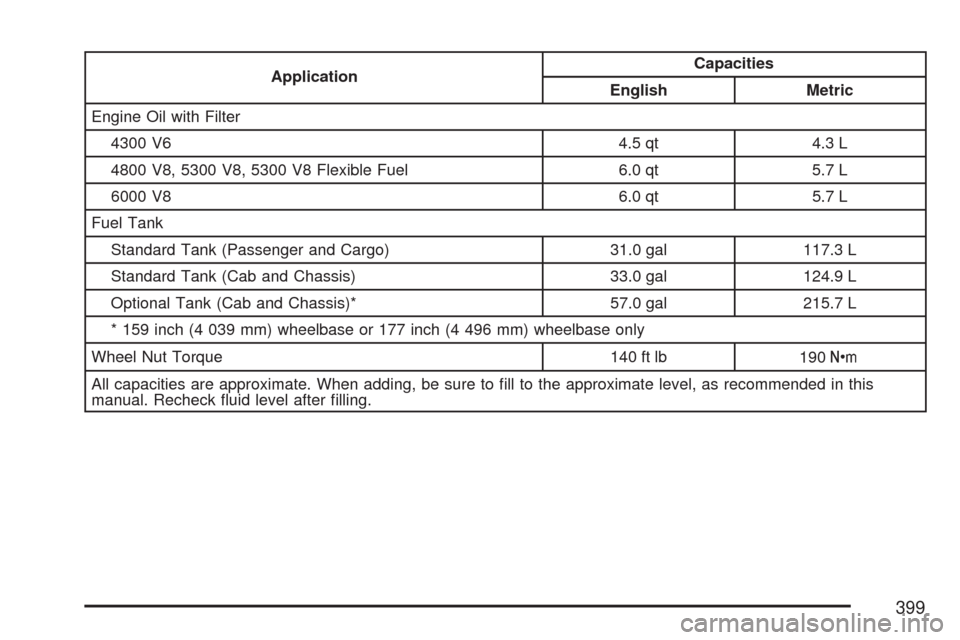
ApplicationCapacities
English Metric
Engine Oil with Filter
4300 V6 4.5 qt 4.3 L
4800 V8, 5300 V8, 5300 V8 Flexible Fuel 6.0 qt 5.7 L
6000 V8 6.0 qt 5.7 L
Fuel Tank
Standard Tank (Passenger and Cargo) 31.0 gal 117.3 L
Standard Tank (Cab and Chassis) 33.0 gal 124.9 L
Optional Tank (Cab and Chassis)* 57.0 gal 215.7 L
* 159 inch (4 039 mm) wheelbase or 177 inch (4 496 mm) wheelbase only
Wheel Nut Torque 140 ft lb
190Y
All capacities are approximate. When adding, be sure to fill to the approximate level, as recommended in this
manual. Recheck fluid level after filling.
399
Page 401 of 458
Maintenance Schedule................................ 402
Introduction............................................... 402
Maintenance Requirements........................ 402
Your Vehicle and the Environment............ 402
Using the Maintenance Schedule............... 403
Scheduled Maintenance
(Gasoline Engine).................................. 405
Additional Required Services
(Gasoline Engine).................................. 408
Maintenance Footnotes
(Gasoline Engine).................................. 409Owner Checks and Services..................... 411
At the First 100, 1,000 and 6,000 Miles
(160, 1 600 and 10 000 km).................. 411
At Each Fuel Fill....................................... 412
At Least Once a Month............................. 412
At Least Once a Year............................... 413
Recommended Fluids and Lubricants........ 415
Normal Maintenance
Replacement Parts................................. 417
Engine Drive Belt Routing......................... 418
Maintenance Record.................................. 419
Section 6 Maintenance Schedule
401