2007 CHEVROLET EXPRESS CARGO VAN heating
[x] Cancel search: heatingPage 282 of 458
Driving with a Trailer
{CAUTION:
If you have a rear-most window open and
you pull a trailer with your vehicle, carbon
monoxide (CO) could come into your
vehicle. You can not see or smell CO. It
can cause unconsciousness or death. See
Engine Exhaust on page 132. To maximize
your safety when towing a trailer:
Have your exhaust system inspected
for leaks, and make necessary repairs
before starting on your trip.
Keep the rear-most windows closed.
If exhaust does come into your vehicle
through a window in the rear or another
opening, drive with your front, main
heating or cooling system on and with
the fan on any speed. This will bring
fresh, outside air into your vehicle.
CAUTION: (Continued)
CAUTION: (Continued)
Do not use the climate control
setting for maximum air because it
only recirculates the air inside your
vehicle. See Climate Control System
in the Index.
Towing a trailer requires a certain amount of
experience. Before setting out for the open road,
you’ll want to get to know your rig. Acquaint
yourself with the feel of handling and braking with
the added weight of the trailer. And always
keep in mind that the vehicle you are driving is
now a good deal longer and not nearly as
responsive as your vehicle is by itself.
Before you start, check all trailer hitch parts and
attachments, safety chains, electrical connector,
lamps, tires and mirror adjustment. If the trailer has
electric brakes, start your vehicle and trailer
moving and then apply the trailer brake controller
by hand to be sure the brakes are working.
This lets you check your electrical connection at
the same time.
282
Page 284 of 458
Turn Signals When Towing a Trailer
When you tow a trailer, your vehicle has to have
extra wiring and a heavy-duty turn signal
flasher (included in the optional trailering package).
The arrows on your instrument panel will flash
whenever you signal a turn or lane change.
Properly hooked up, the trailer lamps will also
flash, telling other drivers you’re about to
turn, change lanes or stop.
When towing a trailer, the arrows on your
instrument panel will flash for turns even if the bulbs
on the trailer are burned out. Thus, you may think
drivers behind you are seeing your signal when
they are not. It’s important to check occasionally to
be sure the trailer bulbs are still working.
Driving On Grades
Reduce speed and shift to a lower gearbefore
you start down a long or steep downgrade. If you
don’t shift down, you might have to use your
brakes so much that they would get hot and no
longer work well.
You can tow in DRIVE (D). You may want to shift
the transmission to THIRD (3) or a lower gear
under heavy loads and/or hilly conditions.
When towing at high altitude on steep uphill
grades, consider the following: Engine coolant will
boil at a lower temperature than at normal
altitudes. If you turn your engine off immediately
after towing at high altitude on steep uphill grades,
your vehicle may show signs similar to engine
overheating. To avoid this, let the engine run while
parked (preferably on level ground) with the
automatic transmission in PARK (P) for a few
minutes before turning the engine off. If you do get
the overheat warning, seeEngine Overheating
on page 315.
284
Page 287 of 458
Service........................................................ 290
Accessories and Modifications................... 290
California Proposition 65 Warning.............. 291
Doing Your Own Service Work.................. 291
Adding Equipment to the Outside of
Your Vehicle.......................................... 292
Fuel............................................................. 292
Gasoline Octane........................................ 293
Gasoline Specifications.............................. 293
California Fuel........................................... 293
Additives................................................... 294
Fuel E85 (85% Ethanol)............................ 295
Fuels in Foreign Countries........................ 296
Filling the Tank......................................... 297
Filling a Portable Fuel Container............... 299
Checking Things Under the Hood.............. 300
Hood Release........................................... 300
Engine Compartment Overview.................. 302
Engine Oil (Gasoline Engine).................... 303
Engine Oil Life System
(Gasoline Engine).................................. 306
Engine Air Cleaner/Filter............................ 308
Automatic Transmission Fluid.................... 309
Engine Coolant.......................................... 312Radiator Pressure Cap.............................. 315
Engine Overheating................................... 315
Cooling System......................................... 317
Engine Fan Noise..................................... 323
Power Steering Fluid................................. 323
Windshield Washer Fluid........................... 324
Brakes...................................................... 325
Battery...................................................... 329
Jump Starting............................................ 330
All-Wheel Drive........................................... 336
Rear Axle.................................................... 337
Front Axle................................................... 338
Noise Control System................................. 338
Tampering with Noise Control System
Prohibited.............................................. 338
Bulb Replacement....................................... 340
Halogen Bulbs........................................... 340
Headlamps................................................ 340
Front Turn Signal, Sidemarker and
Parking Lamps....................................... 342
Center High-Mounted Stoplamp (CHMSL) ... 342
Taillamps................................................... 343
Replacement Bulbs................................... 344
Section 5 Service and Appearance Care
287
Page 312 of 458
How to Add Automatic
Transmission Fluid
Refer to the Maintenance Schedule to determine
what kind of transmission fluid to use. See
Recommended Fluids and Lubricants on page 415.
Using a funnel, add fluid down the transmission
dipstick tube only after checking the transmission
fluid while it is hot. A cold check is used only
as a reference. If the fluid level is low, add only
enough of the proper fluid to bring the level up to
the HOT area for a hot check. It does not take
much fluid, generally less than one pint (0.5 L).
Do not overfill.
Notice:Use of the incorrect automatic
transmission uid may damage your vehicle,
and the damages may not be covered by
your warranty. Always use the automatic
transmission uid listed inRecommended
Fluids and Lubricants on page 415.
•After adding fluid, recheck the fluid level as
described under “How to Check Automatic
Transmission Fluid,” earlier in this section.
•When the correct fluid level is obtained, push
the dipstick back in all the way; then flip the
handle down to lock the dipstick in place.
Engine Coolant
If your vehicle has the DURAMAX®Diesel engine,
see the DURAMAX®Diesel manual for more
information.
The cooling system in your vehicle is filled with
DEX-COOL
®engine coolant. This coolant is
designed to remain in your vehicle for five years
or 150,000 miles (240 000 km), whichever
occurs first, if you add only DEX-COOL
®
extended life coolant.
The following explains your cooling system and
how to add coolant when it is low. If you have
a problem with engine overheating, seeEngine
Overheating on page 315.
A 50/50 mixture of clean, drinkable water and
DEX-COOL
®coolant will:
•Give freezing protection down to−34°F (−37°C).
•Give boiling protection up to 265°F (129°C).
•Protect against rust and corrosion.
•Help keep the proper engine temperature.
•Let the warning lights and gages work as
they should.
312
Page 315 of 458
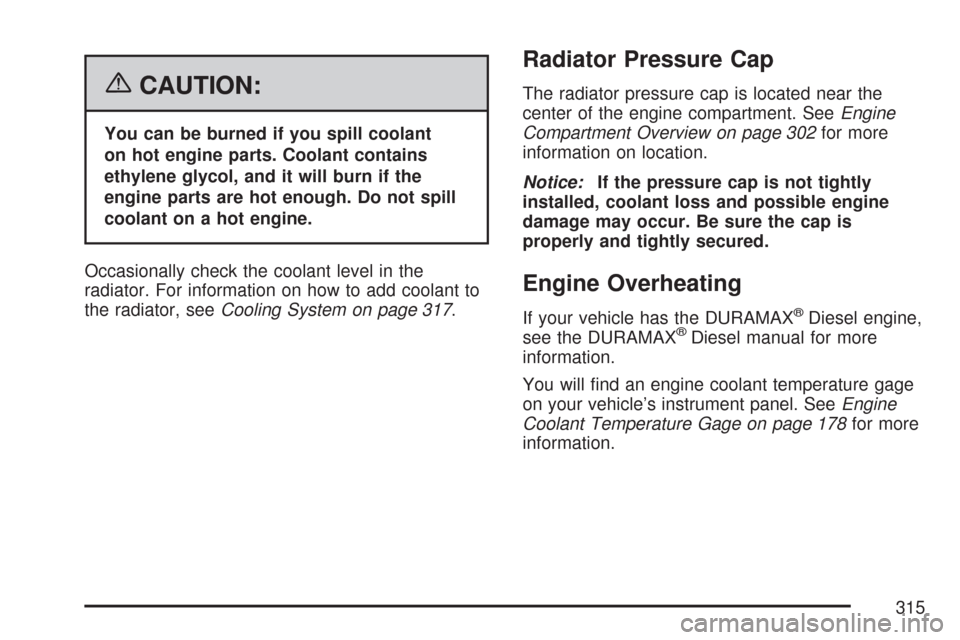
{CAUTION:
You can be burned if you spill coolant
on hot engine parts. Coolant contains
ethylene glycol, and it will burn if the
engine parts are hot enough. Do not spill
coolant on a hot engine.
Occasionally check the coolant level in the
radiator. For information on how to add coolant to
the radiator, seeCooling System on page 317.
Radiator Pressure Cap
The radiator pressure cap is located near the
center of the engine compartment. SeeEngine
Compartment Overview on page 302for more
information on location.
Notice:If the pressure cap is not tightly
installed, coolant loss and possible engine
damage may occur. Be sure the cap is
properly and tightly secured.
Engine Overheating
If your vehicle has the DURAMAX®Diesel engine,
see the DURAMAX®Diesel manual for more
information.
You will find an engine coolant temperature gage
on your vehicle’s instrument panel. SeeEngine
Coolant Temperature Gage on page 178for more
information.
315
Page 346 of 458
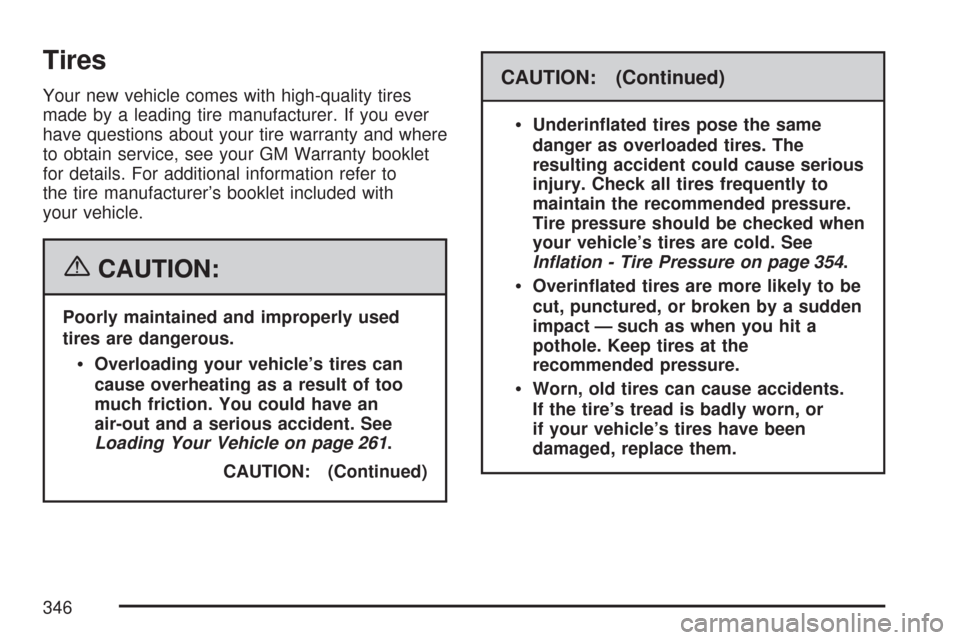
Tires
Your new vehicle comes with high-quality tires
made by a leading tire manufacturer. If you ever
have questions about your tire warranty and where
to obtain service, see your GM Warranty booklet
for details. For additional information refer to
the tire manufacturer’s booklet included with
your vehicle.
{CAUTION:
Poorly maintained and improperly used
tires are dangerous.
Overloading your vehicle’s tires can
cause overheating as a result of too
much friction. You could have an
air-out and a serious accident. See
Loading Your Vehicle on page 261.
CAUTION: (Continued)
CAUTION: (Continued)
Underinated tires pose the same
danger as overloaded tires. The
resulting accident could cause serious
injury. Check all tires frequently to
maintain the recommended pressure.
Tire pressure should be checked when
your vehicle’s tires are cold. See
Inflation - Tire Pressure on page 354.
Overinated tires are more likely to be
cut, punctured, or broken by a sudden
impact — such as when you hit a
pothole. Keep tires at the
recommended pressure.
Worn, old tires can cause accidents.
If the tire’s tread is badly worn, or
if your vehicle’s tires have been
damaged, replace them.
346
Page 447 of 458
Capacities and Specifications...................... 398
Carbon Monoxide......................132, 256, 269
Care of
Safety Belts............................................. 385
Your Cassette Tape Player....................... 224
Your CD Player........................................ 226
Your CDs ................................................. 225
Cargo Door Relocking................................. 109
Center High-Mounted Stoplamp (CHMSL).... 342
Center Passenger Position, Safety
Belts................................................... 33, 34
Chains, Tire................................................. 364
Charging System Light................................ 174
Check
Engine Light............................................ 178
Gages Warning Light............................... 185
Checking Things Under the Hood................ 300
Chemical Paint Spotting.............................. 390
Child Restraints
Child Restraint Systems............................. 47
Infants and Young Children........................ 44
Lower Anchors and Tethers for Children..... 54
Older Children........................................... 41
Securing a Child Restraint in a Center
Seat Position.......................................... 66Child Restraints (cont.)
Securing a Child Restraint in a Rear
Outside Seat Position or the Second
Row Center Seat Position...................... 63
Securing a Child Restraint in the Right
Front Seat Position.......................... 68, 72
Where to Put the Restraint........................ 52
Chime Level Adjustment.............................. 226
Cigarette Lighter.......................................... 159
Cleaning
Aluminum Wheels.................................... 388
Exterior Lamps/Lenses............................. 386
Fabric/Carpet........................................... 384
Finish Care.............................................. 386
Inside of Your Vehicle.............................. 382
Instrument Panel, Vinyl, and Other Plastic
Surfaces............................................... 385
Tires........................................................ 389
Underbody Maintenance........................... 390
Washing Your Vehicle.............................. 386
Weatherstrips........................................... 385
Windshield and Wiper Blades................... 387
Climate Control System............................... 160
Outlet Adjustment..................................... 162
Rear Air Conditioning and Heating
System................................................. 164
Rear Heating System............................... 163
447
Page 449 of 458
Driving
At Night................................................... 244
City.......................................................... 249
Defensive................................................. 228
Drunken................................................... 229
Freeway................................................... 250
Hill and Mountain Roads.......................... 254
In Rain and on Wet Roads...................... 246
Rocking Your Vehicle to Get it Out.......... 260
Winter...................................................... 256
Dual Tire Operation..................................... 355
E
EDR ............................................................ 441
Electrical System
Add-On Equipment................................... 393
Engine Compartment Fuse Block............. 395
Floor Console Fuse Block........................ 394
Fuses and Circuit Breakers...................... 393
Headlamp Wiring..................................... 393
Windshield Wiper Fuses........................... 393
Engine
Air Cleaner/Filter...................................... 308
Change Engine Oil Light.......................... 183
Check and Service Engine Soon Light..... 178
Coolant.................................................... 312Engine (cont.)
Coolant Heater......................................... 123
Coolant Temperature Gage...................... 178
Drive Belt Routing.................................... 418
Engine Compartment Overview................ 302
Exhaust................................................... 132
Fan Noise................................................ 323
Fuel Regulator......................................... 123
Oil ........................................................... 303
Oil Life System........................................ 306
Overheating............................................. 315
Reduced Power Light............................... 184
Running While Parked............................. 133
Starting.................................................... 122
Entry Lighting.............................................. 158
Event Data Recorders................................. 442
Exit Lighting................................................ 158
Extender, Safety Belt..................................... 40
Exterior Lamps............................................ 155
F
Filter
Engine Air Cleaner................................... 308
Finish Damage............................................ 389
Fixed Mast Antenna.................................... 226
Flashers, Hazard Warning........................... 146
449