Page 334 of 492
California Proposition 65 Warning
Most motor vehicles, including this one, contain
and/or emit chemicals known to the State of
California to cause cancer and birth defects or other
reproductive harm. Engine exhaust, many parts and
systems (including some inside the vehicle), many
uids, and some component wear by-products
contain and/or emit these chemicals.
Doing Your Own Service Work
{CAUTION:
You can be injured and your vehicle could
be damaged if you try to do service work
on a vehicle without knowing enough
about it.
Be sure you have sufficient knowledge,
experience, the proper replacement
parts, and tools before you attempt any
vehicle maintenance task.
CAUTION: (Continued)
CAUTION: (Continued)
Be sure to use the proper nuts, bolts,
and other fasteners. English and metric
fasteners can be easily confused. If you
use the wrong fasteners, parts can later
break or fall off. You could be hurt.
If you want to do some of your own service work,
you will want to use the proper service manual.
It tells you much more about how to service your
vehicle than this manual can. To order the
proper service manual, seeService Publications
Ordering Information on page 475.
Your vehicle has an airbag system. Before
attempting to do your own service work, see
Servicing Your Airbag-Equipped Vehicle on
page 88.
You should keep a record with all parts receipts
and list the mileage and the date of any service
work you perform. SeeMaintenance Record
on page 451.
334
Page 343 of 492
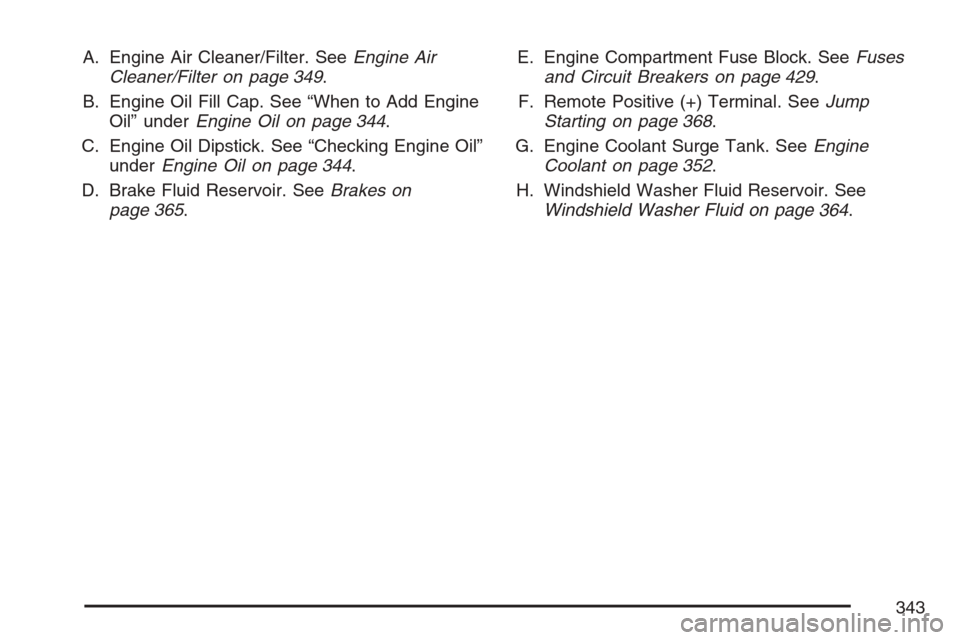
A. Engine Air Cleaner/Filter. SeeEngine Air
Cleaner/Filter on page 349.
B. Engine Oil Fill Cap. See “When to Add Engine
Oil” underEngine Oil on page 344.
C. Engine Oil Dipstick. See “Checking Engine Oil”
underEngine Oil on page 344.
D. Brake Fluid Reservoir. SeeBrakes on
page 365.E. Engine Compartment Fuse Block. SeeFuses
and Circuit Breakers on page 429.
F. Remote Positive (+) Terminal. SeeJump
Starting on page 368.
G. Engine Coolant Surge Tank. SeeEngine
Coolant on page 352.
H. Windshield Washer Fluid Reservoir. See
Windshield Washer Fluid on page 364.
343
Page 370 of 492
3. Turn off the ignition on both vehicles. Unplug
unnecessary accessories plugged into the
cigarette lighter or the accessory power outlet.
Turn off the radio and all lamps that are not
needed. This will avoid sparks and help save
both batteries. And it could save your radio!
4. Open the hoods and locate the positive (+)
and negative (−) terminal locations on each
vehicle.
You will not need to access your battery for
jump starting. Your vehicle has a remote
positive (+) and a remote negative (−) jump
starting terminal for that purpose.
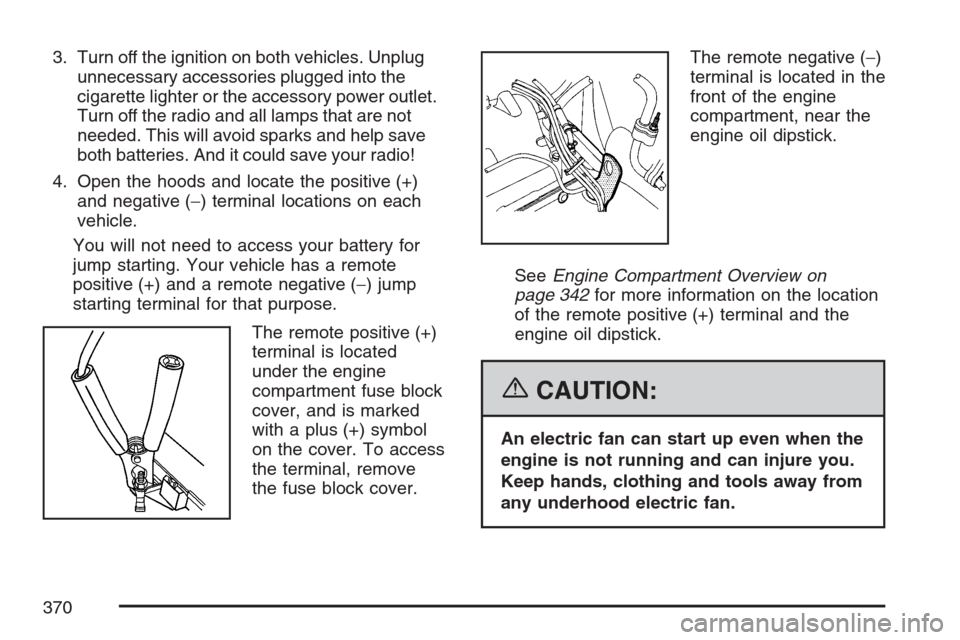
The remote positive (+)
terminal is located
under the engine
compartment fuse block
cover, and is marked
with a plus (+) symbol
on the cover. To access
the terminal, remove
the fuse block cover.The remote negative (−)
terminal is located in the
front of the engine
compartment, near the
engine oil dipstick.
SeeEngine Compartment Overview on
page 342for more information on the location
of the remote positive (+) terminal and the
engine oil dipstick.
{CAUTION:
An electric fan can start up even when the
engine is not running and can injure you.
Keep hands, clothing and tools away from
any underhood electric fan.
370
Page 373 of 492
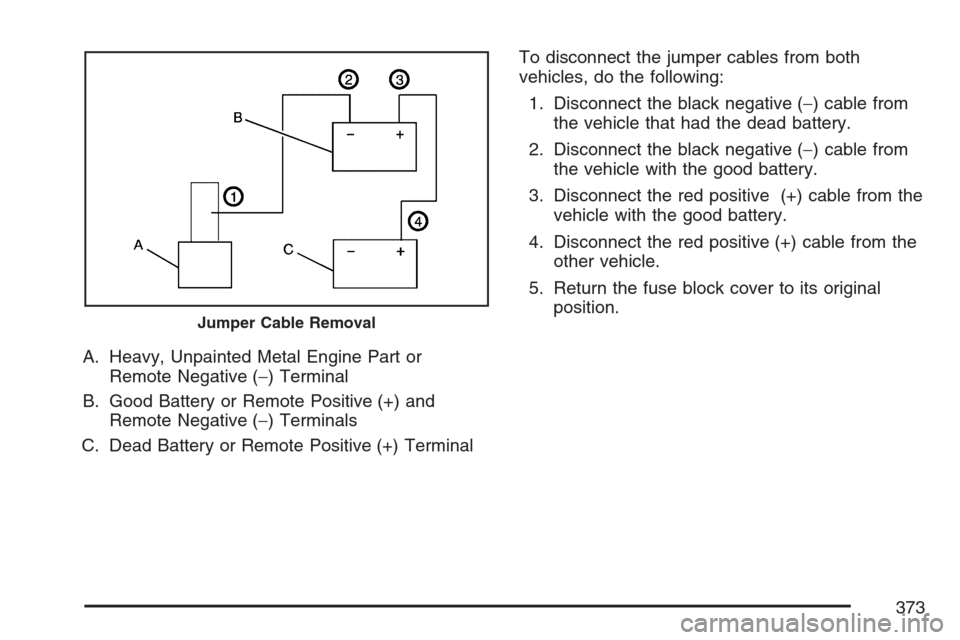
A. Heavy, Unpainted Metal Engine Part or
Remote Negative (−) Terminal
B. Good Battery or Remote Positive (+) and
Remote Negative (−) Terminals
C. Dead Battery or Remote Positive (+) TerminalTo disconnect the jumper cables from both
vehicles, do the following:
1. Disconnect the black negative (−) cable from
the vehicle that had the dead battery.
2. Disconnect the black negative (−) cable from
the vehicle with the good battery.
3. Disconnect the red positive (+) cable from the
vehicle with the good battery.
4. Disconnect the red positive (+) cable from the
other vehicle.
5. Return the fuse block cover to its original
position.
Jumper Cable Removal
373
Page 429 of 492
Windshield Wiper Fuses
The windshield wiper motor is protected by a
circuit breaker and a fuse. If the motor overheats
due to heavy snow or ice, the wiper will stop
until the motor cools. If the overload is caused by
some electrical problem, have it xed.
Fuses and Circuit Breakers
The wiring circuits in your vehicle are protected
from short circuits by fuses and circuit breakers.
This greatly reduces the chance of circuit overload
and re caused by electrical problems.
Your vehicle has an underhood fuse block and an
instrument panel fuse block.
To identify and check fuses, circuit breakers, and
relays, refer to the Fuse Usage Chart on the
inside surface of the fuse panel door.
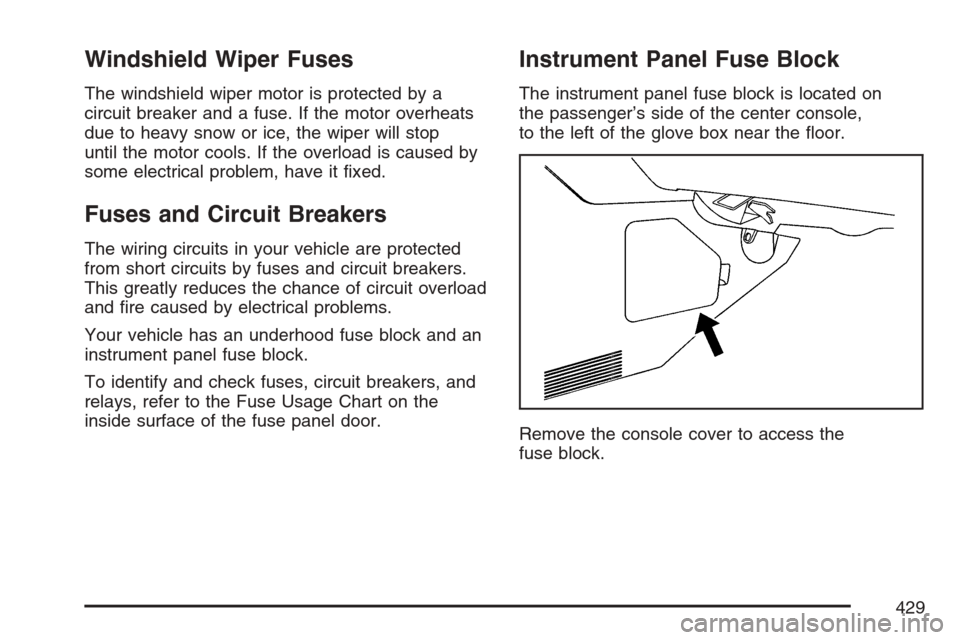
Instrument Panel Fuse Block
The instrument panel fuse block is located on
the passenger’s side of the center console,
to the left of the glove box near the oor.
Remove the console cover to access the
fuse block.
429
Page 430 of 492
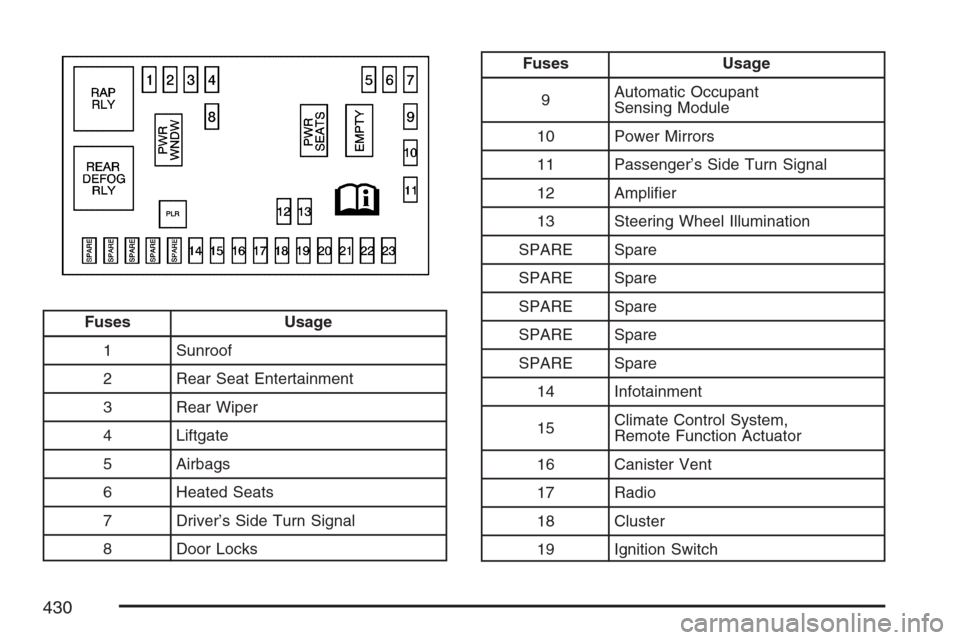
Fuses Usage
1 Sunroof
2 Rear Seat Entertainment
3 Rear Wiper
4 Liftgate
5 Airbags
6 Heated Seats
7 Driver’s Side Turn Signal
8 Door Locks
Fuses Usage
9Automatic Occupant
Sensing Module
10 Power Mirrors
11 Passenger’s Side Turn Signal
12 Amplier
13 Steering Wheel Illumination
SPARE Spare
SPARE Spare
SPARE Spare
SPARE Spare
SPARE Spare
14 Infotainment
15Climate Control System,
Remote Function Actuator
16 Canister Vent
17 Radio
18 Cluster
19 Ignition Switch
430
Page 431 of 492
Fuses Usage
20 Body Control Module
21 OnStar
®
22Center High-Mounted Stoplamp,
Dimmer
23 Interior Lights
Relays Usage
RAP RLY Retained Accessory Power Relay
REAR
DEFOG RLYRear Defogger Relay
Circuit
Breakers Usage
PWR WNDW Power Windows
PWR SEATS Power Seats
EMPTY Empty
Misc. Usage
PLR Fuse Puller
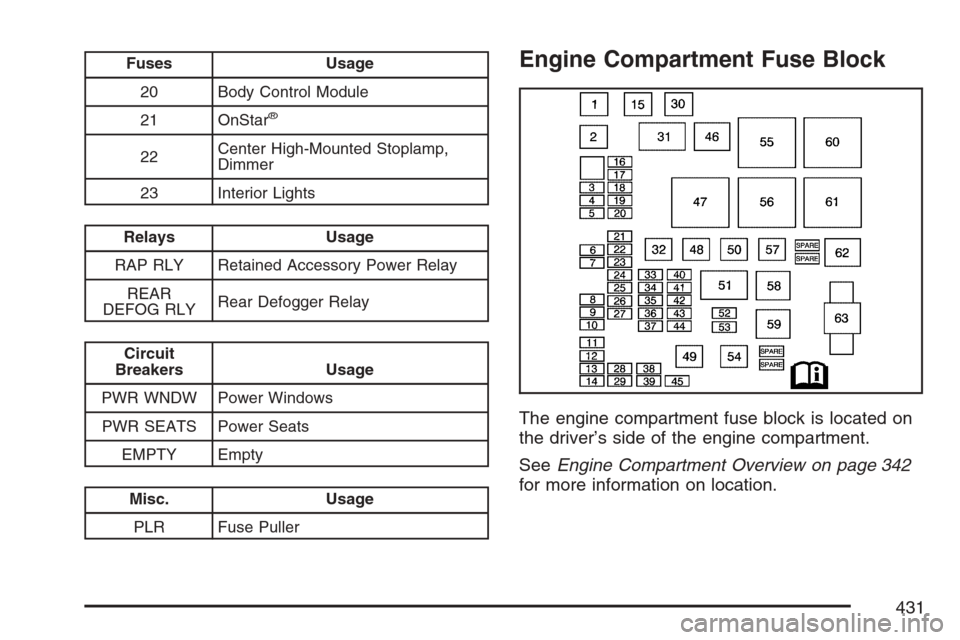
Engine Compartment Fuse Block
The engine compartment fuse block is located on
the driver’s side of the engine compartment.
SeeEngine Compartment Overview on page 342
for more information on location.
431
Page 432 of 492
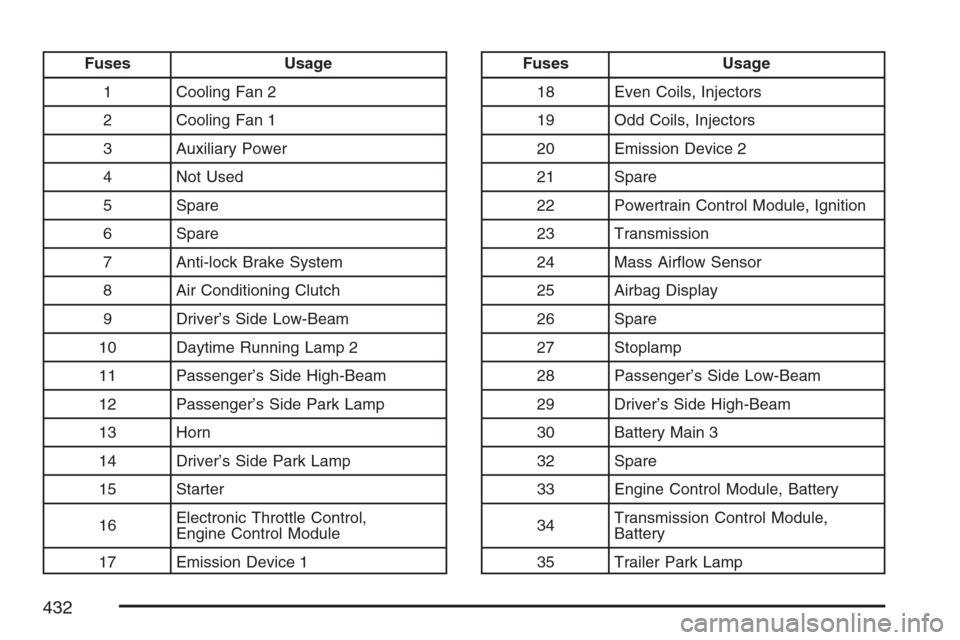
Fuses Usage
1 Cooling Fan 2
2 Cooling Fan 1
3 Auxiliary Power
4 Not Used
5 Spare
6 Spare
7 Anti-lock Brake System
8 Air Conditioning Clutch
9 Driver’s Side Low-Beam
10 Daytime Running Lamp 2
11 Passenger’s Side High-Beam
12 Passenger’s Side Park Lamp
13 Horn
14 Driver’s Side Park Lamp
15 Starter
16Electronic Throttle Control,
Engine Control Module
17 Emission Device 1Fuses Usage
18 Even Coils, Injectors
19 Odd Coils, Injectors
20 Emission Device 2
21 Spare
22 Powertrain Control Module, Ignition
23 Transmission
24 Mass Airow Sensor
25 Airbag Display
26 Spare
27 Stoplamp
28 Passenger’s Side Low-Beam
29 Driver’s Side High-Beam
30 Battery Main 3
32 Spare
33 Engine Control Module, Battery
34Transmission Control Module,
Battery
35 Trailer Park Lamp
432