2007 CHEVROLET CORVETTE lights
[x] Cancel search: lightsPage 194 of 488
If the word OFF or the off symbol is lit on the
passenger airbag status indicator, it means that
the passenger sensing system has turned off
the passenger’s airbag(s). SeePassenger Sensing
System on page 59for more on this, including
important safety information.
If, after several seconds, all status indicator lights
remain on, or if there are no lights at all, there
may be a problem with the lights or the passenger
sensing system. See your dealer for service.
{CAUTION:
If the airbag off indicator and the airbag
readiness light ever come on together, it
means that something may be wrong with
the airbag system. If this ever happens,
have the vehicle serviced promptly,
because an adult-size person sitting in
the right front passenger seat may not
have the protection of the airbag. See
Airbag Readiness Light on page 191.
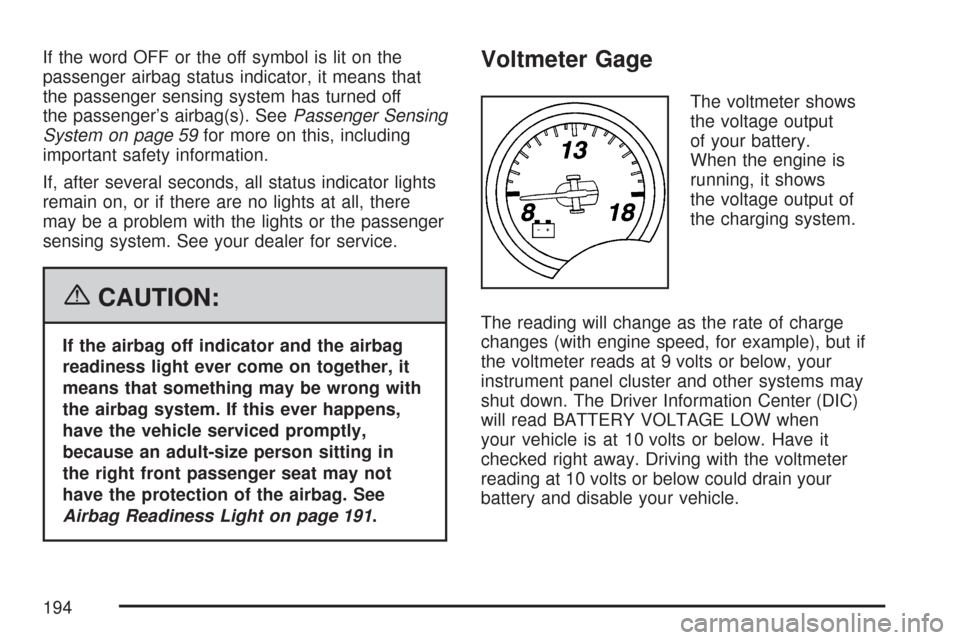
Voltmeter Gage
The voltmeter shows
the voltage output
of your battery.
When the engine is
running, it shows
the voltage output of
the charging system.
The reading will change as the rate of charge
changes (with engine speed, for example), but if
the voltmeter reads at 9 volts or below, your
instrument panel cluster and other systems may
shut down. The Driver Information Center (DIC)
will read BATTERY VOLTAGE LOW when
your vehicle is at 10 volts or below. Have it
checked right away. Driving with the voltmeter
reading at 10 volts or below could drain your
battery and disable your vehicle.
194
Page 206 of 488
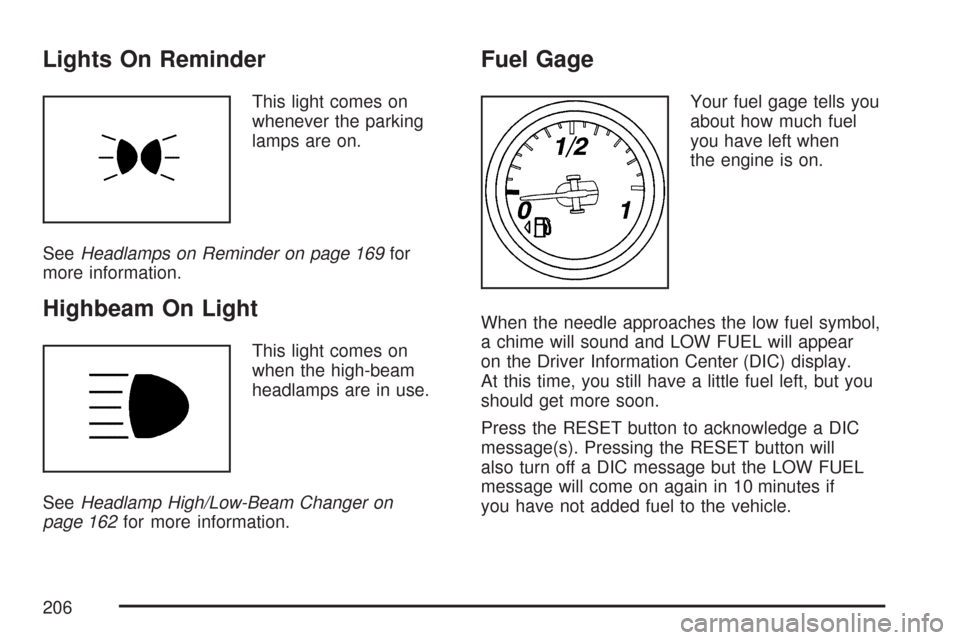
Lights On Reminder
This light comes on
whenever the parking
lamps are on.
SeeHeadlamps on Reminder on page 169for
more information.
Highbeam On Light
This light comes on
when the high-beam
headlamps are in use.
SeeHeadlamp High/Low-Beam Changer on
page 162for more information.
Fuel Gage
Your fuel gage tells you
about how much fuel
you have left when
the engine is on.
When the needle approaches the low fuel symbol,
a chime will sound and LOW FUEL will appear
on the Driver Information Center (DIC) display.
At this time, you still have a little fuel left, but you
should get more soon.
Press the RESET button to acknowledge a DIC
message(s). Pressing the RESET button will
also turn off a DIC message but the LOW FUEL
message will come on again in 10 minutes if
you have not added fuel to the vehicle.
206
Page 225 of 488
SERVICE AIR CONDITIONING
This message displays when the electronic sensors
that control the air conditioning and heating
systems are no longer working. Have the climate
control system serviced by your dealer if you notice
a drop in heating and air conditioning efficiency.
SERVICE ANTILOCK BRAKES
If this message displays while you are driving, stop
as soon as possible and turn the ignition off. Then
start the engine again to reset the system. If the
message stays on, or comes back on again while
you are driving, your vehicle is in need of service.
See your dealer. If the anti-lock brake system (ABS)
warning light is on and the regular brake system
warning light is not on, you still have brakes, but do
not have ABS. If the regular brake system warning
light is also on, you do not have ABS and there is a
problem with the brakes. SeeAnti-Lock Brake
System Warning Light on page 197andBrake
System Warning Light on page 196.
If this message is displayed, the Traction Control
System (TCS) and the Active Handling System
will also be disabled. The DIC will scroll three
messages: SERVICE ANTILOCK BRAKES,
SERVICE TRACTION SYSTEM, and SERVICEACTIVE HANDLING, and the instrument panel
cluster lights will come on along with a chime.
When the service message is displayed, the
computer controlled systems will not assist the
driver. Have the system repaired by your dealer as
soon as possible. Adjust your driving accordingly.
To acknowledge these messages, press the
RESET button.SERVICE CHARGING SYSTEM
If this message displays while you are driving,
there may be a problem with the electrical charging
system. It could mean that there is a loose or
broken drive belt or that there is another electrical
problem. Have your vehicle checked right away
by your dealer. Driving while this message is
on could drain the battery.
If you must drive a short distance with the
message on, be certain to turn off the vehicle’s
accessories, such as the radio and air conditioner.
Multiple chimes sound when this message is
displayed.
To acknowledge the message, press the RESET
button. The message reappears every 10 minutes
until this condition changes.
225
Page 237 of 488
If you choose YES, when you turn the ignition off
and open the driver’s door or press the unlock
button on the keyless access transmitter, the seat
and the telescopic steering wheel, if your
vehicle has this feature, will return to their stored
exit positions for an easy exit or an easy
entrance when returning to the vehicle.
The seat and steering wheel will only return to the
stored driving position if you press the appropriate
memory button or activate the auto memory
recall feature.
If you choose NO, this option will turn off.
When the mode you want is selected, press the
OPTION button to set your choice and advance to
the next personal option.
Approach Lights:This option briey turns on the
parking lamps, the front fog lamps and the
back-up lamps during low light periods when the
keyless access transmitter is used to unlock
the vehicle.Press the OPTION button until APPROACH
LIGHTS appears on the display, then press the
RESET button to scroll through the following
modes:
OFF
ON (default)
If you choose OFF, this option will turn off.
If you choose ON, the parking lamps, the front fog
lamps, and the back-up lamps will come on for
20 seconds during low light periods when all of the
following occurs:
You press the unlock button on the keyless
access transmitter.
Both of the doors are closed.
The vehicle is off or in RAP.
The lamps remain on for 20 seconds or until a door
is opened, the lock button on the keyless access
transmitter is pressed or the vehicle is no longer off
or in RAP.
SeeKeyless Access System on page 72for more
information.
When the mode you want is selected, press the
OPTION button to set your choice and advance to
the next personal option.
237
Page 294 of 488
No one can see as well at night as in the daytime.
But as we get older these differences increase.
A 50-year-old driver might require at least twice as
much light to see the same thing at night as a
20-year-old.
What you do in the daytime can also affect your
night vision. For example, if you spend the
day in bright sunshine you are wise to wear
sunglasses. Your eyes will have less trouble
adjusting to night. But if you are driving, do not
wear sunglasses at night. They might cut down on
glare from headlamps, but they also make a lot
of things invisible.
You can be temporarily blinded by approaching
headlamps. It can take a second or two, or
even several seconds, for your eyes to re-adjust
to the dark. When you are faced with severe glare,
as from a driver who does not lower the high
beams, or a vehicle with misaimed headlamps,
slow down a little. Avoid staring directly into
the approaching headlamps.Keep the windshield and all the glass on your
vehicle clean — inside and out. Glare at night is
made much worse by dirt on the glass. Even
the inside of the glass can build up a lm caused
by dust. Dirty glass makes lights dazzle and
ash more than clean glass would, making the
pupils of your eyes contract repeatedly.
Remember that the headlamps light up far less of a
roadway when you are in a turn or curve. Keep your
eyes moving; that way, it is easier to pick out dimly
lighted objects. Just as the headlamps should be
checked regularly for proper aim, so should your
eyes be examined regularly. Some drivers suffer
from night blindness — the inability to see in dim
light — and are not even aware of it.
294
Page 347 of 488
Engine Coolant
The cooling system in your vehicle is lled with
DEX-COOL®engine coolant. This coolant is
designed to remain in your vehicle for ve years
or 150,000 miles (240 000 km), whichever
occurs rst, if you add only DEX-COOL
®
extended life coolant.
The following explains your cooling system
and how to add coolant when it is low. If you
have a problem with engine overheating,
seeEngine Overheating on page 350.A 50/50 mixture of clean, drinkable water and
DEX-COOL
®coolant will:
Give freezing protection down to−34°F (−37°C).
Give boiling protection up to 265°F (129°C).
Protect against rust and corrosion.
Help keep the proper engine temperature.
Let the warning lights and gages work as
they should.
Notice:Using coolant other than DEX-COOL
®
may cause premature engine, heater core,
or radiator corrosion. In addition, the engine
coolant may require changing sooner, at
the rst maintenance service after each
30,000 miles (50 000 km) or 24 months,
whichever occurs rst. Any repairs would
not be covered by your warranty. Always
use DEX-COOL
®(silicate-free) coolant in
your vehicle.
347
Page 481 of 488
Light
Active Handling System........................... 198
Airbag Readiness..................................... 191
Anti-Lock Brake System Warning............. 197
Brake System Warning............................. 196
Fog Lamp................................................ 205
Highbeam On.......................................... 206
Lights On Reminder................................. 206
Malfunction Indicator................................ 200
One-to-Four Shift..................................... 195
Passenger Airbag Status Indicator............ 192
Safety Belt Reminder............................... 190
Security................................................... 205
TCS Warning Light.................................. 197
Tire Pressure........................................... 199
Traction Control System (TCS) Warning.... 197
Lighting
Entry/Exit................................................. 173Lights
Exterior Lamps......................................... 168
Flash-to-Pass........................................... 162
High/Low Beam Changer......................... 162
On Reminder........................................... 169
Limited-Slip Rear Axle................................. 285
Loading Your Vehicle................................... 309
Lockout Protection......................................... 82
Locks
Automatic Door Lock ................................. 81
Door.......................................................... 78
Lockout Protection..................................... 82
Power Door............................................... 80
Programmable Automatic Door Unlock....... 81
Loss of Control........................................... 291
Lumbar
Power and Side Bolsters............................. 9
481
Page 488 of 488
Vehicle Personalization
DIC .......................................................... 234
Ventilation Adjustment.................................. 186
Visors........................................................... 87
Voltmeter Gage........................................... 194
W
Warning Lights, Gages and Indicators......... 188
Warnings
DIC Warnings and Messages................... 214
Hazard Warning Flashers......................... 158
Other Warning Devices............................ 159
Safety and Symbols..................................... 4
Vehicle Damage.......................................... 5
Wheels
Alignment and Tire Balance..................... 398
Different Size........................................... 396
Replacement............................................ 398
Windows....................................................... 85
Power........................................................ 86Windshield
Replacement............................................ 375
Washer.................................................... 163
Washer Fluid........................................... 360
Wiper Blade Replacement........................ 375
Wiper Blades, Cleaning............................ 413
Wiper Fuses............................................ 419
Wipers..................................................... 162
Winter Driving............................................. 304
Winter Tires................................................. 379
Wiper Activated Headlamps ......................... 169
X
XM Radio Messages................................... 267
XM™ Satellite Radio Antenna System......... 272
Y
Your Vehicle and the Environment............... 431
488