Page 251 of 496

Avoid needless heavy braking. Some people
drive in spurts — heavy acceleration followed
by heavy braking — rather than keeping pace
with traffic. This is a mistake. The brakes may
not have time to cool between hard stops.
The brakes will wear out much faster if you do
a lot of heavy braking. If you keep pace with the
traffic and allow realistic following distances,
you will eliminate a lot of unnecessary braking.
That means better braking and longer brake life.
If your vehicle’s engine ever stops while you
are driving, brake normally but do not pump the
brakes. If you do, the pedal may get harder
to push down. If the engine stops, you will still
have some power brake assist. But you will use
it when you brake. Once the power assist is
used up, it may take longer to stop and the
brake pedal will be harder to push.
Adding non-GM accessories can affect your
vehicle’s performance. SeeAccessories and
Modications on page 324.Anti-Lock Brake System (ABS)
Your vehicle has the Anti-Lock Brake System
(ABS), an advanced electronic braking system
that will help prevent a braking skid.
When you start the engine and begin to drive
away, ABS will check itself. You might hear
a momentary motor or clicking noise while this
test is going on. This is normal.
If there is a problem
with the ABS, this
warning light will stay
on. SeeAnti-Lock Brake
System Warning Light
on page 190.
251
Page 252 of 496
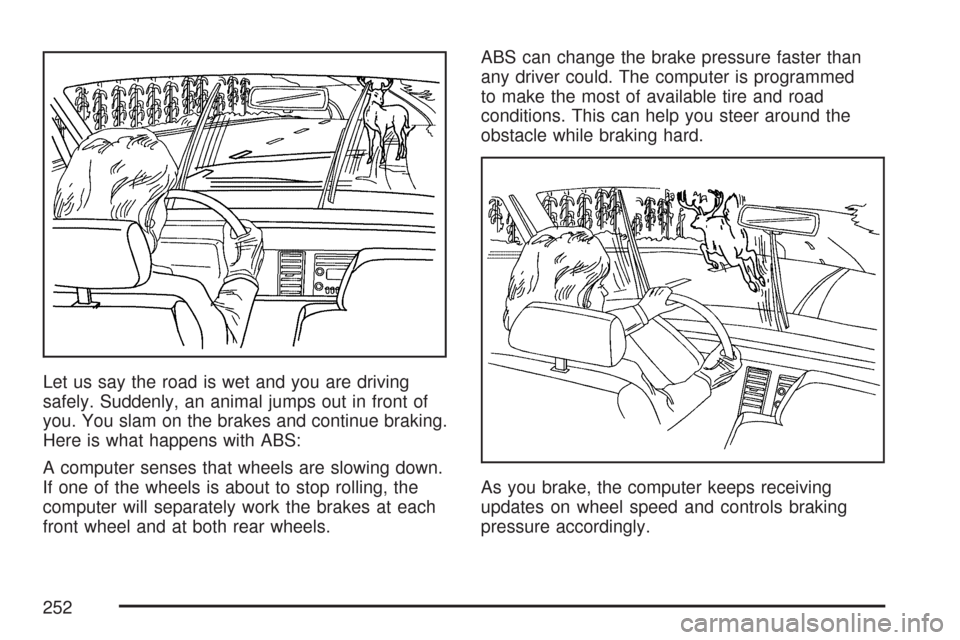
Let us say the road is wet and you are driving
safely. Suddenly, an animal jumps out in front of
you. You slam on the brakes and continue braking.
Here is what happens with ABS:
A computer senses that wheels are slowing down.
If one of the wheels is about to stop rolling, the
computer will separately work the brakes at each
front wheel and at both rear wheels.ABS can change the brake pressure faster than
any driver could. The computer is programmed
to make the most of available tire and road
conditions. This can help you steer around the
obstacle while braking hard.
As you brake, the computer keeps receiving
updates on wheel speed and controls braking
pressure accordingly.
252
Page 253 of 496

Remember: ABS does not change the time
you need to get your foot up to the brake pedal
or always decrease stopping distance. If you
get too close to the vehicle in front of you,
you will not have time to apply the brakes if that
vehicle suddenly slows or stops. Always leave
enough room up ahead to stop, even though
you have ABS.
Using ABS
Do not pump the brakes. Just hold the brake
pedal down rmly and let anti-lock work for you.
You might feel the brakes vibrate or notice
some noise, but this is normal.
Braking in Emergencies
With ABS, you can steer and brake at the same
time. In many emergencies, steering can help
you more than even the very best braking.
Traction Control System (TCS)
Your vehicle may have a Traction Control
System (TCS) that limits wheel spin. This is
especially useful in slippery road conditions.
The system operates only if it senses that
one or both of the rear wheels are spinning or
beginning to lose traction. When this happens,
the system reduces engine power and may
also upshift the transmission to limit wheel spin.
You may feel or hear the system working,
but this is normal.
The TCS button is
located on your
instrument panel.
Press this button
to turn the TCS
off and on.
When the traction control system is turned off,
an indicator light on the button will illuminate.
253
Page 256 of 496

Steering in Emergencies
There are times when steering can be more
effective than braking. For example, you come
over a hill and nd a truck stopped in your lane,
or a car suddenly pulls out from nowhere, or
a child darts out from between parked cars
and stops right in front of you. You can avoid
these problems by braking — if you can stop in
time. But sometimes you cannot; there is not room.
That is the time for evasive action — steering
around the problem.
Your vehicle can perform very well in emergencies
like these. First apply the brakes. SeeBraking
on page 250. It is better to remove as much speed
as you can from a possible collision. Then steer
around the problem, to the left or right depending
on the space available.An emergency like this requires close attention
and a quick decision. If you are holding the
steering wheel at the recommended 9 and 3 o’clock
positions, you can turn it a full 180 degrees very
quickly without removing either hand. But you
have to act fast, steer quickly, and just as quickly
straighten the wheel once you have avoided
the object.
The fact that such emergency situations are always
possible is a good reason to practice defensive
driving at all times and wear safety belts properly.
256
Page 259 of 496

Check your vehicle’s mirrors, glance over your
shoulder, and start your left lane change signal
before moving out of the right lane to pass.
When you are far enough ahead of the passed
vehicle to see its front in your vehicle’s inside
mirror, activate the right lane change signal and
move back into the right lane. Remember that
an outside convex mirror makes the vehicle
you just passed seem farther away from you
than it really is.
Try not to pass more than one vehicle at a time
on two-lane roads. Reconsider before passing
the next vehicle.
Do not overtake a slowly moving vehicle too
rapidly. Even though the brake lamps are not
ashing, it might be slowing down or starting
to turn.
If you are being passed, make it easy for
the following driver to get ahead of you.
Perhaps you can ease a little to the right.
Loss of Control
Let us review what driving experts say about what
happens when the three control systems — brakes,
steering, and acceleration — do not have enough
friction where the tires meet the road to do what
the driver has asked.
In any emergency, do not give up. Keep trying to
steer and constantly seek an escape route or area
of less danger.
Skidding
In a skid, a driver can lose control of the vehicle.
Defensive drivers avoid most skids by taking
reasonable care suited to existing conditions, and
by not overdriving those conditions. But skids
are always possible.
259
Page 270 of 496
Driving Downhill
When off-roading takes you downhill, you will
want to consider a number of things:
How steep is the downhill? Will I be able
to maintain vehicle control?
What is the surface like? Smooth? Rough?
Slippery? Hard-packed dirt? Gravel?
Are there hidden surface obstacles? Ruts?
Logs? Boulders?
What is at the bottom of the hill? Is there a
hidden creek bank or even a river bottom
with large rocks?If you decide you can go down a hill safely, then
try to keep your vehicle headed straight down,
and use a low gear. This way, engine drag
can help the brakes and they will not have to
do all the work. Descend slowly, keeping
your vehicle under control at all times.
{CAUTION:
Heavy braking when going down a hill can
cause your brakes to overheat and fade.
This could cause loss of control and a
serious accident. Apply the brakes lightly
when descending a hill and use a low
gear to keep vehicle speed under control.
270
Page 271 of 496

Q:Are there some things I should not do
when driving down a hill?
A:Yes! These are important because if you
ignore them you could lose control and
have a serious accident.
When driving downhill, avoid turns that take
you across the incline of the hill. A hill that
is not too steep to drive down may be
too steep to drive across. You could roll
over if you do not drive straight down.
Never go downhill with the transmission in
NEUTRAL (N), or with the clutch pedal
pressed down with a manual transmission.
This is called “free-wheeling.” The brakes will
have to do all the work and could overheat
and fade.
Q:Am I likely to stall when going downhill?
A:It is much more likely to happen going
uphill. But if it happens going downhill,
here is what to do.
1. Stop your vehicle by applying the regular
brakes. Apply the parking brake.
2. Shift to PARK (P), or to NEUTRAL with the
manual transmission, and, while still braking,
restart the engine.
3. Shift back to a low gear, release the parking
brake, and drive straight down.
4. If the engine will not start, get out and
get help.
271
Page 275 of 496

Driving in Water
{CAUTION:
Driving through rushing water can be
dangerous. Deep water can sweep your
vehicle downstream and you and your
passengers could drown. If it is only
shallow water, it can still wash away the
ground from under your tires, and you
could lose traction and roll the vehicle
over. Do not drive through rushing water.
Heavy rain can mean ash ooding, and ood
waters demand extreme caution.Find out how deep the water is before you
drive through it. If it is deep enough to cover
the wheel hubs, axles, or exhaust pipe, do not
try it — you probably will not get through.
Also, water that deep can damage the axle
and other vehicle parts.
If the water is not too deep, drive slowly through it.
At faster speeds, water splashes on the ignition
system and your vehicle can stall. Stalling can
also occur if you get the tailpipe under water.
And, as long as the tailpipe is under water, you
will never be able to start the engine. When you
go through water, remember that when the brakes
get wet, it may take you longer to stop.
SeeDriving in Rain and on Wet Roads on page 278
for more information on driving through water.
275