Page 233 of 436
A cornering skid and an acceleration skid are best
handled by easing your foot off the accelerator
pedal.
If your vehicle starts to slide, ease your foot off
the accelerator pedal and quickly steer the
way you want the vehicle to go. If you start
steering quickly enough, your vehicle may
straighten out. Always be ready for a second skid
if it occurs.
Of course, traction is reduced when water, snow,
ice, gravel, or other material is on the road. For
safety, you will want to slow down and adjust your
driving to these conditions. It is important to slow
down on slippery surfaces because stopping
distance will be longer and vehicle control more
limited.While driving on a surface with reduced traction, try
your best to avoid sudden steering, acceleration, or
braking, including reducing vehicle speed by
shifting to a lower gear. Any sudden changes could
cause the tires to slide. You may not realize the
surface is slippery until your vehicle is skidding.
Learn to recognize warning clues — such as
enough water, ice, or packed snow on the road to
make a mirrored surface — and slow down when
you have any doubt.
If you have the Anti-Lock Brake System (ABS),
remember: It helps avoid only the braking skid. If
you do not have ABS, then in a braking skid,
where the wheels are no longer rolling, release
enough pressure on the brakes to get the wheels
rolling again. This restores steering control.
Push the brake pedal down steadily when you
have to stop suddenly. As long as the wheels are
rolling, you will have steering control.
233
Page 245 of 436
But wet ice can be even more trouble because it
may offer the least traction of all. You can get
wet ice when it is about freezing, 32°F (0°C), and
freezing rain begins to fall. Try to avoid driving
on wet ice until salt and sand crews can get there.
Whatever the condition — smooth ice, packed,
blowing, or loose snow — drive with caution.
Accelerate gently. Try not to break the fragile
traction. If you accelerate too fast, the drive wheels
will spin and polish the surface under the tires
even more.
Unless you have the Anti-Lock Brake System
(ABS), you will want to brake very gently, too. If
you do have ABS, seeAnti-Lock Brake System
(ABS) on page 225. This system improves
your vehicle’s stability when you make a hard stop
on a slippery road. Whether you have ABS or
not, you will want to begin stopping sooner than
you would on dry pavement. Without ABS, if
you feel your vehicle begin to slide, let up on the
brakes a little. Push the brake pedal down
steadily to get the most traction you can.Remember, unless you have ABS, if you brake so
hard that your wheels stop rolling, you will just
slide. Brake so your wheels always keep rolling
and you can still steer.
•Whatever your braking system, allow greater
following distance on any slippery road.
•Watch for slippery spots. The road might be
fine until you hit a spot that is covered with
ice. On an otherwise clear road, ice patches
may appear in shaded areas where the
sun cannot reach, such as around clumps of
trees, behind buildings, or under bridges.
Sometimes the surface of a curve or an
overpass may remain icy when the
surrounding roads are clear. If you see a
patch of ice ahead of you, brake before you
are on it. Try not to brake while you are
actually on the ice, and avoid sudden steering
maneuvers.
245
Page 346 of 436
Dust may be removed from small buttons and
knobs using a small brush with soft bristles.
Your dealer has a product for cleaning your
vehicle’s glass. Should it become necessary, you
can also obtain a product from your dealer to
remove odors from your vehicle’s upholstery.
Do not clean your vehicle using the following
cleaners or techniques:
•Never use a knife or any other sharp object to
remove a soil from any interior surface.
•Never use a stiff brush. It can cause damage
to your vehicle’s interior surfaces.
•Never apply heavy pressure or rub
aggressively with a cleaning cloth. Use of
heavy pressure can damage your interior
and does not improve the effectiveness of
soil removal.
•Use only mild, neutral-pH soaps. Avoid laundry
detergents or dishwashing soaps with
degreasers. Using too much soap will leave a
residue that leaves streaks and attracts dirt.
For liquid cleaners, about 20 drops per
gallon (3.78 L) of water is a good guide.
•Do not heavily saturate your upholstery while
cleaning.
•Damage to your vehicle’s interior may result
from the use of many organic solvents such as
naptha, alcohol, etc.
Fabric/Carpet
Use a vacuum cleaner with a soft brush
attachment frequently to remove dust and loose
dirt. A canister vacuum with a beater bar in
the nozzle may only be used on floor carpet and
carpeted floor mats. For soils, always try to remove
them first with plain water or club soda. Before
cleaning, gently remove as much of the soil
as possible using one of the following techniques:
•For liquids: gently blot the remaining soil with a
paper towel. Allow the soil to absorb into the
paper towel until no more can be removed.
•For solid dry soils: remove as much as possible
and then vacuum.
346
Page 359 of 436
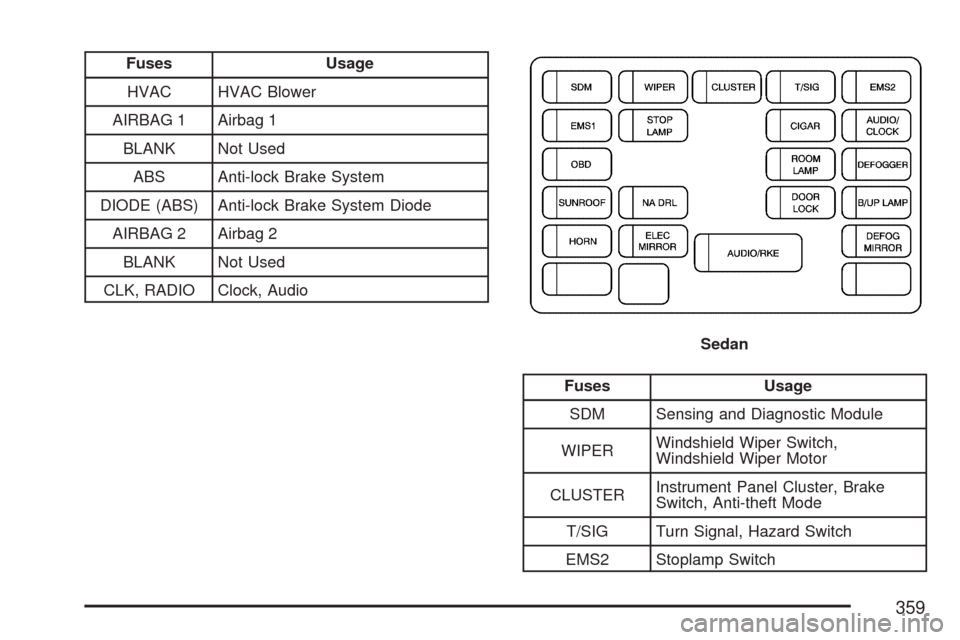
Fuses Usage
HVAC HVAC Blower
AIRBAG 1 Airbag 1
BLANK Not Used
ABS Anti-lock Brake System
DIODE (ABS) Anti-lock Brake System Diode
AIRBAG 2 Airbag 2
BLANK Not Used
CLK, RADIO Clock, Audio
Fuses Usage
SDM Sensing and Diagnostic Module
WIPERWindshield Wiper Switch,
Windshield Wiper Motor
CLUSTERInstrument Panel Cluster, Brake
Switch, Anti-theft Mode
T/SIG Turn Signal, Hazard Switch
EMS2 Stoplamp SwitchSedan
359
Page 363 of 436
Fuses Usage
LOW BEAM RT Passenger’s Side Headlamp Low
ILLUM RTParking Lamp Right Side,
Illumination Circuit
LOW BEAM LT Driver’s Side Headlamp Low
ILLUM LTDriver’s Side Parking Lamp, License
Plate Lamp
INT LTS Room Lamp
BLANK Not Used
DEFOG Defogger
S/ROOF Sunroof
ILLUM LAMPS Illumination Relay
HORN Horn
HEAD LAMPS Headlamps
FUEL Fuel PumpFuses Usage
A/C Air Conditioning Compressor
FOG LAMPS Front Fog Lamp
HVAC
BLOWERHeating, Ventilation, Air
Conditioning Blower
ABS Anti-lock Brake System
I/P FUSE
BATT.Instrument Panel Fuse Box
COOL FAN Radiator Fan
IGN 2 Ignition 2
BLANK Blank
IGN 1 Ignition 1
PWR WNDW Power Windows
SPARE Spare
363
Page 366 of 436
Fuses Usage
ACC/IGN1 Ignition Switch
HAZARDHazard Lamps, Theft-Deterrent
System
H/L LOW RHPassenger’s Side Low-Beam
Headlamp
FAN HI Cooling Fan High Speed
H/L LOW LH Driver’s Side Low-Beam Headlamp
FRT FOG Front Fog Lamps (Option)
FAN LOW Cooling Fan Low Speed
H/L HI High-Beam Headlamps
A/C COMPAir Conditioning
Compressor (Option)
FUEL PUMP Fuel PumpFuses Usage
SPARE Spare
ABS Anti-lock Brake System (Option)
EMS2LEGR Valve, HO2S, EVAP Canister
Purge Solenoid, CMP Sensor
P/WINDOW1 Power Window Switch (Option)
ECUEngine Control Module, Transaxle
Control Module
SPARE Spare
EMS1Engine Control Module, Injector,
Cooling Fan, Air Conditioning
Compressor
SPARE Spare
366
Page 413 of 436
Additional Program Information
All program options, such as shuttle service, may
not be available at every dealer. Please contact
your dealer for specific information about
availability. All Courtesy Transportation
arrangements will be administered by appropriate
dealer personnel.
General Motors reserves the right to unilaterally
modify, change or discontinue Courtesy
Transportation at any time and to resolve all
questions of claim eligibility pursuant to the terms
and conditions described herein at its sole
discretion.
Vehicle Data Collection and Event
Data Recorders
Your vehicle, like other modern motor vehicles,
has a number of sophisticated computer
systems that monitor and control several
aspects of the vehicle’s performance. Your
vehicle uses on-board vehicle computers
to monitor emission control components to
optimize fuel economy, to monitor conditionsfor airbag deployment and, if the vehicle has
the Anti-lock Brake System (ABS), to provide
anti-lock braking and to help the driver control
the vehicle in difficult driving situations.
Some information may be stored during regular
operations to facilitate repair of detected
malfunctions; other information is stored only
in a crash event by computer systems, such
as those commonly called Event Data
Recorders (EDR).
In a crash event, computer systems, such as the
airbag Sensing and Diagnostic Module (SDM) in
your vehicle may record information about the
condition of the vehicle and how it was
operated, such as data related to engine speed,
brake application, throttle position, vehicle
speed, safety belt usage, airbag readiness,
airbag performance, and the severity of a
collision. This information has been used to
improve vehicle crash performance and may be
used to improve crash performance of future
vehicles and driving safety. Unlike the data
recorders on many airplanes, these on-board
systems do not record sounds, such as
conversation of vehicle occupants.
413