Page 407 of 618
If you put things inside your vehicle — like
suitcases, tools, packages, or anything else — they
will go as fast as the vehicle goes. If you have to
stop or turn quickly, or if there is a crash, they will
keep going.
{CAUTION:
Things you put inside your vehicle can
strike and injure people in a sudden stop
or turn, or in a crash.
Put things in the cargo area of your
vehicle. Try to spread the weight
evenly.
Never stack heavier things, like
suitcases, inside the vehicle so that
some of them are above the tops
of the seats.
Do not leave an unsecured child
restraint in your vehicle.
When you carry something inside the
vehicle, secure it whenever you can.
Do not leave a seat folded down
unless you need to.There is also important loading information for
off-road driving in this manual. See “Loading Your
Vehicle for Off-Road Driving” underOff-Road
Driving on page 368.
Add-On Equipment
When you carry removable items, you may need
to put a limit on how many people you can
carry inside your vehicle. Be sure to weigh your
vehicle before you buy and install the new
equipment.
Notice:Overloading your vehicle may cause
damage. Repairs would not be covered by your
warranty. Do not overload your vehicle.
Truck-Camper Loading Information
Your vehicle was neither designed nor intended
to carry a slide-in type camper.
Notice:Adding a slide-in camper or similar
equipment to your vehicle can damage it, and
the repairs would not be covered by your
warranty. Do not install a slide-in camper or
similar equipment on your vehicle.
407
Page 409 of 618
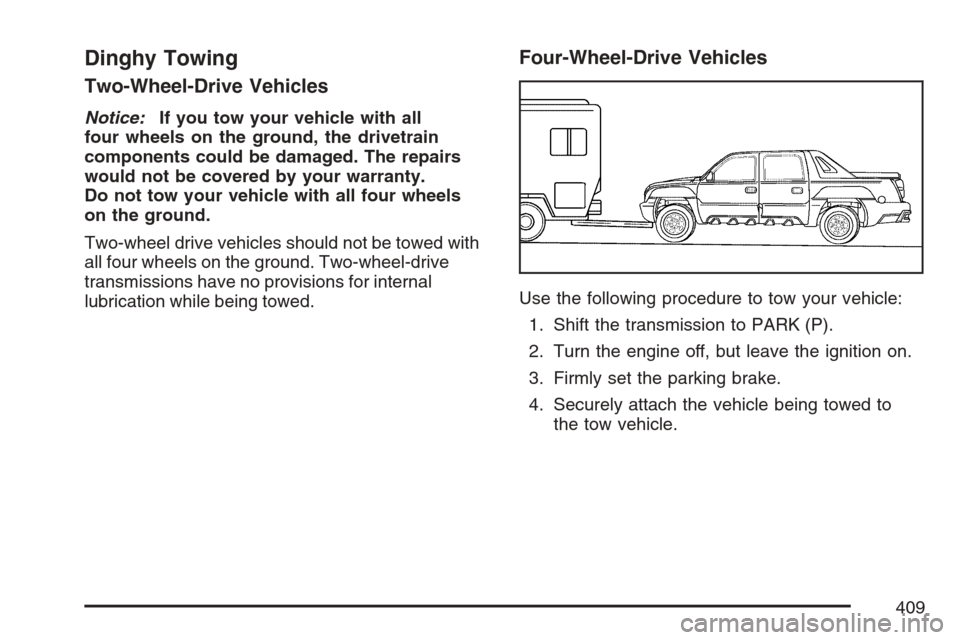
Dinghy Towing
Two-Wheel-Drive Vehicles
Notice:If you tow your vehicle with all
four wheels on the ground, the drivetrain
components could be damaged. The repairs
would not be covered by your warranty.
Do not tow your vehicle with all four wheels
on the ground.
Two-wheel drive vehicles should not be towed with
all four wheels on the ground. Two-wheel-drive
transmissions have no provisions for internal
lubrication while being towed.
Four-Wheel-Drive Vehicles
Use the following procedure to tow your vehicle:
1. Shift the transmission to PARK (P).
2. Turn the engine off, but leave the ignition on.
3. Firmly set the parking brake.
4. Securely attach the vehicle being towed to
the tow vehicle.
409
Page 411 of 618
Four-Wheel-Drive Vehicles
Use the following procedure to tow your vehicle:
1. Drive the vehicle up onto the tow dolly.
2. Firmly set the parking brake.
3. Shift the transmission to PARK (P).
4. Turn the engine off, but leave the ignition on.
5. Securely attach the vehicle being towed to
the tow dolly.
{CAUTION:
Shifting the transfer case to NEUTRAL
can cause your vehicle to roll even if
the transmission is in PARK (P). You or
someone else could be seriously injured.
Be sure to set the parking brake before
placing the transfer case in NEUTRAL.
SeeParking Brake on page 138.6. Shift the transfer case to NEUTRAL (N).
SeeFour-Wheel Drive on page 132for
the proper procedure to select the neutral
position for your vehicle.
7. Release the parking brake only after the
vehicle being towed is rmly attached to
the towing vehicle.
If the tow vehicle will not be started or driven
for six weeks or more, remove the battery
cable from the negative terminal (post) of the
battery to prevent your battery from draining
while towing.
411
Page 412 of 618
Rear Towing (Rear Wheels Off the Ground)
Two-Wheel-Drive Vehicles
Use the following procedure to tow your vehicle
from the rear:
1. Drive the vehicle onto the dolly.
2. Firmly set the parking brake. SeeParking
Brake on page 138for more information.
3. Put the transmission in PARK (P).
4. Follow the dolly manufacturer’s instructions to
attach and secure the vehicle being towed to
the dolly and then the loaded dolly to the
tow vehicle.
Make sure the wheels are straight before
proceeding to the next steps.
5. Release the parking brake only after the
vehicle being towed is rmly attached to
the tow vehicle.
If the tow vehicle will not be started or driven
for six weeks or more, remove the battery
cable from the negative terminal (post) of the
battery to prevent your battery from draining
while towing.
Four-Wheel-Drive Vehicles
Use the following procedure to tow your vehicle
from the rear:
1. Drive the vehicle onto the dolly.
2. Firmly set the parking brake.
3. Put the transmission in PARK (P).
4. Turn the engine off, but leave the ignition on.
5. Follow the dolly manufacturer’s instructions
to attach and secure the vehicle being
towed to the dolly and then the loaded dolly
to the tow vehicle.
Make sure the wheels are straight before
proceeding to the next steps.
412
Page 417 of 618
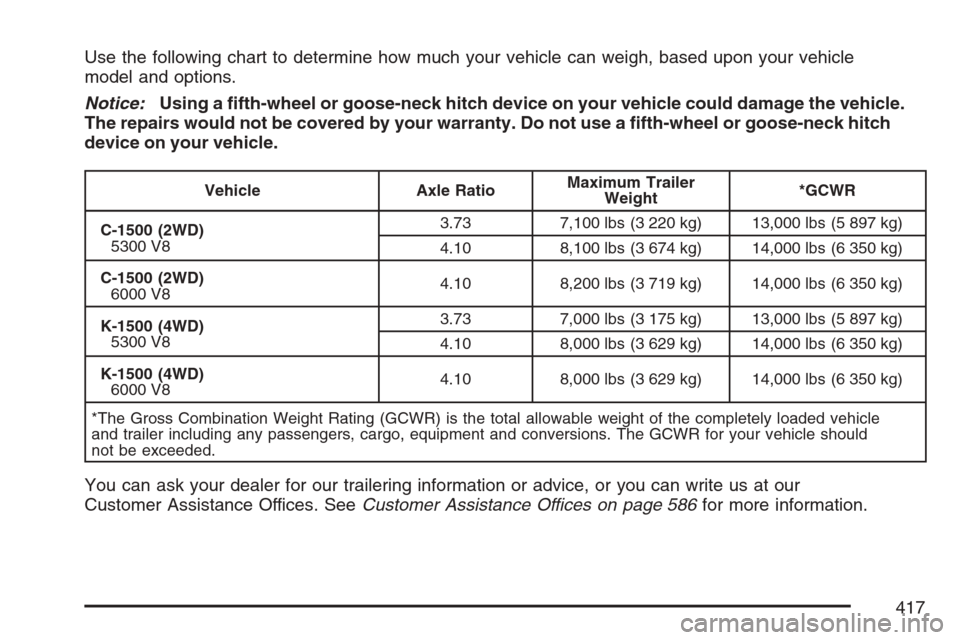
Use the following chart to determine how much your vehicle can weigh, based upon your vehicle
model and options.
Notice:Using a fth-wheel or goose-neck hitch device on your vehicle could damage the vehicle.
The repairs would not be covered by your warranty. Do not use a fth-wheel or goose-neck hitch
device on your vehicle.
Vehicle Axle RatioMaximum Trailer
Weight*GCWR
C-1500 (2WD)
5300 V83.73 7,100 lbs (3 220 kg) 13,000 lbs (5 897 kg)
4.10 8,100 lbs (3 674 kg) 14,000 lbs (6 350 kg)
C-1500 (2WD)
6000 V84.10 8,200 lbs (3 719 kg) 14,000 lbs (6 350 kg)
K-1500 (4WD)
5300 V83.73 7,000 lbs (3 175 kg) 13,000 lbs (5 897 kg)
4.10 8,000 lbs (3 629 kg) 14,000 lbs (6 350 kg)
K-1500 (4WD)
6000 V84.10 8,000 lbs (3 629 kg) 14,000 lbs (6 350 kg)
*The Gross Combination Weight Rating (GCWR) is the total allowable weight of the completely loaded vehicle
and trailer including any passengers, cargo, equipment and conversions. The GCWR for your vehicle should
not be exceeded.
You can ask your dealer for our trailering information or advice, or you can write us at our
Customer Assistance Offices. SeeCustomer Assistance Offices on page 586for more information.
417
Page 422 of 618
Trailer Brakes
If your trailer weighs more than 2,000 lbs (900 kg)
loaded, then it needs its own brakes — and
they must be adequate. Be sure to read and
follow the instructions for the trailer brakes so
you’ll be able to install, adjust and maintain
them properly.
Since your vehicle is equipped with the
StabiliTrak
®system, your trailer brake system
cannot tap into the vehicle’s hydraulic brake
system.
Driving with a Trailer
Towing a trailer requires a certain amount of
experience. Before setting out for the open road,
you’ll want to get to know your rig. Acquaint
yourself with the feel of handling and braking
with the added weight of the trailer. And always
keep in mind that the vehicle you are driving
is now a good deal longer and not nearly
as responsive as your vehicle is by itself.Before you start, check all trailer hitch parts and
attachments, safety chains, electrical connector,
lamps, tires and mirror adjustment. If the trailer
has electric brakes, start your vehicle and
trailer moving and then apply the trailer brake
controller by hand to be sure the brakes are
working. This lets you check your electrical
connection at the same time.
During your trip, check occasionally to be sure
that the load is secure, and that the lamps and
any trailer brakes are still working.
Following Distance
Stay at least twice as far behind the vehicle ahead
as you would when driving your vehicle without
a trailer. This can help you avoid situations
that require heavy braking and sudden turns.
Passing
You’ll need more passing distance up ahead when
you’re towing a trailer. And, because you’re a
good deal longer, you’ll need to go much farther
beyond the passed vehicle before you can
return to your lane.
422
Page 460 of 618
Adding Coolant
If you need more coolant, add the proper
DEX-COOL®coolant mixture at the surge tank,
but only when the engine is cool. SeeCooling
System on page 464.
{CAUTION:
You can be burned if you spill coolant
on hot engine parts. Coolant contains
ethylene glycol, and it will burn if the
engine parts are hot enough. Do not
spill coolant on a hot engine.
When replacing the pressure cap, make sure
it is hand-tight and fully seated.
Coolant Surge Tank Pressure Cap
Notice:If the pressure cap is not tightly
installed, coolant loss and possible engine
damage may occur. Be sure the cap is properly
and tightly secured.
The coolant surge tank pressure cap must be fully
installed on the coolant surge tank. SeeEngine
Compartment Overview on page 444for more
information on location.
Engine Overheating
You will nd a coolant temperature gage on your
vehicle’s instrument panel. SeeEngine Coolant
Temperature Gage on page 249.
In addition, you will nd an ENGINE
OVERHEATED STOP ENGINE, ENGINE
OVERHEATED IDLE ENGINE, and an ENGINE
POWER IS REDUCED message in the Driver
Information Center (DIC) on the instrument panel.
SeeDIC Warnings and Messages on page 267.
460
Page 506 of 618

Federal Communications
Commission (FCC) and Industry
and Science Canada
The Tire Pressure Monitor System (TPMS)
operates on a radio frequency and complies with
Part 15 of the FCC Rules. Operation is subject
to the following two conditions:
1. This device may not cause harmful
interference.
2. This device must accept any interference
received, including interference that may
cause undesired operation.
The Tire Pressure Monitor System (TPMS)
operates on a radio frequency and complies with
RSS-210 of Industry and Science Canada.
Operation is subject to the following two conditions:
1. This device may not cause interference.
2. This device must accept any interference
received, including interference that may
cause undesired operation of the device.
Changes or modications to this system by other
than an authorized service facility could void
authorization to use this equipment.
Tire Inspection and Rotation
Tires should be rotated every 5,000 to 8,000 miles
(8 000 to 13 000 km).
Any time you notice unusual wear, rotate your
tires as soon as possible and check wheel
alignment. Also check for damaged tires or wheels.
SeeWhen It Is Time for New Tires on page 508
andWheel Replacement on page 512for
more information.
Make sure the spare tire is stored securely. Push,
pull, and then try to rotate or turn the tire. If it
moves, use the ratchet/wheel wrench to tighten the
cable. SeeChanging a Flat Tire on page 516.
The purpose of regular rotation is to achieve
more uniform wear for all tires on the vehicle.
The rst rotation is the most important. See
Scheduled Maintenance on page 563.
506