Page 131 of 618

Notice:Spinning the tires or holding the
vehicle in one place on a hill using only
the accelerator pedal may damage the
transmission. The repair will not be covered
by your warranty. If you are stuck, do not
spin the tires. When stopping on a hill,
use the brakes to hold the vehicle in place.
When temperatures are very cold, the
Hydra-Matic
®Automatic Transmission’s gear
shifting may be delayed providing more stable
shifts until the engine warms up. Shifts may
be more noticeable with a cold transmission.
This difference in shifting is normal.
The transmission torque converter clutch operation
is restricted during cold operation. When the
startup transmission temperature is approximately
64°F (18°C) your torque converter clutch will
temporarily not operate. Once the transmission
temperature rises above 68°F (20°C), normal
operation will resume.
Tow/Haul Mode
Your vehicle has a tow/haul mode. The button
is located on the end of the column shift
lever. Press the button to enable or disable the
tow/haul mode. You can use this feature to
assist when towing or hauling a heavy load.
See “Tow/Haul Mode” underTowing a Trailer
on page 414for more information.
131
Page 134 of 618

{CAUTION:
Shifting the transfer case to NEUTRAL
can cause your vehicle to roll even if the
transmission is in PARK (P). You or
someone else could be seriously injured.
Be sure to set the parking brake before
placing the transfer case in NEUTRAL.
SeeParking Brake on page 138.
NEUTRAL (N):Shift the vehicle’s transfer case to
NEUTRAL only when towing your vehicle. See
Recreational Vehicle Towing on page 408or
Towing Your Vehicle on page 408for more
information.
If the SERVICE 4 WHEEL DRIVE message stays
on, you should take your vehicle to your dealer
for service. See “SERVICE 4 WHEEL DRIVE
message” underDIC Warnings and Messages
on page 267.
Shifting Into Four-Wheel Drive High or
AUTO (Automatic Four-Wheel Drive)
Turn the knob to the Four-Wheel High or
AUTO position. This can be done at any speed,
except when shifting from Four-Wheel Drive
Low. The indicator light will ash while shifting.
It will remain on when the shift is completed.
Shifting Into Two-Wheel Drive High
Turn the knob to the Two-Wheel High position.
This can be done at any speed, except when
shifting from Four-Wheel Drive Low.
See shifting out of Four-Wheel Drive Low later
in this section for more information.
134
Page 139 of 618

If the ignition is on when the parking brake is
released, the brake system warning light will go off.
Notice:Driving with the parking brake on can
overheat the brake system and cause
premature wear or damage to brake system
parts. Verify that the parking brake is fully
released and the brake warning light is
off before driving.
If you are towing a trailer and are parking on any
hill, seeTowing a Trailer on page 414.
Shifting Into Park (P)
{CAUTION:
It can be dangerous to get out of your
vehicle if the shift lever is not fully in
PARK (P) with the parking brake rmly
set. Your vehicle can roll. If you have left
the engine running, the vehicle can move
suddenly. You or others could be injured.
CAUTION: (Continued)
CAUTION: (Continued)
To be sure your vehicle will not move,
even when you are on fairly level ground,
use the steps that follow. With four-wheel
drive, if your transfer case is in NEUTRAL,
your vehicle will be free to roll, even if
your shift lever is in PARK (P). So, be
sure the transfer case is in a drive
gear — not in NEUTRAL. If you are pulling
a trailer, seeTowing a Trailer on page 414.
1. Hold the brake pedal down with your right
foot and set the parking brake.
2. Move the shift lever into the PARK (P)
position by pulling the shift lever toward
you and moving it up as far as it will go.
3. Be sure the transfer case is in a drive
gear — not in NEUTRAL (N).
4. Turn the ignition key to LOCK.
5. Remove the key and take it with you. If you
can leave your vehicle with the ignition key in
your hand, your vehicle is in PARK (P).
139
Page 140 of 618
Leaving Your Vehicle With the
Engine Running
{CAUTION:
It can be dangerous to leave your vehicle
with the engine running. Your vehicle
could move suddenly if the shift lever is
not fully in PARK (P) with the parking
brake rmly set.
If you have four-wheel drive and your
transfer case is in NEUTRAL, your vehicle
will be free to roll, even if your shift lever
is in PARK (P). So be sure the transfer
case is in a drive gear — not in NEUTRAL.
CAUTION: (Continued)
CAUTION: (Continued)
And, if you leave the vehicle with the
engine running, it could overheat and
even catch re. You or others could be
injured. Do not leave your vehicle with
the engine running unless you have to.
If you have to leave your vehicle with the engine
running, be sure your vehicle is in PARK (P)
and the parking brake is rmly set before
you leave it. After you move the shift lever into
PARK (P), hold the regular brake pedal down.
Then, see if you can move the shift lever away
from PARK (P) without rst pulling it toward you.
If you can, it means that the shift lever was
not fully locked into PARK (P).
140
Page 145 of 618

{CAUTION:
Four-wheel drive vehicles with the transfer
case in NEUTRAL will allow the vehicle to
roll, even if your shift lever is in PARK (P).
So, be sure the transfer case is in a drive
gear — not in NEUTRAL. Always set your
parking brake.
Follow the proper steps to be sure your vehicle
will not move. SeeShifting Into Park (P) on
page 139.
If you are pulling a trailer, seeTowing a Trailer
on page 414.
Mirrors
Automatic Dimming Rearview Mirror
with OnStar
®, Compass and
Temperature Display
Your vehicle may have this feature. When on, the
automatic dimming mirror dims to the proper level
to minimize glare from lights behind you after dark.
The mirror has a dual display in the upper right
corner of the mirror face that shows the compass
reading and the outside temperature.
Control buttons for the OnStar
®system, if
equipped, are at the bottom of the mirror.
SeeOnStar
®System on page 156for more
information about the services OnStar®provides.
P(On/Off):This is the on/off button.
145
Page 148 of 618

Compass Calibration
The compass may need calibration if one of the
following occurs:
After approximately ve seconds, the display
does not show a compass heading, N for
North, for example, there may be a strong
magnetic eld interfering with the compass.
Such interference may be caused by a
magnetic antenna mount, magnetic note pad
holder, or a similar magnetic item.
The compass does not display the correct
heading and the compass zone variance
is set correctly.
In order to calibrate, CAL must be displayed in the
mirror compass windows. If CAL is not displayed,
push the on/off button for approximately
12 seconds or until CAL is displayed.
The compass can be calibrated by driving the
vehicle in circles at 5 mph (8 km/h) or less until
the display reads a direction.
Cleaning the Mirror
When cleaning the mirror, use a paper towel or
similar material dampened with glass cleaner.
Do not spray glass cleaner directly on the mirror
as that may cause the liquid cleaner to enter
the mirror housing.
Automatic Dimming Rearview
Mirror with Compass and
Temperature Display
Your vehicle may be equipped with this feature.
When on, an automatic dimming mirror will dim to
the proper level to minimize glare from lights
behind you after dark.
The mirror also includes a dual display in the
upper right corner of the mirror with the compass
reading and the outside temperature. The
display can be turned on or off by briey pressing
either the TEMP or the COMP button.
148
Page 151 of 618
To adjust for compass variance:
1. Find your current location and variance zone
number on the following zone map.
2. Press and hold the COMP button for
ve seconds until a zone number
appears in the display.3. Press the COMP button on the bottom of the
mirror until the new zone number appears in
the display. After you stop pressing the
button, the display will show a compass
direction within a few seconds.
Cleaning the Mirror
Use a paper towel or similar material dampened
with glass cleaner. Do not spray glass cleaner
directly on the mirror as that may cause the liquid
cleaner to enter the mirror housing.
151
Page 152 of 618
Outside Power Mirrors
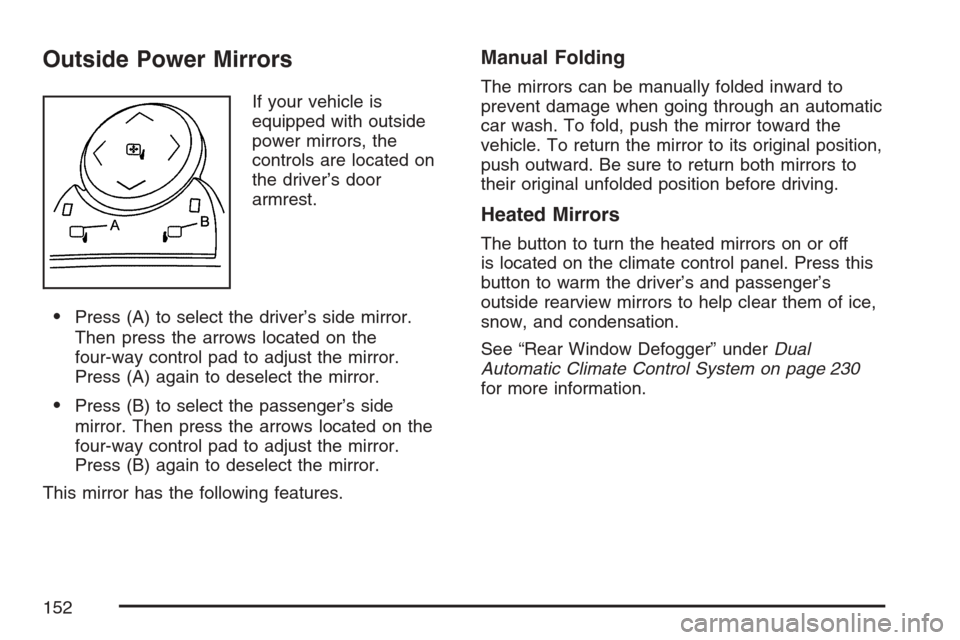
If your vehicle is
equipped with outside
power mirrors, the
controls are located on
the driver’s door
armrest.
Press (A) to select the driver’s side mirror.
Then press the arrows located on the
four-way control pad to adjust the mirror.
Press (A) again to deselect the mirror.
Press (B) to select the passenger’s side
mirror. Then press the arrows located on the
four-way control pad to adjust the mirror.
Press (B) again to deselect the mirror.
This mirror has the following features.
Manual Folding
The mirrors can be manually folded inward to
prevent damage when going through an automatic
car wash. To fold, push the mirror toward the
vehicle. To return the mirror to its original position,
push outward. Be sure to return both mirrors to
their original unfolded position before driving.
Heated Mirrors
The button to turn the heated mirrors on or off
is located on the climate control panel. Press this
button to warm the driver’s and passenger’s
outside rearview mirrors to help clear them of ice,
snow, and condensation.
See “Rear Window Defogger” underDual
Automatic Climate Control System on page 230
for more information.
152
