2007 CADILLAC STS instrument cluster
[x] Cancel search: instrument clusterPage 269 of 560

ENGINE COOLANT HOT IDLE ENGINE
Notice:If you drive your vehicle while the
engine is overheating, severe engine damage
may occur. If an overheat warning appears
on the instrument panel cluster and/or DIC,
stop the vehicle as soon as possible. Do not
increase the engine speed above normal idling
speed. SeeEngine Overheating on page 393
for more information.
This symbol appears
with this message.
This message displays when the engine coolant
temperature is too hot. Stop and allow the vehicle
to idle until it cools down. SeeEngine Coolant
Temperature Warning Light on page 251.
SeeOverheated Engine Protection Operating
Mode on page 395for information on driving to a
safe place in an emergency.
ENGINE HOT –
AC (Air Conditioning) OFF
This message displays when the engine coolant
becomes hotter than the normal operating
temperature. SeeEngine Coolant Temperature
Gage on page 251. To avoid added strain on a hot
engine, the air conditioning compressor is
automatically turned off. When the coolant
temperature returns to normal, the air conditioning
compressor turns back on. You can continue to
drive your vehicle.
If this message continues to appear, have the
system repaired by your dealer as soon as
possible to avoid damage to the engine.
269
Page 270 of 560

ENGINE OVERHEATED STOP ENGINE
Notice:If you drive your vehicle while the
engine is overheating, severe engine damage
may occur. If an overheat warning appears
on the instrument panel cluster and/or
DIC, stop the vehicle as soon as possible.
SeeEngine Overheating on page 393for more
information.
This message displays when the engine has
overheated. Immediately look for a safe place to
pull your vehicle over and turn the engine off right
away to avoid severe engine damage. SeeEngine
Overheating on page 393andOverheated Engine
Protection Operating Mode on page 395. A chime
also sounds when this message is displayed.
ENGINE POWER REDUCED
This message displays to inform you that the
engine power is being reduced to protect
the engine from damage. There could be several
malfunctions that might cause this message.
Reduced engine power can affect the vehicle’s
ability to accelerate. If this message is on,but there is no reduction in performance, proceed
to your destination. The performance may be
reduced the next time the vehicle is driven.
The vehicle may be driven at a reduced speed
while this message is on, but acceleration
and speed may be reduced. Anytime this message
stays on, the vehicle should be taken to your
dealer for service as soon as possible.
ENGINE PROTECTION REDUCED
RPM’S (Revolutions Per Minute)
This message displays when your vehicle is in an
overheated engine operating mode. If this
message appears, the vehicle has determined that
continued operation at the existing engine speed
may lead to engine overheating. The vehicle
automatically limits engine RPMs to prevent engine
overheating. You may notice the vehicle upshifting
early or reduced speeds while this message is
displayed. When the engine oil returns to a
safe operating temperature, this message clears
from the DIC and the vehicle returns to normal
operation. Your vehicle does not require service
when this message is displayed.
270
Page 273 of 560
NO FOB OFF OR RUN?
This message displays when the keyless access
transmitter is not detected inside the vehicle
while you are trying to turn the ignition off. Your
vehicle may be near a strong radio antenna signal
causing the keyless access system to be jammed.
The vehicle remains in Acc. until OFF or START
has been pressed or 10 minutes has expired.
If you turn the ignition off and you cannot nd the
keyless access transmitter, you will not be
able to restart the vehicle. The keyless access
transmitter needs to be inside of the vehicle
in order for the vehicle to start. SeeStarting the
Engine on page 113for more information.
OIL PRESSURE LOW STOP ENGINE
Notice:If you drive your vehicle while
the engine oil pressure is low, severe engine
damage may occur. If a low oil pressure
warning appears on the instrument panel
cluster and/or DIC, stop the vehicle as soon as
possible. Do not drive the vehicle until the
cause of the low oil pressure is corrected. See
Engine Oil on page 380for more information.
This message displays when the vehicle’s
engine oil pressure is low.A multiple chime sounds when this message is
displayed. SeeEngine Oil on page 380for
more information.
Stop the vehicle immediately, as engine damage
can result from driving a vehicle with low oil
pressure. Have the vehicle serviced by your dealer
as soon as possible when this message is
displayed.
PASSENGER DOOR AJAR
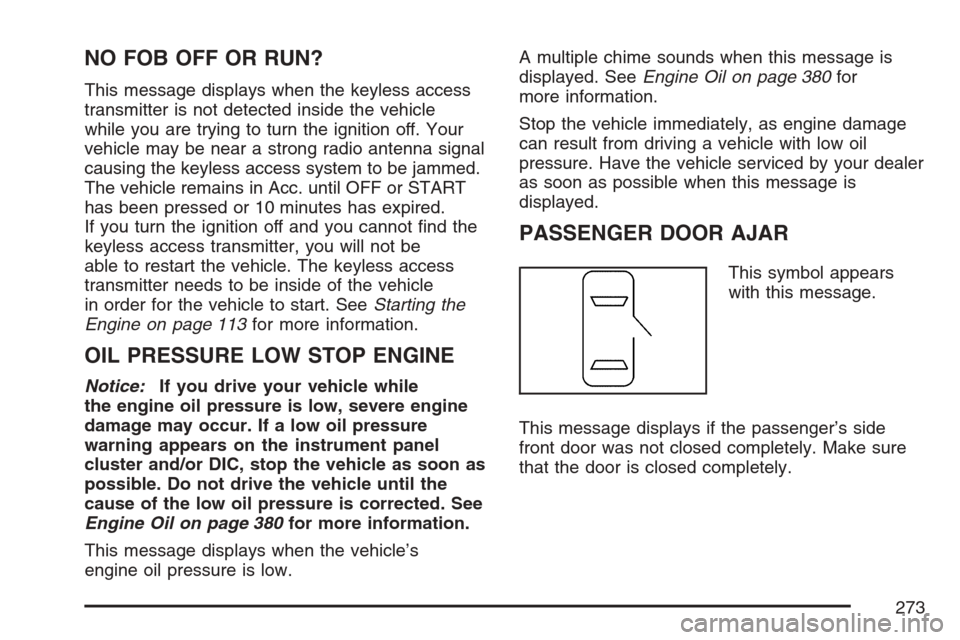
This symbol appears
with this message.
This message displays if the passenger’s side
front door was not closed completely. Make sure
that the door is closed completely.
273
Page 429 of 560

Treadwear Indicators:Narrow bands, sometimes
called wear bars, that show across the tread of a
tire when only 1/16 inch (1.6 mm) of tread remains.
SeeWhen It Is Time for New Tires on page 440.
UTQGS (Uniform Tire Quality Grading
Standards):A tire information system that
provides consumers with ratings for a tire’s
traction, temperature, and treadwear. Ratings are
determined by tire manufacturers using
government testing procedures. The ratings are
molded into the sidewall of the tire. SeeUniform
Tire Quality Grading on page 444.
Vehicle Capacity Weight:The number of
designated seating positions multiplied by 150 lbs
(68 kg) plus the rated cargo load. SeeLoading
Your Vehicle on page 349.
Vehicle Maximum Load on the Tire:Load on an
individual tire due to curb weight, accessory
weight, occupant weight, and cargo weight.
Vehicle Placard:A label permanently attached to
a vehicle showing the vehicle’s capacity weight
and the original equipment tire size and
recommended ination pressure. See “Tire and
Loading Information Label” underLoading
Your Vehicle on page 349.Run-Flat Tires (STS-V)
If your vehicle has run-at tires, there is no spare
tire and no tire changing equipment. Your
vehicle also has a Tire Pressure Monitor
System (TPMS) which will alert you if there is a
loss of tire pressure in any of the tires. See
Tire Pressure Monitor System on page 433.
{CAUTION:
When the low tire warning light is
displayed on the instrument panel cluster,
your vehicle’s handling capabilities will be
reduced during severe maneuvers. If you
drive too fast, you could lose control of
your vehicle. You or others could be
injured. Do not drive over 55 mph
(90 km/h) when the low tire warning light
is displayed. Drive cautiously and check
your tire pressures as soon as you can.
429
Page 433 of 560

If you will be driving at high speeds, speeds of
100 mph (160 km/h) or higher, where it is legal, set
the cold ination pressure to the maximum ination
pressure shown on the tire sidewall, or 38 psi
(265 kPa), whichever is lower. See the example
following. When you end this high-speed driving,
return the tires to the cold ination pressure shown
on the Tire and Loading Information label. See
Loading Your Vehicle on page 349.
Example:
You will nd the maximum load and ination
pressure molded on the tire’s sidewall, in small
letters, near the rim ange. It will read something
like this: Maximum load 690 kg (1521 lbs)
300 kPa (44 psi) Max. Press.
For this example, you would set the ination
pressure for high-speed driving at
38 psi (265 kPa).Tire Pressure Monitor System
Your vehicle has a Tire Pressure Monitor
System (TPMS). This system uses radio and
sensor technology to check tire pressure levels.
Sensors are mounted onto each tire and
wheel assembly, except the compact spare tire
and wheel. The TPMS sensors monitor the
air pressure in your vehicle’s tires and transmits
the tire pressure readings to a receiver located in
the vehicle.
Using the Driver Information Center (DIC), tire
pressure levels may be viewed by the driver. For
additional information and details about the
DIC operation and displays seeDIC Controls and
Displays on page 258andDIC Warnings and
Messages on page 264.
If a low tire pressure condition is detected, the
TPMS will display the CHECK TIRE PRESSURE
warning message on the DIC display and, at
the same time, illuminate the low tire pressure
warning symbol, on the instrument panel cluster.
433
Page 452 of 560

Run-Flat Tires (STS-V)
If your vehicle has run-at tires, there is no spare
tire and no tire changing equipment. Run-at
tires can operate effectively with no air pressure
for a limited distance and speed. These tires
perform so well without any air pressure that a Tire
Pressure Monitor (TPM) is used to alert you
when there is a low tire condition.
{CAUTION:
When the low tire warning light is
displayed on the instrument panel cluster,
your vehicle’s handling capabilities will be
reduced during severe maneuvers. If you
drive too fast, you could lose control of
your vehicle. You or others could be
injured. Do not drive over 55 mph
(90 km/h) when the low tire warning light
is displayed. Drive cautiously and check
your tire pressures as soon as you can.SeeRun-Flat Tires (STS-V) on page 429andTire
Pressure Monitor System on page 433, for
additional information.
{CAUTION:
Special tools and procedures are required
to service a run-at tire. If these special
tools and procedures are not used you or
others could be injured and your vehicle
could be damaged. Always be sure the
proper tools and procedures, as described
in the service manual, are used.
To order a service manual seeService
Publications Ordering Information on page 543.
Tire Inator Kit
Your vehicle has a tire inator kit. There is no jack
or spare tire. The kit uses a liquid tire sealant
and air at the same time to seal small punctures
in the tread area of the tire. Be sure to read
and follow all of the tire inator kit instructions.
452
Page 489 of 560

The underhood fuse block is located in the front of
the engine compartment on the passenger’s
side of the vehicle. SeeEngine Compartment
Overview on page 373for more information
on location and removal procedure for the front
compartment underhood sights shields.
To access the fuses, push in the tabs located on
each side of the fuse block cover, then lift the
cover off.
Fuses Usage
BLOWER Blower Motor
R REAR Passenger’s Side Rear Fuse Block
I/P OUTLET Front Accessory Power Outlet
CCP Climate Control, Headlamp Leveling
PRE 02/CAMOxygen Sensor, Variable Intake (V6),
Purge Solenoid (V6), Camshaft
Phasers (V6)
R REAR Passenger’s Side Rear Fuse Block
WPR SW Wiper/Washer Switch
FOG LAMP Fog Lamps
OUTLET Rear Accessory Power Outlet
EVEN COILSEven Ignition Coils, Even Fuel
Injectors
Fuses Usage
L REAR Driver’s Side Rear Fuse Block
WPR MOD Wiper Module
POST 02 Oxygen Sensor
COMP CLTCH Air Conditioner Compressor Clutch
STARTER Starter Solenoid
ABS Anti-lock Brake Pump
L REAR Driver’s Side Rear Fuse Block
RAIN SSRRain Sensor, Headlamp Washer,
Tire Pressure Monitor
CCP Climate Control
SMT BM-OPT IntelliBeam™ Relay (If Equipped)
EXT LIGHTSLow Beam Relay, High Beam Relay,
Park Lamp Relay
VOLT CHECK Instrument Panel Module
ECM/TCMEngine Control Module (ECM),
Transmission Control Module (TCM),
Easy Key Module, Instrument Panel
Cluster
SPARE Spare
SPARE Spare
LT PARKDriver’s Side Park Lamp, Driver’s
Side Taillamp
489
Page 491 of 560
Relays Usage
BLOWER
RELAY MINIFront Blower Motor
POWERTRAIN
RELAY MICROEngine Controls
RUN/CRANK
RELAY MICROIgnition 1, Starter, Washer Nozzle,
Air Quality, Anti-lock Brake System,
Climate Control Panel, Transmission
Control Module, Instrument Panel
Cluster, Mass Airow Sensor,
Engine Control Module
LOW SPEED
FAN RELAY
MINICooling Fan Low Speed
ACCESSORY
RELAY MINIIgnition 3, Rain Sensor, Headlamp
Washer, Windshield Wiper/Washer
Module
PARK LAMP
RELAY MICROParking Lamps, Instrument Panel
Dimming, Rear License Plate Lamps
HIGH BEAM
RELAY MICROHeadlamp High-Beam
LOW BEAM
RELAY/HID
MINI-OPTLow-Beam/High Intensity DischargeRelays Usage
HIGH SPEED
FAN RELAY
MINICooling Fan High Speed
S/P FAN
RELAY MINICooling Fan Series/Parallel
HORN RELAY
MICROHorn
SPARE Spare
Circuit
BreakersUsage
HDLP WASH
C/B -OPTHeadlamp Washer (If Equipped)
Harness
ConnectionUsage
ENG W/H Engine Harness Connection
BODY W/H Body Harness Connection
BODY W/H Body Harness Connection
491